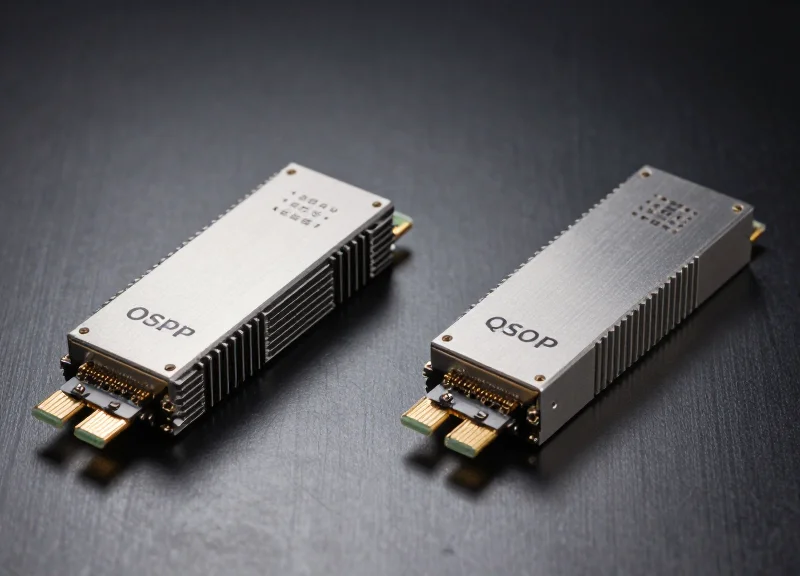
As data centers transition to 800G to meet the explosive demands of AI and cloud computing, the choice between OSFP and QSFP-DD form factors has become a critical strategic decision for network architects. This deep dive explores the technical nuances that define the next generation of high-speed optical networking.
The Evolution of 800G Ethernet Connectivity

The Evolution of 800G Ethernet Connectivity
The transition to 800G Ethernet is a direct response to the massive data throughput requirements of generative AI, large-scale cloud computing, and the proliferation of high-speed 5G networks. While 400G became the industry standard for high-bandwidth interconnects in the late 2010s, the rapid scaling of AI model training has necessitated a doubling of capacity every two years. The leap to 800G is fundamentally enabled by the transition from 50G SerDes (Serializer/Deserializer) to 100G SerDes technology, allowing 8-lane configurations to achieve 800Gbps using PAM4 (Pulse Amplitude Modulation 4-level) signaling.
The standardization of 800G is governed by both the IEEE 802.3df and 802.3ck projects, alongside the critical work of industry-led Multi-Source Agreements (MSAs). These MSAs, specifically the OSFP and QSFP-DD groups, define the physical dimensions, electrical interfaces, and thermal management specifications for the pluggable modules. Their goal is to maintain backward compatibility where possible while addressing the thermal density challenges that arise when pushing 800Gbps through such a small physical footprint.
Comparison of Ethernet Evolution Eras
| Ethernet Speed | Lane Configuration | Electrical Lane Rate | Primary MSA Groups |
|---|---|---|---|
| 100G | 4 x 25G / 2 x 50G | 25G / 50G SerDes | QSFP28, SFP-DD |
| 400G | 8 x 50G / 4 x 100G | 50G / 100G SerDes | QSFP-DD, OSFP |
| 800G | 8 x 100G | 112G SerDes | QSFP-DD800, OSFP |
Key Drivers for 800G Adoption
- Why is the industry moving from 400G to 800G so quickly?
The primary driver is the 'bandwidth-per-rack' density required by AI clusters. 800G allows network operators to double their capacity without increasing the physical number of switches or cables, significantly reducing OpEx and power consumption. - What role did the OSFP and QSFP-DD MSAs play in this evolution?
These groups established the mechanical and electrical specifications that allow multiple vendors to create interoperable components. The OSFP MSA focused on superior thermal performance for high-power AI chips, while the QSFP-DD MSA focused on backward compatibility with legacy QSFP ports. - Is 800G the final stop for pluggable optics?
While 800G is the current frontier, the evolution is already moving toward 1.6T. However, 800G represents a stabilization point where 112G SerDes technology matures before the eventual shift to 224G SerDes and potential Co-Packaged Optics (CPO).
Physical Architecture: Form Factor Dimensions and Connector Types
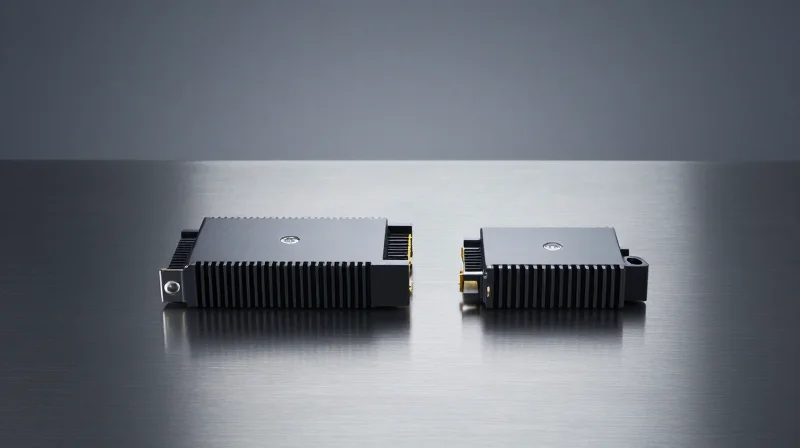
The physical architecture of 800G optics is defined by the tension between thermal efficiency and port density. OSFP (Octal Small Form-factor Pluggable) utilizes a larger, wider footprint designed to handle high-power coherent optics with integrated cooling fins, whereas QSFP-DD (Quad Small Form-factor Pluggable Double Density) maintains a narrower profile to ensure mechanical backward compatibility with legacy QSFP ports. This fundamental difference in form factor affects everything from the number of ports available on a switch faceplate to the maximum power envelope the module can safely sustain without thermal throttling.
Comparative Dimensions and Mechanical Footprint
| Specification | OSFP 800G | QSFP-DD 800G |
|---|---|---|
| Width | 22.58 mm | 18.35 mm |
| Height | 13.0 mm | 8.5 mm |
| Length | 107.8 mm | 102.6 mm |
| Max Power Capacity | 15W - 30W | 12W - 25W |
| Backward Compatibility | Requires Adapter | Native (QSFP28/56) |
Thermal Design: Integrated vs. System Cooling
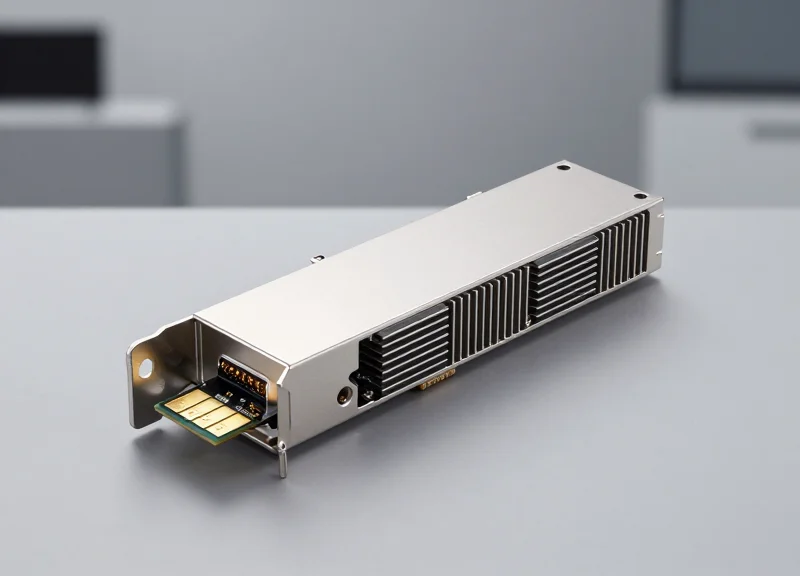
One of the most significant architectural departures in OSFP is its integrated heatsink. By building the cooling fins directly into the module shell, OSFP allows for direct airflow across the optical engine, significantly reducing thermal resistance. This design is optimized for the 15W to 25W power profiles common in 800G transceivers. Conversely, QSFP-DD modules rely on a flat top surface designed to make contact with a heatsink built into the switch cage. While this allows for a slimmer 18.35mm width and higher port density, it requires more sophisticated system-level airflow management to prevent heat buildup in high-density 800G configurations.
Connector Types for 800G Connectivity
- MPO-12 / MPO-16
Used primarily for parallel fiber applications such as 800G SR8 or DR8, allowing for eight or sixteen lanes of fiber within a single connector. - Dual LC
The standard choice for duplex single-mode fiber links like 800G FR4, utilizing Wavelength Division Multiplexing (WDM) to consolidate signals. - CS and SN Connectors
Very Small Form Factor (VSFF) connectors that enable high-density breakout applications, allowing a single 800G port to be split into two 400G or four 200G connections more efficiently than traditional LC connectors.
Faceplate Density and Port Count
The difference in width results in distinct density profiles for network hardware. A standard 1U switch can typically accommodate up to 36 ports of QSFP-DD, providing a maximum throughput of 28.8 Tbps. In contrast, the wider OSFP modules generally limit a 1U chassis to 32 ports (25.6 Tbps). While QSFP-DD offers a density advantage, many operators choose OSFP for 800G because its thermal headroom is better suited for future transitions to 1.6T speeds.
Thermal Management: Solving the Cooling Crisis

Thermal Management: Solving the Cooling Crisis
As data centers transition to 800G, the power consumption of optical transceivers has surged to 15–25 watts per module, creating a thermal bottleneck that dictates hardware selection. The OSFP (Octal Small Form-factor Pluggable) addresses this through an integrated heat sink design that maximizes surface area for direct airflow, while the QSFP-DD (Quad Small Form-factor Pluggable Double Density) relies on a riding heat sink mechanism to maintain its compact footprint and backward compatibility.
OSFP: The Integrated Fin Advantage
The OSFP form factor was engineered with a 'thermal first' philosophy. By integrating cooling fins directly onto the module's top shell, the OSFP eliminates the thermal interface resistance found in traditional cage-and-sink designs. This architecture allows the module to dissipate heat directly into the system's airflow path. Because the heat sink is part of the module itself, OSFP can comfortably support power envelopes up to 15W or 20W, and even up to 25W in specialized configurations, making it the preferred choice for early-stage 800G deployments where power efficiency is still maturing.
QSFP-DD: Riding Heat Sink Mechanics
In contrast, the QSFP-DD maintains a flat-top design to ensure it remains mechanically compatible with legacy QSFP slots. Cooling is achieved through a 'riding heat sink'—a spring-loaded component built into the equipment's cage that presses down onto the module. While this allows for extreme port density, it introduces a physical gap or interface layer between the heat source and the cooling element. At 800G speeds, where modules often exceed 14W, the QSFP-DD requires highly optimized thermal interface materials (TIM) and aggressive fan speeds to prevent the internal components from reaching their thermal shutdown threshold.
| Feature | OSFP Thermal Design | QSFP-DD Thermal Design |
|---|---|---|
| Heat Dissipation Method | Integrated Heat Sink (on-module) | Riding Heat Sink (cage-mounted) |
| Typical Power Limit | 15W - 25W | 12W - 18W |
| Thermal Efficiency | High (Direct air-to-module contact) | Moderate (Interface contact required) |
| Airflow Requirements | Standard forced-air cooling | Optimized high-velocity airflow |
System-Level Implications of Thermal Design
The choice between OSFP and QSFP-DD thermal architectures impacts more than just the module; it affects the entire switch chassis design. OSFP's larger vertical profile and integrated fins necessitate more vertical spacing between ports, which can slightly reduce total port count per 1U rack unit compared to QSFP-DD. However, the superior cooling of OSFP often results in lower fan power consumption at the system level, as the modules do not require the same extreme air velocity to stay within operational temperature ranges.
- Can QSFP-DD handle 20W 800G modules?
While the QSFP-DD800 MSA includes provisions for high-power modules, maintaining 20W in a high-density configuration is technically challenging and often requires specialized cage designs or liquid cooling solutions. - Is OSFP better for future 1.6T transitions?
Most industry experts agree that OSFP has a clearer path to 1.6T (1600G) because its thermal headroom can better accommodate the 25W-30W loads expected in next-generation silicon. - Does the integrated fin design affect OSFP durability?
No, the integrated fins are part of the cast metal housing, making the module robust. However, they must be kept clear of dust and debris to maintain optimal thermal exchange.
Electrical Interface and PAM4 Signaling

Electrical Interface and PAM4 Signaling
Both 800G OSFP and QSFP-DD form factors transition from the 50G-per-lane signaling used in 400G optics to a more robust 100G-per-lane electrical interface. This achievement is facilitated by a common 8-lane configuration (8x112G), which aggregates to a total bandwidth of 800Gbps. The success of this electrical interface relies heavily on host-side SerDes technology and advanced digital signal processing (DSP) to maintain signal integrity across the channel, ensuring that the doubled data rate does not lead to catastrophic signal degradation.
The 112G SerDes Standard
The move to 800G necessitates the adoption of IEEE 802.3ck standards, which define the 112 Gb/s per lane electrical interface. While the physical pinouts and connector geometries differ between OSFP and QSFP-DD, the underlying electrical requirements for return loss, crosstalk, and signal-to-noise ratio (SNR) are increasingly stringent, demanding higher precision from the PCB materials and connectors used in switch manufacturing.
| Parameter | 400G (QSFP-DD/OSFP) | 800G (QSFP-DD/OSFP) |
|---|---|---|
| Electrical Lanes | 8 Lanes | 8 Lanes |
| Per-Lane Speed | 53.125 Gbps (50G) | 106.25 Gbps (100G) |
| Modulation Format | PAM4 | PAM4 |
| Nyquist Frequency | 13.28 GHz | 26.56 GHz |
| Standard Compliance | IEEE 802.3bs/cd | IEEE 802.3ck |
PAM4 Modulation and Forward Error Correction (FEC)
PAM4 (4-level Pulse Amplitude Modulation) is the cornerstone of 800G connectivity. Unlike traditional NRZ signaling that transmits one bit per clock cycle, PAM4 transmits two bits by utilizing four distinct voltage levels. This effectively doubles the bandwidth without requiring a corresponding increase in the baud rate. However, the compressed voltage levels reduce the signal-to-noise margin, making KP4 Forward Error Correction (FEC) mandatory to mitigate the higher Bit Error Rate (BER) inherent in 100G-per-lane transmission.
- What is the baud rate for 800G electrical lanes?
The baud rate for each 100G lane in an 800G system is approximately 53.125 GBaud, which, through PAM4 modulation, results in a 106.25 Gbps data rate per lane. - Are OSFP and QSFP-DD electrically compatible at the host level?
While they use the same 8x100G PAM4 signaling logic, the physical electrical connectors and pin maps are different, meaning a host switch must be designed specifically for one form factor or use a passive adapter. - How does 800G handle signal degradation?
Due to the 26.56 GHz Nyquist frequency, 800G interfaces employ complex DSP-based equalization and Pre-Emphasis on the host side to compensate for channel loss, jitter, and reflections.
Backward Compatibility: Migration Paths for Legacy Ports
Backward Compatibility: Migration Paths for Legacy Ports
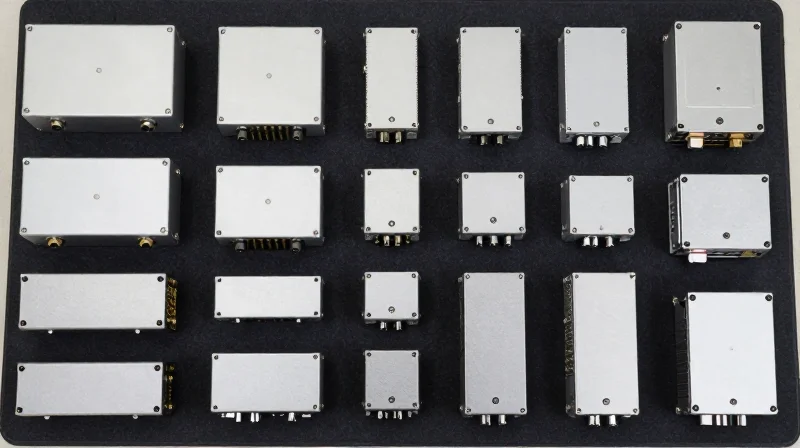
While both 800G form factors support migration from legacy speeds, QSFP-DD provides native backward compatibility for previous QSFP modules within the same cage, whereas OSFP relies on physical adapters to accommodate the smaller dimensions of legacy hardware. The choice between them often hinges on whether a data center prioritizes the reuse of existing transceivers or the thermal headroom required for future-proofing.
The QSFP-DD Ecosystem: Seamless Integration
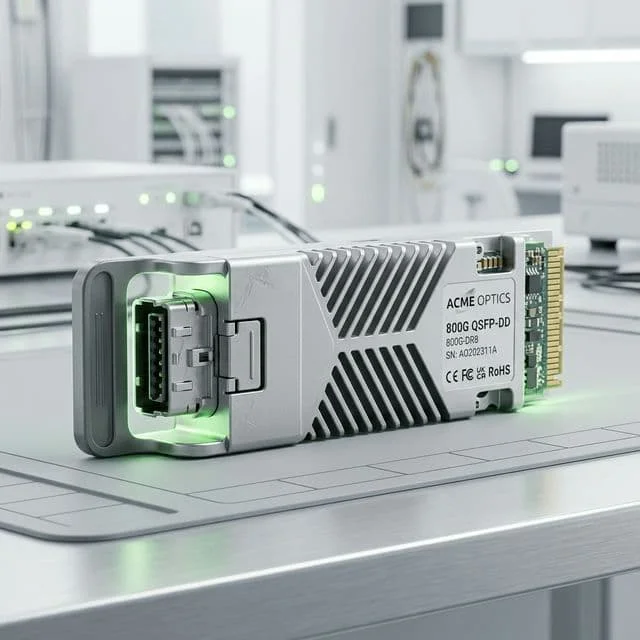
The QSFP-DD (Double Density) standard was specifically engineered to be backward compatible with the massive installed base of QSFP+, QSFP28, and QSFP56 modules. An 800G QSFP-DD port features a dual-row contact design; the first row provides the electrical interface for legacy 4-lane modules, while the second row enables the additional 4 lanes for 800G performance. This allows network operators to plug a 100G or 400G QSFP module directly into an 800G slot without any mechanical overhead, facilitating a phased upgrade path where older hardware can coexist with new 800G optics.
The OSFP Strategy: Adapter-Based Flexibility
Because the OSFP form factor is physically wider and deeper than the QSFP standard, it cannot provide native 'plug-and-play' compatibility in the same cage. To address this, the industry utilizes OSFP-to-QSFP adapters. These mechanical sleeves allow a QSFP28 or QSFP56 module to fit into an OSFP cage, mapping the electrical signals appropriately. While this adds a hardware step, it ensures that OSFP-based switches can still support legacy links during a multi-year transition period to 800G. The trade-off is the extra cost of the adapter versus the OSFP's superior thermal management capabilities.
| Feature | 800G QSFP-DD | 800G OSFP |
|---|---|---|
| Native Compatibility | Yes (QSFP+, QSFP28, QSFP56) | No (Requires Adapter) |
| Mechanical Complexity | Low (Standard Cage) | Medium (Adapter Required) |
| Electrical Mapping | Internal Dual-Row Pins | Adapter-Based Conversion |
| Migration Efficiency | Excellent for Legacy Reuse | Focuses on Future Cooling |
Compatibility FAQ
- Can I use a 400G QSFP-DD module in an 800G QSFP-DD slot?
Yes, the 800G QSFP-DD cage is designed to be fully backward compatible with 400G QSFP-DD modules without any additional hardware. - Does using an adapter with OSFP impact signal integrity?
Modern OSFP-to-QSFP adapters are engineered to meet strict IEEE and MSA signal integrity standards, though they do introduce a minor amount of insertion loss that is typically well within system margins. - Is software configuration needed for backward compatibility?
Generally, yes. The switch port must be configured to recognize the legacy speed (e.g., downshifting from 8x100G lanes to 4x100G or 4x25G) to match the inserted module's capabilities.
Power Consumption Profiles and Efficiency
The transition to 800G connectivity introduces a significant power density challenge, with typical transceivers consuming between 14W and 22W depending on the reach and optical engine configuration. While both OSFP and QSFP-DD are engineered to handle these substantial loads, the OSFP form factor provides a larger thermal envelope and physical volume, which typically allows for more efficient heat dissipation. This efficiency is not just about the module's internal draw but how it forces the host system to react; choosing between these formats requires a calculation of total energy impact, including the secondary power consumed by cooling infrastructure.
Power Consumption Comparison: OSFP vs. QSFP-DD
| Parameter | 800G QSFP-DD | 800G OSFP |
|---|---|---|
| Standard Power Class | Class 1-8 (Up to 18W-20W) | Class 1-10 (Up to 25W+) |
| Typical Power Draw (DR8/FR8) | 16W - 19W | 16W - 20W |
| Thermal Management Efficiency | Moderate (Requires riding heat sink) | High (Integrated heat sink fins) |
| System Airflow Impedance | Higher due to dense port layout | Lower due to optimized fin design |
Impact on Data Center PUE and Operational Costs
Power Usage Effectiveness (PUE) is sensitive to the cooling overhead required for high-density networking. OSFP modules, with their integrated fins and larger surface area, generally exhibit lower thermal resistance than QSFP-DD. In a fully loaded 32-port 1U switch, the OSFP's superior heat dissipation can allow system fans to operate at lower RPMs. Conversely, the smaller QSFP-DD form factor often requires higher static pressure and faster fan speeds to exhaust the same amount of heat, which can lead to a non-linear increase in fan power consumption and a higher overall facility PUE.
- Does 800G OSFP consume more power than QSFP-DD?
Not inherently; the internal components like the DSP and lasers are often identical. However, the OSFP’s better thermal path may allow these components to operate at lower temperatures, which can slightly improve semiconductor efficiency and longevity. - How does 800G power consumption affect OPEX?
At scale, a difference of just 2-3 Watts per module (including cooling overhead) can result in thousands of dollars in annual energy costs per rack, making efficiency a primary factor in TCO (Total Cost of Ownership) calculations. - What is the role of the DSP in 800G efficiency?
The Digital Signal Processor (DSP) is the primary power consumer. Moving from 7nm to 5nm or 3nm DSP nodes is the most effective way manufacturers are currently reducing the 800G power footprint.
Market Adoption: Hyperscale Cloud vs. Enterprise AI Clusters

The choice between 800G OSFP and QSFP-DD is rarely about raw throughput and almost entirely about the specific operational constraints of the data center environment. While both standards support 800Gbps, hyperscale operators building massive AI/ML clusters are increasingly standardizing on OSFP to solve extreme heat dissipation challenges, whereas traditional enterprise and Tier 2 providers remain loyal to QSFP-DD to leverage its seamless backward compatibility with existing 100G and 400G infrastructures.
Hyperscale Cloud and AI: The Shift Toward OSFP
In the realm of hyperscale cloud providers and dedicated AI training clusters, power density is the primary architectural bottleneck. As 800G optical modules approach power consumption levels of 25W to 30W, the superior thermal management of the OSFP design—specifically its integrated heat sink and larger surface area—becomes a necessity rather than a luxury. Companies like Google and NVIDIA have championed OSFP because it allows for denser port configurations without triggering thermal throttling, which is critical when interconnecting thousands of GPUs in a single fabric.
Enterprise Networking: Why QSFP-DD Retains Dominance
For the typical enterprise data center, the leap to 800G is driven by backbone upgrades rather than AI-specific workloads. In these scenarios, the QSFP-DD form factor is preferred because it offers a lower barrier to entry. Since QSFP-DD is physically compatible with older QSFP28 (100G) and QSFP56 (200G) optics, network engineers can upgrade their switches to 800G while still utilizing their existing inventory of fiber patches and lower-speed transceivers during a phased migration. This investment protection is the single largest factor keeping QSFP-DD relevant in non-hyperscale markets.
| Market Segment | Dominant Form Factor | Primary Driver | Typical Use Case |
|---|---|---|---|
| Hyperscale Cloud | OSFP | Thermal Headroom | AI/ML Training, LLM Fabrics |
| Enterprise / Edge | QSFP-DD | Backward Compatibility | Core/Aggregation Backbone |
| Tier 2 Providers | QSFP-DD / OSFP | Density vs. Legacy | Metro Ethernet, Cloud Hosting |
| High-Frequency Trading | OSFP | Maximum Bandwidth Density | Low-Latency Fabric Interconnects |
Adoption Factors and Frequently Asked Questions
- Why is OSFP considered 'future-proof' for AI?
OSFP is designed to support the transition to 1.6T and beyond. Its thermal capacity allows it to handle the higher wattages required for next-generation optics that traditional QSFP-DD slots may struggle to cool without aggressive airflow modifications. - Can an enterprise switch support both?
Generally, hardware manufacturers choose one form factor for their switch faceplates. However, some manufacturers offer 'OSFP-RHS' (Riding Heat Sink) variants or adapters to bridge the gap between the two ecosystems, though this adds cost and complexity. - Will QSFP-DD eventually disappear?
Unlikely in the near term. The massive installed base of QSFP-based ports in global enterprise networks ensures that QSFP-DD will remain the standard for at least another hardware generation, especially for 400G and 800G deployments where legacy support is a priority.
Future-Proofing: Readiness for 1.6T and Beyond

Future-Proofing: Readiness for 1.6T and Beyond
The transition from 800G to 1.6T represents a critical inflection point where physical thermal limits and signal integrity requirements dictate the longevity of hardware investments. While both form factors are evolving to meet these demands, the OSFP architecture currently holds a structural advantage for 1.6T deployment due to its superior thermal dissipation capacity and larger physical volume, which accommodate the complex DSPs required for 200G-per-lane signaling. QSFP-DD continues to innovate via the QSFP-DD800 and QSFP1600 specifications, but it faces steeper engineering hurdles in managing the 25W-30W+ power envelopes expected at the 1.6T threshold.
The Shift to 200G-Per-Lane Signaling
The path to 1.6T is paved by the move from 100G SerDes to 200G SerDes. This doubling of lane speed significantly increases insertion loss and electromagnetic interference (EMI) challenges. OSFP’s connector design is inherently more robust for high-frequency signals, providing better margin for 224G SerDes development. For QSFP-DD to maintain pace, it must rely heavily on advanced PCB materials and 'flyover' cable assemblies that bypass the traditional circuit board traces to maintain signal quality between the switch ASIC and the front-panel port.
Thermal Capacity: The 1.6T Bottleneck
As data centers push toward 1.6T, module power consumption is projected to reach between 28W and 33W. Cooling these components becomes the primary operational challenge. OSFP’s integrated heat sink allows for direct airflow contact, which is more efficient than the flat-top design of QSFP-DD that relies on a separate cage-mounted heat sink. This efficiency is why many early 1.6T development kits and next-generation AI clusters (such as those utilizing NVIDIA’s Blackwell architecture) are standardizing on OSFP.
| Feature | OSFP (1.6T Readiness) | QSFP-DD (1.6T Readiness) |
|---|---|---|
| Max Power Dissipation | Up to 30W-35W+ | Targeting 25W-30W |
| Connector Density | 8 or 16 lanes (OSFP-XD) | 8 lanes (standard) |
| 224G SerDes Support | Native high-margin support | Requires advanced cable technology |
| Thermal Strategy | Integrated Heat Sink | Riding Heat Sink (Cage-based) |
OSFP-XD: Doubling Density for the Future
To address the need for extreme density, the OSFP-XD (Extra Density) specification has been introduced. By doubling the number of electrical lanes to 16, OSFP-XD can support 1.6T using current 100G signaling or 3.2T using upcoming 200G signaling. This makes it a formidable contender for hyper-scale backbones, whereas QSFP-DD focuses on maintaining its legacy footprint to ensure that 1.6T upgrades do not require a complete overhaul of existing rack designs.
- Will 1.6T modules be backward compatible?
QSFP-DD aims for backward compatibility with lower speeds, but 1.6T OSFP modules may require new cages due to the significant changes in thermal and electrical requirements. - Why is 200G-per-lane signaling important?
It allows 1.6T throughput using only 8 lanes, reducing the complexity and cost of the optical components compared to using 16 lanes of 100G. - Which form factor is winning the AI market?
Currently, OSFP is the preferred choice for new AI high-speed interconnects (InfiniBand/Ethernet) due to its ability to handle the extreme heat of high-duty-cycle AI workloads.
Economic Analysis: TCO and Supply Chain Reliability
The economic decision between 800G OSFP and QSFP-DD is no longer dictated solely by the unit price of the transceiver, but rather by the holistic Total Cost of Ownership (TCO) which includes cooling overhead, power consumption, and ecosystem maturity. While QSFP-DD offers a lower entry barrier for legacy-heavy environments through superior backward compatibility, OSFP provides a more sustainable TCO for high-density AI clusters by reducing thermal-related cooling costs and offering a smoother path to 1.6T transitions.
TCO Drivers: CAPEX vs. OPEX
In the 800G era, CAPEX is heavily influenced by manufacturing yields and component availability. QSFP-DD benefits from a mature manufacturing pipeline established during the 400G cycle, often resulting in higher initial yields for vendors. However, OPEX is where OSFP shines; its superior thermal design allows data centers to run cooling systems at lower intensities, directly impacting the Power Usage Effectiveness (PUE) and reducing the electricity cost per gigabit.
| Economic Metric | 800G OSFP Impact | 800G QSFP-DD Impact |
|---|---|---|
| Initial CAPEX | Higher (Newer infrastructure requirements) | Lower (Leverages existing QSFP ecosystem) |
| Cooling OPEX | Lower (Integrated heat sink efficiency) | Higher (Requires aggressive airflow/internal cooling) |
| Backward Compatibility | Requires adapters (Increases cost) | Native (Reduces hardware overhead) |
| Lifecycle Longevity | High (Scalable to 1.6T and 3.2T) | Moderate (Likely reaches limit at 1.6T) |
Supply Chain Reliability and Manufacturing Yields
Supply chain reliability for 800G modules is currently split between two philosophies. The QSFP-DD supply chain is broad and diversified, with a vast array of second-source vendors ensuring competitive pricing and high availability for enterprise customers. Conversely, the OSFP supply chain is increasingly concentrated around high-volume hyperscale requirements. While this concentration originally posed a risk, the massive scale of AI-driven demand has forced a rapid maturation of OSFP manufacturing processes, bringing price parity to the high-volume market.
Market Trends and Vendor Ecosystem
- Multi-Vendor Interoperability
Both form factors benefit from strong MSA (Multi-Source Agreement) backing, but QSFP-DD has a larger historical database of interoperability testing across a wider variety of switch vendors. - Yield Rates and Availability
As signaling reaches 112G SerDes, OSFP's larger physical space often leads to higher assembly yields for complex optical engines compared to the more cramped QSFP-DD housing. - Geopolitical Diversification
Major manufacturers are diversifying production sites across Southeast Asia and North America to mitigate supply chain shocks, with both form factors seeing equal prioritization in global logistics.
Economic FAQ
- Is OSFP more expensive than QSFP-DD at 800G?
At the component level, prices are converging. However, OSFP may require higher initial investment in new patch panels and infrastructure if transitioning from a pure QSFP legacy environment. - How does power consumption affect the total cost?
Every watt saved at the module level can save up to 2-3 watts at the facility level due to reduced cooling needs. OSFP's thermal efficiency can lead to significant OPEX savings in large-scale 800G deployments. - Which form factor has a more reliable supply chain?
Currently, both are highly reliable. QSFP-DD has more vendors, while OSFP has higher volume commitments from tier-1 cloud providers, ensuring both remain stable choices for the foreseeable future.
Deciding between 800G OSFP and QSFP-DD requires a balanced assessment of thermal requirements, port density, and long-term scalability goals. Whether you are building an AI training cluster or upgrading a hyperscale backbone, selecting the right optics is the foundation of a reliable network. Contact our engineering team today for a personalized consultation on your 800G migration strategy.