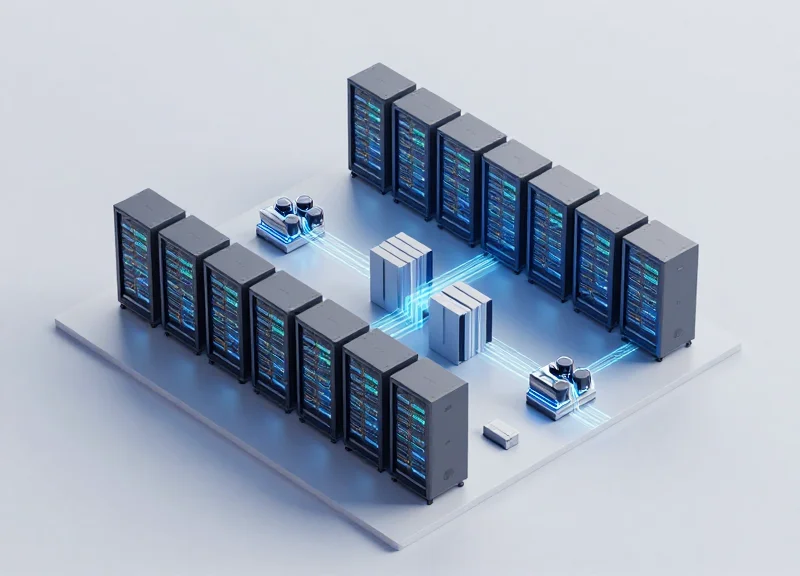
The rise of Generative AI has rendered traditional CPU-centric data center designs obsolete. As training models like GPT-4 require trillions of parameters, the industry is pivoting toward a specialized AI data center architecture designed for massive parallel processing and ultra-low latency. This article provides a comprehensive deep dive into the engineering foundations of these digital powerhouses.
The Evolution: Traditional vs. AI-Centric Data Centers
The Evolution: Traditional vs. AI-Centric Data Centers
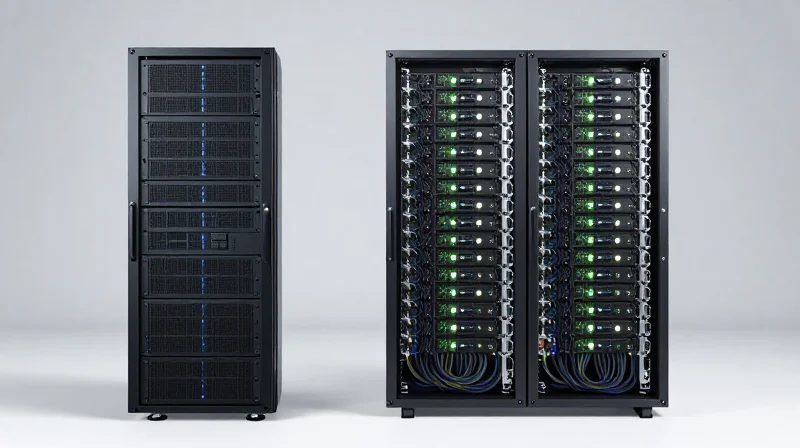
The evolution of data center architecture is defined by a move away from the 'Swiss Army Knife' approach of general-purpose virtualization toward the 'Industrial Factory' model of AI-centric design. While traditional facilities focus on hosting diverse, isolated workloads across CPU-based servers, AI data centers are engineered as a singular, cohesive fabric designed to solve massive mathematical problems. This shift is driven by the unique demands of Large Language Models (LLMs) and generative AI, which require deterministic low-latency networking, extreme power densities, and thermal management systems far beyond the capabilities of legacy air-cooled rows.
Comparative Architecture: A Technical Breakdown
To understand the structural pivot, we must examine how the fundamental pillars of infrastructure—compute, network, and power—have been reimagined for the AI era.
| Feature | Traditional Architecture | AI-Centric Architecture |
|---|---|---|
| Primary Compute | CPU-dominant (Multi-core x86/ARM) | GPU/NPU-dominant (Massive Parallelism) |
| Network Traffic | North-South (Client-to-Server focus) | East-West (Node-to-Node synchronization) |
| Power Density | 5kW - 15kW per rack | 40kW - 120kW+ per rack |
| Interconnects | Standard Ethernet (10/25/100G) | InfiniBand or RoCE v2 (400/800G) |
| Cooling Method | Forced Air / Hot-Aisle Containment | Direct-to-Chip Liquid or Immersion |
The Death of Over-Subscription
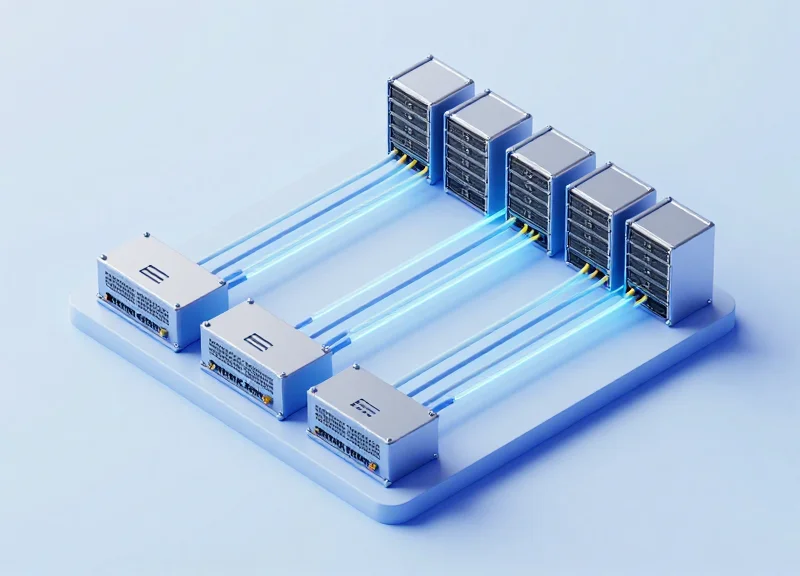
In traditional enterprise networking, over-subscription (sharing bandwidth among multiple users) was a standard efficiency tactic. However, in AI architecture, over-subscription is a performance killer. AI training workloads involve 'All-Reduce' operations where every GPU must communicate its gradients to every other GPU simultaneously. If a single packet is delayed due to network congestion, the entire training cluster—potentially thousands of GPUs—stalls, leading to significant compute waste. This has led to the adoption of non-blocking Clos topologies and 'rail-optimized' fabric designs that ensure every GPU has a dedicated, high-speed path to its peers.
Frequently Asked Questions
- Can traditional data centers be retrofitted for AI?
Yes, but with significant challenges. Retrofitting requires upgrading power feeds to support high-density racks and often necessitates the installation of liquid cooling loops, as standard air conditioning cannot dissipate the 40kW+ heat loads generated by modern GPU clusters. - Why is East-West traffic so critical in AI architectures?
AI models are too large for a single GPU's memory. Therefore, model weights and data are distributed across thousands of GPUs. The 'East-West' traffic refers to the constant communication between these nodes to synchronize calculations during the training process. - What role does RDMA play in this evolution?
Remote Direct Memory Access (RDMA) allows GPUs to access the memory of another GPU without involving the CPU or the OS kernel. This reduces latency and CPU overhead, which is essential for maintaining the high throughput required by AI clusters.
The Compute Core: GPU Clusters and Accelerators
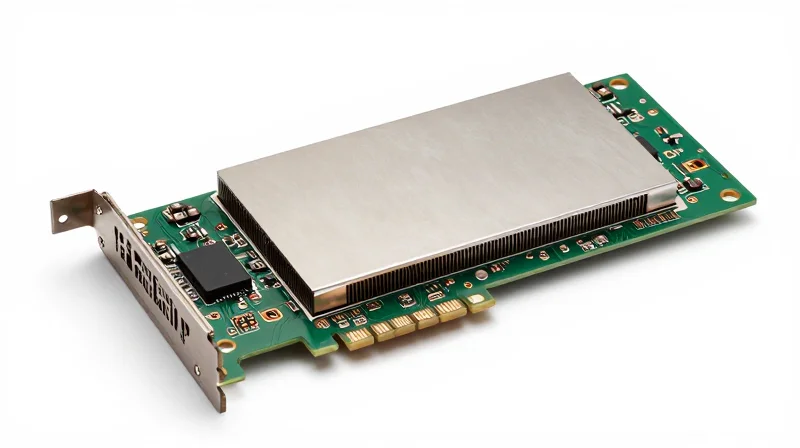
The compute core of a modern AI data center is defined by its ability to execute massive parallel matrix operations. Unlike traditional data centers that rely on the serial processing capabilities of CPUs, AI architectures utilize specialized accelerators—predominantly GPUs—that house thousands of arithmetic logic units (ALUs) working in unison to process the multi-dimensional tensors foundational to deep learning models.
The Evolution of Silicon: From Hopper to Blackwell
NVIDIA’s H100 (Hopper) and the newer B200 (Blackwell) architectures represent the pinnacle of AI silicon design. The H100 introduced the Transformer Engine, which dynamically adjusts precision to maximize throughput. The Blackwell B200 extends this by utilizing a dual-die chiplet design, significantly increasing transistor density and providing the massive compute density required for trillion-parameter Large Language Models (LLMs).
| Feature | NVIDIA H100 (Hopper) | NVIDIA B200 (Blackwell) |
|---|---|---|
| Architecture | Hopper (4nm) | Blackwell (4NP) |
| Transistor Count | 80 Billion | 208 Billion |
| Memory Type | HBM3 | HBM3e |
| FP8 Performance | 4 PFLOPS | Up to 20 PFLOPS (Sparse) |
| Interconnect | NVLink Gen 4 | NVLink Gen 5 |
Tensor Cores and the HBM3e Memory Bottleneck
At the heart of these GPUs are Tensor Cores, specialized hardware units designed specifically for fused multiply-add operations. However, as compute throughput increases, the 'memory wall' becomes a primary constraint. High-Bandwidth Memory (HBM3e) addresses this by using vertically stacked DRAM dies connected via Through-Silicon Vias (TSVs), allowing for memory bandwidth exceeding 4.8 TB/s. This ensures that the Tensor Cores are not starved of data during intensive training cycles.
Clustering and Compute Density
AI data centers do not operate on isolated GPUs; they function as a unified 'Superpod.' High-density rack configurations (such as the GB200 NVL72) integrate GPUs and CPUs via high-speed chip-to-chip interconnects, effectively turning an entire rack into a single, massive logical accelerator. This requires advanced liquid cooling solutions to manage the 100kW+ power density common in these environments.
Accelerator Infrastructure FAQ
- Why is HBM3e critical for AI data centers?
AI models require massive data throughput. HBM3e provides the multi-terabyte-per-second bandwidth necessary to keep high-performance GPUs utilized, preventing idle cycles caused by data latency. - What is the difference between FP8 and FP16 precision?
FP8 (8-bit floating point) uses less memory and offers higher throughput than FP16, making it ideal for training very large models without sacrificing significant accuracy. - How does the Blackwell architecture improve efficiency?
Blackwell uses a dedicated second-generation Transformer Engine and advanced power management to provide up to 25x lower TCO and energy consumption compared to previous generations for LLM inference.
Non-Blocking Networking Fabrics
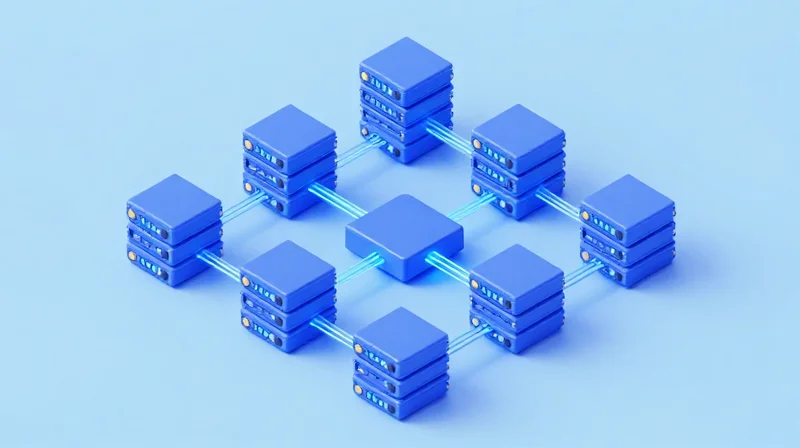
The Architecture of Connectivity: Why Non-Blocking Matters
In AI data center architecture, the network is not just a utility but a primary compute backplane. Because AI training involves synchronous parallel processing, where gradients must be exchanged across thousands of GPUs, any latency or packet loss results in 'tail latency' that stalls the entire cluster. A non-blocking fabric ensures that the cumulative bandwidth of the input ports is matched by the capacity of the internal switching matrix, allowing every node to communicate at its full line rate simultaneously without oversubscription. This prevents the 'all-to-all' communication patterns common in Large Language Models (LLMs) from becoming the primary bottleneck of the training run.
The Dominance of Fat-Tree and Clos Topologies
The most common implementation of a non-blocking network is the Fat-Tree, a specific form of a multi-stage Clos network. In this design, the links between switches 'thicken' as they move up the hierarchy toward the core layer. Unlike traditional hierarchical networks that oversubscribe the core to save costs, an AI-optimized Fat-Tree maintains a 1:1 subscription ratio. This architecture provides multiple parallel paths between any two leaf switches, enabling effective load balancing and high availability. If a single path or switch fails, the fabric uses Adaptive Routing to instantly redirect traffic without reducing the total available bandwidth to the endpoints.
| Feature | Traditional 3-Tier Network | AI-Centric Clos/Fat-Tree |
|---|---|---|
| Oversubscription Ratio | High (e.g., 3:1 to 20:1) | 1:1 (Non-blocking) |
| Primary Traffic Direction | North-South (Client to Server) | East-West (Node to Node) |
| Latency Characteristics | Variable and Jitter-Prone | Deterministic and Ultra-Low |
| Packet Loss Handling | Best-effort (Drops packets) | Lossless (Credit-based/PFC) |
Eliminating Latency with RDMA and InfiniBand
To achieve the high-throughput requirements of modern AI, networking fabrics leverage Remote Direct Memory Access (RDMA). This technology allows a GPU to read and write memory from a remote GPU directly, bypassing the CPU and the traditional OS kernel stack. This process is typically handled by InfiniBand, which offers native hardware-level flow control to prevent buffer overflows, or RoCE v2 (RDMA over Converged Ethernet). When using RoCE, the fabric must support Priority Flow Control (PFC) and Explicit Congestion Notification (ECN) to simulate a lossless environment on standard Ethernet hardware.
- What is 'Tail Latency' in AI networking?
Tail latency refers to the delay of the slowest packet in a synchronization cycle. In AI clusters, if one packet is delayed due to network congestion, thousands of GPUs must wait idle for that single packet before they can proceed to the next training step. - Why is 1:1 oversubscription critical?
A 1:1 ratio ensures that every server can send data at full speed to any other server at the same time. This is essential for AI workloads where data-parallel and model-parallel tasks require massive, simultaneous bursts of traffic. - How does Adaptive Routing help AI workloads?
Standard routing often sends all packets of a single flow through one path, risking congestion. Adaptive Routing monitors the fabric in real-time and dynamically spreads packets across all available paths to maximize utilization and minimize hot-spots.
High-Speed Optical Interconnects: 400G, 800G, and Beyond
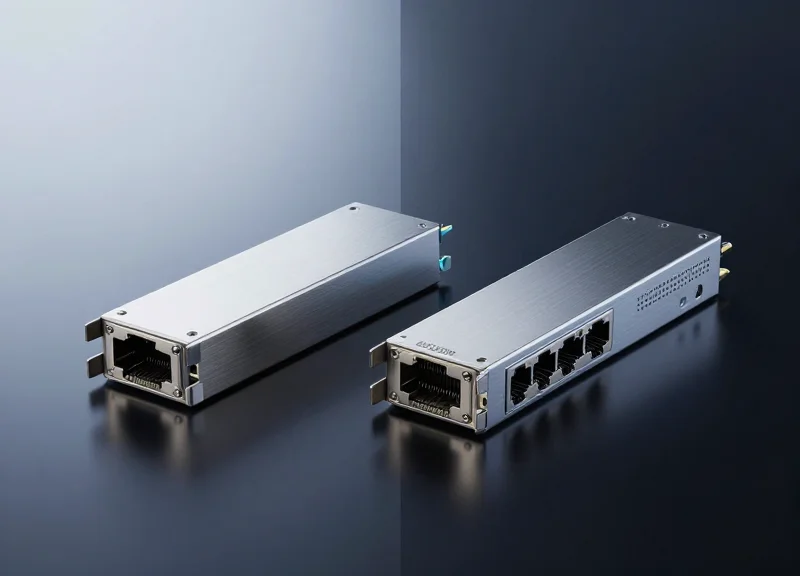
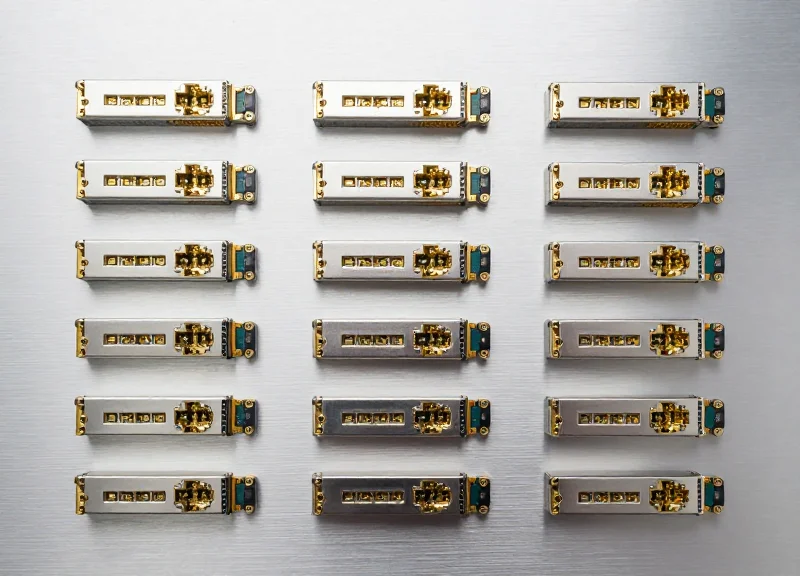
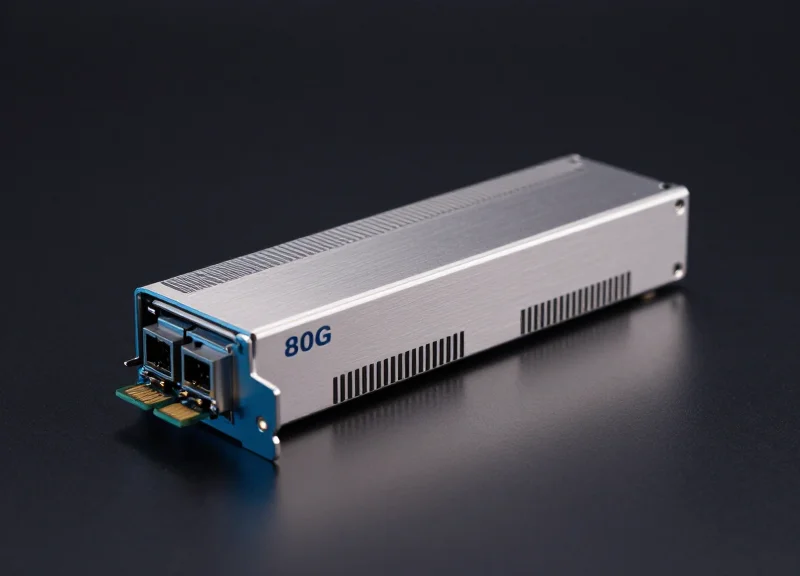
High-speed optical interconnects serve as the high-bandwidth circulatory system of AI data center architecture, moving massive datasets between GPU nodes, high-performance storage, and memory pools with sub-microsecond latency. As AI models scale to trillions of parameters, the networking fabric must support seamless, non-blocking communication to prevent GPU 'stall' time, where expensive compute resources sit idle while waiting for data. This requirement has accelerated the transition from 100G and 200G standards directly into 400G and 800G deployments, with 1.6T (Terabit) solutions already entering the early adoption phase for Tier-1 hyperscalers.
The Transition to 800G and the Rise of 1.6T
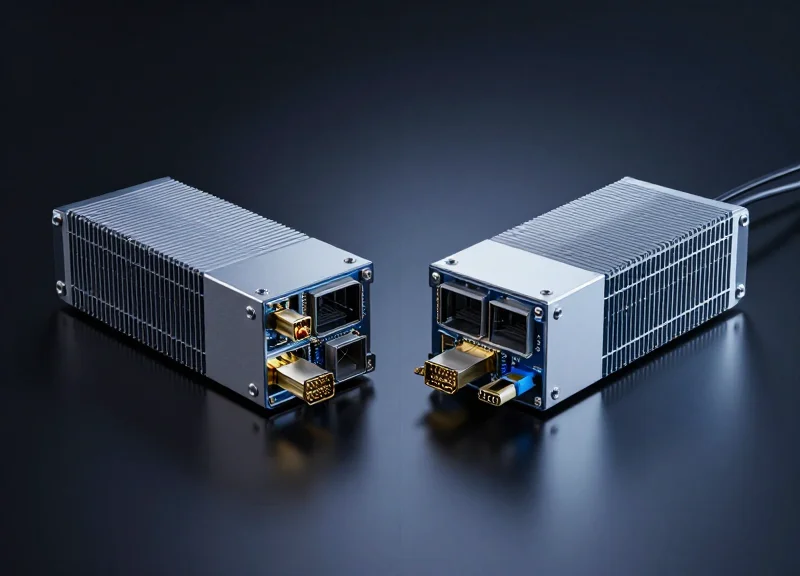
The shift to 800G is driven by the need for higher radix switches and the increasing density of GPU clusters. By moving to 800G per port, data center operators can reduce the physical footprint of their networking hardware while simultaneously doubling the bandwidth density. This transition relies heavily on advanced modulation techniques like PAM4 (Pulse Amplitude Modulation 4-level) and high-performance Digital Signal Processors (DSPs) that reside within the optical transceivers to manage signal integrity over fiber.
| Standard | Typical Form Factor | Modulation | Max Reach (Typical) |
|---|---|---|---|
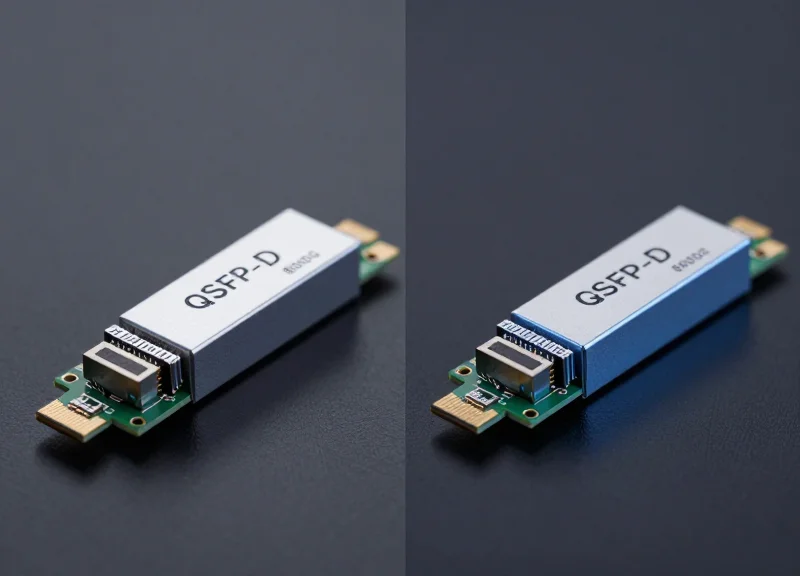
| 400G | QSFP-DD / OSFP | 56G/112G PAM4 | Up to 10km (SMF) |
| 800G | OSFP / QSFP-DD800 | 112G PAM4 | Up to 2km (DR8/2xFR4) |
| 1.6T | OSFP-XD | 224G PAM4 | 500m - 2km (Early Specs) |
Interconnect Media: AOC vs. DAC vs. Optical Transceivers
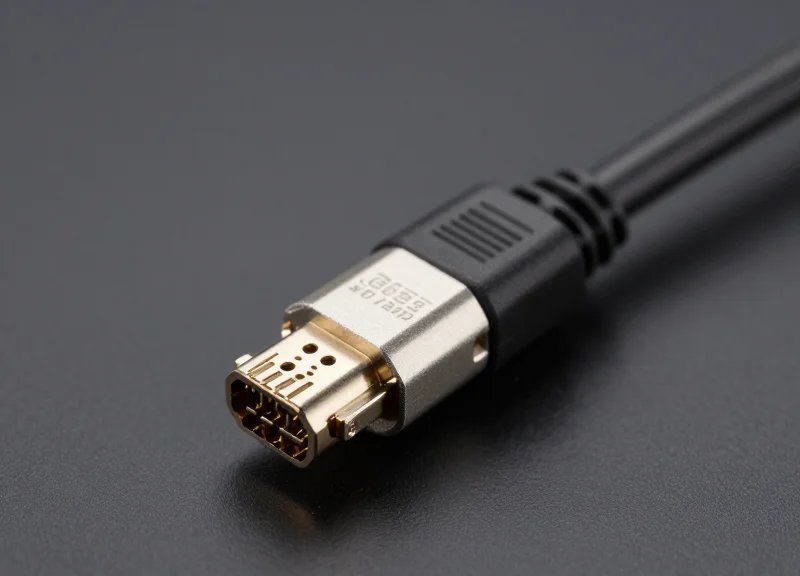
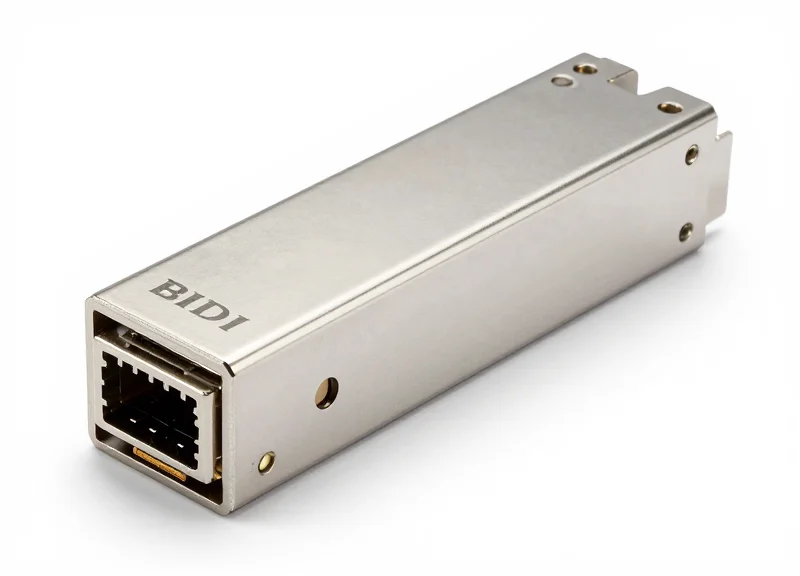
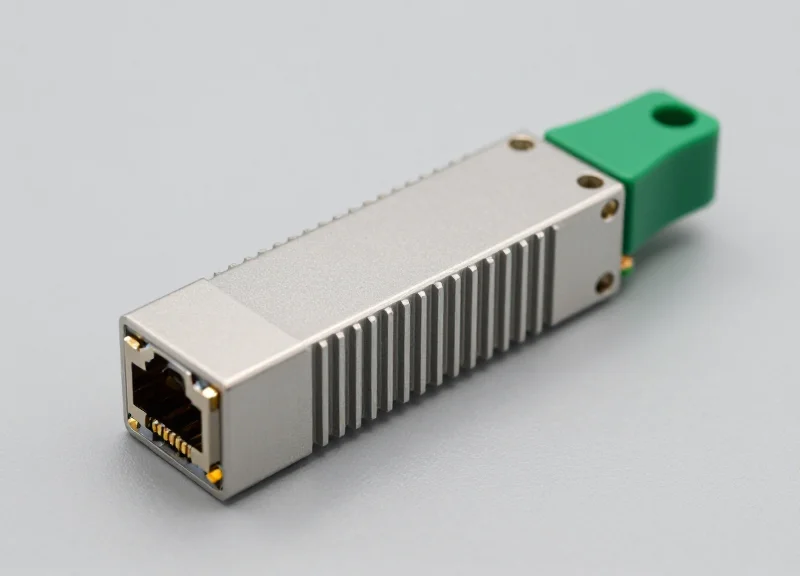
In an AI cluster, the choice of cabling is determined by the distance between the GPU and the Top-of-Rack (ToR) switch, as well as the thermal budget of the rack. Direct Attach Copper (DAC) cables are preferred for short distances (under 3 meters) due to their zero power consumption and low cost. However, for distances beyond the rack or for complex leaf-spine connections, Active Optical Cables (AOCs) and pluggable optical transceivers are mandatory. AOCs offer a factory-terminated, lightweight alternative for intra-row connections, while discrete transceivers provide the flexibility needed for long-haul structured cabling across the entire data center hall.
Emerging Technologies: Co-Packaged Optics (CPO)
As power consumption per bit becomes a critical constraint, the industry is exploring Co-Packaged Optics (CPO). Unlike traditional pluggable modules that sit on the front panel, CPO integrates the optical engine directly onto the switch or GPU package. This reduces the electrical trace length, significantly lowering power consumption and improving signal density, which is vital for the next generation of 51.2T and 102.4T switching silicon.
- Why is 800G preferred over multiple 400G links?
800G reduces the number of required cables and switch ports, lowering the overall complexity and power-per-bit, while providing the necessary throughput for 400G-native GPU interfaces via breakout cables. - What is the role of OSFP in AI networking?
The OSFP (Octal Small Form-factor Pluggable) is the dominant form factor for AI because its superior thermal management allows it to handle the high heat generated by 800G and 1.6T optical engines. - How does PAM4 modulation impact AI fabrics?
PAM4 doubles the data rate by transmitting two bits per symbol compared to NRZ, though it requires sophisticated DSPs and Error Correction (FEC) to manage the increased noise sensitivity.
The Great Debate: InfiniBand vs. RoCEv2 Ethernet
The choice between InfiniBand and RoCEv2 is a fundamental architectural decision in AI data centers, centering on the trade-off between the absolute performance of a dedicated, lossless fabric and the cost-effective scalability of Ethernet-based RDMA.
RDMA and the Quest for Zero-Copy Networking
At the heart of the InfiniBand vs. RoCEv2 debate is Remote Direct Memory Access (RDMA). RDMA allows GPUs to access memory on another node directly without involving the operating system's CPU or the standard TCP/IP stack. This bypass mechanism reduces latency and CPU overhead, which is critical when synchronizing billions of parameters across thousands of GPU nodes during intensive all-reduce operations. Both InfiniBand and RoCEv2 aim to provide this zero-copy capability, but they take different paths to achieve it.
InfiniBand: The Lossless Standard
InfiniBand (IB) was designed specifically for high-performance computing (HPC) and AI workloads. It uses a credit-based flow control mechanism that ensures a strictly lossless fabric at the hardware level. Because flow control is managed by the network interface cards (NICs) and switches natively, IB provides the lowest possible tail-latency and deterministic performance. It is essentially a 'private' high-speed highway where traffic management is built into the road itself, making it the preferred choice for massive-scale GPU clusters.
RoCEv2: RDMA over Converged Ethernet
RDMA over Converged Ethernet version 2 (RoCEv2) encapsulates InfiniBand transport packets into UDP/IP headers, allowing RDMA to run over standard Ethernet switches. To mimic the lossless nature of InfiniBand, RoCEv2 relies on Priority Flow Control (PFC) and Explicit Congestion Notification (ECN). While it offers significant cost savings and leverages existing Ethernet management expertise, it requires meticulous tuning to prevent 'PFC storms' and head-of-line blocking, which can degrade performance in large-scale AI fabrics.
| Feature | InfiniBand | RoCEv2 Ethernet |
|---|---|---|
| Native Protocol | L2/L3 IB Native Fabric | UDP/IP over Ethernet |
| Flow Control | Credit-based (Hardware) | PFC/ECN (Network Layer) |
| Tail Latency | Deterministic / Lowest | Variable / Higher |
| Cost / Complexity | Premium / High Specialist | Lower / Common Knowledge |
| Ecosystem | NVIDIA (Mellanox) Dominant | Open / Vendor Neutral |
Congestion Management and Tail-Latency
In AI training, tail-latency is the primary bottleneck. If a single packet is delayed due to congestion, the entire training job must wait for that packet before proceeding to the next iteration. InfiniBand's hardware-level congestion management is inherently more efficient at preventing these 'long tails.' In contrast, RoCEv2 architectures often require advanced SmartNICs or DPUs to offload congestion control logic to keep up with the performance demands of modern transformer models.
Common Implementation Questions
- When should I choose InfiniBand?
Choose InfiniBand when absolute performance, deterministic low latency, and ease of hardware-level management for large-scale GPU clusters are the primary priorities. - Is RoCEv2 viable for LLM training?
Yes, RoCEv2 is widely used by hyperscalers who have the engineering resources to tune Ethernet fabrics for lossless performance at a lower cost per port than InfiniBand. - Can they coexist in the same data center?
Yes, many architectures use InfiniBand for the 'backend' GPU-to-GPU compute fabric while using standard Ethernet for 'frontend' storage and user-facing connectivity.
SmartNICs and DPUs: Offloading the Data Plane
SmartNICs and Data Processing Units (DPUs) represent a fundamental shift in AI data center architecture, moving away from CPU-centric processing to a distributed model where the 'infrastructure task' is decoupled from the 'application task.' In an AI context, every clock cycle a GPU spends managing network packet headers or storage encryption is a cycle lost for model training. DPUs act as specialized accelerators that handle the complex data plane, ensuring the compute fabric remains focused entirely on high-performance tensor operations.
The Anatomy of Offloading: Why AI Clusters Need DPUs
In traditional architectures, the host CPU manages the software stack for networking and storage. However, as AI workloads scale to thousands of nodes via 400G and 800G interconnects, the overhead of managing these connections—referred to as the 'infrastructure tax'—can consume up to 30% of a server's processing power. DPUs mitigate this by integrating high-performance network interfaces with programmable multicore processors (often ARM-based) and hardware accelerators for RDMA, encryption, and compression.
- Network Offloading
Managing the RoCEv2 or InfiniBand transport layers, including congestion control and packet retransmission, without involving the host CPU. - Storage Virtualization
Implementing NVMe-over-Fabrics (NVMe-oF) to make remote flash storage appear as local disks to the GPU, reducing latency in data loading. - Security & Isolation
Handling hardware-root-of-trust, distributed firewalls, and line-rate encryption (IPsec/TLS) to secure multi-tenant AI training environments.
Comparing Traditional NICs vs. Advanced DPUs
| Feature | Standard SmartNIC | Data Processing Unit (DPU) |
|---|---|---|
| Primary Focus | Connectivity and basic offloads (checksum, TSO). | Complete infrastructure services (Storage, Net, Sec). |
| Programmability | Fixed-function or limited FPGA. | Fully programmable ARM cores and software-defined. |
| Storage Role | Pass-through interface. | NVMe-oF target/initiator and data compression. |
| AI Impact | Moderate reduction in CPU jitter. | Maximum GPU efficiency; enables 'Serverless' infrastructure. |
Optimizing the Data Plane for Distributed Training
The real power of the DPU in an AI data center is its ability to facilitate 'Zero-Copy' data transfers. By leveraging GPUDirect RDMA, the DPU can move data directly from the network interface into the GPU memory of a remote node. This bypasses the host CPU and system memory entirely, drastically reducing tail latency and ensuring that synchronization primitives (like All-Reduce) perform at the theoretical limits of the hardware fabric.
Common Questions on DPU Implementation
- Does a DPU replace the CPU in an AI server?
No, it complements it. The DPU handles infrastructure-level 'data moving' tasks, while the CPU handles application logic and the GPU handles mathematical computation. - How does a DPU improve LLM training?
By offloading the communication overhead of model parallelism, DPUs reduce the time GPUs spend waiting for data from peer nodes, leading to faster total training time. - Is DPU support dependent on the networking protocol?
While most DPUs support both Ethernet (RoCE) and InfiniBand, their impact is most pronounced in RoCE environments where they manage complex congestion control algorithms like DCQCN.
Storage for AI: Managing the I/O Data Deluge

The primary challenge in AI data center architecture is 'GPU starvation,' where expensive compute resources sit idle while waiting for data; solving this requires high-performance parallel file systems and low-latency transport protocols that treat storage as an extension of the compute fabric. As models grow to trillions of parameters, the storage layer must transition from a passive repository to a high-speed pipeline capable of saturating InfiniBand and RoCEv2 networks.
Parallel File Systems: Distributing the Metadata Load
Traditional Network Attached Storage (NAS) often fails in AI environments due to centralized metadata controllers that become bottlenecks. In contrast, parallel file systems such as Lustre, Weka, and BeeGFS distribute both data and metadata across a cluster of storage nodes. This allows for concurrent data access patterns where thousands of GPU worker nodes can read different parts of a massive dataset simultaneously without contention or serial delay.
| Storage Architecture | Key Advantage | Bottleneck Point |
|---|---|---|
| Traditional NAS | Simplicity of management | Centralized Controller throughput |
| Parallel File System (PFS) | Massive aggregate bandwidth | Metadata complexity at scale |
| NVMe-over-Fabrics | Lowest possible latency | Network fabric saturation |
NVMe-oF and GPUDirect Storage (GDS)
To achieve microsecond-level latency, modern AI architectures leverage NVMe-over-Fabrics (NVMe-oF) to extend the NVMe protocol across the data center fabric. When combined with NVIDIA’s GPUDirect Storage (GDS), the architecture enables a direct memory access (DMA) path between the storage and the GPU memory. This bypasses the host CPU and system memory entirely, reducing latency by up to 50 percent and freeing up CPU cycles for data orchestration and preprocessing tasks.
Storage Strategy FAQ
- Why is high-concurrency storage vital for AI?
During the training phase, data is often accessed in random batches; a storage system must handle millions of small, random IOPS to keep the GPU clusters saturated. - How does RDMA affect storage performance?
Remote Direct Memory Access (RDMA) allows storage nodes to write directly into a GPU's memory space, eliminating the overhead of kernel interrupts and CPU context switching. - What is the role of 'Scratch Space' in AI?
Scratch space refers to ultra-fast, local or distributed NVMe tiers used for temporary checkpoints and frequently accessed training data, minimizing the need to pull from slower data lakes.
Thermal Management: From Air to Liquid Cooling
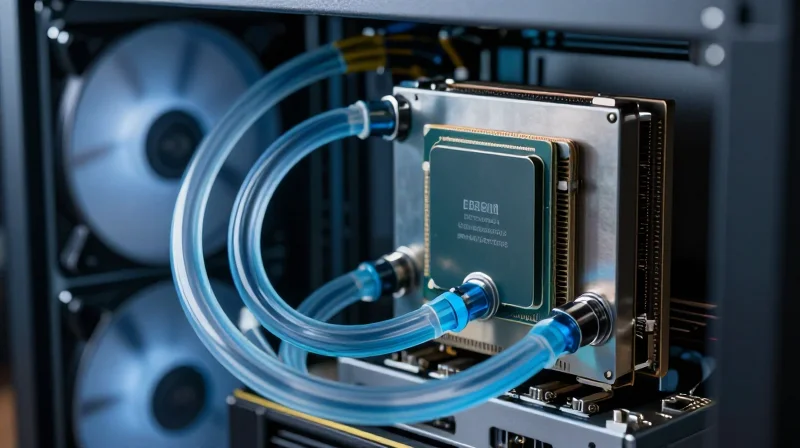
Thermal Management: From Air to Liquid Cooling
As AI data center architecture evolves, thermal management has shifted from a facility-level consideration to a primary constraint of server design. Traditional air-cooled systems, which rely on fans and high-volume airflow to dissipate heat, are hitting a physical ceiling. Modern GPUs, such as the NVIDIA H100 and Blackwell series, now feature Thermal Design Power (TDP) ratings exceeding 700W and even 1,000W per chip. At rack densities exceeding 50kW to 100kW, air simply cannot transport heat away fast enough to prevent thermal throttling, making liquid cooling an architectural requirement rather than an elective upgrade.
Direct-to-Chip and Rear-Door Heat Exchangers
To manage these extreme loads, architects are deploying a combination of Direct-to-Chip (DTC) cooling and Rear-Door Heat Exchangers (RDHX). DTC systems utilize cold plates mounted directly on the silicon, circulating coolant to capture 70-80% of the heat at the source. The remaining heat is often managed by RDHXs—radiator-like units attached to the back of the rack that use chilled water to neutralize hot exhaust before it enters the data center aisle.
| Cooling Method | Heat Capture Efficiency | Typical Rack Density Supported | Infrastructure Complexity |
|---|---|---|---|
| Traditional Air Cooling | Low (30-40%) | 15kW - 30kW | Low: Standard CRAC/CRAH units |
| Rear-Door Heat Exchanger (RDHX) | Moderate (60-80%) | 30kW - 60kW | Medium: Requires secondary water loops |
| Direct-to-Chip (DTC) | High (80-90%+) | 60kW - 150kW | High: Requires CDU and manifold plumbing |
| Immersion Cooling | Extreme (99%+) | 100kW - 200kW+ | Very High: Specialized tanks and dielectric fluid |
The Role of the Coolant Distribution Unit (CDU)
The heart of the modern AI cooling loop is the Coolant Distribution Unit (CDU). This specialized heat exchanger manages the flow, pressure, and temperature of the coolant moving between the rack-level manifolds and the facility-level chilled water system. By decoupling the internal liquid loop from the facility water, CDUs provide precise control and prevent contamination, ensuring that the sensitive micro-channels within GPU cold plates do not become clogged or corroded over time.
- Is liquid cooling mandatory for all AI clusters?
While low-density inference nodes can still operate on air, any cluster utilizing high-end training GPUs at scale requires liquid cooling to avoid significant performance loss due to thermal throttling. - What is the impact on Power Usage Effectiveness (PUE)?
Liquid cooling significantly improves PUE by reducing or eliminating the need for energy-intensive mechanical fans, often bringing PUE levels down to 1.1 or lower. - Can existing air-cooled data centers be retrofitted?
Yes, many facilities use a hybrid approach by installing RDHXs and CDUs in existing rooms, though floor loading and plumbing integration remain significant engineering hurdles.
AI Infrastructure at Scale: The Role of Orchestration
The Orchestration Layer: Maximizing Throughput in AI Clusters
In the context of AI data center architecture, orchestration is the management layer that bridges the gap between raw hardware and the machine learning framework. Unlike traditional cloud workloads that are often loosely coupled, large-scale AI training jobs require tightly coupled execution where thousands of GPUs must act as a single, massive computer. The primary goal of this layer is to maximize Model Flops Utilization (MFU)—the ratio of the actual hardware performance achieved during training to the theoretical peak performance—by minimizing communication overhead and downtime.
Beyond Standard Kubernetes: Specialized Schedulers
While Kubernetes is the industry standard for container orchestration, it was not originally designed for the 'gang scheduling' requirements of AI. In AI training, a job cannot progress if even one GPU in a 1,024-node cluster fails or is delayed. Modern AI architectures integrate specialized plugins or custom schedulers—like Volcano, Kueue, or Slurm—to handle these interdependencies. These schedulers ensure that all required resources are available and healthy before a job begins, preventing 'resource fragmentation' where GPUs sit idle waiting for others to become free.
| Feature | General-Purpose Orchestration | AI-Centric Orchestration |
|---|---|---|
| Scheduling Logic | Fair-share / Resource-based | Gang Scheduling / All-or-Nothing |
| Network Awareness | Minimal (Layer 3 focused) | Topology-Aware (NVLink/InfiniBand aware) |
| Failure Recovery | Restarts individual pods | Checkpoint/Restart and Automated Rerouting |
| Resource Granularity | CPU/Memory limits | GPU partitions and Fabric bandwidth |
Topology Awareness and Locality
To achieve high MFU, the orchestrator must be aware of the underlying physical topology of the data center. This includes knowing which GPUs share an NVLink switch and which nodes reside on the same leaf switch in the InfiniBand fabric. By placing the most communication-intensive ranks of a model (such as those performing pipeline parallelism) on nodes with the highest bandwidth and lowest latency between them, the orchestrator minimizes 'tail latency' that would otherwise stall the entire training process.
Reliability and Automated Recovery
At the scale of 10,000+ GPUs, hardware failures are a statistical certainty rather than an exception. Orchestration platforms for AI must implement automated health checks and rapid recovery mechanisms. If a GPU exhibits memory errors or a network link degrades, the orchestrator must automatically cordone the faulty node, swap in a 'hot spare,' and resume the job from the last saved checkpoint. This automation is critical to maintaining high cluster uptime and reducing the cost per trained model.
- What is MFU and why does it matter?
Model Flops Utilization (MFU) measures how efficiently a model uses the available GPU compute. High MFU means less power and time are wasted on data movement or idle waiting, directly reducing the total cost of ownership (TCO) for AI infrastructure. - Can Kubernetes handle InfiniBand networking?
Yes, through the use of Device Plugins and the Multi-Homing (Multus) CNI, Kubernetes can expose high-performance RDMA and InfiniBand interfaces directly to containers for low-latency communication. - What is 'Gang Scheduling'?
Gang scheduling is a technique where a set of related tasks is scheduled to run simultaneously. In AI, this ensures that the hundreds of processes involved in a distributed training job start at once, preventing deadlocks or wasted resource allocation.
Architecting an AI data center is a multi-layered engineering challenge that spans from the silicon to the cooling plant. As models continue to grow, the importance of high-speed optical networking and efficient thermal management will only intensify. Is your infrastructure ready for the AI era? Contact our engineering team today for a custom evaluation of your high-performance networking needs.