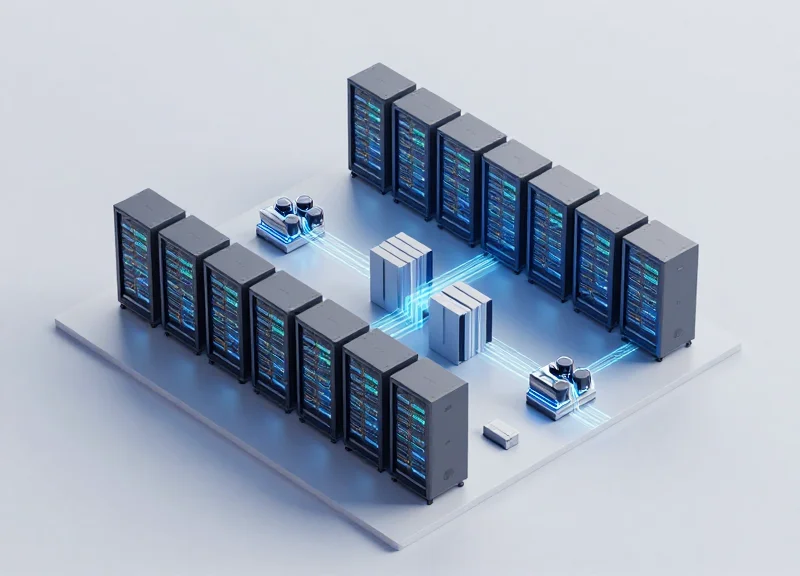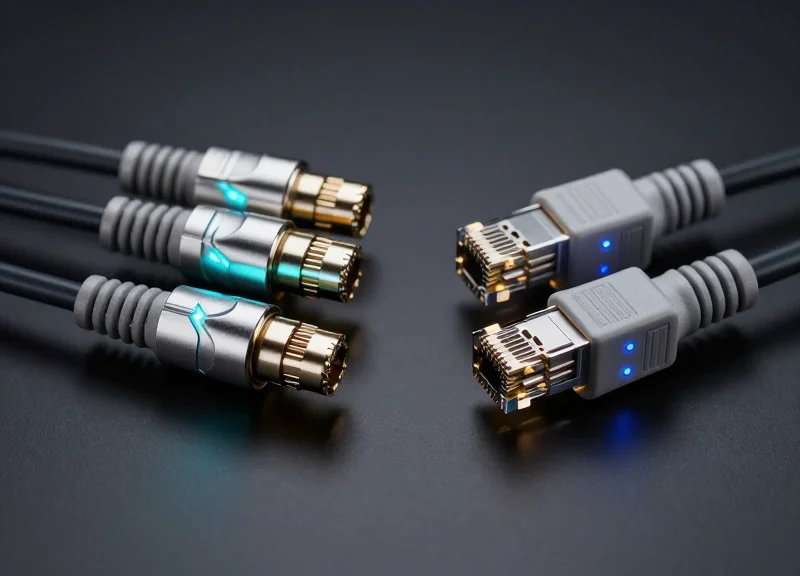
In the era of Generative AI and Large Language Models (LLMs), the network has become the computer. As GPU clusters scale to thousands of nodes, the choice between InfiniBand and Ethernet determines the efficiency of distributed training and inference. This guide breaks down the technical nuances that define modern high-speed optical fabrics.
The AI Networking Bottleneck: Why the Interconnect Matters

The AI Networking Bottleneck: Why the Interconnect Matters
In the context of large-scale AI training, the network is no longer a secondary infrastructure component; it has become the backplane of a single, massive distributed computer. While modern GPUs provide staggering amounts of raw compute power, their effective performance in a cluster is strictly limited by the speed and efficiency of data movement between nodes. When an interconnect fails to keep pace with the GPU's processing speed, the system encounters a 'communication bottleneck,' where expensive hardware sits idle waiting for data, leading to a direct collapse in scaling efficiency and an increase in total cost of ownership (TCO).
The Anatomy of Distributed Training Stalls
Training Large Language Models (LLMs) requires splitting the workload across thousands of GPUs using techniques like data, pipeline, or tensor parallelism. These methods rely on collective communication patterns, such as All-Reduce, where every GPU must periodically synchronize its weight gradients with all other GPUs in the cluster. Because this process is often synchronous, the entire training job can only proceed as fast as its slowest link. A single congested switch or a high-latency packet can stall thousands of GPUs simultaneously, a phenomenon known as the 'tail latency' problem.
| Metric | Standard Data Center Requirement | AI Cluster Requirement |
|---|---|---|
| Traffic Pattern | North-South (Client-Server) | East-West (GPU-to-GPU) |
| Latency Tolerance | Milliseconds (High) | Microseconds (Ultra-Low) |
| Bandwidth Needs | Bursty, 10-100 Gbps | Sustained, 400-800 Gbps |
| Loss Tolerance | Retransmission is acceptable | Zero-loss is critical |
Critical Performance Drivers in AI Interconnects
- How does RDMA reduce the AI bottleneck?
Remote Direct Memory Access (RDMA) allows GPUs to exchange data directly from memory-to-memory without involving the CPU or the operating system kernel. This bypasses the traditional TCP/IP stack, significantly lowering latency and freeing up CPU cycles for other tasks. - Why is 'Zero-Loss' networking essential?
In standard networking, dropped packets are retransmitted, but in AI training, a single lost packet can trigger a cascade of delays across the entire synchronous compute cycle. AI interconnects must be 'lossless' to ensure predictable performance. - What is Linear Scaling and why is it hard to achieve?
Linear scaling means doubling the GPUs results in half the training time. This is only possible if the interconnect bandwidth grows proportionally with compute power; otherwise, the overhead of communication eventually outweighs the benefits of adding more GPUs.
As models grow from billions to trillions of parameters, the volume of data transferred during each training step increases exponentially. This shift has moved the industry focus away from just 'raw TFLOPS' toward 'system-level throughput.' Understanding the technical nuances between InfiniBand and Ethernet is the first step in architecting a fabric that ensures the network is never the reason your GPUs are waiting.
InfiniBand Architecture: Designed for High-Performance Computing
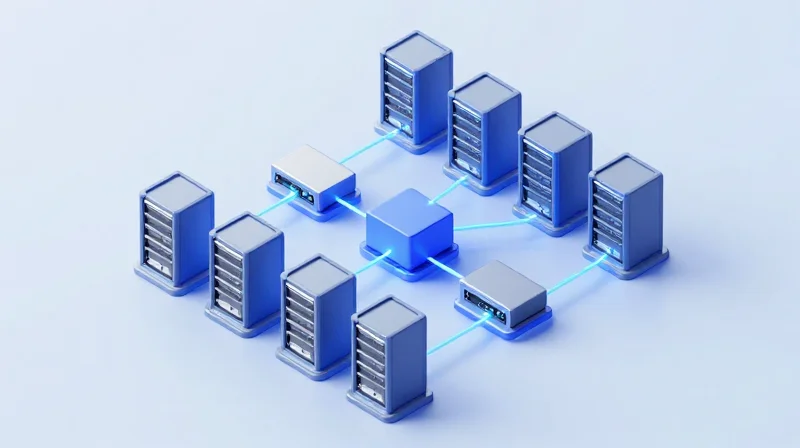
InfiniBand Architecture: Designed for High-Performance Computing
InfiniBand is a purpose-built, switched-fabric communications link designed specifically for high-performance computing (HPC) environments where minimal latency and maximum throughput are non-negotiable. Unlike traditional Ethernet, which was built for reliability across unpredictable wide-area networks, InfiniBand was engineered from the ground up for the data center, treating the network as a system-level interconnect rather than a collection of independent nodes. This architectural shift allows InfiniBand to bypass the operating system's networking stack, providing direct, hardware-level communication between GPU nodes.
Credit-Based Flow Control: The Key to a Lossless Fabric
The defining characteristic of InfiniBand is its status as a 'lossless' fabric. This is achieved through a hardware-level mechanism known as Credit-Based Flow Control. In this system, a sending node must receive a specific number of 'credits' from the receiving switch before it is allowed to transmit a packet. These credits represent available buffer space on the receiving end. By ensuring that data is only sent when the receiver has the capacity to process it, InfiniBand eliminates packet drops due to buffer overflow. In AI training, where a single lost packet can trigger a retransmission and stall thousands of GPUs, this deterministic delivery is critical.
Hardware Offloading and RDMA
InfiniBand architectures excel at 'Zero-Copy' data transfers via Remote Direct Memory Access (RDMA). This technology allows data to move directly from the memory of one server to the memory of another without involving the CPU of either system. By offloading the entire transport layer—including segmentation, reassembly, and error checking—to the Host Channel Adapter (HCA), InfiniBand frees up the CPU and GPU to focus exclusively on computational tasks rather than network management.
| Feature | InfiniBand Architecture | Standard Ethernet Approach |
|---|---|---|
| Flow Control | Hardware-managed, Credit-based (Lossless) | Software-managed, Congestion-based (Lossy) |
| CPU Utilization | Near-Zero (Hardware Offload) | High (Kernel-level processing) |
| Latency | Sub-microsecond (Consistent) | Variable (Jitter dependent on traffic) |
| Topology | Fat-Tree, Dragonfly+ | Spine-Leaf |
FAQ: Understanding InfiniBand's Technical Edge
- Why is 'lossless' so important for AI?
AI training involves massive collective communication patterns (like All-Reduce). If one packet is lost, the entire synchronization step is delayed, leading to 'tail latency' that drastically reduces GPU utilization across the entire cluster. - What is a Host Channel Adapter (HCA)?
The HCA is InfiniBand's equivalent of a Network Interface Card (NIC). However, it is significantly more complex, as it manages the connection state and transport logic in hardware to enable RDMA. - Does InfiniBand support standard software?
Yes, through the Verbs API and middle-ware like MPI (Message Passing Interface) and NCCL (NVIDIA Collective Communications Library), most AI frameworks run seamlessly on InfiniBand without code changes.
Ethernet's Transformation: From General Purpose to RoCE v2

The Shift from Best-Effort to Lossless Ethernet
Ethernet was traditionally designed for general-purpose networking where packet loss is mitigated by the TCP/IP stack through retransmissions. However, for AI training, the latency and jitter introduced by traditional TCP/IP are unacceptable. RoCE (RDMA over Converged Ethernet) solves this by allowing GPUs to read and write memory directly across the network without involving the host operating system or CPU. By bypassing the software stack, RoCE v2 reduces latency to the microsecond level and enables the high-throughput, 'lossless' environment required for massive collective communication patterns like All-Reduce and All-to-All.
RoCE v2: The Layer 3 Evolution
While the original RoCE specification was limited to Layer 2 (Ethernet Link Layer) and could not be routed across subnets, RoCE v2 introduced an encapsulation layer using UDP/IP. By utilizing UDP port 4791, RoCE v2 traffic becomes routable across standard IP networks. This transition was critical for AI scaling, allowing data centers to build massive GPU clusters across multiple racks and subnets while maintaining the performance benefits of Remote Direct Memory Access (RDMA).
| Feature | Traditional Ethernet | RoCE v1 | RoCE v2 |
|---|---|---|---|
| Transport Layer | TCP/IP | Ethernet Link Layer | UDP/IP |
| Routability | L3 (IP) | L2 Only | L3 (IP) |
| Latency | High (Software Stack) | Low (Hardware Offload) | Low (Hardware Offload) |
| Congestion Control | TCP Windowing | PFC Required | PFC and ECN Required |
| Use Case | General Web/Cloud | Small L2 Clusters | Large-Scale AI/HPC |
Key Technologies Enabling RoCE Performance
To mimic the native reliability of InfiniBand, Ethernet must be augmented with specific protocols collectively known as Data Center Bridging (DCB). These features prevent the 'drop and retransmit' behavior of standard Ethernet.
- Priority Flow Control (PFC)
PFC provides a mechanism to pause traffic on a per-priority basis. When a switch's buffer reaches a certain threshold, it sends a 'pause frame' to the sender, preventing packet drops due to buffer overflow. - Explicit Congestion Notification (ECN)
ECN allows switches to mark packets when congestion is detected. The receiving GPU sees these marks and notifies the sender to throttle its transmission rate, preventing the network from reaching a state of total congestion. - Zero-Copy Transfers
By leveraging RDMA, data is transferred directly from the memory of one GPU to another. This eliminates the need for data to be copied into intermediate buffers, significantly reducing CPU utilization and latency.
Common Questions on Ethernet for AI
- Is RoCE v2 as fast as InfiniBand?
In terms of raw bandwidth, both offer 400G and 800G options. However, InfiniBand typically maintains lower tail latency and better congestion management under extreme loads because its lossless nature is built into the hardware, whereas Ethernet requires complex manual tuning of PFC and ECN. - Can I run RoCE on any Ethernet switch?
No. RoCE requires switches that support Data Center Bridging (DCB), specifically Priority Flow Control (PFC). Without these hardware features, RDMA performance will collapse due to packet loss, leading to 'incast' issues that stall AI training jobs. - What is the main advantage of choosing RoCE over InfiniBand?
The primary advantage is cost and ecosystem. Ethernet hardware is generally less expensive, and many IT organizations already have the expertise and tooling to manage Ethernet-based networks, whereas InfiniBand often requires specialized knowledge and proprietary management tools.
Latency and Throughput: The Technical Performance Gap
The technical performance gap between InfiniBand and Ethernet is defined by tail latency and fabric predictability; while Ethernet has closed the throughput gap reaching 400G and 800G speeds, InfiniBand's cut-through switching and hardware-level flow control provide the sub-microsecond latency required to prevent GPU synchronization stalls during massive AI training runs.
Nanosecond Latency: The Architecture of Speed
In the context of AI, latency is measured in two ways: hop-to-hop (switch silicon delay) and end-to-end (adapter to adapter). InfiniBand was built from the ground up for Remote Direct Memory Access (RDMA), allowing it to achieve port latencies consistently under 100 nanoseconds. Ethernet, even when optimized for RoCE v2, must navigate more complex frame processing, typically resulting in switch latencies between 400 and 800 nanoseconds. While these increments seem small, they compound across the 'Fat-Tree' topologies common in data centers, creating significant jitter.
| Performance Metric | InfiniBand (NDR) | Ethernet (RoCE v2) |
|---|---|---|
| Switch Latency (Typical) | < 100ns | 400ns - 800ns |
| Flow Control | Credit-based (Lossless) | PFC/ECN (Buffer-based) |
| Jitter/Tail Latency | Extremely Low | Variable/Moderate |
| Throughput Scaling | Linear up to XDR | High (800G emerging) |
Collective Communication and the All-Reduce Bottleneck
Distributed AI training relies on 'collective communication' where GPUs constantly exchange gradients. The most critical operation, All-Reduce, requires every GPU in a cluster to synchronize data. Because this is a synchronous process, the entire cluster's performance is dictated by the slowest link—often referred to as the 'straggler' problem. InfiniBand’s credit-based flow control ensures that buffers never overflow, preventing the packet loss that causes Ethernet networks to trigger retransmissions, which can spike latency from microseconds to milliseconds.
Effective Throughput vs. Raw Bandwidth
It is a common misconception that 400Gbps Ethernet equals 400Gbps InfiniBand in AI workloads. InfiniBand typically achieves an effective throughput of 95% or higher due to its minimal header overhead and lack of collisions. Ethernet’s effective throughput for AI often fluctuates between 60% and 85% under heavy load because of congestion management overhead and the non-deterministic nature of TCP/IP or RoCE packet steering.
- How does latency affect scaling?
As the number of GPUs increases, the frequency of synchronization points grows. Low latency reduces the 'idle' time GPUs spend waiting for network updates, allowing for near-linear scaling in clusters with tens of thousands of nodes. - Is Ethernet throughput sufficient for Large Language Models (LLMs)?
For inference and small-to-medium scale training, Ethernet's bandwidth is sufficient. However, for training foundational models (LLMs), the cumulative latency of Ethernet often leads to lower GPU utilization (MFU) compared to InfiniBand. - What is the 'Long Tail' problem in AI networking?
It refers to the small percentage of packets that take significantly longer to arrive due to congestion. In AI, because all GPUs must wait for the final packet to complete a step, the 'long tail' latency of Ethernet becomes the ceiling for the entire cluster's performance.
Congestion Control and Lossless Delivery
Architectural Approaches to Congestion and Packet Loss
In high-performance AI clusters, packet loss is the primary enemy of throughput. InfiniBand addresses this through hardware-driven, credit-based flow control that prevents buffers from overflowing, ensuring a truly lossless fabric by design. In contrast, standard Ethernet is inherently lossy, relying on a 'best-effort' delivery model where packets are dropped during congestion to signal the sender to slow down. To support the rigorous demands of AI workloads, Ethernet utilizes extensions like RDMA over Converged Ethernet (RoCE v2), Priority Flow Control (PFC), and Explicit Congestion Notification (ECN) to approximate the lossless performance required for sustained GPU communication.
InfiniBand: The Credit-Based Advantage
InfiniBand’s flow control is managed at the link layer through a deterministic credit system. Before a sender transmits a data packet, it must receive a 'credit' from the receiver indicating that buffer space is available. This proactive handshake ensures that a transmitter never sends more data than the receiving port can ingest. Because this occurs in hardware at nanosecond speeds, InfiniBand eliminates the need for software-heavy retransmissions caused by buffer overflows, maintaining a steady and predictable flow of data for the massive collective operations, such as All-Reduce, that define deep learning training.
Ethernet: Managing Congestion in a Lossy World
Ethernet lacks a native credit system, so it must react to congestion as it occurs. Priority Flow Control (PFC) allows a switch to send a 'PAUSE' frame to the upstream device when its buffers reach a critical threshold. While this prevents drops, it can lead to 'head-of-line blocking' where a single congested flow stops all traffic on a link. To mitigate this, modern AI Ethernet fabrics employ Explicit Congestion Notification (ECN), which marks packets in the IP header to inform end-hosts to throttle their transmission rates before the fabric reaches the point of needing a PAUSE frame. This dual approach requires significant tuning to balance low latency with the prevention of 'PFC storms'.
| Feature | InfiniBand Mechanism | Ethernet (RoCE v2) Mechanism |
|---|---|---|
| Lossless Method | Native Credit-based Control | Priority Flow Control (PFC) |
| Congestion Signaling | Link-layer credits | ECN (Explicit Congestion Notification) |
| Traffic Handling | Hardware-offloaded flow control | Reactive PAUSE frames |
| Key Risks | Higher initial hardware cost | Head-of-line blocking and PFC storms |
Common Questions on Lossless AI Fabrics
- Why is lossless delivery critical for AI training?
AI training involves massive collective communication steps where all GPUs must synchronize. A single dropped packet in a multi-terabyte transfer forces a retransmission and synchronization delay, stalling the entire training run across thousands of GPUs. - What is a PFC Storm in Ethernet networks?
A PFC storm occurs when PAUSE frames propagate recursively through a network, potentially locking up entire segments of the fabric. This is a risk unique to Ethernet-based AI fabrics that InfiniBand avoids through its deterministic credit-based architecture. - Can Ethernet match InfiniBand's reliability?
With technologies like the Ultra Ethernet Consortium (UEC) and finely-tuned ECN/PFC settings, Ethernet can approach InfiniBand-like reliability, but it typically requires more complex configuration and larger switch buffers to handle transient bursts without drops.
Scalability and Topology: Fat-Tree vs. Leaf-Spine Designs
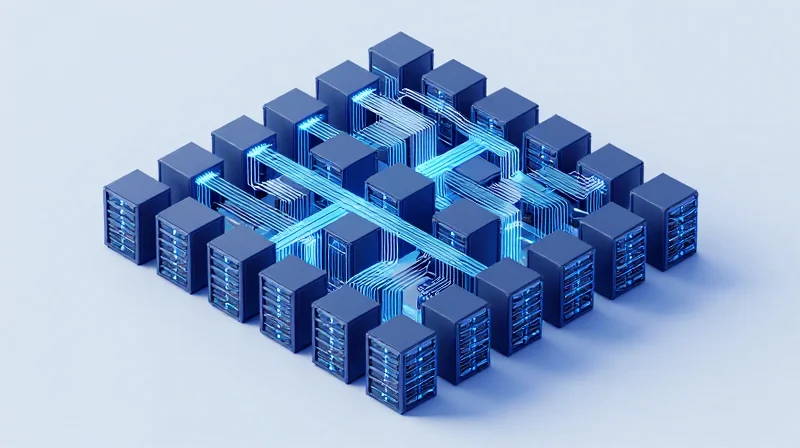
Scalability and Topology: Fat-Tree vs. Leaf-Spine Designs
The primary differentiator in scaling AI clusters lies in how each technology handles the 'all-to-all' communication patterns inherent in Large Language Model (LLM) training. InfiniBand architectures are predominantly built on a non-blocking Fat-Tree topology, which ensures that every GPU can communicate with any other GPU at full line rate without contention. In contrast, Ethernet typically utilizes a Leaf-Spine design which, while flexible and cost-effective for general data center workloads, often introduces oversubscription ratios that can lead to significant performance bottlenecks in high-concurrency AI environments.
The InfiniBand Fat-Tree: Non-Blocking Precision
In a Fat-Tree configuration, the network bandwidth increases as we move up from the leaf switches to the core. For AI, this is usually implemented as a 'non-blocking' fabric with a 1:1 subscription ratio. This means if 400 GPUs are connected to the leaf switches, there is exactly 400 GPUs worth of bandwidth available at the spine layer to facilitate communication. This deterministic pathing is critical for synchronous AI workloads where the slowest link dictates the speed of the entire training epoch.
Ethernet Leaf-Spine and the Oversubscription Challenge
Ethernet Leaf-Spine (Clos) networks are designed for 'East-West' traffic but frequently employ oversubscription (e.g., 3:1 or 4:1) to reduce costs. While modern AI-optimized Ethernet fabrics attempt to reach 1:1 ratios, they rely on Equal-Cost Multi-Pathing (ECMP) to distribute traffic. ECMP uses hashing to assign flows to paths, which can result in 'collisions' where two heavy AI traffic flows are sent down the same physical link while others remain idle, leading to 'incast' congestion that InfiniBand’s Credit-Based Flow Control inherently avoids.
| Feature | InfiniBand (Fat-Tree) | Ethernet (Leaf-Spine) |
|---|---|---|
| Subscription Ratio | Strict 1:1 (Non-blocking) | Variable (Often 1:1 to 3:1) |
| Traffic Management | Centralized Subnet Manager | Distributed Routing (BGP/ECMP) |
| Scaling Limit | ~48,000 nodes per L2 subnet | Virtually unlimited via L3 routing |
| Optical Transceiver Density | Extremely High (Point-to-Point) | High (Varies by oversubscription) |
| Path Selection | Deterministic / Adaptive | Hash-based (ECMP) |
Impact on Optical Transceiver Density
Scaling to tens of thousands of GPUs has a direct physical impact on the data center footprint. A non-blocking Fat-Tree requires a massive volume of optical transceivers and fiber cabling because every switch port must be accounted for in the uplink to the next tier. For a cluster of 32,768 GPUs, InfiniBand may require significantly more optical components than a standard Ethernet deployment, but this 'over-provisioning' is what enables the ultra-low tail latency required for multi-trillion parameter models.
FAQ: Topology and Scalability in AI
- Why is Fat-Tree preferred over Mesh for AI?
Fat-Tree provides a predictable number of hops between any two nodes and eliminates the complex routing loops found in mesh topologies, making it easier to manage the massive throughput of GPU-to-GPU communication. - Can Ethernet scale as large as InfiniBand?
Yes, Ethernet can scale to even larger node counts than InfiniBand due to its robust Layer 3 routing capabilities (BGP), but it often sacrifices latency consistency and requires complex tuning like RoCEv2 and PFC to match InfiniBand’s performance. - How does topology affect transceiver costs?
Non-blocking topologies require a 1:1 ratio of downlink to uplink ports. This doubles the number of transceivers compared to a network with 2:1 oversubscription, making the high-performance AI fabric a significant portion of the total hardware budget.
Total Cost of Ownership (TCO) and Ecosystem Maturity
Total Cost of Ownership: Beyond the Price Tag
The total cost of ownership (TCO) for AI networking is not merely a comparison of port prices but a calculation of the 'time-to-solution' efficiency. InfiniBand generally carries a 30% to 50% premium in capital expenditure (CapEx) due to specialized ASICs and a more consolidated supply chain. However, for organizations running multi-billion parameter model training, InfiniBand's superior efficiency can reduce training time by weeks, often making it the more cost-effective choice when the opportunity cost of idle GPUs is factored into the equation. Conversely, Ethernet leverages a massive global supply chain to offer lower hardware costs and a broader pool of skilled administrators.
CapEx and OpEx Comparison
| Metric | InfiniBand (NVIDIA/Mellanox) | Ethernet (RoCE v2 / UEC) |
|---|---|---|
| Hardware Cost | Higher (Specialized components) | Lower (Commodity/Volume pricing) |
| Vendor Diversity | Low (Primary single-vendor) | High (Multi-vendor interoperability) |
| Management Skillset | Niche/Specialized | Broad/Commonly available |
| Ease of Deployment | High (Self-configuring fabric) | Medium (Requires manual tuning/PFC) |
| Optics & Cabling | Proprietary/Optimized | Standardized/Competitive |
Ecosystem Maturity and Vendor Lock-in
Ethernet's maturity is its greatest strength, supported by the Ultra Ethernet Consortium (UEC) and decades of data center dominance. This multi-vendor landscape prevents vendor lock-in and ensures that pricing remains competitive. InfiniBand, while highly optimized for high-performance computing (HPC), presents a higher risk of lock-in. Because the ecosystem is primarily driven by a single dominant provider, organizations are more vulnerable to supply chain disruptions and proprietary licensing. However, the vertical integration of InfiniBand often results in a more cohesive software stack and fewer interoperability 'surprises' during large-scale deployments.
Frequently Asked Questions: Economics of AI Fabrics
- Which technology offers a better ROI for small-scale AI clusters?
For clusters under 128 GPUs, Ethernet (RoCE v2) often provides better ROI because the performance delta is negligible at small scales, and the cost savings on switches and optics are significant. - Does InfiniBand's performance justify the cost for inference?
In most inference scenarios, Ethernet is the preferred choice. Inference is typically less sensitive to the ultra-low tail latencies that InfiniBand provides, making the Ethernet price-performance ratio more attractive. - How does the 'talent gap' affect TCO?
Operational expenditure (OpEx) can be higher for InfiniBand if an organization lacks specialized network engineers. Ethernet skills are ubiquitous, making it easier and cheaper to hire or train staff to manage the fabric.
The Role of 800G and 1.6T Optical Transceivers
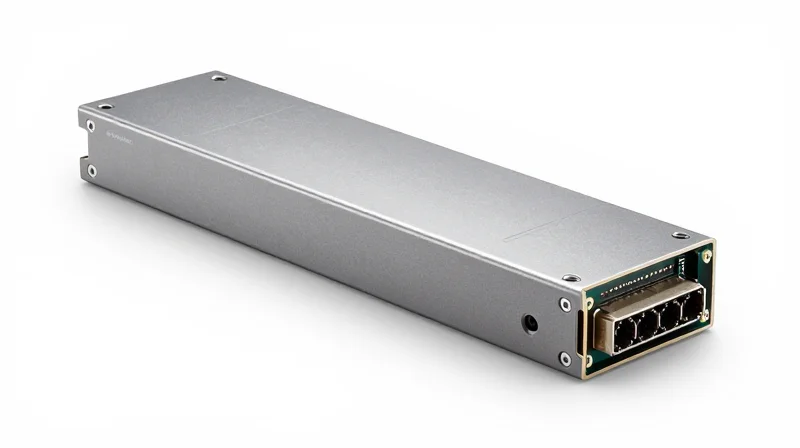
The Role of 800G and 1.6T Optical Transceivers
The transition to 800G and 1.6T optical transceivers represents the critical physical evolution required to prevent the network from becoming a bottleneck in massive GPU clusters. Regardless of whether a data center utilizes InfiniBand or Ethernet, these high-capacity optics provide the raw bandwidth needed to move terabytes of data across the fabric during distributed AI training cycles, such as All-Reduce operations. By leveraging advanced modulation techniques and silicon photonics, these transceivers effectively bridge the gap between protocols by ensuring that the physical layer can support the sub-microsecond latency requirements of modern AI workloads.
Standardization Across Protocols
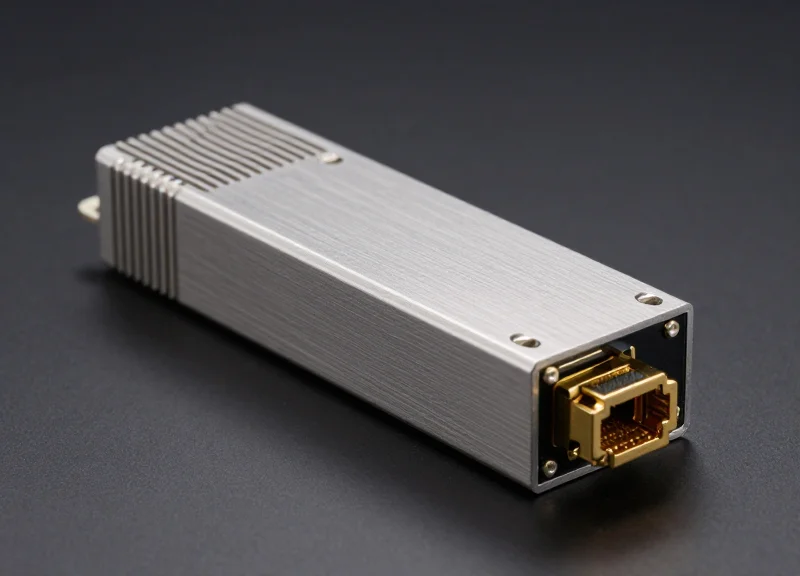
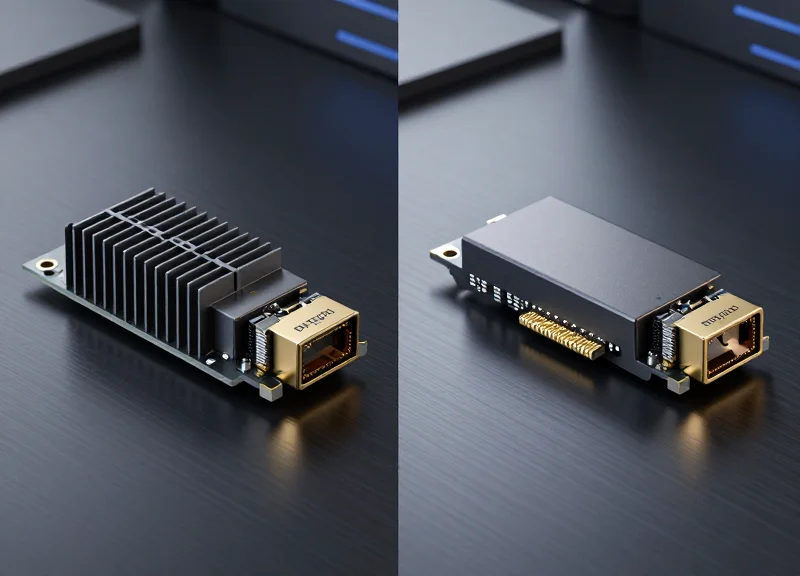
One of the most significant trends in high-performance networking is the convergence of optical hardware. While InfiniBand and Ethernet operate differently at the data link and network layers, they increasingly share the same physical form factors, such as OSFP (Octal Small Form-factor Pluggable) and QSFP-DD. This standardization allows for a more robust supply chain and faster adoption of 800G and the upcoming 1.6T standards, as manufacturers can develop high-density modules that cater to both markets simultaneously.
| Feature | 800G Transceivers | 1.6T Transceivers |
|---|---|---|
| Modulation | PAM4 (100G per lane) | PAM4 (200G per lane) |
| Form Factor | OSFP, QSFP-DD800 | OSFP1600, QSFP-DD1600 |
| Primary Use Case | Current H100/A100 Clusters | Next-Gen B100/B200 Clusters |
| Key Technology | DSP-based or LPO | Advanced DSP and Silicon Photonics |
Energy Efficiency and the Rise of LPO
As bandwidth scales to 1.6T, power consumption becomes a primary concern for AI operators. Linear Drive Pluggable Optics (LPO) is emerging as a solution by removing the Digital Signal Processor (DSP) from the transceiver module, relying instead on the switch silicon's integrated SerDes. This reduces latency and significantly lowers the power envelope, which is vital when thousands of transceivers are deployed in a single rack-scale AI system. Both InfiniBand and Ethernet ecosystems are exploring LPO to maintain their performance edge while controlling operational costs.
- Why are 800G optics preferred for AI clusters today?
800G optics provide the necessary throughput for 400G and 800G NICs, matching the high-speed interface of H100 GPUs and enabling a non-blocking fat-tree architecture. - Will 1.6T transceivers replace InfiniBand?
No, 1.6T is a physical layer speed. It will be utilized by both the next generation of NDR InfiniBand and Ultra Ethernet to support even larger and faster AI training fabrics. - How does 1.6T impact the physical cabling in a data center?
1.6T requires 200G per lane signaling, necessitating higher quality fiber and potentially shorter reach for copper DACs, which increases the reliance on active optical cables (AOCs).
Future Trends: Ultra Ethernet Consortium (UEC) vs. InfiniBand NDR/XDR
Future Trends: Ultra Ethernet Consortium (UEC) vs. InfiniBand NDR/XDR
The next phase of AI infrastructure is defined by a strategic divide: the movement toward open, vendor-neutral ecosystems led by the Ultra Ethernet Consortium (UEC) and the continued evolution of specialized, high-performance fabrics like InfiniBand NDR and XDR. While InfiniBand currently holds the crown for the lowest latency in massive GPU clusters, the UEC is re-engineering Ethernet's legacy protocols to eliminate the 'incast' and congestion issues that have historically hindered its performance in high-performance computing (HPC) environments.
The Ultra Ethernet Consortium (UEC): Modernizing the Transport Layer
The UEC, backed by industry giants like AMD, Arista, Broadcom, and Meta, is developing a new transport protocol designed specifically for AI and HPC. Unlike standard Ethernet which relies on RoCEv2, the UEC transport layer aims to provide non-blocking, multi-path data delivery with selective retransmission. This allows for massive scaling—up to 1,000,000 nodes—while maintaining the cost advantages and interoperability of the global Ethernet ecosystem. The goal is to provide a 'lossless-like' experience without the complexity of traditional Priority Flow Control (PFC).
InfiniBand Roadmap: From NDR (400G) to XDR (800G)
NVIDIA is not standing still, aggressively pushing the InfiniBand roadmap to maintain its lead in the 'compute fabric' space. Current deployments are centered on NDR (Next Data Rate) at 400Gb/s per port, utilizing advanced features like SHARPv3 (Scalable Hierarchical Aggregation and Reduction Protocol) to offload collective operations from GPUs to the network. The upcoming XDR (Extended Data Rate) generation is set to double throughput to 800Gb/s per port, integrating even tighter telemetry and congestion control to ensure that GPU utilization remains near 100% even as model parameters scale into the trillions.
| Feature | Ultra Ethernet (UEC) | InfiniBand (NDR/XDR) |
|---|---|---|
| Primary Advocate | Broad Industry Coalition (Open) | NVIDIA (Proprietary/Optimized) |
| Transport Protocol | UEC Transport (Selective Retry) | InfiniBand (Credit-based Flow Control) |
| Max Throughput (Next Gen) | 800G / 1.6T (Projected) | 800G (XDR) / 1.6T (GDR) |
| Network Philosophy | Flexible, High-Scale, Open Standard | Purpose-built, Low Latency, Integrated |
| Scalability | Targets 1,000,000+ Nodes | Tens of thousands (Typical AI Clusters) |
FAQ: Navigating the Future of AI Networking
- Will UEC replace InfiniBand for AI?
UEC is unlikely to fully replace InfiniBand in the short term, but it provides a critical alternative for hyperscalers who want to avoid vendor lock-in and leverage existing Ethernet expertise for trillion-parameter model training. - When will XDR InfiniBand be available?
NVIDIA's XDR (800G) InfiniBand is expected to begin sampling and appearing in high-end AI factory roadmaps throughout 2026 and 2025, aligning with the release of next-generation GPU architectures. - Is UEC backward compatible with standard Ethernet?
Yes, one of the primary design goals of the UEC is to maintain compatibility with the Ethernet physical layer while introducing a more efficient transport protocol above it.
Choosing between InfiniBand and Ethernet is a strategic decision that impacts the ROI of your AI infrastructure. While InfiniBand remains the gold standard for pure performance, Ethernet's rapid evolution makes it a formidable contender for enterprise-scale AI. Contact our technical experts today to design an optical networking solution tailored to your GPU cluster requirements.