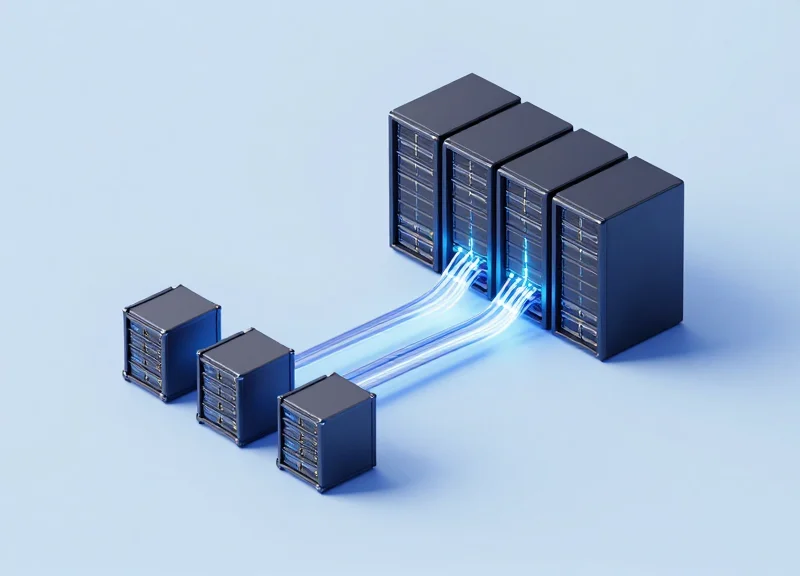
In the rapidly evolving world of edge computing, the bottleneck is no longer just processing power, but the efficiency of how data moves. This guide explores why specialized edge interconnects are replacing traditional standards to meet the brutal demands of real-time processing and low-power operations in decentralized environments.
The Evolution of Connectivity: Why Edge Needs New Interconnects
The Evolution of Connectivity: Why Edge Needs New Interconnects
The shift toward edge computing necessitates a fundamental departure from traditional backhaul-heavy architectures because legacy interconnects, designed for centralized clouds, cannot provide the deterministic latency and localized bandwidth efficiency required by distributed, real-time applications. As processing moves closer to the data source, the networking layer must evolve from long-haul transport to high-density, low-power proximity switching.
The Limitations of Legacy Data Center Networking
Traditional interconnects like standard Fiber Channel or long-haul Ethernet were optimized for 'North-South' traffic—moving data from a remote user to a centralized server. However, edge computing thrives on 'East-West' traffic, where micro-nodes must communicate instantaneously. Legacy solutions introduce 'tromboning' effects, where data must travel back to a central hub before reaching a neighboring edge node, creating unacceptable latency spikes and wasting expensive backhaul bandwidth.
| Feature | Legacy Interconnects (Cloud) | Edge-Native Interconnects |
|---|---|---|
| Primary Traffic Path | North-South (User to Central DC) | East-West (Node to Node) |
| Latency Targets | 50ms - 150ms | 1ms - 10ms |
| Power Profile | High (Rack-scale cooling) | Ultra-Low (Passive/Ruggedized) |
| Deployment Scale | Centralized Hubs | Highly Distributed/Fragmented |
Key Drivers for Edge-Specific Interconnects
- How does 5G influence interconnect choice?
5G provides the wireless last mile, but it requires edge-native fiber or copper interconnects at the base station to process data without sending it back to the core network. - Why is power consumption a critical factor?
Edge nodes often operate in space and power-constrained environments like utility poles or factory floors, making the high-wattage transceivers used in traditional DCs non-viable. - What role does AI play in this evolution?
Edge AI inference requires massive throughput between local compute modules and storage to maintain real-time feedback loops, demanding higher localized bandwidth than legacy WANs can offer.
Ultimately, the evolution is driven by the 'Physics of Latency.' As we approach the limits of the speed of light, the only way to improve performance is to shorten the physical distance between interconnect points and optimize the protocol stack for immediate, localized handshakes.
Latency Benchmarks: Real-Time Performance Comparison

Latency Benchmarks: Real-Time Performance Comparison
The primary performance differentiator between edge-native interconnects and legacy alternatives is the radical reduction in round-trip time (RTT) achieved by bypassing the traditional TCP/IP stack and minimizing physical distance. While cloud-based processing relies on backhaul connections that fluctuate based on ISP congestion and geographical hops, edge-native interconnects utilize specialized protocols like RoCE (RDMA over Converged Ethernet) or CXL (Compute Express Link) to achieve deterministic, microsecond-level performance essential for closed-loop control systems and real-time AI inference.
Quantitative Latency Breakdown by Interconnect Type
| Interconnect Technology | Typical Latency (RTT) | Primary Bottleneck | Best Use Case |
|---|---|---|---|
| Compute Express Link (CXL) | 100ns - 500ns | Memory Controller Sync | Memory Pooling & Cache Coherency |
| InfiniBand / RoCE v2 | 1µs - 10µs | Switching Fabric Jitter | Distributed AI Training & HPC |
| Standard 10/40GbE (TCP/IP) | 100µs - 2ms | Kernel/Software Interrupts | General Enterprise Networking |
| SD-WAN / Public Cloud | 20ms - 150ms | Geographic Distance & Hops | Asynchronous Data Analytics |
When evaluating these benchmarks, it is critical to distinguish between average latency and tail latency (P99). Standard Ethernet-based alternatives often suffer from high tail latency due to buffer bloat and packet retransmission, which can cause 'hiccups' in industrial automation. Edge-native interconnects, conversely, offer a flat latency profile, ensuring that 99.9% of packets arrive within a predictable window. This determinism is the prerequisite for 'Hard Real-Time' environments where a delay of even 5 milliseconds could result in mechanical failure or safety protocol violations.
Performance FAQ: Solving the Edge Latency Puzzle
- Why is the jump from milliseconds to microseconds necessary?
Modern robotics and autonomous systems require sensor-to-actuator loops that operate faster than human perception. At 1ms, a high-speed assembly arm may move several millimeters past its target; at 10 microseconds, precision is maintained at the sub-millimeter level. - Does hardware acceleration like SmartNICs impact these benchmarks?
Significantly. SmartNICs offload the network stack from the CPU, reducing latency by 30-50% compared to standard NICs by preventing CPU context switching and cache misses during packet processing. - How does physical distance limit these benchmarks?
Latency is bound by the speed of light in fiber (approx. 5 microseconds per kilometer). This physical reality means that regardless of protocol, true real-time performance is impossible if the compute node is more than 10-20km away from the data source.
Protocol Overhead and Jitter Impact
Protocol overhead and jitter are the primary enemies of edge performance, as traditional network stacks like TCP/IP introduce significant metadata bulk and unpredictable timing variances that can cripple real-time distributed applications. While cloud-native alternatives often rely on software-managed flow control that adds milliseconds of 'jitter' (latency variation), edge-native interconnects utilize hardware-level offloading to maintain nanosecond-scale consistency even under heavy load.
The Performance Cost of Protocol Metadata
In edge computing, where packet sizes are often small and frequent—such as sensor telemetry or command-and-control signals—the ratio of header metadata to actual payload data becomes a critical bottleneck. Standard TCP/IP stacks can impose an overhead of 20 to 60 bytes per packet. In contrast, specialized edge interconnects like RoCE (RDMA over Converged Ethernet) or InfiniBand use streamlined headers and zero-copy mechanisms, ensuring that the majority of the available bandwidth is utilized for application data rather than network bookkeeping.
| Protocol Characteristic | Legacy TCP/IP (Cloud-Ready) | Edge-Native Fabric (RoCE v2/IB) |
|---|---|---|
| Header Overhead | 20-60 Bytes | 12-28 Bytes |
| Flow Control | Software Windowing (ARQ) | Hardware Credit-Based / PFC |
| CPU Utilization | High (Kernel Interrupts) | Low (Hardware Offload) |
| Bandwidth Efficiency | 60-75% for small packets | 90-95% for small packets |
Jitter: The Silent Reliability Killer
Jitter refers to the fluctuation in latency between sequential packets. For edge use cases like industrial robotics or autonomous vehicle coordination, high jitter is often more damaging than high static latency because it prevents precise synchronization. Traditional alternatives suffer from 'buffer bloat' and software-driven retransmission delays, leading to erratic packet delivery. Edge-specific interconnects mitigate this through Priority Flow Control (PFC) and dedicated hardware queues that guarantee deterministic delivery windows, effectively flattening the tail latency curve.
- How does packet loss impact jitter at the edge?
In traditional protocols, packet loss triggers a 'slow start' mechanism and retransmission timeouts, causing massive spikes in jitter. Edge interconnects use lossless Ethernet or hardware-level 'Go-Back-N' logic to recover instantly without stalling the entire data stream. - Why is hardware-offloading essential for jitter reduction?
By bypassing the operating system's kernel and CPU scheduling, hardware-offloaded protocols remove the unpredictable delays caused by system interrupts and background processes, resulting in a predictable and consistent timing profile. - Can software-defined networking (SDN) fix protocol overhead?
While SDN can optimize the path, it cannot remove the physical bytes required by the protocol header itself; therefore, a lean physical protocol remains superior to an optimized heavy protocol for bandwidth-constrained edge links.
Power Consumption: The Efficiency Frontier
Power Consumption: The Efficiency Frontier
In edge computing environments, power consumption is no longer just an operational expense—it is a primary physical constraint. Unlike centralized data centers with dedicated cooling and massive power feeds, edge nodes often operate in thermally constrained enclosures or rely on battery and PoE (Power over Ethernet) budgets. Choosing the right interconnect requires a pivot from raw throughput to the 'Watts per Gigabit' metric, ensuring that high-speed data transfer does not lead to thermal throttling or premature hardware failure.
The Watts per Gigabit (W/Gbps) Benchmark
The efficiency of an interconnect is best measured by the energy required to move a specific volume of data. Legacy data center interconnects, such as high-performance InfiniBand or 400G Ethernet, are optimized for maximum bandwidth and minimum latency, often resulting in high power draws that are unsustainable at the edge. Conversely, edge-native solutions like PCIe-based fabrics and optimized 10G/25G Ethernet balance the energy equation by reducing signal processing overhead and utilizing low-power physical layers (PHYs).
| Interconnect Technology | Typical Power Consumption (W/Gbps) | Cooling Requirement | Ideal Edge Use Case |
|---|---|---|---|
| Standard 100G Ethernet | 0.15 - 0.25 W | Active/Forced Air | Regional Edge Gateways |
| PCIe Gen4 (Direct Connect) | 0.05 - 0.10 W | Passive/Heatsink | On-device AI Acceleration |
| Low-Power 10G Copper (Base-T) | 0.30 - 0.50 W | High Thermal Output | Legacy Integration |
| Edge-Native Optical (25G) | 0.08 - 0.12 W | Passive/Minimal | Remote Outdoor Nodes |
Thermal Management in Passive Environments
Excessive power consumption in an interconnect translates directly into heat. In fanless edge designs, every additional watt consumed by the networking interface increases the internal ambient temperature, which can force the CPU or GPU to downclock. Efficient interconnects allow for higher density in small form factors, enabling more compute power to be packed into ruggedized enclosures without the need for active mechanical cooling, which is a frequent point of failure in harsh environments.
Power Efficiency FAQs
- Why is W/Gbps more critical at the edge than in the cloud?
Edge nodes lack the industrial-scale HVAC systems found in data centers. High power consumption leads to heat buildup in sealed units, which triggers thermal throttling and reduces overall system reliability. - Does the choice of cabling affect power consumption?
Yes. Short-reach Direct Attach Copper (DAC) cables typically consume significantly less power than Optical Transceivers or standard Copper (Base-T) because they require less signal amplification and processing. - How does protocol overhead impact energy efficiency?
Protocols with high overhead, like traditional TCP/IP over Ethernet, require more CPU cycles for packet processing, indirectly increasing the total energy footprint compared to RDMA or PCIe-based offloads.
Total Cost of Ownership (TCO) at Scale
Calculating the Total Cost of Ownership (TCO) at the edge requires moving beyond the sticker price of networking hardware; true cost efficiency is found in the intersection of hardware longevity, energy efficiency, and the reduction of expensive wide-area network (WAN) traffic. Specialized edge interconnects frequently outperform traditional Ethernet or cloud-reliant architectures by consolidating management overhead and lowering the physical footprint required at each remote site.
Operational Expenses and the Cost of Maintenance
At scale, the 'truck roll' cost—the expense of sending a technician to a remote site—is the primary driver of OpEx. Traditional alternatives often rely on complex, multi-layered networking stacks that are prone to configuration drift and hardware failure. In contrast, purpose-built edge interconnects are designed for 'zero-touch' provisioning and remote observability, which significantly lowers the frequency of manual interventions.
Comparing Cost Dimensions: Interconnects vs. Standard Ethernet
| Cost Metric | Edge-Native Interconnects | Traditional Ethernet/Cloud |
|---|---|---|
| Initial CapEx | Moderate to High | Low to Moderate |
| Energy Consumption | Low (Optimized ASIC) | High (General Purpose) |
| Maintenance/OpEx | Low (Remote/Automated) | High (Manual Tuning) |
| Bandwidth Costs | Minimal (Local Processing) | High (Backhaul Reliance) |
| Hardware Density | High (Compact Forms) | Lower (Bulkier Switches) |
Reducing the Hardware Footprint and Power Budget
Modern edge interconnects allow for higher port density and lower power requirements per gigabit. This reduction in the 'Watts per Rack' translates directly into lower cooling requirements and allows deployments in space-constrained environments like industrial cabinets or roadside enclosures where traditional server-room equipment would fail due to thermal limits. By integrating switching and processing closer together, organizations can reduce the total number of physical appliances by up to 30%.
The Bandwidth Egress Advantage
By facilitating high-speed, low-latency communication locally between edge nodes, these interconnects enable decentralized data processing. This reduces the volume of raw data that must be sent to the cloud for analysis, effectively slashing monthly bandwidth bills and egress fees—often the most unpredictable and volatile component of edge computing budgets. The ability to filter and process at the source transform bandwidth from a bottleneck into a manageable fixed cost.
TCO Implementation FAQ
- How does hardware footprint impact overall ROI?
A smaller footprint reduces real estate costs and allows for deployment in harsh environments, expanding the reachable market for edge services without needing controlled data center environments. - Is the higher initial CapEx of specialized interconnects justified?
Yes, typically within 18-24 months. The savings in energy efficiency, reduced maintenance, and bandwidth costs usually offset the initial hardware premium quickly at scale. - What is the primary driver of TCO in decentralized networks?
Operational complexity and bandwidth. Systems that simplify peer-to-peer node communication without constant cloud handshakes provide the most significant long-term savings.
Interconnect Standard Deep-Dive: PCIe vs. CXL vs. Ethernet
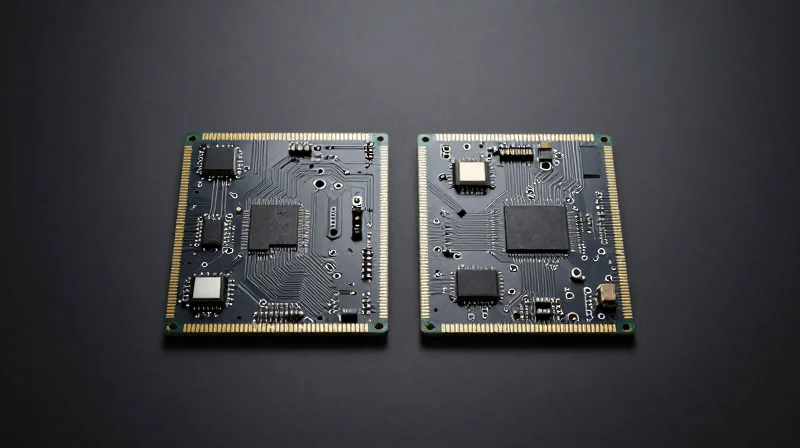
The choice between PCIe, CXL, and Ethernet at the edge is dictated by a hierarchy of proximity and protocol overhead: PCIe serves as the low-latency internal foundation, CXL extends that foundation with memory-centric efficiency, and Ethernet provides the necessary scale-out reach for distributed environments. Understanding the intersection of these standards is critical for optimizing edge architectures where power and space are at a premium.
PCIe: The localized Performance Benchmark
Peripheral Component Interconnect Express (PCIe) remains the dominant standard for high-speed communication within a single edge node. Its primary advantage is direct DMA (Direct Memory Access) and extremely low sub-microsecond latency. In edge scenarios involving real-time AI inference or high-frequency sensor data ingestion, PCIe provides the raw throughput required to bridge GPUs, FPGAs, and NVMe storage directly to the CPU root complex without the encapsulation overhead of networking protocols.
CXL: Memory Coherency at the Edge
Compute Express Link (CXL) leverages the PCIe physical layer but introduces a protocol that allows for cache coherency and memory pooling. For edge micro-data centers, CXL is transformative because it enables 'memory expansion'—allowing multiple accelerators to share a common memory pool. This reduces the 'memory tax' often found in edge nodes where each accelerator would otherwise require its own dedicated, underutilized DRAM, thereby lowering both TCO and power consumption.
Ethernet: The Fabric of Distributed Edge
While PCIe and CXL are limited to short distances (typically centimeters to a few meters), Ethernet is the only viable solution for connecting disparate edge nodes across a facility or city. With advancements like RDMA over Converged Ethernet (RoCE), Ethernet is closing the latency gap, making it suitable for high-performance edge clusters where scalability and interoperability with existing telecommunications infrastructure are non-negotiable.
| Feature | PCIe (Gen 5/6) | CXL (2.0/3.0) | Ethernet (100G/400G) |
|---|---|---|---|
| Primary Use | Internal Component Link | Memory & Cache Sharing | Node-to-Node Networking |
| Latency | Extremely Low (<100ns) | Low (Add ~20-50ns to PCIe) | Medium (1us - 10us+) |
| Max Distance | < 1 Meter | < 2 Meters (without retimers) | Up to 100km+ (Fiber) |
| Edge Benefit | Raw GPU/NVMe Speed | Resource Pooling Efficiency | Massive Scalability |
Strategic Implementation FAQ
- When should I prioritize CXL over standard PCIe?
Choose CXL when your edge application requires large memory footprints or when you need to share memory between a CPU and a dedicated accelerator to avoid the latency of data copying. - Can Ethernet replace PCIe in edge enclosures?
Rarely. While 'NVMe-over-Fabrics' uses Ethernet, the protocol overhead and hardware cost for NICs usually make PCIe the more cost-effective choice for internal device connectivity. - How does CXL 3.0 impact edge fabric design?
CXL 3.0 introduces fabric capabilities that allow for complex non-tree topologies, potentially allowing small edge clusters to function as a single composable unit without traditional top-of-rack switches.
Compute Express Link (CXL) in the Edge Ecosystem
Redefining Resource Utilization with CXL
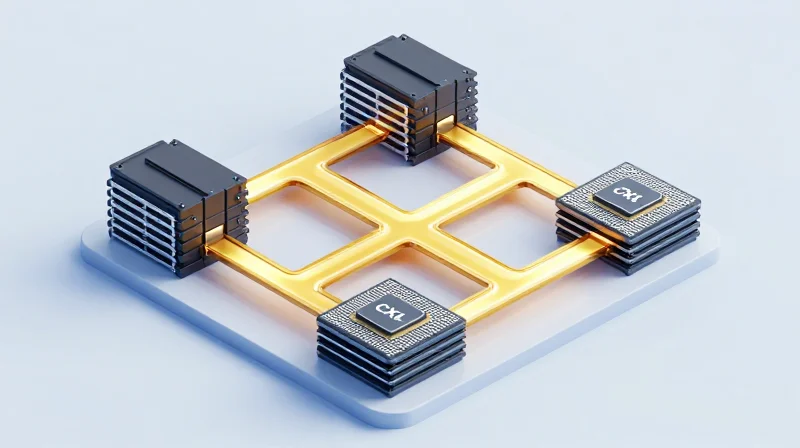
Compute Express Link (CXL) acts as a high-speed, cache-coherent interconnect built on the PCIe physical layer, designed to eliminate the 'memory wall' in dense edge environments. By decoupling memory from the CPU and allowing it to be shared across multiple hosts, CXL enables memory pooling, which solves the problem of stranded memory—resources that are physically present but inaccessible to the workloads that need them most. In an edge ecosystem where physical space and power budgets are extremely tight, the ability to dynamically allocate memory resources via CXL leads to significantly higher hardware utilization rates and reduced OpEx.
Cache Coherency and the Performance Advantage
The primary differentiator for CXL over traditional interconnects like Ethernet or standard PCIe is its support for cache-coherent memory access. Through the CXL.mem and CXL.cache protocols, accelerators (such as GPUs or NPUs) and CPUs can access a shared memory space without the high latency of software-managed I/O cycles. This is particularly transformative for Edge AI and real-time video analytics, where massive datasets must be moved between compute units with sub-microsecond latency to maintain system responsiveness.
| Feature | Standard PCIe (Gen 5) | CXL 2.0/3.0 | Direct-Attached Memory (DDR) |
|---|---|---|---|
| Protocol Type | Load/Store I/O | Cache Coherent Memory | Parallel Interface |
| Latency | Moderate (Software Overhead) | Ultra-Low (Hardware Managed) | Lowest (Local) |
| Scalability | Limited to Point-to-Point | High (Fabric/Switching) | Low (Fixed Slots) |
| Resource Pooling | No | Yes | No |
Improving Edge Server Density and TCO
By adopting CXL, edge operators can achieve a more modular 'composable' architecture. Instead of over-provisioning every edge node with maximum RAM to account for peak loads, operators can deploy a central memory pool. This reduction in redundant hardware directly translates to a smaller physical footprint—often reducing the number of required rack units by 20-30%—and a lower Total Cost of Ownership (TCO). Furthermore, the reduction in physical components decreases the heat signature per unit of compute, a vital consideration for uncooled or ruggedized edge deployments.
- Can CXL run over existing PCIe physical slots?
Yes, CXL leverages the PCIe 5.0 and 6.0 physical layers, meaning it uses the same pins and connectors, though the internal controllers and firmware must be CXL-compliant. - How does CXL improve Edge AI performance?
It allows Large Language Models (LLMs) or complex neural networks to reside in pooled memory, enabling multiple low-power edge accelerators to access the model weights simultaneously without duplicating data. - What is the primary cost barrier for CXL at the edge?
The initial CapEx is higher due to the requirement for the latest generation CPUs and specialized CXL memory expanders, though this is typically offset by long-term savings in power and hardware density.
Reliability and Security in Hostile Environments
Edge computing deployments frequently operate outside the protected confines of a traditional Tier 3 data center, exposing hardware to extreme temperatures, vibration, and unauthorized physical access. To bridge this gap, modern edge interconnects prioritize 'Security by Design,' moving beyond software-based protection to hardware-rooted encryption and deterministic fault recovery. While standard alternatives like basic Ethernet lack intrinsic physical-layer security, specialized interconnects like CXL and PCIe 5.0/6.0 integrate Integrity and Data Encryption (IDE) to ensure that data in transit remains opaque and tamper-proof even if the physical node is compromised.
Hardware-Level Security: IDE and SPDM
The primary differentiator between general-purpose networking and edge-optimized interconnects is the implementation of the Security Protocol and Data Model (SPDM). This framework allows for mutual authentication between components—such as a CPU and an accelerator—ensuring that only trusted hardware participates in the data stream. Furthermore, the Integrity and Data Encryption (IDE) feature in modern PCIe and CXL standards provides wire-speed encryption that prevents 'Man-in-the-Middle' (MitM) attacks at the board level. This is critical for edge nodes where a malicious actor might attempt to probe physical traces or swap components to intercept sensitive data.
Reliability Metrics in Hostile Environments
| Feature | Standard Ethernet | PCIe / CXL (Edge Profile) | Proprietary Industrial Interconnects |
|---|---|---|---|
| Encryption Layer | Software (TLS/IPsec) | Hardware (IDE/AES-GCM) | Hardware/Physical |
| Fault Tolerance | Retry-based (Latency) | Advanced Error Reporting (AER) | Hardware Redundancy |
| Physical Security | Low (Standard Ports) | High (Component Binding) | Very High (Tamper-evident) |
| Latency Penalty | High (Encapsulation) | Near-Zero (Hardware-logic) | Zero (Native) |
Ensuring Uptime through Fault Tolerance
Reliability at the edge is not just about uptime; it is about graceful degradation. Specialized interconnects utilize Advanced Error Reporting (AER) and sophisticated link-retraining mechanisms to handle transient errors caused by electromagnetic interference (EMI) or heat-induced signal attenuation. In scenarios where a node is part of a mission-critical system, such as an autonomous factory floor, the interconnect must distinguish between a temporary signal glitch and a permanent hardware failure, re-routing traffic or lowering clock speeds to maintain operation rather than triggering a total system halt.
Security and Reliability FAQ
- How does hardware encryption affect performance?
Modern edge interconnects like CXL use dedicated AES-GCM engines within the silicon, resulting in sub-microsecond latency penalties, which is significantly faster than software-based encryption. - What is 'Component Binding' in edge security?
It is a security process where hardware components are cryptographically locked to one another, preventing a stolen GPU or SSD from being used in a different system. - Can these interconnects survive extreme temperatures?
While the protocol remains the same, edge-rated interconnect hardware uses industrial-grade PHYs (Physical Layers) designed to operate from -40C to +85C without signal integrity loss.
Future-Proofing Your Edge Strategy

Future-Proofing Your Edge Strategy
Future-proofing an edge computing deployment is no longer about maximizing raw bandwidth alone; it is about building a modular, protocol-agnostic fabric capable of handling non-deterministic AI workloads and the hyper-dense connectivity of 6G. To remain competitive, organizations must prioritize interconnects that support disaggregated resource pooling—allowing compute, memory, and accelerators to scale independently rather than being bound by traditional motherboard constraints.
Preparing for the AI and 6G Paradigm Shift
The advent of 6G will bring sub-millisecond latency requirements and terabit-per-second throughput to the edge. Current alternatives like standard 10GbE or legacy PCIe configurations will become bottlenecks. Transitioning to CXL (Compute Express Link) 3.0 and beyond is critical for enabling memory sharing across nodes, which reduces the data movement overhead that currently plagues edge AI inference. By adopting these standards now, firms can ensure their hardware remains relevant as 6G networks enable massive MIMO and heterogeneous device ecosystems.
| Feature | Current Standard (PCIe 5.0/Eth) | Future Requirement (CXL 3.1 / 6G Era) |
|---|---|---|
| Primary Role | Point-to-point data transfer | Composable resource pooling |
| Memory Access | Isolated per-device | Fabric-wide shared memory |
| Latency Target | 5-10 Microseconds (End-to-end) | Sub-microsecond (Deterministic) |
| AI Scalability | Limited by physical slots | Elastic expansion via switches |
Strategic FAQ: Navigating the Transition
- Should I invest in proprietary interconnects for edge AI?
Avoid proprietary locks where possible. While custom fabrics offer short-term performance gains, open standards like CXL and OCP-compliant hardware ensure long-term vendor interoperability and lower replacement costs. - How does 6G impact my choice of physical cabling?
6G's high-frequency bands require internal interconnects to match high external data rates. Moving toward optical interconnects at the edge server level will be necessary to manage electromagnetic interference and heat in compact environments. - Is PCIe 4.0 still viable for new edge deployments?
For simple IoT gateways, yes. However, for any workload involving real-time video analytics or generative AI at the edge, PCIe 5.0 is the minimum baseline to avoid throttling modern NPU and GPU throughput.
Ultimately, the most resilient edge strategy is one that treats the interconnect as a dynamic backplane rather than a static cable. By leveraging software-defined networking (SDN) principles and memory-coherent fabrics, architects can create edge nodes that are easily upgraded as new silicon and 6G radio modules emerge.
The Final Verdict: Which Interconnect Should You Choose?
The final choice between edge computing interconnects and their alternatives is rarely about finding the absolute fastest technology, but rather the most efficient alignment between data movement requirements and the physical constraints of the edge deployment. While high-bandwidth solutions like CXL and NVLink dominate the data center, the edge requires a nuanced balance of power efficiency, thermal resilience, and total cost of ownership (TCO) that often favors specialized or hybrid interconnect strategies.
Interconnect Selection Matrix
| Use Case | Primary Requirement | Recommended Interconnect | Primary Alternative |
|---|---|---|---|
| Autonomous Vehicles | Ultra-low Latency | PCIe Gen 5/6 | Automotive Ethernet |
| Industrial IoT | Reliability & Distance | TSN (Time Sensitive Networking) | Standard Ethernet |
| Smart City Surveillance | High Throughput | Fiber Ethernet (100G+) | 5G / Private LTE |
| Edge AI Inference | Memory Coherency | CXL (Compute Express Link) | PCIe Gen 4/5 |
Matching Technology to Deployment Environment
For deployments in harsh environments where physical security and thermal management are paramount, PCIe-based fabrics offer the best performance-to-power ratio. However, if your edge strategy involves massive scaling across a distributed smart city grid, the cost-effectiveness and ubiquity of Ethernet-based alternatives make them the superior choice for long-term sustainability. Organizations should prioritize standards-based interconnects to avoid vendor lock-in, especially as the edge ecosystem continues to fragment.
Frequently Asked Questions
- Is CXL overkill for standard edge computing nodes?
No, specifically for Edge AI. CXL is becoming essential for memory pooling, allowing multiple edge accelerators to share a single memory resource, which reduces the overall hardware footprint and power consumption. - When should I choose proprietary interconnects over open standards?
Only when the performance gain of a vertical stack (such as NVLink for intensive GPU-to-GPU communication) provides a quantifiable ROI that justifies the increased cost and potential lack of interoperability. - How does the rollout of 5G influence internal interconnect choice?
5G functions as the external gateway. To prevent local bottlenecks, internal interconnects must have sufficient bandwidth to ingest and process data at 5G line speeds, often necessitating a move from 10G to 25G/100G Ethernet or PCIe Gen 5.
Selecting the right interconnect is a foundational decision for any edge deployment, directly impacting performance and profitability. To ensure your infrastructure is optimized for the next decade of distributed computing, consult with our systems architects today for a custom TCO analysis.