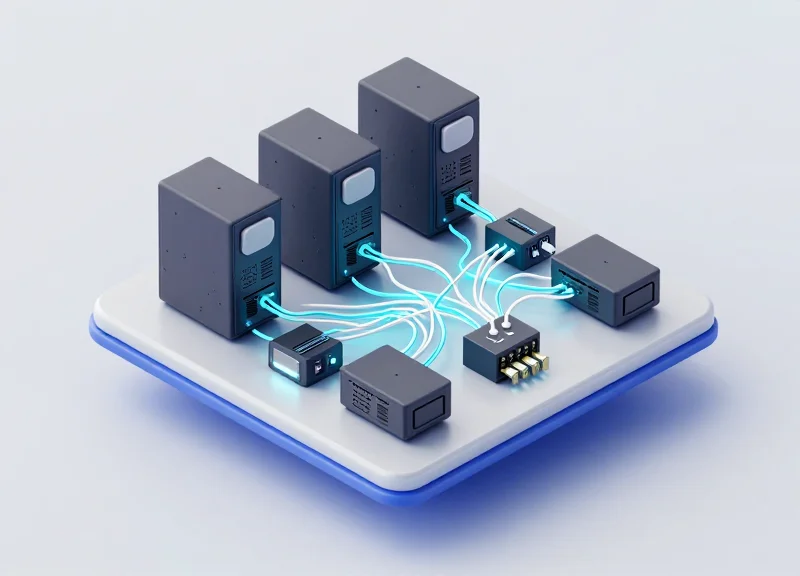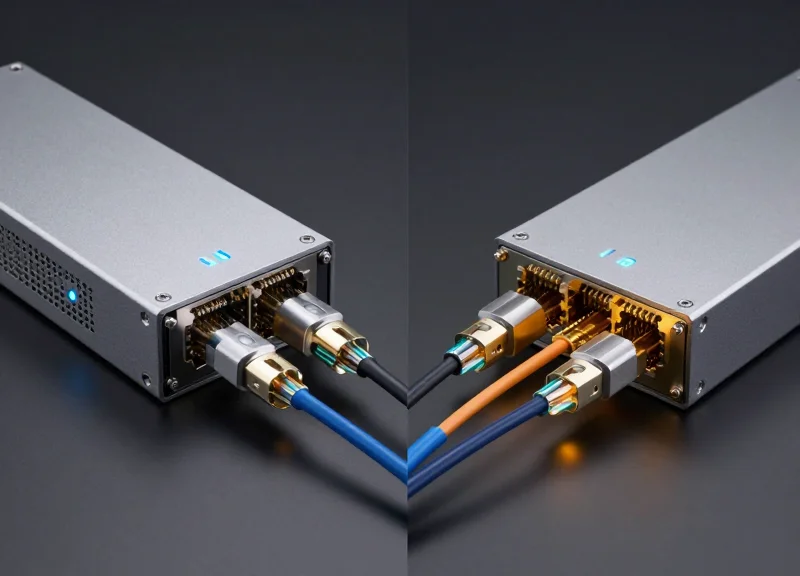
In an era where data drives every global transaction, the stability of your long-haul network infrastructure is non-negotiable. Ubytelink's 100G LR4 for 10km solutions addresses the growing demand for high-bandwidth, long-distance connectivity with enterprise-grade reliability and precision engineering.
The Evolution of 100G LR4 Technology
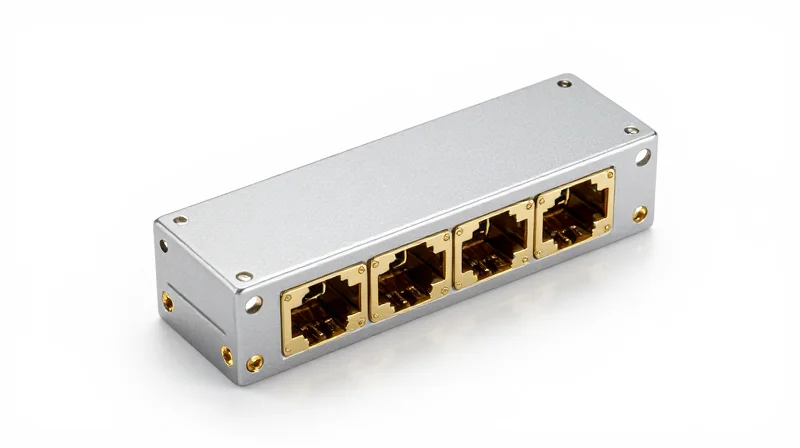
The evolution of 100G LR4 technology represents a critical milestone in optical networking, shifting from bulky, power-intensive modules to the highly efficient QSFP28 form factor that now powers global enterprise and service provider networks for 10km spans. This transition has been driven by the need for higher port density, reduced power consumption, and the standardization of LAN-WDM technology to bridge the gap between short-reach data center links and long-haul telecommunications.
From CFP to QSFP28: Miniaturization and Efficiency
In the early stages of 100G deployment, the industry relied on the CFP (C Form-factor Pluggable) and CFP2 standards. While these modules successfully delivered 100Gbps speeds, their physical size limited the number of ports available on a single switch rack unit. The development of the QSFP28 form factor revolutionized the market by providing a high-density solution that fits the same footprint as 40G QSFP+ modules, allowing for a seamless upgrade path to 100G without increasing the physical footprint of the hardware.
| Feature | CFP / CFP2 | QSFP28 (LR4) |
|---|---|---|
| Physical Size | Large / Medium | Compact (Small) |
| Power Consumption | Up to 24W / 12W | Typically <3.5W |
| Port Density | Low | High (Up to 36 ports per RU) |
| Optical Standard | Varies | IEEE 802.3ba 100GBASE-LR4 |
The Role of LAN-WDM in 10km Solutions
The 100G LR4 standard utilizes Local Area Network Wavelength Division Multiplexing (LAN-WDM) to transmit signals. By multiplexing four distinct wavelengths—1295.56nm, 1300.05nm, 1304.58nm, and 1309.14nm—onto a single pair of single-mode fibers, LR4 modules can achieve a stable 10km reach. This approach minimizes chromatic dispersion and ensures high signal integrity, making Ubytelink 100G LR4 solutions ideal for campus backbones and metropolitan area networks where reliability is paramount.
- Why is the LR4 standard essential for 10km links?
LR4 is specifically designed for 10km spans over single-mode fiber, offering a standardized approach that guarantees interoperability across different vendor platforms while maintaining low bit-error rates. - How does Ubytelink ensure the quality of its 100G LR4 modules?
Ubytelink employs rigorous testing protocols, including thermal cycling and bit-error rate testing, to ensure that every module meets the high-performance requirements of modern global networks. - What are the primary benefits of the QSFP28 form factor for enterprises?
The primary benefits include significantly lower power cooling costs, the ability to maximize rack space with high-density switches, and lower overall total cost of ownership compared to legacy CFP modules.
Technical Deep Dive: The Mechanics of 10km Reach

The Architecture of 100G LR4: 4x25G Parallelism
The Ubytelink 100G LR4 transceiver achieves its 10km reach by converting 100Gbps electrical signals into four discrete 25Gbps optical channels. This architecture, defined by the IEEE 802.3ba standard, utilizes four different wavelengths in the 1310nm O-band, allowing for massive data throughput over a single pair of single-mode fibers (SMF) without the signal degradation typically associated with serial transmissions at such high frequencies.
LAN-WDM vs. CWDM: Precision at Scale
Unlike Coarse Wavelength Division Multiplexing (CWDM), which uses 20nm spacing, LR4 solutions employ LAN-WDM (Local Area Network Wavelength Division Multiplexing). LAN-WDM uses a much tighter channel spacing of roughly 4.5nm (800GHz). This precision is critical for the 10km reach because it places the optical signals near the zero-dispersion point of the fiber, ensuring that the four 25Gbps signals remain distinct and clear even after long-distance travel.
| Feature | 100G LR4 (LAN-WDM) | 100G CWDM4 |
|---|---|---|
| Wavelength Spacing | ~4.5nm (800GHz) | 20nm |
| Maximum Distance | 10km | 2km |
| Fiber Type | Single-mode (G.652) | Single-mode (G.652) |
| Dispersion Sensitivity | Low (Optimized O-band) | Moderate |
Internal Componentry: DFB Lasers and MUX/DEMUX
The stability of the Ubytelink 100G LR4 module is rooted in its internal Optical Assembly. It features four cooled Distributed Feedback (DFB) lasers, which provide the narrow spectral width required for LAN-WDM. These signals are combined via an optical multiplexer (MUX) for transmission and separated by a de-multiplexer (DEMUX) at the receiving end, where high-sensitivity PIN photodiodes convert the light back into electrical data.
- Why is cooling necessary for LR4 lasers?
The tight 800GHz spacing of LAN-WDM requires precise wavelength control. Thermoelectric Coolers (TEC) are used to maintain a constant temperature, preventing wavelength drift that could cause cross-talk between channels. - Does 100G LR4 require FEC?
While the 100G LR4 standard is designed to operate with a very low Bit Error Rate (BER), modern implementations often utilize Forward Error Correction (FEC) on the host side to ensure maximum link reliability over the full 10km span. - What is the typical optical power budget?
A high-quality 100G LR4 module generally provides an optical power budget of approximately 6.3dB to 8.5dB, allowing for connector losses and fiber attenuation over 10km.
Ubytelink Quality Engineering: Setting Industry Standards

Ubytelink Quality Engineering: Setting Industry Standards
Ubytelink redefines optical networking through a "Quality-First" engineering philosophy that integrates Tier-1 laser components with fully automated sub-assembly processes. Unlike generic transceivers that often rely on manual alignment, Ubytelink’s 100G LR4 modules are calibrated using robotic precision to ensure every unit delivers identical, ultra-low Bit Error Rate (BER) performance over the full 10km reach. This systematic approach ensures that our solutions don't just meet IEEE 802.3ba standards but significantly exceed them in terms of thermal stability and signal integrity.
The Anatomy of a Premium QSFP28 Module
The reliability of a 100G LR4 link is dictated by the quality of its internal optics. Ubytelink utilizes high-performance DML (Directly Modulated Laser) transmitters specifically binned for low noise and high extinction ratios. By sourcing components from the world's leading semiconductor fabs, we ensure that the four 25Gbps lanes maintain a strict LAN-WDM wavelength grid. This prevents spectral drift, which is the primary cause of packet loss in long-distance single-mode fiber deployments.
| Feature | Ubytelink Engineering | Generic Standards |
|---|---|---|
| Assembly Process | Automated Active Alignment | Manual/Semi-Automated |
| Laser Source | Tier-1 Binned DML/EML | Unclassified/Standard Grade |
| Failure Rate (AFR) | < 0.1% | 1.5% - 3.0% |
| Thermal Testing | 100% Chamber Burn-in | Batch/Sample Testing |
Advanced Testing and Global Interoperability
Precision engineering at Ubytelink extends beyond the hardware to the firmware level. Each 100G LR4 module is programmed and tested for real-world compatibility with a massive library of host platforms, including Cisco, Arista, Juniper, and Dell. This eliminates the 'vendor lock-in' hurdles while providing the same Digital Optical Monitoring (DOM) accuracy as original equipment manufacturer (OEM) modules.
- How does Ubytelink ensure consistent performance in high-density environments?
Every module is subjected to rigorous thermal cycle testing to ensure the internal cooling and power consumption remain stable within the tight confines of high-density 1U switches. - What steps are taken to prevent signal degradation over the 10km distance?
We use Active Optical Alignment (AOA) during manufacturing to minimize insertion loss at the TOSA/ROSA interface, maximizing the available power budget for the 10km link. - Are Ubytelink modules compliant with global regulatory standards?
Yes, our modules undergo full certification for CE, FCC, RoHS, and MSA compliance, ensuring they meet safety and environmental standards for global enterprise and service provider networks.
Superior Signal Integrity and Error-Free Performance

Superior Signal Integrity and Error-Free Performance
In the landscape of 100G networking, reaching the 10km threshold is only half the battle; the true measure of a transceiver is its ability to deliver data without corruption or unnecessary retransmissions. Ubytelink 100G LR4 QSFP28 modules are engineered to provide maximum signal integrity, leveraging advanced optical components and rigorous testing to achieve a Bit Error Rate (BER) that significantly outperforms industry standards. This ensures that mission-critical traffic, from high-frequency financial transactions to real-time cloud computing, flows seamlessly without the latency penalties associated with heavy error correction and packet loss.
The Impact of Low Bit Error Rates (BER)
A low BER is the foundation of high-performance networking. While the IEEE 802.3ba standard defines specific thresholds for 100GBASE-LR4, Ubytelink modules are designed with an enhanced link margin. By utilizing high-quality TOSA (Transmitter Optical Sub-Assembly) and ROSA (Receiver Optical Sub-Assembly) components, these modules minimize jitter and noise, resulting in a cleaner eye diagram. This precision reduces the workload on Forward Error Correction (FEC) algorithms, leading to lower overall system latency and more consistent throughput across long-distance spans.
Receiver Sensitivity and Link Budget
Receiver sensitivity is critical when operating at the 10km limit of single-mode fiber (SMF). Ubytelink utilizes high-sensitivity PIN photodiodes coupled with low-noise transimpedance amplifiers (TIAs). This combination allows the module to accurately interpret incoming optical pulses even after the signal has been attenuated by fiber loss and connector interfaces. By maintaining a superior receiver sensitivity, Ubytelink modules offer greater flexibility for network designers to include additional patches or splices within the 10km span without risking link drops.
| Performance Parameter | IEEE 802.3ba Standard | Ubytelink 100G LR4 Performance |
|---|---|---|
| Typical Bit Error Rate (BER) | 1x10^-12 | < 1x10^-15 |
| Receiver Sensitivity (OMA) | -8.6 dBm | -10.5 dBm (Typical) |
| Optical Path Penalty | 2.2 dB | < 1.8 dB |
| Link Margin (at 10km) | Standard | Enhanced (+2 dB) |
- How does high receiver sensitivity affect network reliability?
Higher sensitivity provides a larger link budget margin, allowing the network to remain stable even as fiber optic components age or if additional patch panels are introduced into the link, preventing intermittent signal loss. - Why is a low BER important for 100G networks?
Low BER reduces the frequency of packet retransmissions at the transport layer, ensuring that the full 100Gbps bandwidth is utilized for data payload rather than overhead or error recovery cycles. - Does Ubytelink support Digital Optical Monitoring (DOM)?
Yes, real-time DOM allows network administrators to monitor transmitter power, receiver power, and temperature to proactively identify potential signal integrity issues before they cause a total link failure.
Rigorous Testing Protocols for Global Reliability

Reliability in 100G networking is the result of a uncompromising validation architecture. For the Ubytelink 100G LR4 10km solution, every module is subjected to a tiered testing protocol that simulates a decade of operational stress in just a few weeks. By combining automated optical characterization with accelerated environmental aging, Ubytelink ensures that each unit maintains signal integrity and power efficiency regardless of the deployment environment, from climate-controlled hyperscale data centers to remote edge enclosures.
Thermal Dynamics and Environmental Stability
The LAN-WDM lasers used in 100G LR4 modules are highly sensitive to temperature fluctuations, which can cause wavelength drift and subsequent signal loss. Ubytelink utilizes state-of-the-art thermal cycling chambers to verify that the internal cooling and stabilization mechanisms keep the four 25Gbps lanes locked within their specified frequency grid.
| Test Category | Protocol Description | Target Standard |
|---|---|---|
| Thermal Cycling | Rapid transition between -40°C and +85°C | Telcordia GR-468-CORE |
| Accelerated Aging | Continuous operation at 70°C for 2,000+ hours | MIL-STD-883 |
| Damp Heat | 85% relative humidity at 85°C for 500 hours | IEC 60068-2-67 |
| Vibration/Shock | High-frequency mechanical oscillation tests | TIA/EIA-455-11 |
Optical Precision and BER Verification
Beyond environmental resilience, every module must pass a rigorous optical performance audit. This involves real-time Bit Error Rate (BER) monitoring under worst-case link budget scenarios. We utilize high-fidelity oscilloscopes to analyze eye diagrams, ensuring that the extinction ratio and optical signal-to-noise ratio (OSNR) provide sufficient margin for 10km spans.
- How does Ubytelink prevent 'infant mortality' in optical modules?
Every batch undergoes a 100% burn-in process where modules are operated at maximum voltage and temperature for a set duration to trigger and eliminate early-stage component failures. - Why is LAN-WDM wavelength stability critical during testing?
Because the four lanes are tightly spaced in the O-band, any thermal drift can cause inter-channel interference. Our tests ensure the multiplexer and de-multiplexer remain perfectly aligned. - What mechanical tests are performed on the QSFP28 housing?
Modules undergo repeated insertion/extraction cycles and mechanical shock tests to ensure the latching mechanism and LC connectors remain robust throughout the device's lifecycle.
By adhering to these rigorous protocols, Ubytelink 100G LR4 modules deliver a consistent, high-reliability connection that minimizes maintenance overhead and maximizes network uptime for global enterprises and service providers.
Maximizing Thermal Efficiency in Dense Environments
Engineered for Cool Operation in High-Density Ports
Ubytelink 100G LR4 transceivers are specifically engineered to address the thermal challenges of high-density 100G switching platforms where airflow is often restricted. By maintaining power consumption significantly below the 3.5W MSA standard—often averaging under 3.2W—these modules minimize the heat footprint at the port level. This efficiency is achieved through the integration of low-power Digital Signal Processors (DSPs) and optimized TOSA/ROSA components, preventing the thermal throttling that can lead to packet loss or link instability in mission-critical 10km spans.
Thermal Efficiency and System Reliability
In a fully populated 48-port switch, even a 0.3W saving per module can reduce the total chassis heat load by over 14 Watts. Ubytelink's focus on energy efficiency not only lowers operational expenditure (OpEx) through reduced cooling requirements but also extends the Mean Time Between Failures (MTBF) for both the module and the host switch by maintaining a lower internal junction temperature across the optical sub-assemblies.
| Thermal Metric | Ubytelink 100G LR4 | Industry Average |
|---|---|---|
| Typical Power Consumption | < 3.2W | 3.5W - 3.8W |
| Max Case Temperature | 70°C (Commercial) | 70°C |
| Thermal Interface Material | High-K Carbon Fiber Composite | Standard Silicone Pad |
| Heat Dissipation Efficiency | High (Optimized Airflow Shell) | Standard |
Addressing High-Density Heat Dissipation
The physical design of the Ubytelink housing utilizes high-conductivity materials and a precision-tooled shell that acts as a passive heat sink. This design ensures that heat generated by the DFB lasers is rapidly wicked away from the core components. Furthermore, the modules support advanced Digital Optical Monitoring (DOM), allowing network administrators to monitor real-time temperature data and proactively manage cooling profiles before thermal thresholds are reached.
- How does Ubytelink prevent thermal throttling?
Through a combination of low-power circuit design and advanced heat-conducting housings that rapidly transfer heat away from internal lasers to the switch's airflow path. - What is the impact of lower power consumption on 10km links?
Lower power consumption reduces internal noise and heat-induced wavelength drift, ensuring the 100G LR4 signal remains locked and stable over the full 10km distance. - Are these modules compatible with closed-front switches?
Yes, the low-thermal profile of Ubytelink modules is ideal for enclosures with limited ventilation, where maintaining a low ambient temperature is difficult.
Multi-Vendor Compatibility and Seamless Integration
The Ubytelink 100G LR4 for 10km solutions addresses the critical challenge of hardware interoperability by providing transceivers that are fully compliant with Multi-Source Agreements (MSA). This ensures that global networks can scale and upgrade using a mix of top-tier hardware brands—such as Cisco, Juniper, Arista, and Mellanox—without the financial and operational constraints of proprietary 'vendor lock-in.' By prioritizing universal compatibility, Ubytelink simplifies procurement and maintenance for mission-critical data centers, allowing for a more agile and cost-effective approach to network expansion.
MSA Compliance and Precision EEPROM Coding
The foundation of Ubytelink's compatibility lies in strict adherence to the IEEE 802.3ba and QSFP28 MSA standards. However, physical compliance is only half the battle. Each module features precision-programmed EEPROM chips that contain brand-specific metadata. This ensures that when the Ubytelink 100G LR4 is inserted into a switch or router, it is recognized as a native, certified component, preventing 'unsupported transceiver' warnings and enabling full diagnostic capabilities through Digital Optical Monitoring (DOM/DDM).
| Feature | Ubytelink 100G LR4 | Standard OEM Transceivers |
|---|---|---|
| Vendor Compatibility | Universal (Cisco, Arista, Juniper, etc.) | Single-Brand Specific |
| Supply Chain Agility | High (Independent Stock & Global Logistics) | Low (Dependent on OEM lead times) |
| Cost Efficiency | Significant Savings (Up to 70%) | High Premium Pricing |
| Diagnostic Support | Full DOM/DDM Support | Brand-Limited Support |
Strategic Advantages of a Vendor-Neutral Infrastructure
- Reduced Total Cost of Ownership (TCO)
Organizations can reallocate budget from high-margin OEM optics to core infrastructure upgrades without sacrificing reliability. - Unified Inventory Management
Maintain a single SKU of 100G LR4 modules for various hardware brands, reducing the complexity of spare parts management across global sites. - Future-Proof Upgrades
As networks transition to different hardware vendors, Ubytelink optics remain compatible, preserving the initial investment and easing the migration process.
Integration and Deployment FAQ
- Does using Ubytelink optics void my network equipment warranty?
No. Under laws like the Magnuson-Moss Warranty Act in the US and similar consumer protection regulations globally, equipment manufacturers cannot void a hardware warranty simply for using a third-party peripheral unless that specific peripheral is proven to have caused damage. - How does Ubytelink guarantee compatibility with specific OS versions?
Each transceiver undergoes rigorous testing in our compatibility lab using various network operating systems (e.g., Cisco IOS-XE, Arista EOS, Juniper Junos) to ensure command-line interface (CLI) recognition and seamless packet transmission. - Can these modules be used in mixed-vendor environments?
Yes. The 100G LR4 standard ensures that a Ubytelink module in a Cisco switch can communicate perfectly with an OEM module in an Arista switch at the other end of the 10km link.
Operational Cost Savings and Long-Term ROI
The true value of a 100G LR4 transceiver is not found in its initial purchase price but in its ability to sustain peak performance over a multi-year lifecycle without intervention. For global enterprises and data center operators, Ubytelink 100G LR4 solutions offer a strategic hedge against escalating operational expenditures (OpEx) by combining high-grade optical components with rigorous quality control. By preventing common failure modes such as laser degradation and thermal instability, these modules ensure that the network remains productive, thereby accelerating the Return on Investment (ROI) and lowering the Total Cost of Ownership (TCO).
Quantifying the TCO Advantage
When evaluating 100G LR4 solutions, network architects must account for the 'hidden' costs of failure, which include truck rolls, labor for diagnostic troubleshooting, and the opportunity cost of network downtime. Ubytelink’s commitment to premium quality ensures a Mean Time Between Failures (MTBF) that far exceeds industry averages, allowing organizations to shift their focus from reactive maintenance to proactive scaling.
| Metric | Generic LR4 Transceivers | Ubytelink 100G LR4 |
|---|---|---|
| Annual Failure Rate | 1.5% - 3.0% | <0.1% |
| Maintenance Cycle | Reactive / Frequent | Predictable / Minimal |
| Power Efficiency | High Variability | Optimized <3.5W |
| Service Life | 3-5 Years | 7-10+ Years |
Energy Efficiency and Operational Savings
In high-density deployments, the cumulative power consumption and heat dissipation of hundreds of transceivers can significantly impact utility costs and cooling requirements. Ubytelink 100G LR4 modules are engineered for low-power operation, typically consuming less than 3.5W. Over a five-year period, this efficiency reduces energy bills and lessens the load on Data Center Infrastructure Efficiency (DCIE) metrics, contributing directly to the bottom line.
ROI Analysis & Lifecycle Questions
- How does Ubytelink reduce the frequency of 'truck rolls'?
By utilizing high-reliability EML lasers and hermetic packaging, our modules resist environmental stressors that cause generic optics to fail, eliminating the need for technician site visits for replacements. - What is the typical payback period for premium 100G LR4 modules?
While the initial cost may be slightly higher than budget alternatives, the ROI is typically realized within 12 to 18 months through savings in maintenance labor and the avoidance of single-event downtime costs. - How does the lifecycle of Ubytelink modules compare to standard optics?
Ubytelink modules are designed for a 10-year operational horizon, whereas standard optics often see performance degradation after 3-5 years, requiring an entire infrastructure refresh cycle much sooner.
Ubytelink's 100G LR4 solutions empower global organizations to build faster, more resilient networks without compromise. Experience the difference that premium Silicon Valley-grade engineering makes in your mission-critical infrastructure. Contact our technical team today to optimize your 100G backbone.