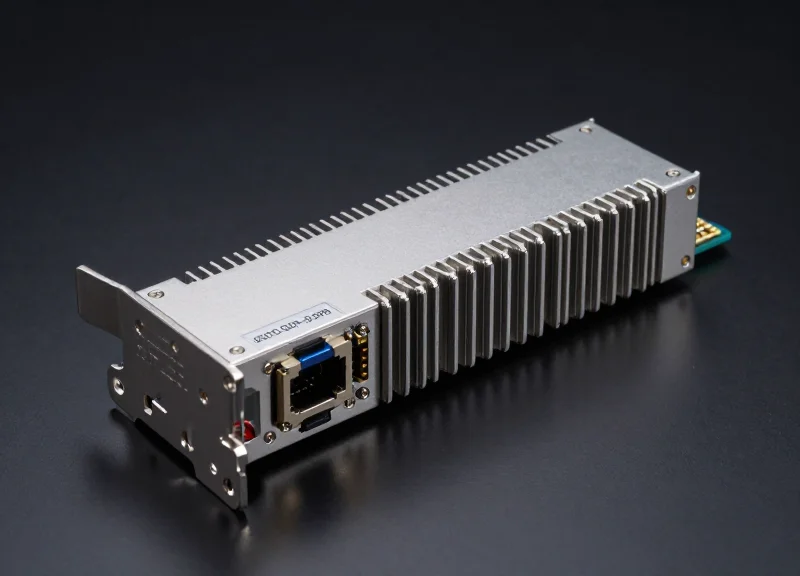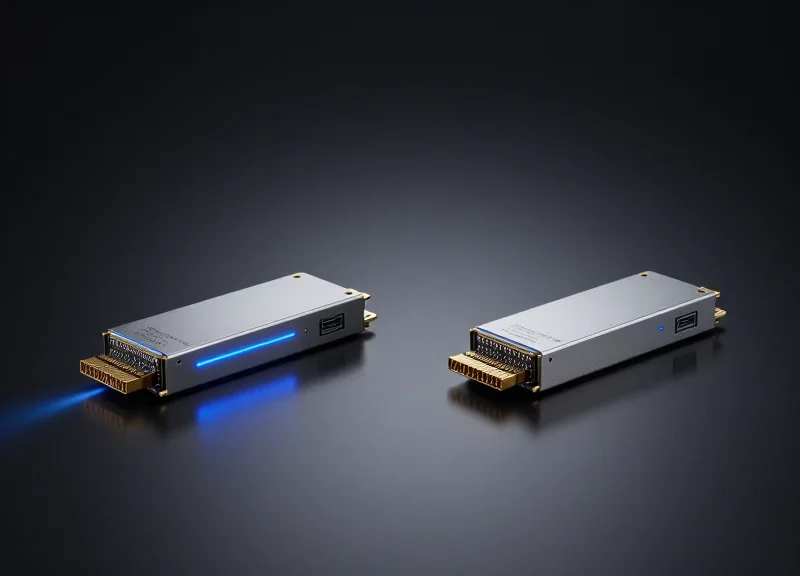
As artificial intelligence and high-performance computing (HPC) drive data center traffic to unprecedented levels, the industry faces a critical bottleneck: the power and heat generated by traditional optical modules. 800G LPO (Linear-drive Pluggable Optics) has emerged as a revolutionary solution, stripping away the power-hungry DSP to provide a leaner, faster, and more efficient path for high-speed data transmission. This article explores why LPO is becoming the architecture of choice for the AI era.
The Evolution of Optical Networking: Why LPO Matters Now
The Evolution of Optical Networking: Why LPO Matters Now
As data centers migrate from 400G to 800G to accommodate the explosive growth of Generative AI and Large Language Models (LLMs), traditional optical architectures are facing a sustainability crisis. Linear Drive Pluggable Optics (LPO) represents a paradigm shift by removing the power-hungry Digital Signal Processor (DSP) from the pluggable module, shifting the equalization tasks to the host ASIC. This evolution is no longer just a performance upgrade but a technical necessity to keep power consumption, thermal management, and latency within the operational limits of massive AI clusters.
The Transition from 400G to 800G
In the 400G era, standard Retimed Pluggable Optics relied heavily on internal DSPs to clean up signals and compensate for transmission impairments. However, doubling the bandwidth to 800G essentially doubles the signal processing complexity. In a typical AI training cluster with tens of thousands of GPUs, the cumulative power draw of thousands of 800G DSP-based modules creates a 'thermal ceiling' that limits compute density and increases cooling costs exponentially.
The DSP Bottleneck: Power and Latency
Traditional DSP-based modules are responsible for roughly 25% to 30% of the total power consumed by an optical transceiver. Beyond power, the process of analog-to-digital conversion and complex error correction introduces several nanoseconds of latency. In the world of high-frequency trading or synchronized AI training iterations, these nanoseconds aggregate into significant performance bottlenecks. LPO solves this by utilizing a linear driver and a Transimpedance Amplifier (TIA) with high linearity, effectively bypassing the DSP's 'tax' on power and speed.
| Feature | Traditional DSP-based 800G | 800G LPO Technology |
|---|---|---|
| Power Consumption | ~16W - 18W per module | ~8W - 10W per module |
| Latency | Higher (DSP Processing) | Ultra-low (Linear Drive) |
| Cost Structure | High (Expensive DSP chips) | Lower (Simplified BOM) |
| Design Complexity | Complex Signal Retiming | Host-Side Equalization Dependency |
Key Drivers for LPO Adoption
- Why is 800G the breaking point for traditional modules?
At 800G, the thermal density of DSPs makes it difficult to maintain stable temperatures within high-density switches, leading to potential hardware failures and higher OpEx for cooling. - What is the primary technical advantage of LPO for AI?
Lower latency and reduced power per bit are the primary advantages. By eliminating the DSP, LPO modules can reduce power consumption by nearly 50%, allowing for denser GPU interconnects. - Is LPO a direct replacement for all 800G applications?
Not necessarily. LPO is optimized for short-reach, high-density environments like Intra-Data Center (DCI) links within 100 meters, where the host ASIC can handle signal integrity without the need for a module-level DSP.
Defining 800G LPO: Architecture and Core Components
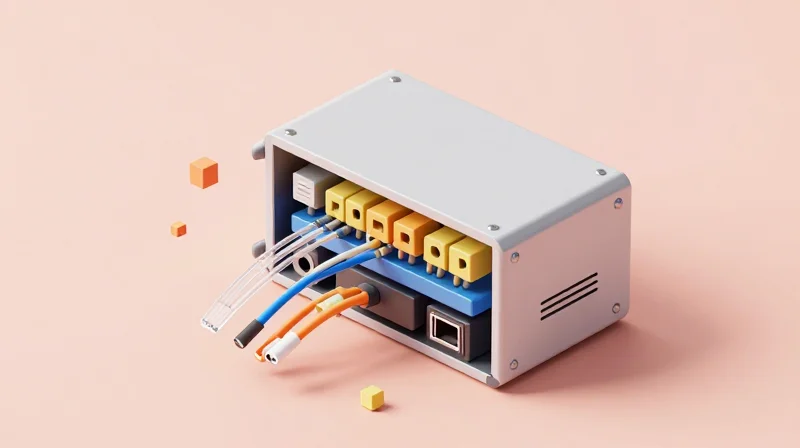
At its core, 800G Linear-drive Pluggable Optics (LPO) technology represents a fundamental shift in optical transceiver design by removing the Digital Signal Processor (DSP) from the module itself. Unlike traditional re-timed modules that perform signal equalization and clock recovery internally, LPO relies on a 'linear-drive' approach where the host-side ASIC (typically within a switch or router) handles the complex signal processing, while the optical module functions as a transparent, high-linearity conduit for data.
The Architecture of Linear Drive
In a traditional 800G module, the DSP consumes nearly 50% of the total power, generating significant heat as it converts signals between electrical and optical domains. The LPO architecture eliminates this 're-timer' step entirely. Instead, the electrical signals from the switch's SerDes are transmitted directly to a high-linearity driver within the module, which modulates the laser. On the receiving end, the signal is captured by a high-linearity Trans-Impedance Amplifier (TIA) and sent back to the host ASIC for processing. This simplified signal path drastically reduces latency and power consumption.
| Feature | Traditional 800G (DSP-based) | 800G LPO (Linear-drive) |
|---|---|---|
| Signal Processing | Internal DSP (Retiming/Equalization) | External (Host-side ASIC) |
| Power Consumption | 16W - 20W per module | 8W - 10W per module |
| Latency | ~100ns (DSP processing time) | < 1ns (Purely analog path) |
| Component Complexity | High (Requires cooling for DSP) | Low (Passive thermal management) |
Core Hardware Components
The success of 800G LPO hinges on the performance of three critical analog components that must compensate for the absence of the DSP's error correction capabilities.
- High-Linearity Driver
The driver must amplify the electrical signal from the host without adding non-linear distortion, ensuring the optical output accurately reflects the input waveform. - Linear Trans-Impedance Amplifier (TIA)
The TIA converts current from the photodiode back to voltage while maintaining a wide dynamic range and extremely low noise floor to prevent signal degradation. - High-Performance Laser (EML or Silicon Photonics)
Since there is no DSP to clean up signals, the laser source must exhibit superior stability and low Relative Intensity Noise (RIN) to maintain signal integrity over the fiber link.
Technical Implementation Challenges
- Does 800G LPO require specific switches?
Yes, LPO requires host ASICs with strong equalization capabilities (like advanced SerDes) because the module itself does not correct signal errors. - What is the maximum reach for LPO?
Due to the lack of DSP-based error correction, 800G LPO is currently optimized for short-reach applications, typically under 500 meters to 2 kilometers. - Is LPO interoperable with DSP modules?
Interoperability is a challenge; LPO is designed for homogeneous environments where both ends of the link support linear-drive standards.
Power Efficiency: The 50% Reduction Benchmark

Power Efficiency: The 50% Reduction Benchmark
The 800G Linear-drive Pluggable Optics (LPO) technology achieves its landmark 50% power reduction primarily by removing the power-hungry Digital Signal Processor (DSP) from the optical module. In traditional re-timed transceivers, the DSP is responsible for signal equalization and error correction, a process that accounts for nearly half of the module's total power consumption. By transitioning to a 'linear-drive' architecture where the host ASIC handles these functions, LPO modules drastically lower their Thermal Design Power (TDP), typically operating at 8-10 Watts compared to the 16-20 Watts required by standard 800G DSP-based modules.
Comparative Analysis: LPO vs. Traditional DSP Modules
| Metric | Traditional 800G (DSP-based) | 800G LPO (Linear-drive) |
|---|---|---|
| Power Consumption | 16W - 20W | 8W - 10W |
| Latency | ~100ns (DSP Processing) | <1ns (Direct Drive) |
| Thermal Output | High (Requires robust cooling) | Low (Simplified thermal management) |
| Bit Error Rate (BER) | Post-FEC optimized by DSP | Relies on high-linearity Host ASIC |
The reduction in thermal output is as critical as the reduction in raw power consumption. Lower heat generation per port allows data center operators to increase port density within a single rack without exceeding the thermal limits of air-cooling systems. In massive AI clusters where thousands of 800G links are deployed, the aggregate savings in both electricity for the optics and the energy required for the cooling infrastructure can represent millions of dollars in operational expenditure (OPEX) savings annually.
Meeting Sustainability Goals in the AI Era
As hyperscalers race to build out artificial intelligence infrastructure, meeting Environmental, Social, and Governance (ESG) targets has become a significant challenge. The energy demands of GPU-heavy workloads are unprecedented. 800G LPO technology provides a path toward sustainable scaling by significantly improving the 'Performance per Watt' metric. By cutting the optical interconnect power budget in half, LPO enables the expansion of AI training clusters while keeping the total carbon footprint of the data center within manageable limits.
- How does lowering TDP benefit high-density switch designs?
Lower Thermal Design Power (TDP) reduces the physical strain on the switch's power supply units and allows for more compact heat sinks, enabling 51.2T or 102.4T switches to operate reliably in standard chassis. - Is the 50% power saving consistent across all LPO vendors?
While specific values vary between 8W and 11W, the removal of the DSP consistently results in a reduction of approximately 40% to 50% compared to equivalent re-timed modules. - Does the reduced power consumption affect the transmission distance?
Yes. Because LPO lacks the signal-regeneration capabilities of a DSP, it is optimized for short-reach (SR) and bit-interleaved applications, typically limited to 100 meters or less over fiber.
Latency and Signal Integrity in Linear-drive Systems
Eliminating the Retiming Bottleneck
The primary latency advantage of 800G Linear Drive Pluggable Optics (LPO) stems from the removal of the Digital Signal Processor (DSP) within the optical module. In traditional DSP-based modules, the signal undergoes an Analog-to-Digital Conversion (ADC), electronic equalization, and Digital-to-Analog Conversion (DAC) to reconstruct the signal. This 'retiming' process, while robust for long-distance transmission, introduces a deterministic latency of approximately 100 to 150 nanoseconds per hop. LPO replaces this complex digital path with a high-linearity analog signal chain, allowing signals to pass through the driver and Trans-Impedance Amplifier (TIA) at near-light speeds, reducing module-level latency to sub-nanosecond scales.
Latency Performance: LPO vs. DSP-based Modules
| Feature | Traditional 800G (DSP) | 800G LPO (Linear) |
|---|---|---|
| Signal Processing | Digital Retiming (CDR/ADC/DAC) | Pure Analog Path |
| Processing Latency | ~100ns - 150ns | < 1ns |
| Signal Integrity Source | Internal DSP | Host-side SerDes |
| Jitter Management | Active Filtering | Passive/Linear Compensation |
Signal Integrity and the Role of Host SerDes
Because LPO modules lack a DSP to 'clean' the signal, the burden of signal integrity shifts to the host switch or NIC's SerDes (Serializer/Deserializer). This requires high-performance host-side equalization (such as CTLE and FFE) to compensate for the channel loss between the switch ASIC and the optical engine. The LPO TIA and driver must maintain extreme linearity to ensure that the Pulse Amplitude Modulation (PAM4) eyes remain open and distinguishable without the aid of digital error correction within the module itself.
Critical Value for AI and Distributed Computing
In large-scale AI training clusters, thousands of GPUs communicate via protocols like RDMA (Remote Direct Memory Access) or RoCE (RDMA over Converged Ethernet). These architectures are extremely sensitive to tail latency; even a few hundred nanoseconds of delay across multiple switch hops can significantly degrade the efficiency of 'all-reduce' operations. By stripping away the DSP latency, LPO allows for more frequent synchronization between compute nodes, directly improving the training throughput of Large Language Models (LLMs).
Technical FAQs: Latency and Integrity
- Does LPO increase Bit Error Rate (BER) due to the lack of DSP?
LPO relies on the host ASIC's Forward Error Correction (FEC) and advanced SerDes to manage BER. While the raw BER may be higher than a DSP-based module, it remains within the spec required for 800G Ethernet standards over short distances (typically up to 50-100m). - Why is latency so critical for GPU-to-GPU communication?
AI workloads involve massive parallel processing where GPUs must wait for data from others before proceeding. Cumulative latency in the fabric causes 'idle time,' reducing the effective TFLOPS of the entire cluster. - Can LPO be used for long-distance data center interconnects?
Generally no. Without the signal regeneration capabilities of a DSP, LPO is currently optimized for intra-rack or intra-row connections where fiber runs are short and signal degradation is minimal.
800G LPO vs. Standard DSP Modules: A Comparative Study
800G LPO vs. Standard DSP Modules: A Comparative Study
The fundamental difference between 800G LPO technology and standard optical modules lies in the management of signal integrity: while standard modules utilize a Digital Signal Processor (DSP) to actively reconstruct data at each hop, LPO modules rely on a purely analog, linear-drive approach that offloads compensation to the host ASIC. This shift removes the high power and latency overhead of the DSP, creating a specialized solution optimized for short-reach high-performance computing (HPC) environments where energy efficiency and speed are paramount.
Technical Performance Comparison
| Feature | 800G LPO Module | Standard 800G DSP Module |
|---|---|---|
| Power Consumption | 7W - 9W | 15W - 18W |
| Latency | <10ns (Nanosecond scale) | ~100ns - 150ns (Microsecond scale) |
| Transmission Reach | Short Reach (SR8/DR8, <500m) | Short to Long Reach (Up to 10km+) |
| Signal Processing | Linear Analog Drive only | Full 3R (Retiming, Reshaping, Reamplifying) |
| Module Cost (CapEx) | Lower (Removal of DSP chip) | Higher (DSP is 20-30% of BOM) |
| Host Requirements | Strict Signal Integrity/LPO-Ready | Standard IEEE/OIF compliant ports |
Transmission Distance and Signal Integrity
Standard DSP modules are designed for robustness across varying fiber conditions. The DSP's Clock and Data Recovery (CDR) and equalization functions allow it to clean up 'noisy' signals coming from the host, making it capable of driving data over several kilometers. In contrast, 800G LPO technology is constrained by the absence of re-timing. Because the signal is simply amplified rather than rebuilt, jitter accumulates more rapidly. This limits LPO to Short Reach (SR) applications, typically under 100 meters for multi-mode fiber or 500 meters for single-mode fiber. However, within the confines of an AI training cluster or a single row of racks, this distance is sufficient for the vast majority of intra-cluster links.
Economic and Operational Impact
The removal of the DSP chip has profound implications for Total Cost of Ownership (TCO). Beyond the initial reduction in module price, the lower thermal output of LPO modules reduces the cooling requirements of the switch chassis. In large-scale 800G deployments, using LPO can reduce total interconnect power consumption by nearly 50%, enabling higher port density without exceeding the thermal design power (TDP) of standard 1U or 2U switch form factors. This makes LPO a strategic choice for hyperscalers focused on maximizing FLOPs per watt.
Implementation Considerations
- Can LPO and DSP modules coexist in the same network?
Yes, but they typically serve different layers. LPO is ideal for the leaf-spine or GPU-to-Switch layer, while DSP modules remain necessary for data center interconnect (DCI) or long-reach spine-to-core links. - What are the risks of adopting LPO over standard modules?
The primary risk is interoperability and 'link budget' sensitivity. Since LPO lacks a DSP to fix signal errors, the host SerDes must be of high quality, and the entire physical channel must be strictly validated to ensure a low Bit Error Rate (BER). - Does LPO support Forward Error Correction (FEC)?
LPO modules do not perform FEC internally. Instead, they rely entirely on the host ASIC (Switch or NIC) to handle the FEC logic, which is standard for 800G Ethernet (e.g., RS-FEC).
LPO vs. CPO (Co-Packaged Optics): Navigating the Future
800G LPO technology represents a pragmatic evolution that addresses the power density challenges of high-speed networking while avoiding the radical architectural disruptions required by Co-Packaged Optics (CPO). While CPO offers the ultimate theoretical limit for power efficiency by integrating optics directly onto the switch ASIC substrate, LPO provides a competitive 'middle path' that yields immediate power savings without sacrificing the modularity and serviceability of traditional pluggable form factors.
Maintenance and Serviceability: The Pluggable Advantage
The most significant hurdle for CPO adoption is the 'failed module' scenario. In a CPO architecture, if an optical engine fails, the entire switch motherboard or the high-cost ASIC assembly may require factory-level repair, leading to unacceptable downtime in mission-critical AI clusters. LPO maintains the pluggable status quo: if a module fails, it is hot-swapped in seconds. This field-replaceability ensures that 800G LPO systems maintain the high availability (99.999%) that data center operators demand.
Technical Comparison: LPO vs. CPO
| Feature | 800G LPO (Linear-drive) | Co-Packaged Optics (CPO) |
|---|---|---|
| Form Factor | Pluggable (QSFP-DD/OSFP) | Integrated on ASIC Substrate |
| Power Efficiency | Excellent (Approx. 50% reduction) | Superior (Maximized signal path reduction) |
| Field Maintenance | High (Hot-swappable modules) | Low (Requires specialized repair) |
| Ecosystem Maturity | High (Multi-vendor interoperability) | Emerging (Proprietary/Niche) |
| Cooling | Standard Air/Liquid Cooling | Complex Integrated Cooling |
Thermal Management and Power Density
Thermal design power (TDP) is the primary driver for both technologies. CPO addresses this by shortening the electrical traces to mere millimeters, reducing the power needed to drive signals. However, LPO achieves a similar end-state for 800G by removing the power-hungry DSP from the module itself. By shifting the equalization burden to the high-performance switch ASIC, LPO allows for high-density 800G ports that stay within the thermal envelope of existing air-cooled racks, delaying the need for the expensive liquid-cooling infrastructure often associated with CPO deployments.
Market Trajectory: Why LPO is the Near-Term Winner
Industry analysts suggest that while CPO may become inevitable at the 1.6T or 3.2T generations, LPO is the dominant choice for the current 800G cycle. The ability to leverage existing supply chains and the maturity of the OSFP/QSFP-DD ecosystems allows for rapid scaling. LPO provides a lower 'Total Cost of Ownership' (TCO) because it avoids the yield issues and manufacturing complexities that currently plague CPO integrated circuits.
Strategic FAQ: LPO vs. CPO
- Does LPO replace CPO?
No, LPO is a complementary technology that extends the life of pluggable optics. It serves as a bridge until CPO technology and its ecosystem reach industrial maturity. - Why is CPO considered 'riskier' for 800G?
CPO requires a fundamental redesign of the switch chassis and poses significant challenges for interoperability and vendor lock-in, whereas LPO works with standard switch designs. - Can LPO handle the same distance as CPO?
Both are currently optimized for short-reach (SR) and medium-reach (DR/FR) applications within the data center, typically up to 500m or 2km.
Implementation Challenges: Interoperability and Host Equalization
Implementation Challenges: Interoperability and Host Equalization
The primary implementation challenge of 800G LPO technology is the removal of the Digital Signal Processor (DSP), which forces the host switch's SerDes to perform all equalization tasks for a signal that now passes through an uncompensated optical path. This requires a precise, closed-loop optimization between the host silicon and the optical module.
The Technical Burden on Host SerDes
In traditional optical modules, the internal DSP acts as a signal regenerator, cleaning up jitter and noise before transmission. Without this, the host-side SerDes must be capable of compensating for the total link loss and distortion of both the electrical and optical paths. This necessitates advanced CTLE (Continuous Time Linear Equalization) and FFE (Feed Forward Equalization) capabilities on the switch chip that are significantly more robust than those required for standard pluggables. If the host SerDes lacks sufficient margin, the Bit Error Rate (BER) will rise, potentially exceeding the correction limits of the system Forward Error Correction (FEC).
| Feature | Standard 800G DSP Module | 800G LPO Module |
|---|---|---|
| Signal Regeneration | Handled by internal DSP | Handled by Host SerDes |
| Equalization Complexity | Adaptive and localized | End-to-end linear equalization |
| Power Consumption | High (approx. 14-18W) | Ultra-low (approx. 8-10W) |
| Latency | Higher (DSP processing time) | Minimal (Purely linear path) |
Navigating the Interoperability Barrier
Interoperability remains the largest hurdle for widespread LPO adoption. Because there is no DSP to provide a standardized 'black box' interface, the physical layer becomes highly sensitive to the specific characteristics of the host SerDes and the optical components. This often necessitates a system-level tuning approach, where specific switch-module combinations must be validated as pairs. Organizations like the OIF are currently working on CEI-112G-Linear specifications to create the necessary standards for multi-vendor environments.
- Does LPO require specialized switch chips?
Yes, LPO requires high-performance SerDes with enhanced equalization capabilities and fine-grained control over signal parameters to maintain integrity over the optical link. - Is vendor lock-in a risk with LPO?
Currently, the lack of full standardization means some LPO modules only reach performance targets when used with specific switch hardware, though OIF standards are addressing this. - How does LPO impact link testing?
Testing becomes more complex as engineers must measure the signal quality at the end of the entire link rather than at the module interface, requiring more sophisticated diagnostic tools.
The Strategic Role of LPO in AI Data Center Fabrics
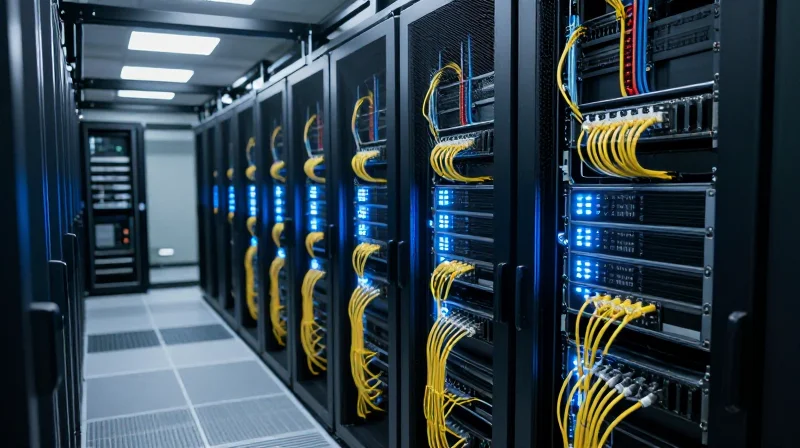
The strategic role of LPO in AI data center fabrics is defined by its ability to eliminate the power-hungry and latency-inducing Digital Signal Processor (DSP) from the optical path. In high-performance compute clusters, where distributed training workloads require constant synchronization between thousands of GPUs, the nanosecond-level savings provided by linear drive architectures directly translate into improved training efficiency and reduced tail latency across the fabric.
LPO in InfiniBand and Ethernet AI Backends
AI workloads typically utilize two distinct network fabrics: the front-end (standard Ethernet for management) and the back-end (high-speed InfiniBand or specialized Ethernet for GPU communication). LPO is uniquely suited for the back-end fabric, where short-reach (SR) and medium-reach (DR/FR) connections dominate. By removing the DSP, LPO modules can reduce the power consumption of an 800G link by up to 50%, which is vital for high-density racks where thermal headroom is increasingly consumed by the GPUs themselves.
| Feature | Traditional 800G DSP-based | 800G LPO (Linear Drive) |
|---|---|---|
| Latency | ~100ns+ (DSP processing) | <1ns (Direct drive) |
| Power (per module) | 16W - 20W | 8W - 12W |
| Heat Dissipation | Significant; requires aggressive cooling | Minimal; improves rack density |
| Cost Structure | High (expensive DSP chips) | Lower (simplified BOM) |
Enabling Scale for Hyperscale GPU Clusters
For hyperscalers deploying clusters with over 100,000 GPUs, such as those utilizing NVIDIA H100 or Blackwell architectures, the cumulative power savings of LPO are transformative. When thousands of 800G transceivers are replaced with LPO modules, the data center operator can save megawatts of power, which can then be reallocated to additional compute nodes. Furthermore, the reduced complexity of LPO modules inherently improves the Mean Time Between Failures (MTBF), as there are fewer active silicon components to fail under the high thermal stress of AI workloads.
AI Fabric Deployment FAQ
- Why is LPO preferred over CPO for current AI builds?
LPO maintains the pluggable form factor, allowing for field serviceability and modular upgrades, whereas Co-Packaged Optics (CPO) requires replacing the entire switch-optical assembly if a single lane fails. - Does LPO require specific switch hardware?
Yes, LPO relies on the host switch SerDes to perform signal equalization. Modern 51.2T and 102.4T switch ASICs are increasingly designed with 'LPO-friendly' modes to ensure signal integrity. - What is the typical reach of LPO in an AI cluster?
LPO is most effective for reaches up to 500 meters (DR4/DR8), covering the majority of intra-rack and intra-row connections in a standard spine-leaf AI architecture.
Future Outlook: The Roadmap to 1.6T and Beyond
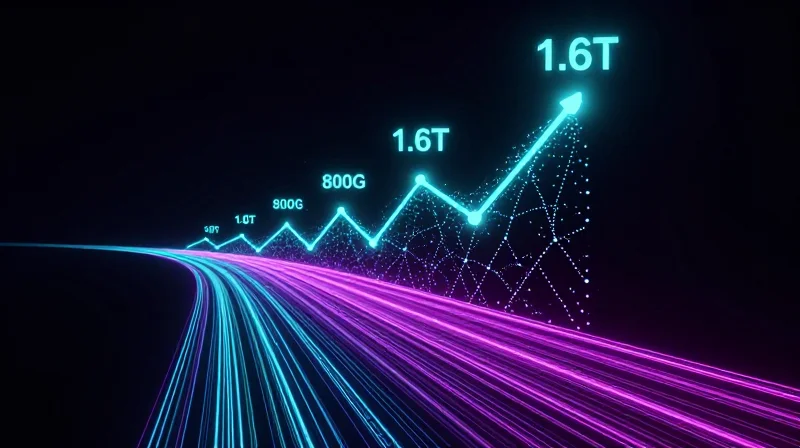
Scaling LPO to 1.6T and Next-Generation Throughput
The roadmap for Linear Drive Pluggable Optics (LPO) is inextricably linked to the industry's shift toward 1.6T networking, which represents the next major performance tier for hyperscale data centers. While 800G LPO is currently being qualified for initial deployments, the architectural advantages of removing the DSP—specifically the reduction in latency and power—become even more significant as per-lane speeds transition from 112G to 224G. The trajectory toward 1.6T will require LPO modules to leverage 8 lanes of 224G SerDes, necessitating even tighter integration between the switch ASIC and the optical engine to manage signal integrity without internal retiming.
Technical Evolution: 800G vs. 1.6T LPO
| Feature | 800G LPO | 1.6T LPO (Targeted) |
|---|---|---|
| Lane Speed | 112G PAM4 | 224G PAM4 |
| Form Factor | OSFP / QSFP-DD800 | OSFP1600 / QSFP224 |
| Power Consumption | ~8W - 10W | ~12W - 14W |
| Host Interface | 8x112G SerDes | 8x224G SerDes |
| Typical Latency | <1ns (Module) | <1ns (Module) |
The move to 1.6T will likely introduce 'Linear Receive' or 'Half-Retimed' variants as intermediate steps if pure LPO faces signal integrity hurdles at 224G. However, the industry consensus within the OIF (Optical Internetworking Forum) and IEEE 802.3dj project is that a robust ecosystem for 224G linear interfaces is essential. As switch ASICs like Broadcom's Tomahawk 5 and its successors provide more advanced equalization capabilities, the burden on the optical module decreases, clearing the path for 1.6T LPO to become the dominant interconnect for short-reach AI backends.
Future Outlook FAQ
- Will LPO replace CPO in the 1.6T era?
LPO is currently preferred by hyperscalers due to its maintainability and pluggable nature. While Co-Packaged Optics (CPO) offers potential power savings, LPO provides a lower-risk path to 1.6T by utilizing existing manufacturing and replacement workflows. - What is the role of 224G SerDes in the LPO roadmap?
224G SerDes is the enabling technology for 1.6T. It allows for higher density and throughput, but it also demands superior signal integrity from LPO components since the margin for error is significantly reduced compared to 112G. - How will LPO standardization evolve?
Future standards will focus on multi-vendor interoperability and defining strict 'Linear' interface specifications. This ensures that a switch from one vendor can reliably drive an LPO module from another without custom tuning.
800G LPO technology is more than just a marginal improvement; it is a fundamental shift toward sustainable, low-latency networking required for the AI revolution. By reducing power consumption and complexity, LPO offers a clear path for hyperscalers to scale their infrastructure efficiently. Explore our range of high-performance optical solutions or consult with our technical team to see how 800G LPO can transform your network architecture.