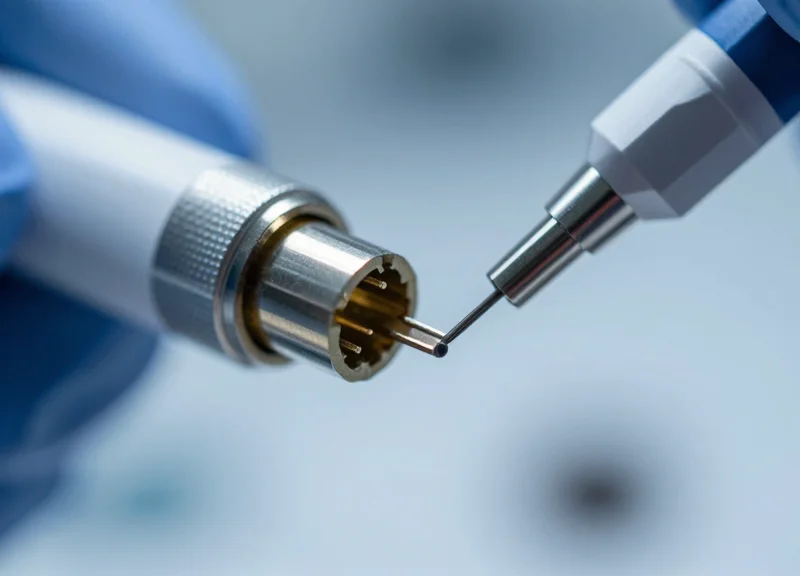
In the era of 400G and 800G networking, the smallest speck of dust can lead to catastrophic signal failure. Understanding the technical nuances of Fiber Connector Cleaning for MPO and LC interfaces is no longer optional—it is a foundational requirement for network reliability and performance longevity.
The Physics of Contamination in High-Speed Optics
The Physics of Contamination in High-Speed Optics
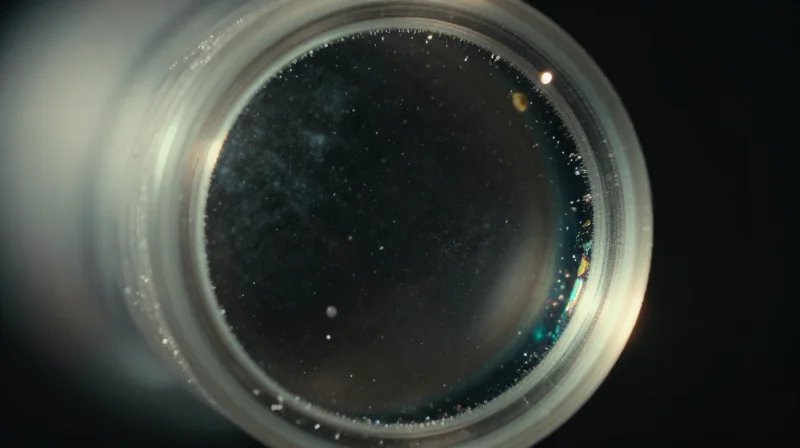
At the microscopic level, fiber optic transmission relies on perfect physical contact between two glass cores. Contamination is the primary disruptor of this interface, acting as a physical barrier that prevents the precise alignment required for light to pass through without interference. For single-mode fibers with a core diameter of only 9 microns, a single particle of dust—often invisible to the naked eye—can block a significant percentage of the signal or create a catastrophic air gap that triggers Fresnel reflection.
The Mechanics of Signal Degradation
When connectors like LC or MPO are mated, they are engineered to achieve Physical Contact (PC) or Angled Physical Contact (APC). In an ideal state, the glass-to-glass interface eliminates the air-to-glass transition. However, when a contaminant is trapped between ferrules, it prevents the surfaces from seating correctly. This gap causes light to hit a change in the refractive index (from glass to air), leading to two specific optical failures: Insertion Loss (IL) and Return Loss (RL).
| Failure Type | Technical Mechanism | Impact on High-Speed Networks |
|---|---|---|
| Insertion Loss (IL) | Absorption or scattering of light by opaque or translucent particles. | Reduced link budget and signal-to-noise ratio, leading to bit errors. |
| Back Reflection (RL) | Light reflecting back to the source due to refractive index mismatch in air gaps. | Instability in laser diodes and increased noise in high-frequency PAM4 signaling. |
| Surface Pitting | Compression of hard particles into the glass end-face during mating. | Permanent hardware damage requiring expensive replacement of the connector. |
Specific Vulnerabilities: MPO vs. LC Interfaces
While LC connectors focus on a single ceramic ferrule, MPO connectors utilize a larger, rectangular thermoplastic ferrule housing 12 to 32 fibers. This larger surface area increases the statistical probability of contamination. Furthermore, the spring tension in an MPO connector is significantly higher; a single particle trapped on one side of the ferrule can cause the entire interface to tilt, resulting in varying levels of insertion loss across multiple fiber channels simultaneously.
- Why can't I just blow on the connector to clean it?
Human breath contains oils and moisture that leave a film on the fiber end-face, which is far more detrimental than dry dust, as it creates a sticky surface for more debris to accumulate. - Does the 'Angle' in APC connectors prevent contamination issues?
No. While the 8-degree angle helps redirect back-reflected light into the cladding, particles still create air gaps that increase insertion loss and can physically damage the precision-polished surface. - How much pressure is applied during connector mating?
Standard connectors can exert upwards of 15,000 PSI at the point of contact. This pressure is high enough to crush a dust particle into the glass, causing permanent scratches or pits.
LC Connector Specifications: Precision for Single-Fiber Links
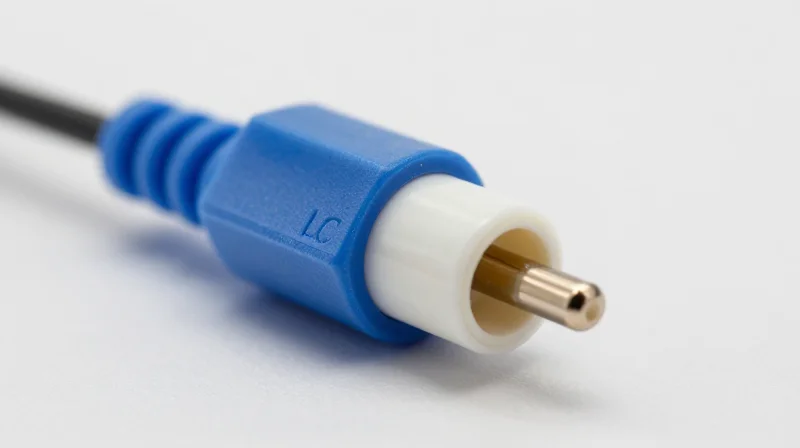
The Lucent Connector (LC) is defined by its 1.25mm ceramic ferrule, a Small Form Factor (SFF) design that provides double the port density of legacy 2.5mm connectors like the SC or ST. While this miniaturization is essential for modern high-speed data centers and SFP+ modules, the reduced surface area means that microscopic contaminants occupy a much larger percentage of the optical path, making precision cleaning a non-negotiable requirement for link integrity.
The 1.25mm Ferrule: Engineering and Tolerance
The precision of an LC connector relies on the physical contact of two zirconia ferrules centered within a mating sleeve. Because the light-carrying core of a single-mode fiber is only about 9 microns in diameter, even a 5-micron dust particle can prevent the two ferrules from making 'Physical Contact' (PC). In an LC interface, the spring-loaded force is concentrated over a smaller area compared to larger connectors, meaning that trapped debris can be crushed into the ceramic surface, potentially causing permanent pits or scratches.
| Specification | LC (Small Form Factor) | SC (Standard Factor) |
|---|---|---|
| Ferrule Diameter | 1.25 mm | 2.50 mm |
| Alignment Tolerance | Sub-micron | Standard |
| Contamination Impact | High (Reduced Surface Area) | Moderate |
| Typical Application | High-density SFP/QSFP | Legacy LAN/FTTH |
The Risk of Skin Contact and Oil Contamination
One of the most significant challenges with LC connectors is their susceptibility to human error. Due to their small size, technicians often inadvertently touch the ferrule tip during the plugging process. Human skin oils are complex mixtures of lipids and salts that exhibit a high refractive index. When oil is present on an LC end-face, it disrupts the signal in two ways: it creates a barrier that prevents physical glass-to-glass contact, and it acts as a 'liquid lens' that refracts the light, causing significant insertion loss and back reflection.
LC Specific Maintenance Challenges
- Why is 'Dry' cleaning sometimes insufficient for LC connectors?
On a 1.25mm surface, friction from dry wipes can generate a static charge that pulls dust back onto the tip. Oil-based fingerprints also require a solvent to break the chemical bond with the zirconia ferrule. - Does the LC housing affect cleaning efficiency?
Yes, the plastic housing surrounding the ferrule can trap loose debris. Effective cleaning must ensure the tool reaches the recessed ferrule without dragging edge-borne contaminants across the center core. - How does contamination affect 10G/40G/100G LC links?
Higher bit rates use more sensitive modulation schemes. A contaminated LC connector that might have passed for 1G Ethernet will likely trigger high Bit Error Rates (BER) or total link failure at 100G speeds.
MPO/MTP Technical Challenges: Multi-Fiber Alignment
MPO/MTP Technical Challenges: Multi-Fiber Alignment
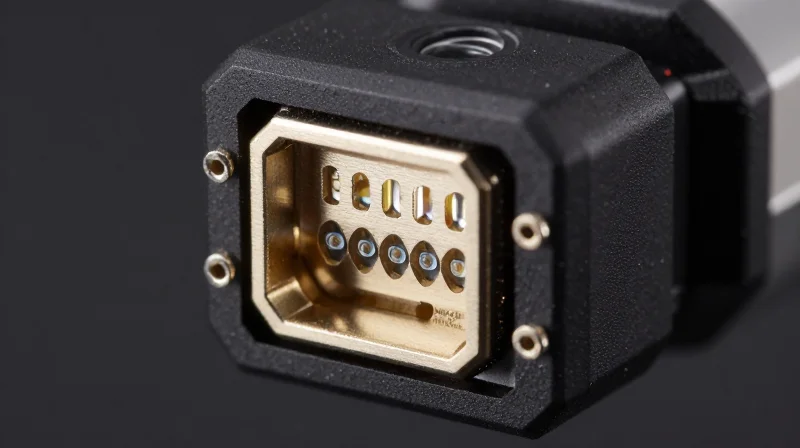
Cleaning MPO/MTP connectors is inherently more complex than single-fiber interfaces because the Mechanical Transfer (MT) ferrule must maintain simultaneous physical contact across a wide rectangular array of 12 to 72 fibers. Unlike the circular 1.25mm LC ferrule, the MPO interface features a significantly larger surface area that acts as a reservoir for contaminants. The presence of high-precision stainless steel alignment pins on 'male' connectors further complicates the process, creating physical barriers that prevent standard cleaning materials from reaching the entire fiber array, often leading to cross-contamination between fibers during the mating process.
The MT Ferrule: Surface Area and Electrostatic Attraction
The MT ferrule is typically composed of a glass-filled thermoplastic. This material, while durable, is highly susceptible to static electricity. When a technician removes the dust cap, the friction can generate a static charge that actively pulls airborne particulates toward the fiber end-face. Because the MPO has a larger surface area than an LC connector, there is more 'real estate' for dust to settle. Contaminants located far from the actual fiber cores are still dangerous; the pressure of mating (approximately 10 to 20 Newtons) can cause oils and debris to migrate across the ferrule surface, eventually landing on a fiber core and causing a link failure.
The Pin Challenge: Obstructions in the Cleaning Path
MPO connectors utilize a 'pinned' and 'unpinned' (male and female) system to ensure fiber alignment. For pinned connectors, the two stainless steel pins protruding from the ferrule create 'dead zones.' Traditional cleaning tapes or cloths often fail to reach the area immediately surrounding the base of these pins. Debris trapped at the base of a pin can prevent the connectors from fully seating, resulting in an air gap. Even a gap of a few microns across the multi-fiber array can lead to massive increase in back reflection (ORL) and insertion loss (IL) across all channels.
| Feature | LC Connector (Single-Fiber) | MPO/MTP (Multi-Fiber) |
|---|---|---|
| Ferrule Material | Zirconia Ceramic | Glass-filled Thermoplastic |
| Alignment Mechanism | Ceramic Split Sleeve | Precision Stainless Steel Pins |
| Surface Area | Small (1.25mm Diameter) | Large (~2.5mm x 6.4mm) |
| Cleaning Complexity | Low (Centric Rotation) | High (Linear/Rectangular Sweep) |
| Contamination Risk | Single-point failure | Cross-fiber migration/Array-wide gap |
Frequently Asked Questions: MPO Cleaning Dynamics
- Can I use the same cleaning fluid for LC and MPO connectors?
While the chemical solvent may be the same (typically high-purity IPA or specialized HFE-based cleaners), the application method differs. MPO cleaning requires more fluid to neutralize static across the larger surface area, but excess fluid must be strictly avoided to prevent 'pooling' around the alignment pins. - Why is 'dry cleaning' often insufficient for MPO connectors?
Dry cleaning can increase the static charge on the plastic MT ferrule, causing it to attract more dust immediately after cleaning. A 'wet-to-dry' cleaning motion is technically superior for MPO to dissipate static and break down stubborn skin oils that accumulate over the larger surface. - Do female (unpinned) MPO connectors require different tools?
The tools are generally the same, but the cleaning tip for an unpinned connector is flat. When cleaning pinned connectors, the tool must have specific recesses or 'windows' to accommodate the pins while ensuring the cleaning ribbon makes contact with the fibers between them.
IEC 61300-3-35: The Gold Standard for End-Face Quality
The IEC 61300-3-35 Standard: Quantitative Cleanliness
IEC 61300-3-35 is the foundational international standard that transforms fiber inspection from a subjective 'look and see' process into a repeatable, automated science. It provides specific, quantifiable thresholds for the size and quantity of scratches and defects allowed on a fiber end-face. By utilizing automated inspection software calibrated to this standard, technicians can ensure that every connection—whether an LC duplex or a high-density MPO—meets the precise requirements for low insertion loss and high return loss, preventing network downtime caused by contaminated interfaces.
The Four-Zone Inspection Model
To determine if a connector is fit for service, the standard divides the fiber end-face into four concentric circles known as zones. The requirements become increasingly stringent as you move from the outer edge of the ferrule toward the center of the fiber core, where the light signal actually travels.
| Zone Identification | Region Name | Diameter (Single-mode) | Pass/Fail Criteria Logic |
|---|---|---|---|
| Zone A | Core | 0 to 25 µm | Most critical; typically zero scratches or defects of any size allowed. |
| Zone B | Cladding | 25 to 120 µm | No large defects; limited small scratches that do not impact light refraction. |
| Zone C | Adhesive | 120 to 130 µm | The epoxy ring; defects are acceptable unless they risk migrating to the core. |
| Zone D | Contact | 130 to 250 µm | The physical contact area; must be free of large debris that could cause air gaps. |
MPO-Specific Application of the Standard
For MPO/MTP connectors, IEC 61300-3-35 introduces additional complexity because the 'Contact' zone (Zone D) covers a much larger surface area across the multi-fiber MT ferrule. Unlike an LC connector where a single fiber is centered, an MPO inspection must validate every fiber in the array against these zones simultaneously. A single failing fiber core (Zone A) or a large piece of debris in the contact area between fibers can result in a 'Fail' for the entire connector assembly, highlighting why precision cleaning is non-negotiable for parallel optics.
- What is the difference between a 'scratch' and a 'defect'?
A scratch is a permanent, linear permanent mark on the glass, usually from improper handling. A defect is a non-linear feature, such as a pit, chip, or a piece of loose contamination like dust or oil. - Can a connector pass if Zone D is dirty?
Usually no. While Zone D (Contact) is the least sensitive for light transmission, large particles here can prevent the two ferrules from making 'Physical Contact,' which creates an air gap and leads to massive signal reflection. - Does the standard apply to both SMF and MMF?
Yes, but the zone diameters change. For example, the Core zone (Zone A) for Multi-mode fiber is significantly larger (up to 65 µm) compared to Single-mode (25 µm) to account for the larger core size.
Dry vs. Wet-to-Dry Cleaning Methodologies
Dry vs. Wet-to-Dry Cleaning Methodologies
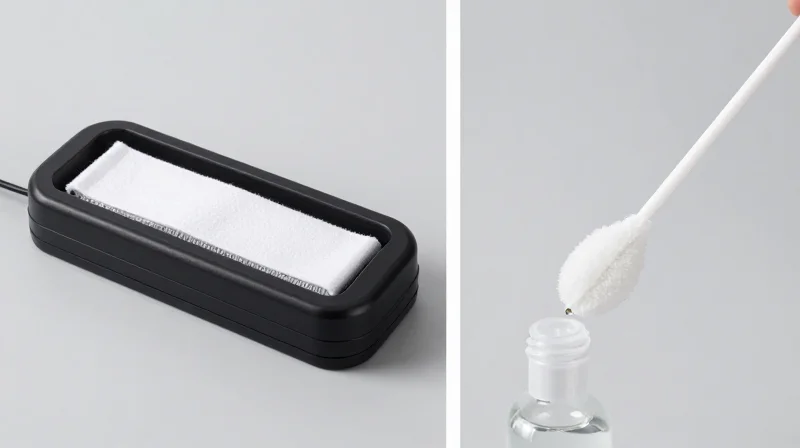
The choice between dry and wet-to-dry cleaning is dictated by the nature of the contaminant and the environmental conditions of the fiber installation. While dry cleaning is often the first line of defense for loose debris, wet-to-dry cleaning is the superior technical approach for breaking the molecular bond of stubborn oils and neutralizing electrostatic charges that attract airborne particles back to the ferrule.
Dry Cleaning: Efficiency and its Limitations
Dry cleaning typically involves the use of specialized 'one-click' mechanical cleaners or lint-free wipes. These tools utilize a dry, lint-free thread or tape that is advanced over the connector end-face. While highly effective for removing light dust and simple debris in controlled environments, dry cleaning can occasionally lead to the buildup of a static charge on the ferrule. This Triboelectric effect can actually attract more dust post-cleaning. Furthermore, dry cleaning is often insufficient for removing 'baked-on' contaminants, such as machining oils or salt spray, which require a chemical solvent to emulsify the residue.
Wet-to-Dry: The Gold Standard for Resilience
The wet-to-dry methodology involves applying a small amount of specialized, fast-evaporating cleaning fluid to a wipe or the tip of a cleaning tool, followed immediately by a dry wipe. The solvent acts as a surfactant, lifting oils and salts into suspension so they can be physically wiped away. This method is particularly critical for MPO connectors, where the larger surface area and the presence of alignment pins make it easier for contaminants to hide. Using an engineered solvent instead of standard IPA is recommended, as high-purity engineered fluids evaporate faster and do not leave the 'halo' residue often associated with lower-grade alcohols.
| Feature | Dry Cleaning (One-Click) | Wet-to-Dry Method |
|---|---|---|
| Best Use Case | Routine maintenance, light dust | Initial installs, heavy oils, salts |
| Static Management | May increase static charge | Neutralizes electrostatic surface charges |
| Removal Efficacy | Low for skin oils/machining fluids | High for all contaminant types |
| Complexity | Very Low (One-step) | Moderate (Requires solvent + tool) |
| Risk Profile | Can smear oils across the core | Risk of over-saturation if not careful |
Methodology FAQ
- Can I use 99% Isopropyl Alcohol (IPA) for wet cleaning?
While 99% IPA is common, it is hygroscopic, meaning it absorbs moisture from the air which can leave mineral residues. Engineered fiber optic cleaning fluids are preferred because they are faster-evaporating and leave zero residue. - Why is dry cleaning alone often discouraged for MPO connectors?
MPO connectors have a large surface area (the MT ferrule). Dry cleaning can create a significant static charge across this area, and without a solvent, oils trapped near the alignment pins are often just smeared rather than removed. - What is 'over-saturation' in wet-to-dry cleaning?
Over-saturation occurs when too much fluid is used, causing the solvent to seep into the connector housing or remain on the end-face. The 'dry' part of the wet-to-dry cycle is essential to prevent these liquid spots from appearing as defects during inspection.
Advanced Cleaning Tools: Pens, Cassettes, and Swabs
The Engineering of Precision Cleaning Instruments
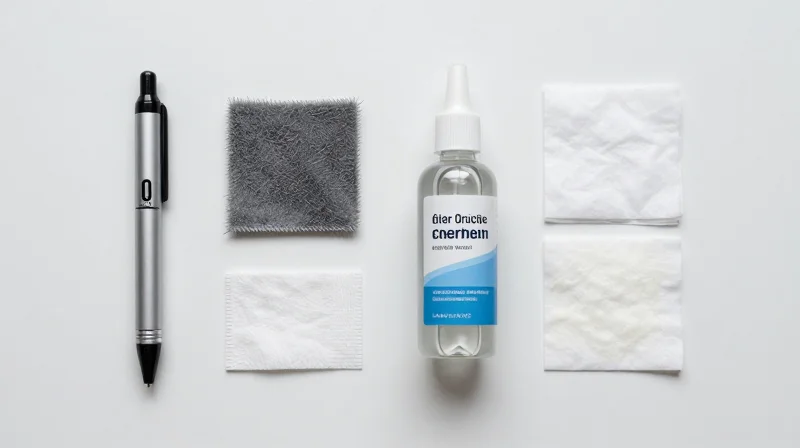
Maintaining signal integrity in high-density fiber environments requires a diverse toolkit of cleaning instruments, each engineered to address specific mechanical constraints of LC and MPO connectors. These tools move beyond simple physical debris removal, utilizing advanced materials science to mitigate the triboelectric effect—the static charge generated by friction—which otherwise attracts airborne particulates back to the end-face immediately after cleaning.
One-Click Cleaning Pens: The Industry Workhorse
Mechanical 'one-click' cleaners are designed for both patch cords and bulkhead adapters. When the user pushes the tool forward, a precision-controlled mechanism rotates the cleaning ribbon while simultaneously advancing it. This dual action ensures that fresh, lint-free cloth is always in contact with the ferrule. For LC connectors, these pens use a 1.25mm tip, while MPO versions feature a wider cleaning head designed to cover the entire MT ferrule surface, often including features to clean around alignment pins.
Cassette Cleaners for Patch Cord Maintenance
Cassette-style cleaners are the primary choice for cleaning male connectors (patch cords) prior to mating. These handheld devices house a continuous spool of ultra-fine, anti-static micro-woven ribbon. Unlike pens, cassettes provide a flat, stable surface that allows the technician to apply consistent pressure across the ferrule. This is particularly critical for MPO connectors, where the large surface area of the MT ferrule must be cleaned uniformly to avoid leaving 'halos' of oil or dust near the outer fiber rows.
Specialized Swabs for Targeted Decontamination
Micro-swabs are essential for 'wet-to-dry' cleaning protocols and for reaching areas that mechanical pens cannot access, such as the internal housing of a bulkhead adapter or the sides of a ferrule. These are not standard cotton swabs; they are constructed from medical-grade polyester or poly-wrapped foam to prevent fiber shedding. When used with a specialized solvent like HFE-7100, they can dissolve stubborn resins and salts that dry-cleaning methods leave behind.
| Tool Type | Primary Application | Mechanism | Best Used For |
|---|---|---|---|
| One-Click Pen | Bulkhead & Patch Cords | Automatic rotation/advance | High-speed, repetitive field use |
| Cassette | Patch Cords (Male) | Manual swipe on ribbon | Bench-top or lab environments |
| Micro-Swab | Adapters & Stubborn Contamination | Manual precision contact | Deep cleaning with solvents |
Anti-Static Ribbons and Material Science
The efficacy of advanced cleaning tools relies heavily on the 'dry-cloth' material. Modern cleaning ribbons are engineered with synthetic fibers that possess a high density of microscopic 'pockets' to trap and lock away debris. Furthermore, these materials are treated to be anti-static. In the dry environment of a data center, the act of rubbing a dry cloth against a ceramic or plastic ferrule creates a static charge. Advanced tools dissipate this charge, preventing the connector from becoming a 'dust magnet' immediately after the cleaning cycle is complete.
Frequently Asked Questions
- Can I reuse a cleaning pen until the ribbon runs out?
Yes, cleaning pens are designed for a specific number of clicks (usually 500-800). Once the ribbon is exhausted, the tool should be discarded as the internal take-up spool contains the contaminated material. - Why can't I use standard isopropyl alcohol (IPA) with swabs?
Standard IPA often contains water and impurities that leave a residue upon evaporation. Specialized fiber optic solvents are fast-evaporating and leave zero residue, ensuring the end-face remains pristine. - Is MPO cleaning different for pinned vs. unpinned connectors?
Yes. Tools for pinned (male) MPO connectors must have a cleaning head that can navigate around the alignment pins to reach the fiber surface, whereas unpinned (female) tools utilize a flat interface.
The 'Inspect Before You Connect' Workflow
The Standard Operating Procedure for Fiber Hygiene
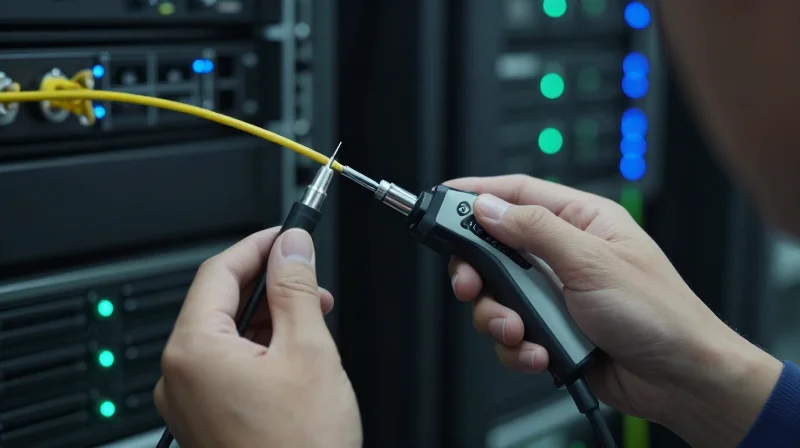
The 'Inspect Before You Connect' (IBYC) workflow is a rigorous, four-step proactive maintenance protocol that mandates the visual inspection of every fiber end-face with a digital microscope prior to mating. This approach shifts fiber maintenance from a reactive troubleshooting task to a preventive engineering standard, ensuring that contaminants are identified and removed before they can cause permanent physical damage or signal degradation. By adhering to IEC 61300-3-35 standards during this process, technicians can guarantee that both the LC/MPO connectors and the internal transceiver optics remain pristine throughout the equipment's lifecycle.
The Four-Step Cyclic Process
- Step 1: Inspect
Use a digital fiber scope to examine the connector end-face. If the connector is clean according to IEC standards, proceed directly to connection. If dirty, proceed to cleaning. - Step 2: Clean
Utilize appropriate cleaning tools (such as MPO click-cleaners or lint-free wipes) to remove debris. Never clean a connector without inspecting it first, as dry cleaning a clean connector can actually introduce static and attract new dust. - Step 3: Re-Inspect
Always verify the effectiveness of the cleaning cycle. If the end-face remains contaminated, repeat the cleaning step using a wet-to-dry method if necessary. Never mate a connector that has failed inspection. - Step 4: Connect
Only once the end-face is verified as 'Pass' should the connection be made. This ensures that no contaminants are transferred into the transceiver port or the opposing connector.
Preventing Cross-Contamination Hazards
The greatest risk in fiber networking is the mating of a 'clean' patch cord into a 'dirty' bulkhead or transceiver port. When two connectors mate, they do so under high physical pressure (approximately 15,000 psi for LC connectors). This pressure crushes particles into the glass, creating pits or scratches that are irreversible. Furthermore, contaminants can migrate from a dirty transceiver ferrule to a clean patch cord, essentially 'infecting' every subsequent port that cord is plugged into.
| Scenario | Immediate Impact | Long-term Consequence |
|---|---|---|
| Mating Clean to Clean | Optimal Insertion Loss/Return Loss | Component longevity and high uptime. |
| Mating Dirty to Clean | Signal attenuation; debris transfer | Permanent end-face pitting; port failure. |
| Mating Dirty to Dirty | High bit error rates (BER); link failure | Immediate hardware replacement required. |
Workflow FAQ
- Should I inspect a brand new patch cord out of the bag?
Yes. Factory-sealed cables are not guaranteed to be clean. Plastic outgassing from the packaging or dust from the manufacturing floor often settles on the end-face during transit. - How many cleaning attempts are acceptable?
If a connector does not pass inspection after 3 to 5 cleaning attempts, the debris may be permanently embedded or the glass may be scratched. At this point, the cable should be decommissioned. - Is 'blind cleaning' (cleaning without a scope) acceptable?
No. Blind cleaning can move debris into the critical core zone or cause static-induced re-contamination, making the problem worse without the technician's knowledge.
Operational Impact: Calculating the ROI of Fiber Hygiene
Calculating the return on investment (ROI) for fiber connector cleaning shifts the perspective from a nominal material expense to a critical risk-management strategy. By implementing a standardized 'Inspect Before You Connect' workflow, organizations can eliminate up to 85% of fiber-related network failures. The financial impact is twofold: it prevents the immediate 'soft failures'—such as bit error rate (BER) spikes and intermittent signal loss—and halts the permanent physical degradation of expensive optical transceivers and patch panels.
Quantifying the Cost: Cleaning vs. Failure
| Expense Category | Preventive Cleaning Protocol | Reactive Failure Response |
|---|---|---|
| Direct Material Cost | $0.05 - $0.75 (per connector) | $1,000+ (replacement optics) |
| Labor Requirement | 1-2 Minutes (technician) | 4-8 Hours (troubleshooting/dispatch) |
| Operational Impact | Zero downtime | SLA penalties and service outages |
| Equipment Longevity | Optimized for 20+ year lifespan | Risk of permanent ferrule pitting |
The 'Laser Burn' and Permanent Damage Factor
One of the most overlooked aspects of the ROI calculation is the prevention of 'laser burn.' When a contaminated MPO or LC connector is energized, the high-intensity light (especially in 100G+ networks) can cause organic contaminants to combust. This localized heat creates microscopic pits or 'craters' in the glass ferrule. Unlike loose dust, these pits cannot be cleaned and require the total replacement of the cable or the transceiver module. A $60 cleaning tool is a minor investment compared to the $1,500 replacement cost of a high-speed QSFP28 transceiver.
Operational Efficiency and FAQ
- How does cleaning affect OpEx in high-density data centers?
In high-density environments, cleaning reduces 're-work.' Technicians who clean every connection spend less time re-opening racks to fix link-down errors, directly lowering the man-hours required for deployment. - Is the ROI higher for MPO compared to LC connectors?
Yes. Because MPO connectors support multiple fibers (12-24) in a single interface, one speck of dust can take down an entire trunk, making the cleaning of multi-fiber arrays significantly more cost-effective per link. - Can automated inspection tools improve ROI?
Absolutely. Digital inspection probes with pass/fail analysis remove human error, ensuring that cleaning is only done when necessary and that it was 100% effective, preventing repeat site visits.
Ultimately, fiber hygiene is an insurance policy for the physical layer. The cost of maintaining a clean environment is measured in cents per port, while the cost of failure is measured in thousands of dollars per minute of downtime. For any mission-critical network, the decision to invest in professional-grade cleaning supplies is a fundamental requirement for sustainable operational excellence.
Ensuring the cleanliness of MPO and LC connectors is the most effective way to guarantee the integrity of your high-speed optical infrastructure. By adhering to IEC standards and utilizing professional-grade tools, you can eliminate the primary cause of fiber network failure. Upgrade your maintenance protocol today to secure your network's future—explore our range of high-precision cleaning solutions.