As the AI revolution accelerates, the demand for specialized data center infrastructure has shifted from a luxury to a critical operational requirement. For enterprises and cloud service providers, the challenge lies in scaling high-performance networks without overextending budgets. This article explores the economic and technical benefits of wholesale procurement and custom hardware solutions, providing a roadmap to building a resilient, AI-ready data center through strategic partnerships.
The Evolution of AI-Driven Data Center Demands

The Shift from General Purpose to AI-Optimized Infrastructure
The rapid adoption of Large Language Models (LLMs) and generative AI has rendered traditional data center designs obsolete, as these workloads move the bottleneck from individual CPU performance to the interconnect fabric between thousands of GPUs. Unlike standard cloud computing, AI training requires massive, synchronized data exchanges across clusters, necessitating a transition from non-blocking Clos networks to specialized, high-radix fabrics like InfiniBand or RoCEv2 (RDMA over Converged Ethernet) to maintain efficiency and minimize 'tail latency.' To maximize the ROI of expensive H100 or B200 deployments, the infrastructure must ensure that GPUs are never 'starved' for data.
Comparing Legacy vs. AI-Centric Architectures
| Feature | Traditional Data Center | AI-Driven Data Center |
|---|---|---|
| Primary Workload | Web serving, databases, general apps | LLM training, deep learning inference |
| Interconnect Technology | Standard 10/40/100G Ethernet | 400/800G InfiniBand or RoCEv2 |
| Latency Tolerance | Millisecond range (Elastic) | Microsecond range (Deterministic) |
| Traffic Pattern | North-South (Client-Server) | East-West (Inter-node mesh) |
| Power Density | 5-15 kW per rack | 40-100+ kW per rack (Liquid Cooled) |
The Critical Need for High-Bandwidth Interconnects
In the context of wholesale procurement for 2026, the focus has shifted toward high-radix switches and optical interconnects. Modern AI clusters demand a non-blocking architecture where every node can communicate with every other node at full wire speed. This is essential for 'All-Reduce' operations common in distributed training, where gradients are synchronized across GPUs. When sourcing architecture wholesale, operators must prioritize 800G transceivers and active optical cables (AOCs) to support the massive throughput required for trillion-parameter models. Failure to provide sufficient bandwidth results in massive inefficiencies, where the hardware remains idle, significantly driving up the cost of compute time.
Frequently Asked Questions: AI Infrastructure Demands
- Why is latency more critical for AI than standard cloud applications?
AI training involves millions of tiny, synchronized communication steps; even a few microseconds of jitter can cause thousands of GPUs to stall, wasting compute cycles and extending training times by weeks. - What is the role of wholesale pricing in AI architecture?
Bulk procurement of high-density networking gear and liquid-cooled racks allows operators to scale to 10,000+ GPU clusters while managing the high capital intensity required for 800G transitions and specialized power delivery. - How does GenAI change power and cooling requirements?
Generative AI clusters require dense power delivery and often liquid-to-chip cooling solutions to handle the 700W+ TDP of modern GPUs, which far exceeds the thermal limits of traditional air-cooled wholesale facilities.
Economic Advantages of Wholesale AI Hardware Procurement
Wholesale procurement of AI data center architecture provides a decisive competitive advantage by reducing the Total Cost of Ownership (TCO) through aggressive volume-based pricing, consolidated logistics, and customized configuration services that are unavailable at the retail level. In the current 2026 market, where AI hardware supply chains remain constrained, bulk purchasing agreements serve as both a cost-saving measure and a strategic hedge against price volatility, ensuring that scaling enterprises can maintain predictable budget cycles while securing the compute power necessary for advanced model training.
Tiered Pricing and Capital Efficiency
The primary economic driver for wholesale acquisition is the dramatic reduction in per-unit costs. When organizations move beyond individual server purchases to full rack or multi-cluster configurations, vendors unlock custom pricing tiers that bypass standard MSRP. These savings are compounded by the reduction in secondary costs, such as individual component packaging and fragmented shipping fees, which can account for up to 5-10% of a total project budget.
| Economic Metric | Retail Procurement | Wholesale Bulk Purchase |
|---|---|---|
| Unit Cost Reduction | 0-5% | 15-30% or more |
| Shipping & Freight | Fragmented per-unit parcels | Consolidated freight (LTL) |
| Integration Efficiency | On-site manual assembly | Factory pre-racked & tested |
| Allocation Priority | Standard Queue | Contractual Reserved Supply |
Logistical Optimization and Time-to-Value
Beyond the hardware bill of materials, wholesale procurement offers substantial savings in logistics and deployment speed. Bulk orders facilitate 'Rack-and-Stack' services, where hardware is integrated, wired, and tested in a factory environment before being shipped as a complete, functional unit. This reduces on-site labor costs and minimizes packaging waste. Furthermore, consolidated shipping for large-scale deployments mitigates the volatility of international freight costs and simplifies the customs process for global data center expansions.
Strategic Procurement FAQs
- How do custom quotes impact overall ROI?
Custom quotes allow for the exclusion of redundant retail components and the optimization of power delivery systems, ensuring you only pay for the performance required for your specific LLM or generative AI workloads. - What is the threshold for wholesale pricing tiers?
While it varies by vendor, wholesale pricing typically triggers at the full-rack level or when committing to a cluster deployment of 8 or more high-density nodes, such as NVIDIA DGX systems. - Does bulk buying reduce deployment time?
Yes, by utilizing factory-integrated shipping, organizations can move from delivery to production in a fraction of the time, often reducing deployment windows from months to weeks.
Customization through OEM/ODM: Beyond Off-the-Shelf Solutions
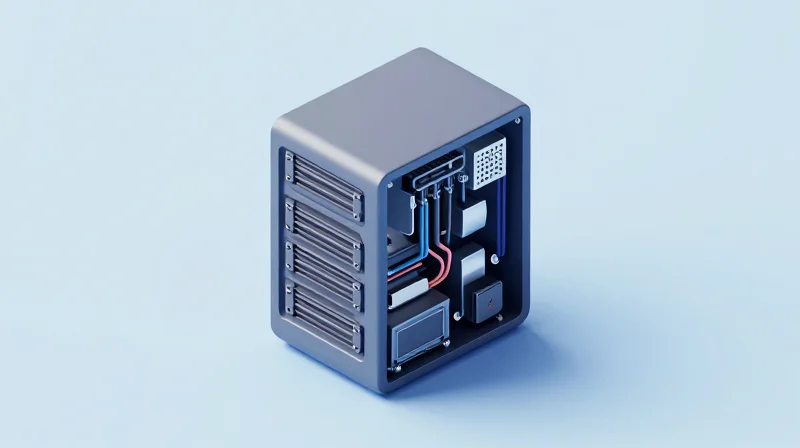
To truly capitalize on the 2026 AI boom, wholesale buyers are leveraging Original Equipment Manufacturing (OEM) and Original Design Manufacturing (ODM) to bypass the limitations of standard, off-the-shelf server configurations. These customization models allow organizations to specify power profiles, thermal management systems, and interconnect topologies that are precisely tuned to their unique AI software stacks, ensuring that hardware resources are never underutilized or mismatched with the demands of Large Language Models (LLMs).
Differentiating OEM and ODM for AI Infrastructure
While both models involve bulk procurement, they serve different strategic needs. OEM typically involves taking a manufacturer's existing reference design and modifying specific components—such as upgrading the RAM, storage, or network interface cards—to meet performance targets. ODM, conversely, involves a collaborative design process where the hardware is built from the ground up to the buyer’s specifications, which is essential for hyperscalers requiring non-standard rack dimensions or proprietary liquid cooling loops.
| Feature | OEM Customization | ODM Customization |
|---|---|---|
| Design Ownership | Manufacturer-owned designs | Customer-defined specifications |
| Interconnect Flex | Choice of standard fabrics | Custom PCB and bus routing |
| Power Delivery | Standard PSU configurations | Custom 48V or DC-to-rack designs |
| Ideal For | Enterprise private AI clouds | Hyperscale Tier 1 providers |
Optimizing for the Software Stack
The primary advantage of customized wholesale hardware is the alignment with the AI software layer. For example, a data center running primarily Mixture-of-Experts (MoE) models requires significantly higher memory bandwidth and faster chip-to-chip communication than a site focused on simple image classification. Through ODM channels, wholesale buyers can demand specific NVLink topologies or PCIe Gen 5 configurations that maximize the throughput of their specific software algorithms, effectively future-proofing their investment against evolving model sizes.
Customization FAQ
- How do OEM/ODM lead times compare to off-the-shelf orders?
Standardized equipment may ship in weeks, whereas custom OEM orders typically take 3-4 months and full ODM designs can take 6-12 months including prototyping and validation. - What are the typical Minimum Order Quantities (MOQs)?
OEM customization is often available for mid-sized orders (e.g., 50+ nodes), while full ODM projects usually require thousands of units to justify the custom engineering costs. - Does customization impact the warranty or support?
Wholesale contracts for custom hardware typically include bespoke Service Level Agreements (SLAs) and spare-part stocking requirements managed directly by the manufacturer.
By moving beyond the 'one-size-fits-all' approach, businesses can achieve a lower Total Cost of Ownership (TCO). Customizing the hardware to the workload eliminates the cost of unnecessary features while doubling down on the performance-critical components necessary for generative AI at scale.
Core Components: High-Speed Transceivers and Interconnects
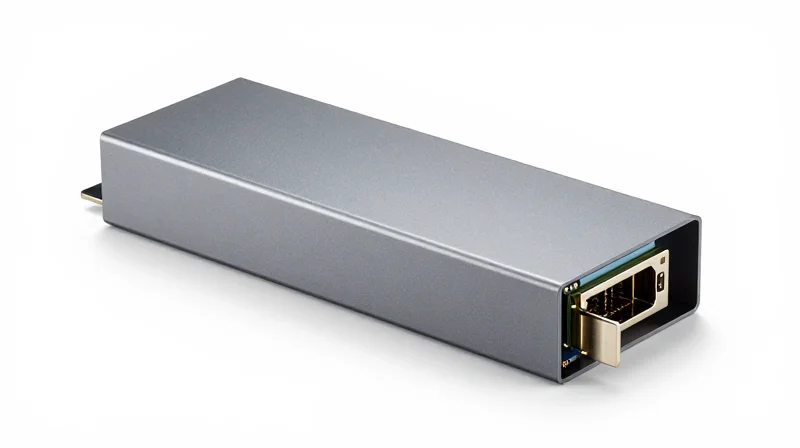
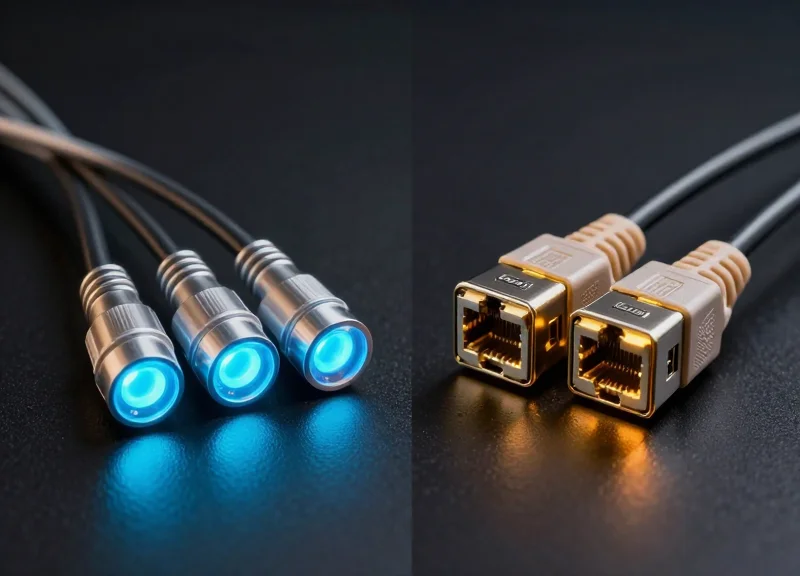
High-speed transceivers and interconnects represent the nervous system of the AI data center, where the move from 400G to 800G connectivity is no longer optional but a prerequisite for handling the massive east-west traffic generated by distributed GPU training. In a wholesale context, the selection of these components dictates the long-term power efficiency and error rates of the entire fabric, making rigorous testing and standardized form factors essential for bulk deployments.
The Evolution to 800G: Meeting the Bandwidth Hunger of LLMs
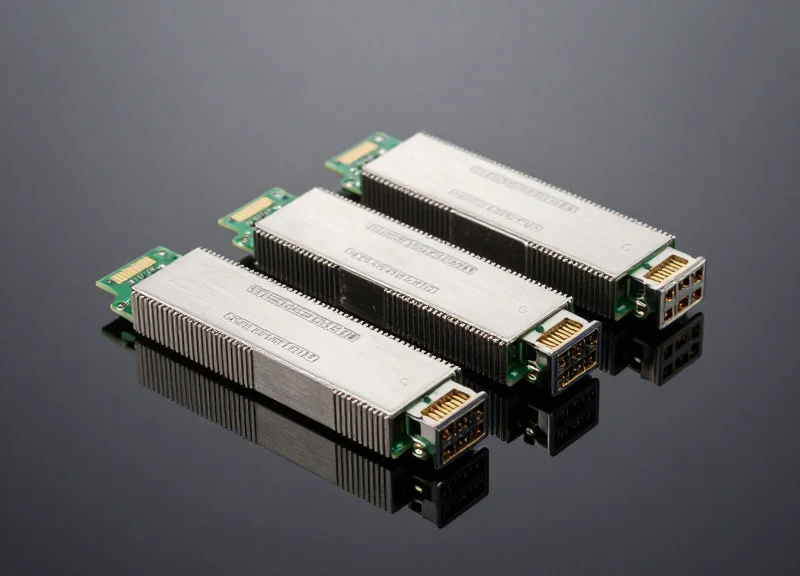
As Large Language Models (LLMs) scale to trillions of parameters, the bottleneck shifts from individual compute nodes to the interconnects between them. To prevent GPU idling—where expensive processors wait for data to arrive—AI architectures are rapidly adopting 800G OSFP and QSFP-DD800 modules. These high-speed interconnects allow for higher radix switches, reducing the number of hops and lower overall latency across the cluster.
| Feature | 400G (QSFP-DD) | 800G (OSFP) | Impact on AI Workload |
|---|---|---|---|
| Max Throughput | 400 Gbps | 800 Gbps | Doubles data transfer rates for faster model synchronization. |
| Typical Power | 10W - 12W | 14W - 18W | Requires advanced thermal management in high-density racks. |
| Standard Interface | 8x50G PAM4 | 8x100G PAM4 | Essential for compatibility with NVIDIA Quantum-2 and Spectrum-4. |
| Latency Profile | Standard | Ultra-Low | Critical for All-Reduce operations in collective communications. |
Wholesale Quality Assurance: The Hidden Cost of Failure
When purchasing AI data center hardware wholesale, the focus often drifts toward the lowest unit price per transceiver. However, in an AI fabric consisting of tens of thousands of links, even a 0.1% failure rate can cause frequent 'link flaps' that interrupt training checkpoints, leading to days of lost progress. High-quality interconnects utilize superior laser drivers and Digital Signal Processors (DSPs) that maintain signal integrity over longer distances and varied temperatures, ensuring that bulk-sourced components do not become a liability.
OSFP vs. QSFP-DD: Choosing the Right Standard for 2026
While both form factors support 800G, the industry is seeing a significant lean toward OSFP (Octal Small Form-factor Pluggable) for AI-specific deployments. OSFP modules are slightly larger and offer better thermal dissipation capabilities, which is vital when switches are fully populated. QSFP-DD remains popular for backwards compatibility in existing enterprise infrastructures, but for greenfield AI builds, OSFP is often the preferred choice for 2026 wholesale quotes due to its path toward 1.6T speeds.
- Why is bulk pricing so different for 800G modules compared to retail?
Wholesale pricing for 800G modules is driven by volume commitments and long-term forecasts. Suppliers can optimize their manufacturing runs and semiconductor allocations (DSPs and lasers) when orders reach the thousands, passing significant savings to the buyer. - How does interconnect quality affect AI training time?
Lower-quality interconnects increase the Bit Error Rate (BER). This forces the network to retransmit packets or drop to lower speeds, which creates synchronization delays during the 'All-Reduce' phase of GPU training, directly extending the time-to-market for AI models. - Are active optical cables (AOCs) better than transceivers for wholesale buyers?
AOCs are often more cost-effective for short-reach connections (under 30 meters) within a single row. However, transceivers paired with structured cabling offer better flexibility and easier maintenance, which many operators prefer despite the slightly higher initial cost.
Strategic Sourcing: Navigating Global Supply Chain Constraints
Strategic Sourcing: Navigating Global Supply Chain Constraints
Navigating the current AI hardware landscape requires a departure from traditional 'just-in-time' procurement toward a proactive, strategic sourcing model. As demand for 400G/800G optics and high-density server components continues to outpace global manufacturing capacity, the primary bottleneck isn't just price—it's availability. Firms that successfully deploy AI at scale do so by securing direct lines to manufacturing and bypassing the multi-tiered distribution layers that often add weeks or months to lead times.
The Ubytelink Advantage: Bypassing Market Volatility
Ubytelink serves as a critical bridge in the global supply chain, offering wholesale clients direct access to Tier-1 production facilities. By maintaining deep inventory positions on critical interconnect components and leveraging established relationships with silicon foundries, Ubytelink minimizes the 'bullwhip effect' where small fluctuations in demand result in massive shortages at the end of the supply chain. This direct-to-source approach ensures that custom quotes aren't just theoretical numbers, but guaranteed allocations.
| Sourcing Metric | Traditional Distribution | Ubytelink Direct Sourcing |
|---|---|---|
| Average Lead Times | 12–24 Weeks (Market Dependent) | 4–8 Weeks (Priority Allocation) |
| Price Stability | Subject to Tiered Markups | Fixed Wholesale & Bulk Rates |
| Visibility | Limited to 'In-Transit' status | Direct Factory Tracking & Forecasting |
| Customization | Standard Off-the-Shelf Only | Full OEM/ODM Specification Control |
Critical Factors for Supply Chain Resilience
To maintain resilience in 2026, data center operators must focus on three core areas: Geographic Diversification of manufacturing, Component Commonality (standardizing on high-volume parts), and Long-Range Forecasting. Ubytelink assists partners by analyzing projected growth and pre-staging inventory in strategic hubs, ensuring that as your GPU clusters expand, the networking fabric to support them is already on-site.
- How do wholesale agreements protect against price hikes?
Wholesale contracts through Ubytelink often include price protection clauses and pre-negotiated rates that shield buyers from the spot-market volatility common in the semiconductor industry. - Why is direct factory access important for 800G deployments?
High-speed optics like 800G OSFP modules involve complex assembly and low yields; direct access ensures you are first in line for the highest-quality bins as they exit production. - What role does Ubytelink play in logistics management?
We handle the entire 'white glove' logistics process, including customs clearance and door-to-data-center delivery, reducing the administrative burden on your procurement team.
Technical Standards and Interoperability in AI Architectures
Technical standards and interoperability are the bedrock of scalable AI infrastructure, ensuring that high-performance components purchased at wholesale prices function reliably across diverse hardware ecosystems. To avoid vendor lock-in and performance bottlenecks, large-scale deployments must adhere to rigorous specifications like those set by the IEEE and Multi-Source Agreements (MSAs). This adherence allows for the integration of 400G and 800G optical modules, smartNICs, and switches from various manufacturers—such as NVIDIA, Cisco, and Arista—into a unified, high-throughput fabric that supports massive AI training workloads without latency degradation.
The Pillars of Interoperability: IEEE and MSA Compliance
When sourcing wholesale AI data center architecture, the distinction between proprietary locks and open standards is vital. Standards ensure that a transceiver from one manufacturer can talk to a switch from another, which is critical for maintaining a flexible supply chain in 2026.
| Standard Body | Key Specification | Impact on AI Architecture |
|---|---|---|
| IEEE 802.3ck | 100/200/400/800 Gb/s Ethernet | Defines the electrical interfaces for high-speed signaling in AI fabrics. |
| QSFP-DD / OSFP MSA | Form Factor & Pin Mapping | Ensures physical and thermal compatibility for high-density 800G ports. |
| InfiniBand Trade Association | NDR and XDR Specifications | Standardizes low-latency, high-bandwidth communication for GPU clusters. |
| OAM (OCP Accelerator Module) | Mezzanine Card Standards | Standardizes the physical design of AI accelerators for easier cooling and power. |
Integration with Legacy and Leading Vendor Ecosystems
A primary challenge in wholesale procurement is ensuring that third-party optical modules and cables are fully compatible with the proprietary Operating Systems (OS) of core networking gear. Whether you are utilizing Cisco’s Nexus Dashboard, Arista’s EOS, or NVIDIA’s Spectrum-4 platform, components must be pre-coded and tested for EEPROM compatibility. This eliminates the risk of 'unsupported transceiver' errors and ensures that advanced features, such as Digital Diagnostic Monitoring (DDM), function correctly for real-time network telemetry.
Common Compatibility Questions in AI Procurement
- Can wholesale transceivers work with NVIDIA Quantum-2 InfiniBand?
Yes, provided they are programmed specifically for the InfiniBand protocol and meet the strict BER (Bit Error Rate) requirements defined by the IBTA. - Why are MSAs important for custom quotes?
MSAs provide a standard footprint, ensuring that components from different vendors have the same mechanical and electrical properties, allowing for more competitive wholesale pricing. - What is 'White Box' interoperability?
It refers to using open-source network OS like SONiC on standardized hardware, which maximizes flexibility when building custom AI data center architectures.
By prioritizing standards-based hardware, enterprises can leverage bulk pricing from direct manufacturers while maintaining the high-performance thresholds required for modern generative AI and LLM training environments. Working with partners who provide rigorous validation testing ensures that these wholesale components meet or exceed the performance of more expensive branded alternatives.
Power Efficiency and Thermal Management at Scale
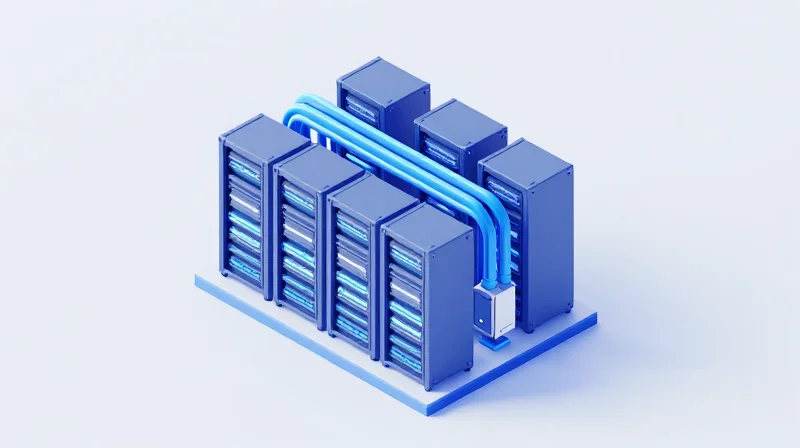
The massive compute requirements of generative AI and LLM training have pushed thermal design power (TDP) per rack to unprecedented levels, often exceeding 100kW. Managing this heat density requires moving beyond traditional air cooling toward integrated liquid-to-chip solutions and high-efficiency power distribution units (PDUs) that minimize energy loss. By procuring custom-engineered wholesale architectures, operators can synchronize thermal management hardware with their specific workload profiles to achieve a Power Usage Effectiveness (PUE) below 1.2.
Comparative Cooling Solutions for High-Density AI Racks
| Cooling Method | Heat Dissipation Limit | Infrastructure Impact | TCO Impact (Wholesale) |
|---|---|---|---|
| Rear Door Heat Exchanger (RDHx) | Up to 50kW per rack | Moderate - retrofit compatible | Lower initial CAPEX for brownfield |
| Direct-to-Chip (Cold Plate) | Up to 150kW+ per rack | High - requires fluid loops | Optimized for 2026 GPU clusters |
| Two-Phase Immersion | Highest (>200kW) | Very High - specialized tanks | Maximum efficiency at extreme scale |
Power Delivery Optimization: 48V Architecture
Standard 12V power distribution is increasingly obsolete for AI-ready data centers due to significant conduction losses at high current levels. Wholesale procurement of 48V power shelves and busbar systems reduces I2R (resistive) losses by up to 16 times compared to legacy systems. This shift is essential for supporting the power-hungry NVIDIA H100 and Blackwell architectures, ensuring that bulk hardware investments do not suffer from thermal throttling or excessive energy waste.
Custom Bulk Quotes for Thermal Infrastructure
When sourcing thermal management components wholesale, it is vital to request custom quotes that account for peak load scenarios rather than average usage. High-density manifolds, quick-disconnect couplings, and coolant distribution units (CDUs) should be bundled with server shipments to ensure component compatibility and streamlined deployment timelines.
- Why is PUE more critical for AI workloads than traditional cloud?
AI workloads operate at much higher power densities; even a 0.1 improvement in PUE can result in millions of dollars in annual energy savings across a wholesale data center deployment. - Can air cooling still support modern AI GPUs?
While possible with specialized ducting and extreme airflow, air cooling typically fails to maintain optimal operating temperatures for clusters exceeding 40kW per rack without risking hardware degradation. - How does wholesale procurement benefit thermal management?
Bulk pricing allows for the standardization of cooling components across the entire facility, reducing spare part inventory costs and simplifying maintenance protocols.
Future-Proofing: Preparing for the 1.6T Transition

Preparing for the 1.6T transition is no longer a speculative exercise but a strategic requirement for wholesale buyers who wish to avoid 'forklift upgrades' within the next 24 to 36 months. As AI models grow exponentially, the move from 800G to 1.6T Ethernet is driven by the need for 224G SerDes technology, which provides the necessary bandwidth density to support the next generation of GPUs and specialized AI accelerators.
The 1.6T Evolution: Key Technical Benchmarks
The leap to 1.6T represents a doubling of current high-end capacity, primarily achieved through increased lane speeds and more sophisticated modulation. For those procuring wholesale architecture in 2026, the focus must shift toward chassis and backplanes capable of handling the thermal and signal integrity demands of 224G signaling.
| Feature | 800G Standard (Current) | 1.6T Standard (Emerging) |
|---|---|---|
| Per-Lane Rate | 100G / 112G SerDes | 212G / 224G SerDes |
| Primary Form Factor | OSFP / QSFP-DD | OSFP-XD / OSFP1600 |
| Typical Module Power | 15W - 18W | 25W - 30W |
| Interconnect Strategy | Passive DAC / AEC / Optics | LPO / CPO / Active Optics |
Investment Strategies for Future-Proofing
When sourcing wholesale AI data center components, 'future-proofing' is a metric of ROI. Buyers should prioritize modular switch architectures that allow for line-card upgrades without replacing the entire fabric. Furthermore, investing in high-quality passive infrastructure, such as OM5 fiber or high-grade Singlemode (SMF) cabling, ensures that the physical layer can support the tighter tolerances required by 1.6T optics.
- Will 800G hardware be obsolete when 1.6T arrives?
No, 800G will remain the workhorse for many clusters. However, 1.6T will be necessary for the 'top-of-rack' to 'spine' links in massive-scale AI training environments to reduce cable congestion. - Does 1.6T require specific cooling considerations?
Yes. Due to the high power consumption of 1.6T transceivers (up to 30W), wholesale buyers should specify liquid-cooled racks or enhanced airflow designs in their 2026 custom quotes. - How does wholesale pricing for 1.6T-ready systems compare?
Initial 1.6T-ready chassis carry a 20-30% premium over standard 800G units, but they offer a lower total cost of ownership (TCO) by extending the hardware lifecycle by several years. - Is OSFP-XD the definitive standard for 1.6T?
While several standards exist, OSFP-XD (Extra Density) is gaining the most traction for 1.6T due to its ability to manage the thermal loads and port density required for high-radix switches.
Operational Continuity during Upgrades
To ensure a smooth transition, wholesale procurement should focus on backward-compatible silicons, such as Broadcom Tomahawk 5 or NVIDIA Spectrum-4 platforms. These chipsets provide a stable foundation that allows for a mixed-speed environment, enabling data centers to scale up to 1.6T in phases rather than all at once, protecting the initial capital expenditure.
The Procurement Process: From Quote to Deployment
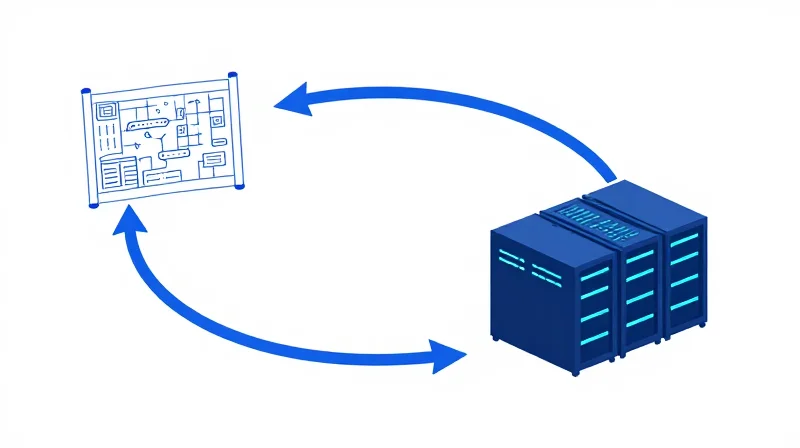
The procurement process for wholesale AI data center architecture is a structured, multi-phase journey designed to align hardware specifications with high-density compute requirements while maximizing cost efficiency. Unlike standard retail purchases, bulk AI hardware acquisition involves rigorous technical validation, custom engineering cycles, and phased logistics to ensure that multi-million dollar investments integrate seamlessly into complex power and networking environments.
The Five Stages of AI Hardware Acquisition
Efficiently scaling an AI data center requires a disciplined approach to the supply chain. Below is the standard workflow used by Tier 1 and Tier 2 providers to move from a conceptual design to a functional rack-ready environment.
| Phase | Action Items | Key Deliverable |
|---|---|---|
| 1. Consultation & RFQ | Defining GPU density, networking speed (400G/800G), and power limits. | Custom Quote & BOM (Bill of Materials) |
| 2. Technical Validation | Verification of MSA compliance and interoperability testing. | Validation Report / Sample Approval |
| 3. Contract & Pricing | Finalizing volume discounts and SLA terms. | Purchase Agreement & Lead Time Schedule |
| 4. Production & QA | Mass production with rigorous burn-in testing. | Quality Assurance Certification |
| 5. Phased Deployment | Coordinated shipping and onsite installation support. | Operational Infrastructure |
Navigating Technical Validation and Sampling
For wholesale buyers, the sampling phase is the most critical checkpoint. Given the sensitivity of AI workloads to latency and jitter, it is standard practice to request engineering samples of transceivers, DAC cables, and NICs. These components must undergo 'burn-in' tests within the buyer's specific environment—often involving NVIDIA InfiniBand or Arista switches—to ensure that real-world performance matches the theoretical datasheet specifications. Failure to validate at this stage can lead to massive delays during full-scale rollout.
Logistics and Multi-Site Rollouts
Deploying 2026-standard AI clusters often involves geographic complexity. Wholesale agreements typically include 'Just-In-Time' (JIT) delivery options, where hardware is stored in the vendor’s regional hubs and released in waves as data center halls are commissioned. This prevents expensive hardware from sitting in warehouses and allows for final firmware updates to be applied just prior to rack integration.
Procurement FAQ: Managing Bulk AI Hardware Orders
- How long are lead times for 800G optics in 2026?
Current lead times for high-volume 800G OSFP/QSFP-DD orders range from 4 to 12 weeks, depending on the specific component availability and custom manufacturing requirements. - Can we lock in pricing for multi-phase projects?
Yes, most wholesale contracts allow for price locking over a 6 to 12-month window, protecting buyers from market volatility during multi-stage data center expansions. - What is the minimum order quantity (MOQ) for wholesale pricing?
MOQs vary by component, but typically start at 100+ units for transceivers or full-rack solutions to qualify for significant bulk discounts.
In the race to dominate the AI landscape, hardware is the foundation of success. By leveraging wholesale pricing and custom OEM/ODM options, your organization can scale efficiently and maintain a competitive edge. Ready to optimize your network? Contact Ubytelink today for a custom quote and discover the best wholesale options for your AI Data Center Architecture.