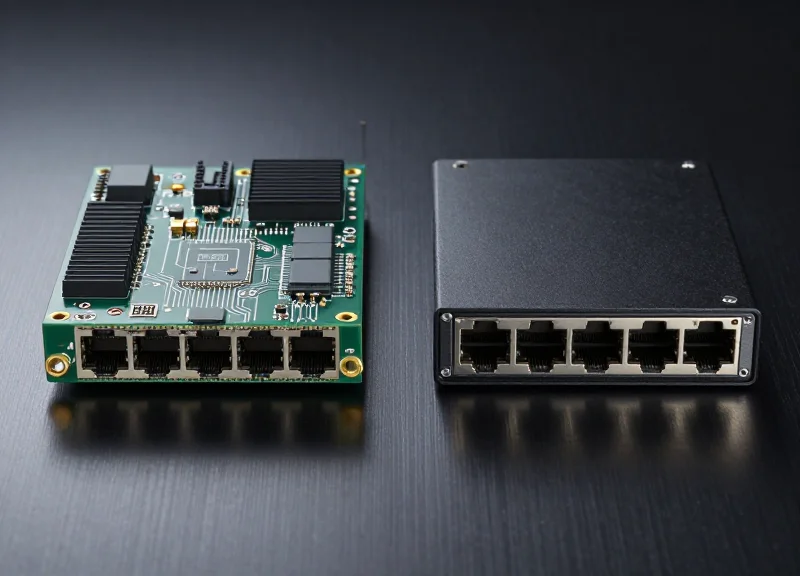
In the rapidly evolving landscape of enterprise networking, the choice of core infrastructure can determine the agility and profitability of an entire organization. As data volumes surge, IT decision-makers face a critical crossroads: do you invest in the scalable versatility of modular core switch modules, or the compact density of fixed-configuration alternatives? This article leverages twenty years of Silicon Valley engineering insight to dissect the performance metrics and financial realities of modern core switching.
The Strategic Importance of the Enterprise Core Layer

The enterprise core layer acts as the high-speed switching backbone of the entire network, serving as the central point where all data traffic converges. In a modern business environment, this layer is not merely a connection point but a strategic asset that determines the network's overall latency, throughput, and resilience. Choosing between dedicated enterprise core switch modules and alternative architectures like stacked fixed-configuration switches or software-defined fabrics is a decision that impacts everything from data center efficiency to end-user application performance.
The Three-Tier Hierarchical Model and the Core's Mandate
In the classic three-tier hierarchical design (Access, Distribution, and Core), the core layer is optimized for speed and reliability. Unlike the access layer, which focuses on endpoint connectivity and security policies, the core layer’s primary mandate is the fast and efficient transport of large volumes of data. It must maintain low latency and provide non-blocking performance to prevent bottlenecks that could cripple organizational productivity.
| Feature | Core Layer Focus | Access/Distribution Focus |
|---|---|---|
| Primary Goal | Maximum throughput and uptime | User connectivity and policy enforcement |
| Traffic Handling | High-volume aggregation | Local packet switching and VLAN tagging |
| Latency Tolerance | Near-zero required | Moderate tolerance |
| Hardware Priority | Modular redundancy and backplane capacity | Port density and PoE support |
Business Continuity and Hardware Architecture
The strategic importance of the core layer is most evident during periods of high demand or hardware failure. Enterprise-grade core switch modules are typically designed with a 'zero-fail' philosophy, incorporating redundant supervisors, power supplies, and hot-swappable components. When organizations opt for cheaper alternatives, such as daisy-chained edge switches, they often sacrifice the backplane bandwidth and internal switching fabric necessary to handle bursty traffic, leading to packet loss and increased jitter in sensitive applications like VoIP and real-time data analytics.
- Why is the core layer considered the 'backbone'?
It connects disparate segments of the network, including the data center, WAN, and various distribution blocks, ensuring all components communicate at wire speed. - How does core architecture affect scalability?
Modular core switches allow for 'pay-as-you-grow' expansion via line cards, whereas many alternatives require disruptive hardware replacements to increase capacity. - What is the risk of an underpowered core layer?
An inadequate core creates a 'choke point' that nullifies the speed of high-performance access points and servers, resulting in poor application response times.
Architecture Deep Dive: Modular vs. Fixed-Configuration
Defining the Architectural Split: Modular vs. Fixed
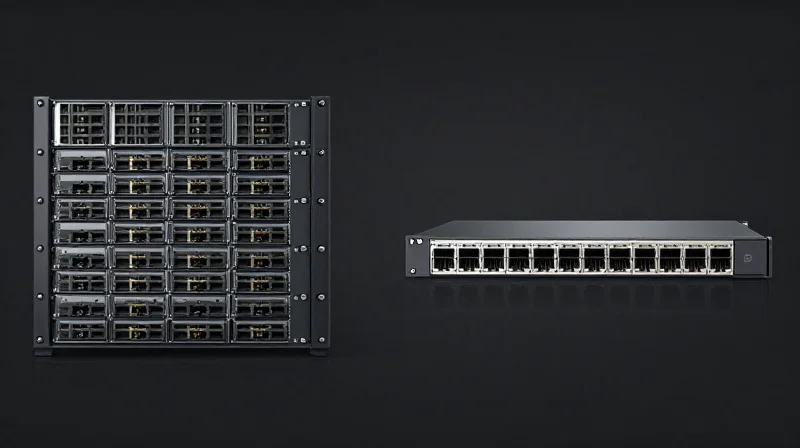
The choice between modular and fixed-configuration switches is fundamentally a choice between long-term elastic scalability and immediate deployment simplicity. Modular chassis systems are designed as a skeletal frame containing a high-speed backplane, where supervisors, line cards, and power supplies are independently managed and hot-swappable. Conversely, fixed-configuration switches integrate all ports and logic into a single ASIC-driven unit; while these can be 'stacked' to simulate a single logical entity, they cannot match the internal throughput or the deep-buffer capabilities inherent to a dedicated modular core architecture.
Backplane Throughput and Internal Fabric Comparison
In a modular system, the backplane acts as a high-capacity highway for data, often utilizing a crossbar fabric that allows any-to-any port communication without congestion. Fixed-configuration stacks rely on external stacking cables, which typically offer significantly lower bandwidth than an internal chassis backplane. This discrepancy means that while a modular core can support non-blocking performance across hundreds of 10/40/100G ports, a stacked alternative may encounter bottlenecks at the stacking link during high-traffic bursts.
| Feature | Modular Chassis Systems | Fixed/Stackable Alternatives |
|---|---|---|
| Internal Backplane | Multi-Terabit passive or active fabric | Limited by external stacking port speeds |
| Hardware Redundancy | N+1 Power, Dual Supervisors, Hot-Swap Fans | External RPS or stack-level redundancy only |
| Port Density | Scalable to hundreds of high-speed ports | Fixed per unit; limited by RU rack space |
| Serviceability | Component-level replacement without downtime | Requires unit replacement or stack reconfiguration |
Scalability and Operational Longevity
Modular architectures offer superior investment protection. As technology evolves (e.g., from 40G to 400G), enterprise administrators can often simply replace a supervisor engine or a specific line card rather than ripping and replacing the entire core infrastructure. Fixed switches, although cheaper upfront, reach a 'ceiling' once all ports or stacking slots are occupied, requiring a forklift upgrade to transition to the next generation of networking speeds.
- Can a stack of fixed switches reliably serve as an enterprise core?
While technically possible for mid-market firms, a stack lacks the unified control plane and sub-second failover capabilities of dual-supervisor modular systems, making it riskier for mission-critical environments. - What is the primary trade-off in port density?
Modular switches provide higher density in a smaller rack footprint by utilizing multi-port line cards, whereas fixed switches require more cabling and rack units to achieve similar port counts. - Does modularity affect latency?
Yes. Modular systems typically utilize advanced ASICs and optimized internal paths that provide lower, more predictable latency across the entire fabric compared to the multi-hop latency common in stacked configurations.
Latency Benchmarks: Where Every Microsecond Counts

Latency Benchmarks: Where Every Microsecond Counts
In high-performance enterprise cores, latency is dictated by the architectural path a packet traverses: modular systems offer deterministic, albeit slightly higher, latency due to the fabric-crossbar traversal, while fixed-configuration alternatives provide lower 'on-chip' latency but suffer from significant jitter and delay when traffic must cross stacking links or inter-switch trunks. Choosing between them requires a balance between the raw speed of a single ASIC and the predictable performance of a multi-slot chassis.
The Fabric Factor: Modular vs. Fixed ASIC Latency
The primary latency differentiator is the physical distance and the number of serializations a frame undergoes. In a modular core switch, a frame arriving on one line card must be converted for the backplane, switched through a Switch Fabric Module (SFM), and re-processed by the egress line card. This usually results in a consistent latency of 2.0 to 5.0 microseconds. Fixed-configuration switches often utilize a 'System-on-a-Chip' (SoC) where all ports reside on the same silicon, allowing for sub-microsecond (nanosecond) latency. However, once those fixed switches are stacked, the 'stacking cable' becomes a bottleneck, often introducing 10x the latency of a modular backplane.
| Architecture Style | Port-to-Port Latency (L2/L3) | Inter-Unit Latency | Consistency (Jitter) |
|---|---|---|---|
| Modular Chassis (Fabric-Based) | 2.2 µs - 4.5 µs | Uniform across all slots | Low / Highly Predictable |
| Fixed Standalone (High-End ASIC) | 0.6 µs - 0.9 µs | N/A | Excellent (Single Hop) |
| Stacked Fixed Alternatives | 0.8 µs (local) | 15.0 µs - 50.0 µs (stack) | High / Variable |
Buffering and Congestion: Tail Latency Risks
Raw latency is only half the story; 'tail latency'—the delay experienced during 99% of peak traffic—is where modular modules shine. Core switch modules typically utilize Virtual Output Queuing (VoQ) to prevent Head-of-Line (HoL) blocking across the fabric. While a fixed-configuration alternative may be faster during a simple ping test, under heavy load, its smaller shared buffer can lead to micro-bursting and frame drops, causing retransmissions that increase effective latency from microseconds to milliseconds.
- How does 'Cut-Through' switching impact these benchmarks?
Fixed switches almost exclusively use cut-through switching to achieve sub-microsecond speeds. Modular core switches may support both, but often default to store-and-forward for inter-line-card traffic to ensure only valid frames consume expensive backplane bandwidth. - Why does stacking latency matter in the core?
When fixed switches are used as core alternatives, traffic frequently hops between stack members. Because stacking protocols add proprietary encapsulation and rely on limited-bandwidth cables, the latency 'penalty' for crossing switches is much higher than crossing a modular backplane. - Is nanosecond latency necessary for typical enterprise apps?
For standard ERP or VOIP traffic, the difference between 1µs and 5µs is negligible. However, for high-frequency trading, real-time AI inference, or NVMe-over-Fabrics storage, the lower latency of a high-end fixed ASIC or a specialized modular fabric is critical.
Power Consumption and Thermal Efficiency
Modular enterprise core switches represent a specialized trade-off in power consumption: while they carry a higher 'base' power load due to massive fan trays and dedicated fabric modules, they frequently offer superior energy efficiency per-port at high densities compared to an equivalent number of independent fixed-form-factor switches. For large-scale deployments, the centralized power management of a chassis reduces the total number of power conversion losses found in distributed power supplies across multiple smaller units.
The 'Chassis Tax' and Energy Proportionality
In any modular deployment, the chassis itself requires a significant amount of power before a single packet is switched. This 'chassis tax' includes the operation of high-performance supervisor engines, common fabric modules, and high-CFM (Cubic Feet per Minute) cooling systems. However, as line cards are added, the incremental power increase is relatively low. In contrast, fixed-configuration switches have a lower entry point for power consumption but scale linearly; adding more ports means adding more power supplies, fans, and CPU overhead for each individual unit, which can eventually exceed the power draw of a single consolidated modular system.
| Metric | Modular Chassis (Full) | Fixed Switch Stack (8 Units) |
|---|---|---|
| Average Power per 10GbE Port | 4W - 7W | 8W - 12W |
| Power Supply Efficiency | 94-96% (Titanium/Platinum) | 88-92% (Gold/Platinum) |
| Cooling Architecture | Centralized Variable-Speed | Distributed Constant-Speed |
| Redundancy Model | N+N or N+1 Shared | 1:1 Internal or External RPS |
Thermal Management and Airflow Efficiency
Thermal efficiency is where modular systems often hold a technical advantage in the data center. Modern chassis are designed with front-to-back airflow patterns that align perfectly with hot-aisle/cold-aisle containment strategies. Because a single modular unit replaces many smaller ones, the airflow is more predictable and can be managed via centralized variable-speed fans that respond to the thermal sensors of the entire system. Fixed-configuration switches in a stack often create 'thermal hotspots' due to overlapping exhaust ports and the mechanical limitations of small 40mm fans, which must spin at higher RPMs—consuming more energy—to dissipate heat from dense ASIC layouts.
Green Networking and ROI
When calculating the Return on Investment (ROI) for enterprise core modules, energy costs must be amortized over a 5-to-7-year lifecycle. High-efficiency modular power supplies (PSUs) often reach 96% efficiency, significantly reducing 'vampire' power loss. Over a five-year period, the reduction in BTU (British Thermal Units) output from a consolidated modular core can result in thousands of dollars in savings on HVAC operational costs alone, reinforcing the 'Green IT' initiative while providing a more stable environment for sensitive silicon.
Power & Thermal FAQ
- Does a modular switch always use more power than a fixed switch?
Initially, yes. A modular chassis with one line card uses more power than a single fixed switch because of the supervisor and fan overhead. However, once you scale to 100+ ports, the modular system typically becomes more energy-efficient. - How does PoE impact thermal efficiency?
Power over Ethernet (PoE) adds significant thermal load. Modular switches manage this better through large-scale, high-efficiency power bays that distribute the load across multiple modules, whereas fixed switches can struggle with internal heat build-up at full PoE+ loads. - Can modular switches operate in non-optimized cooling environments?
Modular switches require strict airflow management. While they are more efficient in a data center, a fixed switch might be easier to deploy in a small closet without dedicated HVAC, provided the port density remains low.
Total Cost of Ownership (TCO) Breakdown
The true cost of core networking infrastructure is rarely captured in the initial quote; a comprehensive TCO analysis must account for the five-year trajectory of maintenance, power, software licensing, and the cost of unforeseen capacity requirements. While fixed-form-factor switches offer an attractive entry price, modular chassis systems frequently provide a more predictable financial model for enterprises that expect to scale port density or upgrade to higher-speed interfaces (like 100G to 400G) without replacing the entire switching fabric and power infrastructure.
Five-Year Financial Projection: Modular vs. Fixed Alternatives
The following data reflects a typical enterprise deployment requiring high availability and redundant supervisors. Note that the modular approach assumes a 'pay-as-you-grow' model for line cards, whereas the fixed alternative assumes a forklift replacement or additional stack members to meet Year 3 growth.
| Cost Component | Modular Chassis (5-Year) | Fixed-Stack Alternative (5-Year) |
|---|---|---|
| Initial Hardware CAPEX (Chassis/Fixed Units) | "$45,000 - $75,000" | "$20,000 - $35,000" |
| Software Licensing (OS & Advanced Features) | "$12,000" | "$10,000" |
| Maintenance & Support (24x7x4 SLA) | "$18,000" | "$14,000" |
| Year 3 Incremental Upgrade (Port Density) | "$7,000 (Line Card)" | "$22,000 (New Unit/Stack Replacement)" |
| Power, Cooling & Rack Space | "$9,000" | "$7,500" |
| Estimated 5-Year TCO | "$91,000" | "$73,500 - $88,500" |
CAPEX vs. OPEX: Analyzing the Scalability Premium
The 'Scalability Premium' is the higher upfront cost paid for a modular chassis. This investment is essentially an insurance policy against 'forklift upgrades'—the costly process of removing and replacing entire units when they reach capacity. In modular systems, the backplane is often designed to support multiple generations of Line Cards. Therefore, when the organization transitions from 10GbE to 40GbE or 100GbE, the cost is limited to the new Line Card and optics, rather than new power supplies, fans, and management software. For fixed switches, scaling often requires adding more units to a stack, which can increase management complexity and eventually hit a physical limit of the stacking cable bandwidth, forcing a total hardware refresh earlier than the five-year mark.
Maintenance and Software Licensing Structures
Maintenance contracts (such as Cisco SmartNet or Juniper Care) are typically calculated as a percentage of the total hardware list price. While modular systems have a higher base price, maintaining a single large asset can sometimes be more cost-effective than managing dozens of individual support contracts for a distributed fixed-switch environment. Furthermore, many vendors are moving toward subscription-based software models (e.g., Cisco DNA). In these scenarios, modular switches allow for 'license portability' between line cards, whereas fixed units often tie the license to the specific chassis serial number, leading to sunk costs if the unit is decommissioned early.
- What is the typical break-even point for modular switches?
Most enterprises reach a break-even point between years 3 and 4, specifically when the first significant port density or speed upgrade is required. - How do power costs impact the TCO?
Modular switches are often more power-efficient at scale because they utilize centralized high-efficiency power supply units (PSUs) to drive multiple cards, whereas a stack of fixed switches requires multiple redundant PSUs, each with its own conversion loss. - Does modularity reduce labor costs?
Yes, modularity reduces 'human OPEX' because it requires fewer cables for management and fewer IP addresses to manage, simplifying the administrative overhead of the core layer.
Scalability and Future-Proofing: The Modular Advantage
Scalability and Future-Proofing: The Modular Advantage
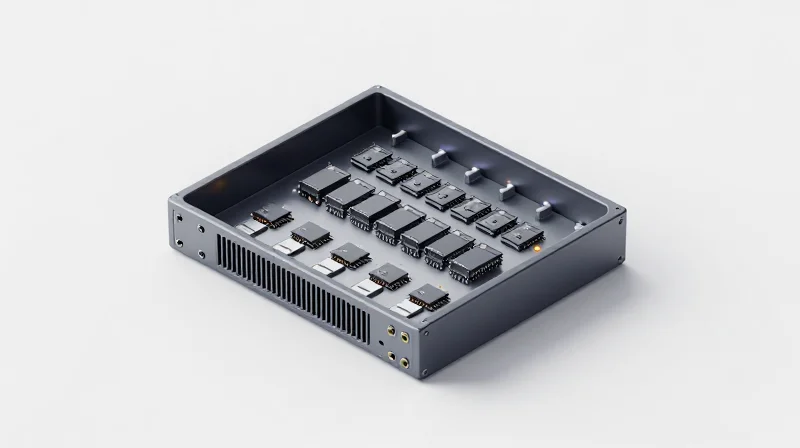
Modular core switches represent the pinnacle of network investment protection by decoupling the chassis lifecycle from the rapid evolution of interface standards. Unlike fixed-form alternatives that require a complete 'rip-and-replace' strategy when bandwidth demands exceed port capacity or speed, modular systems allow enterprises to swap individual line cards to integrate 400G or 800G optics while maintaining the same management plane and physical infrastructure. This architectural flexibility ensures that the core of the network remains agile and capable of absorbing next-generation traffic loads without a total overhaul.
The 'Pay-as-You-Grow' Financial Model
The financial advantage of modularity is rooted in the 'pay-as-you-grow' philosophy. Enterprises can initially invest in a high-capacity chassis but only populate it with the specific line cards needed for current operations. As the organization grows, additional modules can be added to increase port density or introduce higher speeds like 100G and 400G. This approach defers CAPEX and avoids the trap of over-provisioning fixed hardware that may become obsolete before its full capacity is ever utilized.
| Feature | Modular Chassis | Fixed-Form Alternative |
|---|---|---|
| Incremental Growth | High (per line card) | Low (requires new unit) |
| Transition to 400G/800G | Module swap in existing chassis | Full hardware replacement |
| Backplane Longevity | 7-10+ Years | 3-5 Years |
| Operational Disruption | Minimal (card-level updates) | High (complete unit migration) |
Navigating the 400G and 800G Horizon
As data centers and enterprise cores move toward 400G and 800G, the internal fabric of the switch becomes the primary bottleneck. Leading modular platforms are designed with forward-looking switching fabrics that provide significant headroom. When standards shift, the upgrade path often involves replacing the fabric modules and line cards while the chassis, power supplies, and cooling systems remain in place. Fixed switches, conversely, are bound by their integrated ASICs, meaning an upgrade to 800G necessitates the decommissioning of the entire device, leading to higher e-waste and complex migration projects.
- Can modular switches handle the power requirements of 800G?
Yes, modern enterprise-grade chassis are engineered with the power headroom and advanced thermal management required for high-wattage, next-generation optics like 800G transceivers. - Is it more cost-effective to stack fixed switches?
While stacking fixed switches offers some scalability, it increases management complexity and often lacks the unified backplane throughput necessary for seamless 400G transitions. - What is the typical lifespan of a modular core switch?
A well-planned modular chassis can serve an enterprise core for over a decade, through multiple generations of interface speed upgrades.
Redundancy and High Availability (HA) Mechanisms
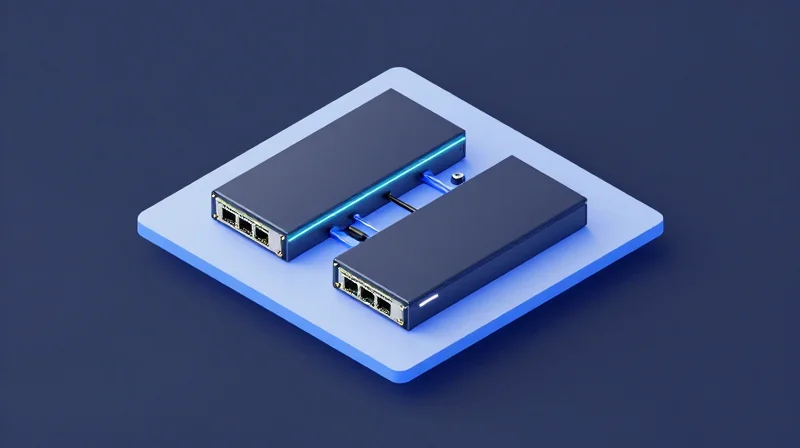
In the enterprise core, high availability (HA) is the threshold between business continuity and catastrophic downtime. Modular core switches achieve resiliency through hardware-level integration, specifically via N+1 supervisor redundancy, where a standby engine maintains real-time state synchronization with the active module. In contrast, fixed-configuration alternatives rely on software-defined protocols like Multi-Chassis Link Aggregation (MLAG) or Virtual Port Channels (vPC) to cluster independent units into a logical entity. While both aim for zero packet loss, the underlying mechanisms differ significantly in failover speed, control plane stability, and management complexity.
Modular Resiliency: The Gold Standard of Stateful Switchover
Modular systems are designed with a 'hitless' failover philosophy. By utilizing Stateful Switchover (SSO) and Non-Stop Forwarding (NSF), the standby supervisor module mirrors the L2/L3 state of the active module. If the primary engine fails, the standby takes over without resetting the line cards or clearing the routing table. This hardware-integrated approach ensures that the data plane remains active even as the control plane recovers, typically resulting in failover times measured in milliseconds, which is imperceptible to VoIP or high-frequency trading applications.
Fixed Alternatives: MLAG, vPC, and Fabric Redundancy
Alternative architectures, such as leaf-spine designs using fixed switches, achieve HA by distributing the load across multiple physical nodes. Technologies like MLAG (standard) or vPC (Cisco-specific) allow two separate switches to appear as a single logical switch to downstream devices. While this provides excellent node-level redundancy—protecting against the total failure of a single switch—it introduces 'split-brain' risks and requires careful configuration of peer links. Unlike the unified backplane of a chassis, these protocols depend on external cabling and software convergence, which can lead to slightly longer recovery times during complex topology changes.
| Feature | Modular N+1 Supervisor | Fixed MLAG / vPC Clusters |
|---|---|---|
| Control Plane | Unified (Active/Standby Sync) | Independent (Distributed Sync) |
| Failover Mechanism | Stateful Switchover (SSO) | LACP/Protocol Convergence |
| Typical Failover Time | < 50ms (Hitless) | 200ms - 2 seconds |
| Management Complexity | Low (Single IP/Management Point) | Moderate (Multiple IPs/Peer Links) |
| Hardware Efficiency | Dedicated standby is idle capacity | Both units actively forward traffic |
Architectural Trade-offs in Mission-Critical Environments
Choosing between these mechanisms often comes down to the desired blast radius. A modular chassis offers superior internal redundancy (fans, power, supervisors), but it remains a single physical point of failure (e.g., in the event of a fire or power surge to that rack). Fixed-switch clusters offer geographic separation, allowing switches to be placed in different racks or rooms. However, the modular approach wins on operational simplicity; upgrading the firmware on a redundant supervisor pair is a streamlined, validated process compared to the coordinated dance required to update multiple independent switches in an MLAG pair without dropping traffic.
- Is MLAG as reliable as a modular supervisor?
In terms of packet forwarding, yes. However, MLAG requires managing two separate control planes, which increases the risk of human configuration errors compared to the automated synchronization of a modular chassis. - Can I use both mechanisms simultaneously?
Yes. Many enterprise cores use redundant modular chassis in an MLAG or VSS (Virtual Switching System) configuration, providing both hardware-level supervisor redundancy and node-level site redundancy. - What is the impact of a supervisor failover on user sessions?
With a modular chassis using SSO/NSF, user sessions (TCP, VPN, SSH) typically remain active. In protocol-based fixed switch failovers, some sessions may time out if the convergence takes longer than the application's retry interval.
Management Complexity and Network Automation

The Operational Divide: Centralized Chassis vs. Distributed Fabrics
The primary management distinction between enterprise core switch modules and fixed-configuration alternatives lies in the 'logical entity' count. A modular chassis, regardless of the number of line cards, is managed as a single device with a unified control plane, one IP address, and a shared configuration file. In contrast, replacing a modular core with a cluster of fixed switches—often in a leaf-spine or stacked topology—drastically increases the number of managed endpoints. While fixed switches offer greater flexibility, they introduce a management tax that can only be mitigated through advanced Network Automation and Software-Defined Networking (SDN) controllers.
The Role of SDN and API-Driven Orchestration
Modern enterprises are increasingly leaning on automation to bridge the gap between modular simplicity and fixed-switch scalability. Using tools like Ansible, Terraform, or proprietary controllers (e.g., Cisco DNA Center, Arista CloudVision), administrators can push configurations across a dozen fixed switches as if they were a single unit. However, this shifts the complexity from hardware maintenance to software development and maintenance. The modular core remains the 'low-touch' champion for smaller IT teams, whereas automated fixed-switch fabrics favor organizations with DevOps-oriented networking staff who can leverage RESTful APIs and Netconf/YANG models.
| Feature | Modular Core (Chassis) | Fixed-Switch Cluster (SDN) |
|---|---|---|
| Management Plane | Single unified IP/CLI | Multiple IPs or Controller-based |
| Software Updates | One OS image for all cards | Orchestrated rolling updates |
| Config Consistency | Inherent by design | Maintained via Automation/SDN |
| Troubleshooting | Internal backplane tracing | Complex hop-by-hop analysis |
Operational Efficiency and Lifecycle Management
Lifecycle management is significantly more streamlined in modular environments. Upgrading a core switch's capacity often involves sliding in a new line card, which the supervisor module automatically detects and configures. In a fixed-switch alternative, adding capacity requires cabling new uplinks, configuring MLAG or EVPN parameters, and ensuring firmware parity across the fabric. While automation can speed up these tasks, the inherent risk of configuration drift is higher in distributed environments, making the modular approach the preferred choice for mission-critical campus cores where uptime is paramount.
- Does a modular switch require less specialized staff?
Generally, yes. Modular switches utilize traditional CLI-based management that is familiar to most network engineers, whereas managing fixed-switch clusters at scale often requires knowledge of Python, YAML, and SDN protocols. - How does automation impact the cost of fixed-switch alternatives?
While fixed switches have a lower hardware CAPEX, the OPEX can be higher due to the cost of SDN licensing (e.g., Cisco ACI or VMware NSX) and the personnel hours required to build and maintain automation scripts. - Which architecture is better for rapid troubleshooting?
The modular chassis is superior for rapid troubleshooting because all traffic remains internal to the backplane, eliminating the need to trace packets across multiple physical inter-switch links.
The Decision Matrix: When to Choose Which?
The Strategic Choice: Modular vs. Fixed-Configuration
Choosing between modular core switch modules and fixed-configuration alternatives is a strategic decision dictated by your network's growth trajectory, failure domain tolerance, and lifecycle management goals. Modular chassis remain the gold standard for high-density environments requiring centralized control and maximum uptime, while fixed-configuration stacks or leaf-spine architectures offer superior agility and lower entry costs for rapidly evolving, distributed workloads.
| Selection Criteria | Modular Chassis (Core Modules) | Fixed-Configuration Alternatives | Winner for Use Case |
|---|---|---|---|
| Port Density (per RU) | Extremely High (Line card expansion) | Moderate (Requires stacking/cascading) | Modular |
| Initial CAPEX | High (Chassis + Supervisor cost) | Lower (Pay-as-you-grow) | Fixed |
| Long-term TCO (5-7 years) | Lower (Incremental line card upgrades) | Higher (Total hardware replacement) | Modular |
| Failure Domain | Large (Chassis-wide impact) | Small (Isolated switch failure) | Fixed |
| Management Overhead | Low (Single IP for hundreds of ports) | Moderate to High (Multiple device IPs) | Modular |
| Airflow & Power Efficiency | Centralized & Optimized | Distributed & Higher per-port draw | Modular |
When to Prioritize Modular Core Modules
Modular systems are the preferred choice when the primary objective is long-term investment protection. If your roadmap includes a transition from 10G to 100G or 400G within the same physical footprint, a chassis allows you to swap line cards without re-cabling the entire rack. It is also the ideal solution for enterprises with strict compliance or uptime requirements where N+1 supervisor redundancy and hot-swappable power fabrics are non-negotiable.
When Fixed-Configuration Alternatives Make Sense
Fixed alternatives excel in modern leaf-spine data center designs where horizontal scalability is more valuable than vertical density. For organizations with limited upfront budget or those utilizing Software-Defined Networking (SDN) to manage clusters of switches as a single fabric, fixed units provide the necessary flexibility. They are particularly effective in edge deployments or smaller branch offices where the full capacity of a modular chassis would remain underutilized.
- Which architecture is best for a 5-year growth plan?
Modular chassis are typically superior for 5-year plans because they allow for incremental port speed upgrades via line cards, avoiding a full 'rip-and-replace' scenario. - How do I decide based on limited rack space?
Modular switches offer the highest port density per rack unit (RU), making them the better choice for space-constrained environments that need hundreds of connections. - Is redundancy better in modular or fixed switches?
Modular switches offer superior internal redundancy (supervisors, fabrics), while fixed switches rely on external protocols like MLAG or VPC to achieve similar high availability.
Selecting between enterprise core switch modules and fixed alternatives is not a one-size-fits-all decision; it requires a nuanced balance of performance needs and financial constraints. By prioritizing latency requirements and long-term TCO over initial CAPEX, organizations can build a foundation that supports a decade of growth. Ready to optimize your core network? Contact our engineering team today for a custom TCO audit and performance simulation.