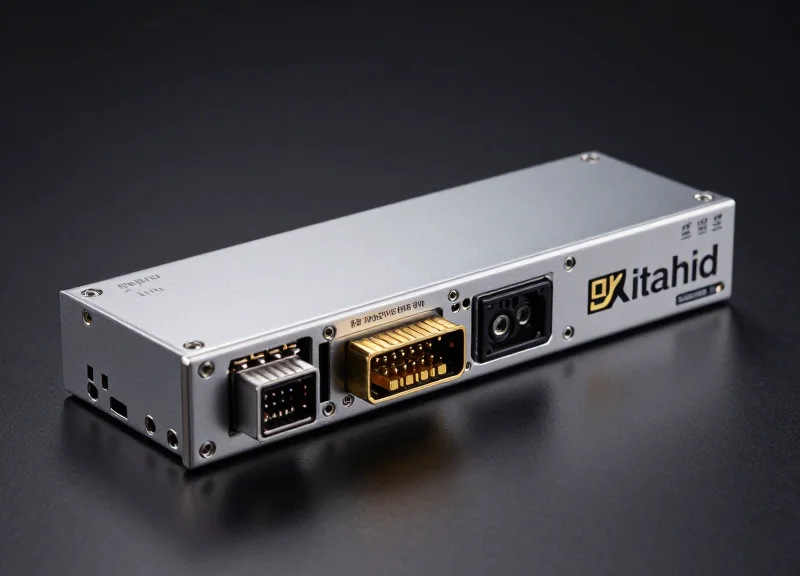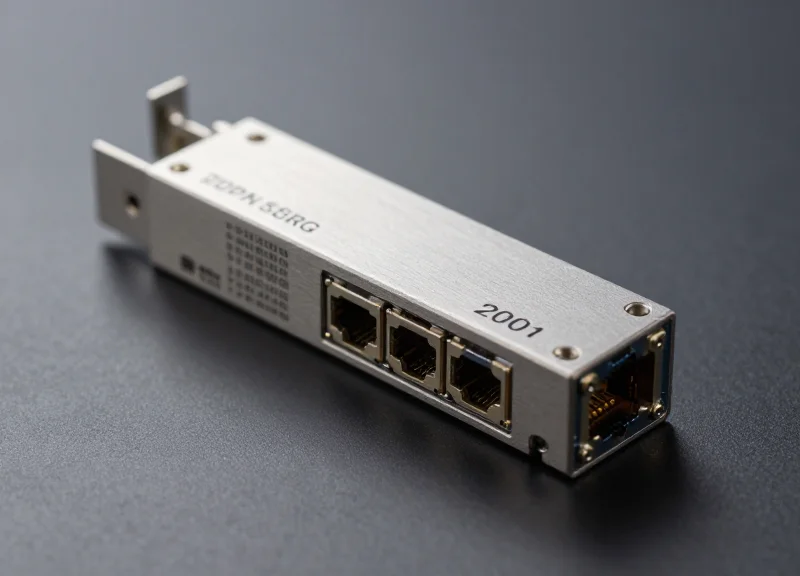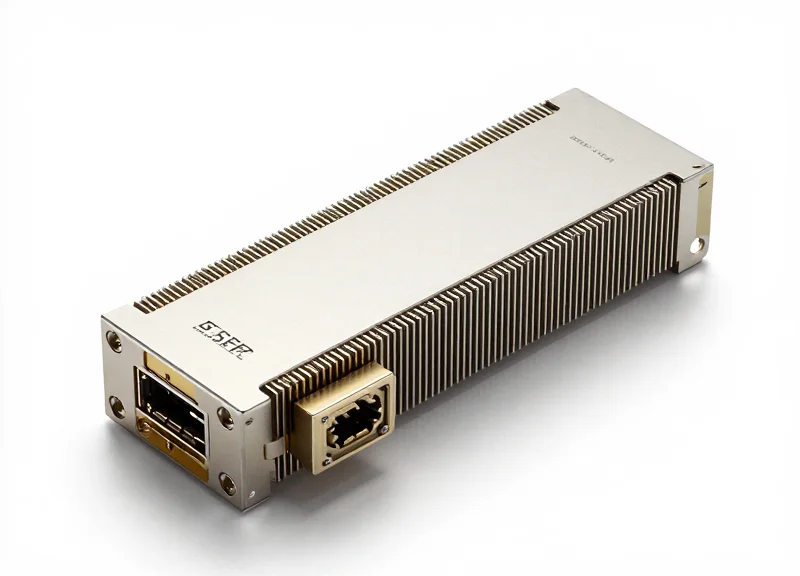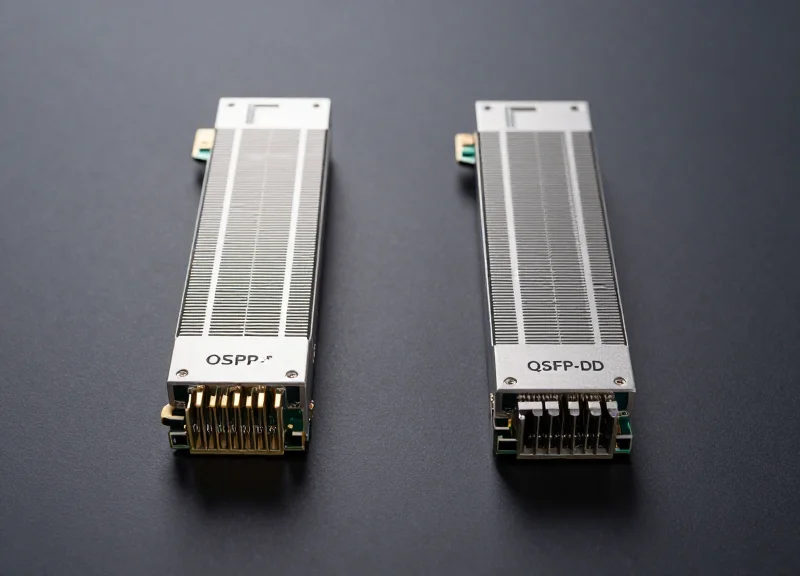
The shift to 800G Ethernet is the new benchmark for AI-driven data centers and high-performance computing. However, selecting the right form factor—OSFP or QSFP-DD—is a multi-million dollar decision that affects thermal management, power efficiency, and long-term scalability. This article breaks down the technical nuances and procurement strategies to help you scale your network effectively.
The Evolution of 800G: Why the Form Factor Choice Matters

The Evolution of 800G: Why the Form Factor Choice Matters
The migration to 800G is a pivotal milestone in data center evolution, driven by the insatiable bandwidth demands of AI training, hyperscale cloud services, and 5G edge computing. The choice between OSFP (Octal Small Form-factor Pluggable) and QSFP-DD (Quad Small Form-factor Pluggable Double Density) is far more than a mechanical preference; it is a strategic decision that dictates the thermal efficiency, port density, and backward compatibility of your entire network fabric for the next decade.
From 400G to 800G: A Shift in Power Dynamics
While 400G modules were largely an extension of previous architectures, 800G represents a leap in signal integrity and power consumption. As modules approach 20W to 30W per port, the physical dimensions and heat-dissipation capabilities of the form factor become the bottleneck for switch performance. This has forced a divergence in the market: those prioritizing legacy integration often lean toward QSFP-DD, while those building greenfield AI clusters are increasingly turning to the superior thermal ceiling of OSFP.
| Feature | OSFP | QSFP-DD (800G) |
|---|---|---|
| Width | Wider (22.58 mm) | Narrower (18.35 mm) |
| Thermal Management | Integrated Heat Sink (Superior) | Requires Host-Side Cooling (Standard) |
| Power Limit | Up to 30W+ | Up to 25W |
| Compatibility | Requires Adapter for QSFP | Native Backward Compatibility |
Critical Factors for Bulk Procurement and Wholesale Strategy
When sourcing 800G optics at scale, procurement teams must look beyond the unit price. The 'hidden' costs of form factor choice include the energy required to cool the switch chassis and the longevity of the line cards. For example, the OSFP form factor allows for more efficient airflow, which can significantly reduce the Total Cost of Ownership (TCO) in massive 800G deployments where cooling represents a significant percentage of the operational budget.
- Does 800G OSFP fit into QSFP-DD ports?
No, they are physically different sizes. OSFP is wider and taller, meaning you must choose the switch hardware that matches the intended module form factor. - Which form factor is more future-proof for 1.6T?
Industry consensus suggests OSFP has a cleaner path to 1.6T due to its larger physical volume and better power handling capabilities. - How does form factor affect bulk pricing?
While manufacturing costs are similar, QSFP-DD currently has a slightly larger installed base, but OSFP production is scaling rapidly for AI-specific demand, often leading to competitive bulk quotes for high-density projects.
Technical Deep Dive: 800G OSFP (Octal Small Form-factor Pluggable)
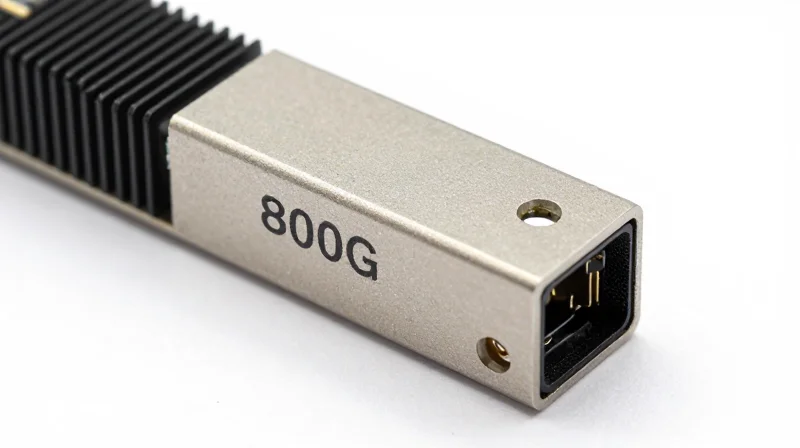
Technical Deep Dive: 800G OSFP (Octal Small Form-factor Pluggable)
The 800G OSFP stands as the most thermally efficient form factor in the current market, specifically designed to address the cooling challenges of 112G SerDes lanes and the high-performance Digital Signal Processors (DSPs) required for 800Gbps transmission. Its design philosophy prioritizes heat dissipation, making it the standard for high-bandwidth AI clusters and InfiniBand fabrics where thermal stability is a prerequisite for uptime.
Integrated Heat Sink and Thermal Management
The defining physical characteristic of the OSFP module is its integrated heat sink. Unlike other form factors that rely on the equipment's cage and external heat sinks, the OSFP incorporates cooling fins directly onto the module's top casing. This architectural choice increases the effective surface area for airflow, allowing for significantly better thermal transfer. For wholesale buyers, this means lower cooling costs at the rack level and reduced risk of module failure due to heat-induced performance degradation.
30W Power Capacity for Next-Gen Optics
As data centers transition to 800G and look ahead toward 1.6T, power consumption per port has surged. The 800G OSFP is engineered to support a power envelope of up to 30W, providing ample headroom for the advanced silicon used in DR8, FR8, and coherent optics. This high-power capability ensures that the form factor can support long-reach applications and complex modulation schemes that would typically exceed the thermal limits of smaller modules.
| Technical Parameter | 800G OSFP Capability | Data Center Impact |
|---|---|---|
| Max Power Supply | Up to 30W | Supports complex DSPs and high-power laser arrays |
| Cooling Mechanism | Integrated Heat Sink Fins | Simplifies switch thermal design and improves reliability |
| Physical Width | 22.58 mm | Allows for 32 to 36 ports per 1U front panel |
| Electrical Lanes | 8 x 112G (PAM4) | Direct 800G throughput without bottlenecks |
Common 800G OSFP Technical FAQ
- Why is the integrated heat sink critical for 800G?
At 800G speeds, modules generate intense heat that can lead to bit error rate (BER) increases. The integrated heat sink ensures heat is moved away from the sensitive optical components immediately, maintaining signal integrity. - Does OSFP support backward compatibility?
OSFP can support QSFP+ and QSFP28 modules through the use of mechanical adapters, though its primary focus is maximizing future-proof 800G and 1.6T densities. - How does OSFP compare in wholesale pricing for AI builds?
Due to its dominance in AI fabrics like NVIDIA’s Spectrum-4, OSFP modules often see high-volume production, leading to competitive bulk pricing despite their advanced thermal features.
Technical Deep Dive: 800G QSFP-DD (Double Density)
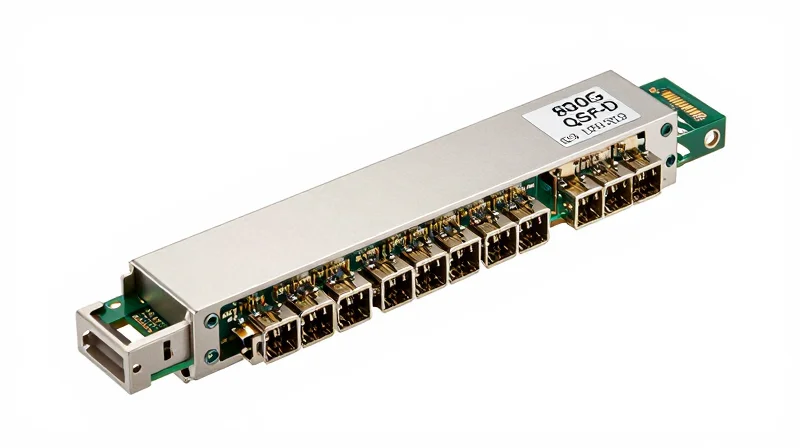
Technical Deep Dive: 800G QSFP-DD (Double Density)
The 800G QSFP-DD (Double Density) represents the pinnacle of iterative evolution in optical transceivers, offering a high-density, pluggable solution that maintains strict backward compatibility with legacy QSFP ports. Unlike the OSFP form factor which requires an adapter for legacy compatibility, the QSFP-DD's mechanical design allows it to host previous generations of QSFP modules directly in the same switch ports. This makes it the strategic choice for enterprises and service providers looking to scale bandwidth to 800G without undergoing a disruptive 'rip-and-replace' of their entire hardware ecosystem.
Mechanical Interface and Electrical Lane Architecture
The 'Double Density' nomenclature refers to the addition of a second row of electrical contacts, effectively doubling the number of lanes from four to eight. In the 800G iteration, each of these eight lanes operates at 112G PAM4. This architecture ensures that while the total throughput reaches 800Gbps, the physical footprint remains small enough to maintain the same port density as 400G switches, allowing for 32 or 36 ports in a standard 1RU chassis.
| Feature | QSFP-DD 400G | QSFP-DD 800G (Type 2a) |
|---|---|---|
| Electrical Lane Speed | 56G PAM4 | 112G PAM4 |
| Total Lanes | 8 | 8 |
| Backward Compatibility | QSFP28/QSFP56 | QSFP28/56/400G DD |
| Max Power Consumption | Approx. 12-14W | Up to 18-24W |
Why QSFP-DD Dominates Brownfield Upgrades
For wholesale buyers and data center architects, the 800G QSFP-DD is often the most cost-effective path for brownfield expansions. Because it utilizes the same cages as 400G systems, the transition cost is minimized, and the learning curve for field technicians is virtually non-existent. While thermal management is tighter compared to OSFP due to the lack of an integrated heatsink, modern cooling innovations in QSFP-DD cages—such as improved riding heat sinks on the host side—have effectively closed the gap for most standard rack deployments.
- Can I plug a 400G QSFP-DD module into an 800G QSFP-DD port?
Yes, one of the primary advantages of 800G QSFP-DD is its native backward compatibility, allowing legacy 400G modules to function without hardware adapters. - What is the thermal limit of 800G QSFP-DD?
Current MSA specifications allow for power envelopes up to 24W, though most 800G DR8 or 2xFR4 modules operate efficiently between 16W and 18W. - Is QSFP-DD better than OSFP for wholesale procurement?
It depends on the infrastructure; QSFP-DD is generally preferred for consistency with existing 100G/400G hardware, while OSFP is favored for new AI-driven greenfield builds requiring maximum cooling capacity.
OSFP vs. QSFP-DD: Thermal Efficiency and Power Consumption
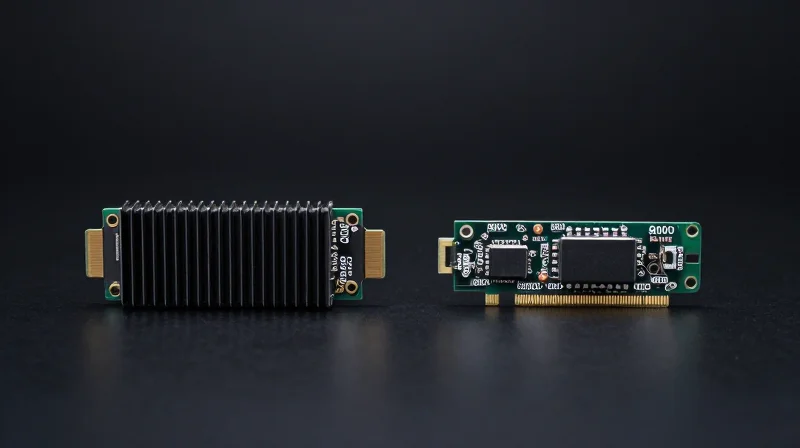
OSFP vs. QSFP-DD: Thermal Efficiency and Power Consumption
The primary technical divergence between 800G OSFP and QSFP-DD lies in their thermal management architecture. While OSFP features an integrated heatsink that facilitates superior airflow and heat dissipation, QSFP-DD relies on the host system's cooling infrastructure. This difference is critical for 800G deployments, as higher power consumption (ranging from 15W to 30W) necessitates aggressive thermal strategies to prevent signal degradation and hardware failure.
Integrated Heatsinks vs. Host-Based Cooling
OSFP modules are designed with a built-in finned heatsink, which significantly increases the surface area available for cooling. This design allows OSFP to support up to 30W of power, making it the preferred choice for future-proofing 1.6T transitions. In contrast, QSFP-DD maintains the traditional flat-top design to ensure backward compatibility. While this simplifies the physical upgrade path, it creates a higher thermal resistance between the module and the cage heatsink, often limiting efficient power envelopes to approximately 20W-25W without specialized cooling enhancements.
| Feature | 800G OSFP | 800G QSFP-DD |
|---|---|---|
| Max Power Consumption | Up to 30W | Up to 25W |
| Thermal Design | Integrated Finned Heatsink | Flat Top (Host Heatsink Needed) |
| Cooling Efficiency | High (Optimized for 800G/1.6T) | Moderate (Optimized for Density) |
| Airflow Requirements | Lower per module due to fins | Higher per module for same heat |
Operational Implications for Wholesale Buyers
For wholesale purchasers and data center architects, selecting the wrong form factor can lead to significantly higher Total Cost of Ownership (TCO). OSFP's thermal efficiency often results in lower fan speeds and reduced energy expenditure for cooling the facility. However, QSFP-DD's ability to reuse existing cooling configurations in legacy racks may lower the initial capital expenditure (CAPEX). Bulk buyers must balance these cooling costs against their long-term power budgets and the expected lifecycle of their switch fabric.
- Why is OSFP considered more thermally efficient?
OSFP includes an integrated heatsink on the module itself, which places the cooling fins directly in the airflow path, reducing the thermal resistance between the optical components and the environment. - Can QSFP-DD handle the heat of 800G wholesale deployments?
Yes, but it requires high-performance cages and often higher fan speeds within the switch. It is suitable for environments where backward compatibility is more critical than maximum thermal headroom. - How does power consumption affect bulk pricing?
Higher power modules often require more complex internal components (DSP and EML lasers). When buying wholesale, OSFP modules may have a slightly different price point due to the integrated cooling hardware, though they offer better energy savings over time.
Strategic Wholesale Procurement: Maximizing ROI in 2026

Strategic Wholesale Procurement: Maximizing ROI in 2026
Strategic wholesale procurement of 800G OSFP and QSFP-DD modules is a critical lever for optimizing Total Cost of Ownership (TCO), allowing organizations to hedge against price volatility and secure predictable deployment schedules. In the 2026 market, bulk acquisition transcends simple volume discounts; it serves as a risk-mitigation strategy that ensures high-performance optics are available exactly when network infrastructure reaches its next scaling milestone, thereby preventing costly project delays and maximizing capital expenditure efficiency.
The Financial Impact of Bulk Pricing on 800G TCO
The transition to 800G represents a significant capital investment. When purchasing modules individually or in small batches, the 'spot price' often includes premiums for immediate availability and fragmented logistics. Wholesale procurement leverages economies of scale to drastically reduce the unit price, which is essential when outfitting high-density leaf-spine architectures where thousands of ports may be activated simultaneously.
| Procurement Metric | Spot/Small Batch Buying | Strategic Wholesale (Bulk) |
|---|---|---|
| Unit Cost per Module | Highest (Premium Pricing) | Lowest (Tiered Discounts) |
| Supply Chain Risk | High (Vulnerable to Shortages) | Low (Reserved Inventory) |
| Logistics & Shipping | Frequent, High-Cost Shipments | Consolidated, Cost-Effective Freight |
| Compatibility Testing | Fragmented Batch Validation | Uniform Batch Verification |
Leveraging Custom Quotes for Specialized Requirements
For data center operators, standard off-the-shelf pricing rarely reflects the complexities of a major upgrade. Custom quotes allow for negotiated terms that go beyond price, such as staged delivery schedules that align with installation phases, extended warranties, and technical support SLAs. This level of customization ensures that the procurement process supports the specific thermal and power requirements of the chosen form factor, whether it be the high-dissipation OSFP or the backward-compatible QSFP-DD.
- How do bulk orders impact lead times for 800G modules?
Wholesale agreements typically include prioritized production slots, reducing standard lead times from months to weeks by securing a spot in the manufacturer’s supply queue. - Why are custom quotes essential for OSFP vs. QSFP-DD decisions?
Custom quotes allow vendors to provide specific pricing based on the cabling requirements (DAC vs. AOC vs. Optics) and the specific reach (DR8, 2xFR4, etc.) needed for your unique fabric. - Does wholesale procurement include multi-vendor compatibility?
Yes, strategic quotes often include 'coding services' where modules are pre-configured to work across different OEM switch platforms, reducing the need for expensive brand-specific transceivers.
Ultimately, the shift to 800G requires a shift in purchasing mindset. By moving from reactive buying to strategic wholesale procurement, organizations can lock in 2026 pricing and ensure that their path to 1.6T and beyond is built on a foundation of cost-efficiency and hardware reliability.
OEM and ODM Options: Customizing for Unique Architectures

Tailoring 800G Transceivers for Enterprise and Cloud Architectures
For large-scale data centers and telecommunications providers, off-the-shelf 800G modules may not always align with the rigid requirements of proprietary Network Operating Systems (NOS) or specific environmental cooling profiles. OEM (Original Equipment Manufacturer) and ODM (Original Design Manufacturer) options provide a strategic pathway to customize OSFP and QSFP-DD modules at the hardware and firmware level. This ensures that wholesale investments are not just cost-effective but fully optimized for the end-user's unique architectural constraints, bridging the gap between generic MSA standards and high-performance proprietary hardware.
Firmware Specialization and NOS Compatibility
One of the most critical aspects of ODM services is the development of specialized firmware. Many leading switch manufacturers use vendor-locking mechanisms that reject or limit the functionality of third-party modules. Custom-coded firmware allows 800G OSFP and QSFP-DD modules to emulate the EEPROM signatures required by brands like Arista, Cisco, and NVIDIA/Mellanox. This level of customization prevents 'unsupported transceiver' errors, ensures accurate Digital Optical Monitoring (DOM) reporting, and maintains high-speed link stability across complex, mixed-vendor environments.
| Feature | Standard Wholesale | OEM/ODM Customization |
|---|---|---|
| Firmware Type | Generic MSA Compliant | Vendor-Specific / Proprietary Coding |
| Labeling | Manufacturer Standard | Private Label / Custom Serial Tracking |
| EEPROM Access | Fixed/Locked | Re-programmable for specific NOS |
| Cooling Profile | Standard Fin Design | Modified Heat Sinks for Airflow Opt. |
| Packaging | Bulk Generic | Retail-ready or Eco-friendly Custom |
Strategic Branding and Private Labeling
Beyond technical specifications, ODM options allow wholesale buyers to implement custom labeling and unique serial number sequences. For service providers, this simplifies asset management and inventory tracking across massive deployments. Custom-labeled 800G modules also enable value-added resellers (VARs) to build brand equity by providing a cohesive product ecosystem to their clients without the capital expenditure required for original manufacturing. In 2026, this branding consistency is vital for maintaining a professional presence in the high-growth AI and Hyperscale markets.
FAQ: Navigating Custom 800G Procurement
- What is the typical MOQ for custom 800G firmware?
Most manufacturers require a minimum order quantity (MOQ) of 50 to 100 units for custom firmware coding, though some niche providers may offer lower thresholds for specialized enterprise tests. - Can custom-labeled modules maintain the same warranty?
Yes. Reputable ODM partners provide full performance warranties on custom-branded hardware, often matching the standard 3-5 year lifespan of generic 800G optics. - Does custom cooling affect OSFP/QSFP-DD form factors?
ODM services can include modifications to the module's heat sink fin height or spacing to better suit specific airflow directions (front-to-back or back-to-front) within custom rack designs. - Is custom EEPROM coding reversible?
Depending on the hardware design, some modules are 'open' for re-coding using specialized field programmers, while others are permanently locked during the OEM production phase for security.
Interoperability and Standards Compliance (IEEE and MSA)
When sourcing 800G optical modules at scale, compliance with IEEE standards and Multi-Source Agreements (MSAs) is the only guarantee that hardware from different manufacturers will function harmoniously within the same fabric. For wholesale buyers, strict adherence to these standards eliminates the risk of vendor lock-in and ensures that 800G OSFP and QSFP-DD modules meet the rigorous electrical and mechanical specifications required for 100G-per-lane signaling.
Understanding IEEE 802.3ck vs. MSA Specifications
The interoperability of 800G optics rests on two pillars: the IEEE 802.3ck standard, which defines the Ethernet physical layer (PHY) for 100 Gb/s electrical signaling, and the MSAs, which define the form factor and management interfaces. While IEEE ensures the data packets move correctly across the copper or fiber, the MSA ensures the module physically fits the port and communicates with the host software via standardized protocols like CMIS (Common Management Interface Specification).
| Standard/Agreement | Primary Focus | Applicability to 800G |
|---|---|---|
| IEEE 802.3ck | Electrical Interface | Defines 100G lanes for 800G throughput (8x100G). |
| OSFP MSA | Form Factor & Thermal | Specifies the larger OSFP dimensions and integrated heat sinks. |
| QSFP-DD800 MSA | Backwards Compatibility | Ensures 800G modules are compatible with previous QSFP generations. |
| CMIS 5.0/Higher | Software Management | Standardizes the module-to-host register map and control logic. |
The Importance of CMIS in Multi-Vendor Interoperability
For enterprise and cloud data centers, the Common Management Interface Specification (CMIS) is vital. It allows a single Network Operating System (NOS) to manage 800G modules from multiple wholesale suppliers without custom code. When requesting quotes for 800G OSFP vs QSFP-DD, verifying CMIS 5.0 (or higher) compliance is essential to ensure diagnostic monitoring, power control, and firmware updates work consistently across all ports.
- Why is MSA compliance critical for wholesale purchasing?
MSA compliance ensures that modules are physically and electrically interchangeable across different switch brands, such as Cisco, Arista, and NVIDIA, protecting your long-term infrastructure investment. - Can OSFP modules work in QSFP-DD ports?
No. Despite sharing the same 800G bandwidth and IEEE 802.3ck electrical standards, their physical dimensions and connector designs are incompatible without specific adapter hardware. - How do standards impact bulk pricing?
Standardized modules benefit from economies of scale. Choosing MSA-compliant hardware allows buyers to solicit competitive custom quotes from multiple vendors, driving down the price per unit compared to proprietary solutions.
Ultimately, prioritizing IEEE and MSA standards during the procurement process safeguards the network against future compatibility issues. As 800G technology matures, staying aligned with these global specifications ensures that wholesale-purchased modules remain viable components of the high-speed data center ecosystem through 2026 and beyond.
Navigating the 800G Supply Chain: Lead Times and Logistics
Navigating the 800G Supply Chain: Lead Times and Logistics
Procuring 800G OSFP and QSFP-DD modules at wholesale scale in 2026 demands a proactive approach to lead times, which currently fluctuate between 8 and 20 weeks depending on component availability and customization requirements. To mitigate supply chain risks, organizations must transition from just-in-time to just-in-case inventory models, leveraging pre-negotiated bulk allocations and strategic warehousing to ensure network deployments remain on schedule. Success in high-capacity optics procurement is increasingly defined by the strength of the vendor-logistics partnership and the ability to forecast demand at least two quarters in advance.
Current Lead Time Projections for 800G Hardware
| Module Type | Standard Lead Time | Bulk Wholesale Lead Time | Primary Constraint |
|---|---|---|---|
| 800G OSFP (Standard) | 8-10 Weeks | 12-16 Weeks | DSP & Laser Supply |
| 800G QSFP-DD (Standard) | 10-12 Weeks | 14-18 Weeks | Thermal Management Components |
| Custom/OEM Modules | 12-14 Weeks | 16-22 Weeks | Firmware Validation & Labeling |
Optimizing Logistics for High-Value Optical Components
Given the high value and sensitive nature of 800G optics, air freight remains the preferred shipping method to minimize transit time and reduce the risk of environmental damage during long-haul transport. However, procurement managers must also account for last-mile logistics and customs clearance, particularly for trans-Pacific shipments where regulatory scrutiny on high-tech hardware is increasing. Implementing a multi-hub distribution strategy—where stock is held in regional warehouses—can significantly reduce the time between final order and site delivery, protecting against sudden port closures or geopolitical disruptions that might otherwise derail a data center build-out.
800G Supply Chain FAQ
- How can we guarantee delivery windows for large deployments?
Utilize 'Blanket Purchase Orders' (BPOs) or 'Call-off Orders.' These allow you to lock in bulk pricing and total volume upfront while scheduling staggered delivery dates over a 6-to-12-month period, ensuring hardware is manufactured in advance of your needs. - Do OSFP modules have shorter lead times than QSFP-DD?
Currently, OSFP modules for AI-driven data centers often have more robust manufacturing pipelines, leading to slightly shorter lead times (2-3 weeks less) compared to QSFP-DD, though this is vendor-dependent. - What is the impact of specialized firmware on delivery?
Custom firmware or vendor-specific coding for proprietary Network Operating Systems (NOS) typically adds 2 to 4 weeks to the production cycle to allow for specialized testing and validation.
The Ubytelink Advantage: Specialized 800G Solutions
The Ubytelink Advantage: Why Specialized Support Matters for 800G Wholesale
In the transition to 800G, the complexity of managing heat dissipation in OSFP modules or backward compatibility in QSFP-DD requires more than just a transaction; it requires a strategic partnership. Ubytelink's advantage lies in providing customized wholesale quotes that account for the specific thermal and power profiles of your network infrastructure, ensuring that bulk orders translate into seamless operational uptime rather than troubleshooting nightmares. By focusing on precision engineering and volume-based cost efficiencies, we bridge the gap between high-end hardware and real-world deployment needs.
Tailored Procurement and Technical Validation
Standard distributors often lack the deep-dive technical understanding required for 800G optics. Ubytelink provides a dedicated engineering layer that validates each module's firmware compatibility with major switch vendors like Arista, Cisco, and NVIDIA (Mellanox). This reduces the risk of costly post-purchase failures in massive 800G deployments where even a 1% failure rate can disrupt petabytes of data flow.
| Feature | Generic Wholesaler | Ubytelink Advantage |
|---|---|---|
| Firmware Customization | Standard/Locked | Custom-coded for Multi-Vendor Compatibility |
| Technical Consultation | Sales-focused | Engineering-led Design Support |
| Lead Time Management | Variable/Uncertain | Stock-buffered with Global Logistics Tracking |
| Testing Protocols | Batch-sampled | 100% Individual Module Performance Verification |
Frequently Asked Questions on Ubytelink 800G Services
- How do I request a custom wholesale quote for 800G modules?
Organizations can access our direct RFQ portal to specify form factors (OSFP vs QSFP-DD), reach (SR8, DR8, FR8, LR8), and volume requirements to receive a quote tailored to 2026 market pricing. - Can Ubytelink provide samples for pilot testing?
Yes, we offer evaluation units for qualified wholesale projects to ensure total interoperability with your specific network operating system before finalizing bulk orders. - Do you support mixed-vendor 800G environments?
Our technical team specializes in cross-compatibility, providing optics that can bridge communication between different hardware ecosystems without performance degradation.
By choosing Ubytelink for your 800G procurement, you are investing in a reliable supply chain and technical expertise that extends far beyond the point of sale. Our commitment to rigorous quality control and customized solutions ensures that your data center is ready for the bandwidth demands of AI, machine learning, and high-performance computing.
Choosing between 800G OSFP and QSFP-DD is pivotal for your network's future. Whether you prioritize backward compatibility or superior thermal performance, Ubytelink provides the wholesale pricing and OEM/ODM flexibility your project requires. Contact Ubytelink today for a custom quote and let our experts streamline your 800G transition.