As 800G optical transceivers and high-speed networking components reach unprecedented power densities, the thermal limitations of traditional air cooling have become a critical bottleneck. In this guide, we evaluate immersion cooling against existing standards to determine the most viable path forward for next-generation data centers.
The 800G Thermal Crisis: Why Air Cooling is Failing
The 800G Thermal Crisis: Why Air Cooling is Failing
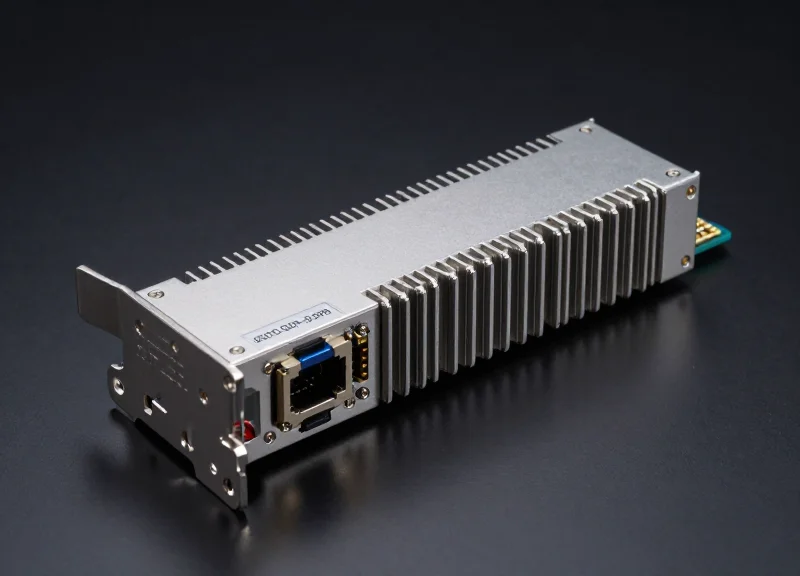
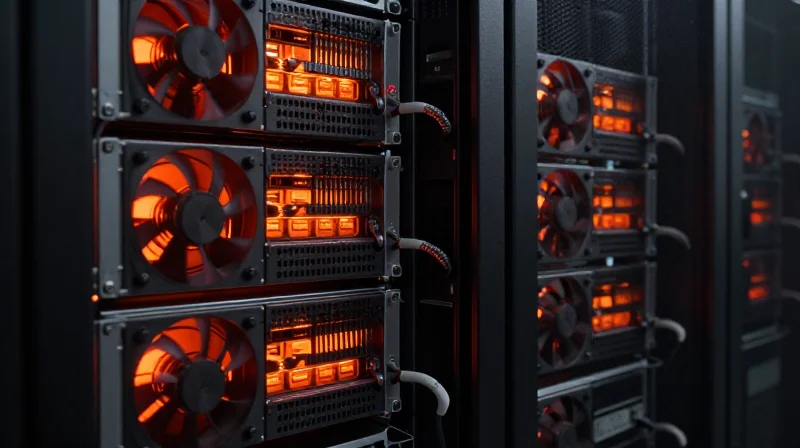
The transition to 800G networking represents a paradigm shift in data center thermals, as the Thermal Design Power (TDP) for individual optical transceivers has escalated to between 16W and 25W. This concentration of heat in the small form factor of OSFP or QSFP-DD modules creates a localized heat flux that traditional air-cooled systems struggle to dissipate. When a 32-port or 64-port switch is fully populated, the front-panel heat density exceeds the thermal conductivity of air, leading to throttled performance, reduced component lifespan, and a 'fan power trap' where the energy required to cool the switch rivals the energy used to power the silicon itself.
The Escalation of Optical Power Consumption
To understand why air cooling is failing, one must look at the generational jump in power requirements. Previous generations, such as 100G, operated comfortably within a 3.5W to 5W envelope. The leap to 800G involves sophisticated Digital Signal Processors (DSPs) and high-speed SerDes that generate significantly more heat to maintain signal integrity over copper or fiber.
| Generation | Typical TDP per Module | Front Panel Power (32 Ports) | Cooling Difficulty |
|---|---|---|---|
| 100G (QSFP28) | 3.5W - 5W | ~160W | Low (Standard Air) |
| 400G (QSFP-DD) | 10W - 14W | ~448W | Moderate (High-Flow Air) |
| 800G (OSFP/QSFP-DD800) | 17W - 25W | ~800W+ | Critical (Liquid/Immersion Ready) |
The Physics of Air-Cooling Limitations
Air cooling relies on the convective heat transfer coefficient, which is inherently limited by air's low density and thermal conductivity. To compensate for the increased heat of 800G modules, fans must spin at significantly higher RPMs. This results in three primary failures: first, acoustic noise levels that exceed safe occupational limits; second, a 'diminishing returns' curve where more power is spent moving air than is saved by cooling; and third, the physical inability to fit large enough heatsinks onto high-density front panels without blocking the very airflow needed for cooling.
- What is the primary cause of heat in 800G modules?
The primary heat source is the high-performance DSP (Digital Signal Processor) required to manage 112G PAM4 signaling lanes, which consumes roughly 50-60% of the total module power. - Why can't we just use bigger fans?
Increasing fan size or speed leads to exponential increases in power consumption (Fan Laws) and can cause vibration issues that interfere with delicate optical alignments. - Does air cooling affect the reliability of 800G optics?
Yes. Higher operating temperatures in air-cooled environments accelerate the degradation of laser diodes and increase the FIT (Failures in Time) rate for the transceiver electronics.
Immersion Cooling vs. Air Cooling: Mechanical Fundamentals
The Physics of Heat Dissipation: Air vs. Liquid
At the 800G threshold, the primary mechanical challenge is not just moving heat away from the rack, but extracting it from the silicon package itself. Air cooling relies on forced convection, which is fundamentally limited by air's low density and poor thermal conductivity. In contrast, immersion cooling utilizes dielectric fluids that possess significantly higher heat transfer coefficients, allowing for the rapid absorption of thermal energy directly from optical engines and ASICs without the intermediary resistance of a traditional heatsink-to-air interface.
| Property | Air (Atmospheric) | Dielectric Fluid (Single-Phase) | Improvement Factor |
|---|---|---|---|
| Thermal Conductivity (W/m·K) | 0.026 | 0.10 - 0.15 | 4x - 6x |
| Specific Heat Capacity (J/kg·K) | 1,006 | 1,800 - 2,200 | ~2x |
| Density (kg/m³) | 1.16 | 800 - 1,600 | 700x - 1,300x |
| Convective Heat Transfer (W/m²·K) | 10 - 100 | 500 - 2,000 | 10x - 20x |
Overcoming the Boundary Layer Bottleneck
In air-cooled 800G switches, a stagnant 'boundary layer' of air forms on the surface of components, acting as an insulator. To break this layer, fans must spin at extreme RPMs, consuming significant power and creating acoustic noise. Immersion cooling eliminates this bottleneck. Because the liquid medium is in direct contact with every millimeter of the 800G module, it removes heat evenly, preventing the 'hot spots' that typically lead to thermal throttling and component degradation in air-cooled environments.
- How does immersion handle the 800G module's concentrated heat?
By providing 100% surface area contact, immersion cooling reduces the thermal resistance between the chip and the cooling medium to near-zero levels, far outperforming the 50-60% efficiency of air-based heatsinks. - Is the mechanical complexity higher for immersion systems?
While the initial setup involves fluid management, immersion systems actually reduce mechanical complexity by eliminating thousands of individual server/switch fans and simplifying the facility-level chilled water requirements. - Does liquid cooling affect 800G signal integrity?
No. Engineered dielectric fluids are non-conductive and chemically inert, often improving signal integrity by maintaining a stable, lower operating temperature for the high-speed optical components.
Direct-to-Chip (Cold Plate) vs. Immersion: Choosing the Right Liquid Path
Direct-to-Chip (Cold Plate) vs. Immersion: Choosing the Right Liquid Path
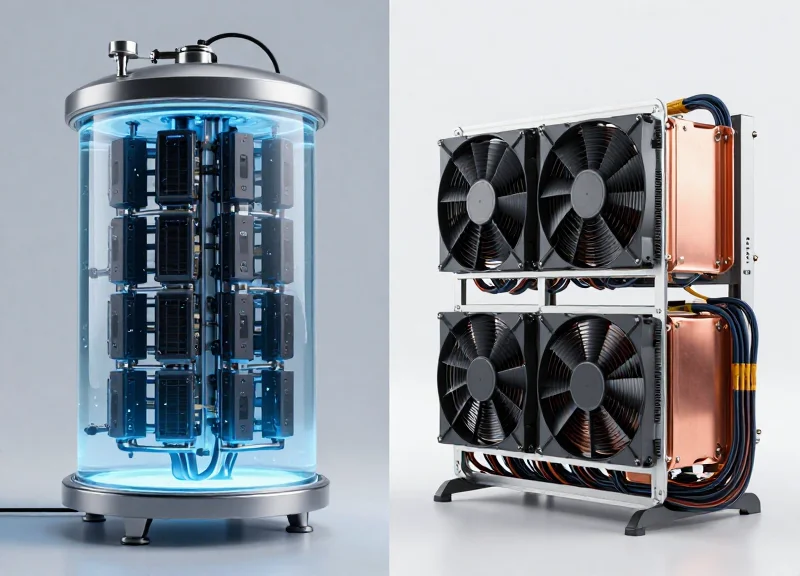
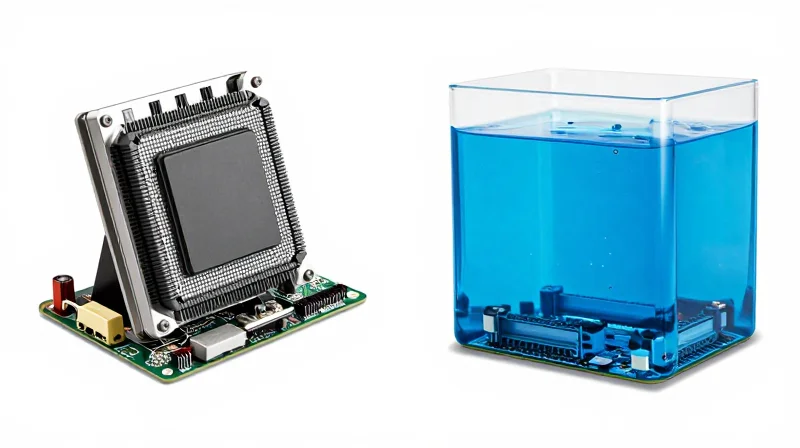
The choice between Direct-to-Chip (D2C) and immersion cooling for 800G deployments is a decision between targeted thermal management and holistic environmental control. While D2C excels at siphoning heat from high-wattage ASICs, immersion cooling offers a comprehensive solution that addresses the cooling needs of the entire switch chassis, including the increasingly problematic 800G optical transceivers.
The Hybrid Nature of Direct-to-Chip Cooling
Direct-to-Chip cooling utilizes cold plates mounted directly onto the primary heat source, typically the switch ASIC. This method is highly efficient for the silicon itself, but it often necessitates a hybrid approach. Because the cold plate only covers the processor, the rest of the components—specifically the 800G optics which can reach 25W-30W per module—still require traditional air cooling or complex secondary heat pipes. This can lead to a 'thermal gap' where the ASIC remains cool, but the surrounding I/O modules suffer from heat-induced performance throttling.
Immersion Cooling: Total Thermal Enclosure
In contrast, single-phase immersion cooling submerges the entire switch and all its pluggable optics into a thermally conductive, dielectric fluid. This eliminates the need for fans and airflow management entirely. By providing a uniform cooling medium for every square millimeter of the hardware, immersion effectively manages the concentrated heat density of 800G optics that D2C systems struggle to reach without significant mechanical complexity.
| Feature | Direct-to-Chip (Cold Plate) | Immersion (Single-Phase) |
|---|---|---|
| Heat Capture Target | ASIC/Processor Only | Entire Chassis & Optics |
| Optics Cooling | Requires Airflow/Hybrid | 100% Liquid Immersed |
| Leak Risk Profile | Moderate (Water/Glycol) | Low (Dielectric Fluid) |
| Infrastructure Impact | Standard Rack Compatible | Requires Specialized Tanks |
| Maintenance Style | Standard Hot-Swap | Clean-room/Drip-dry process |
Operational and Strategic Considerations
- Is D2C sufficient for 51.2T switches?
D2C is highly effective for the ASIC, but at 51.2T and beyond, the density of 800G optics creates a 'heat wall' at the faceplate that may require immersion to avoid transceiver failure. - Which technology offers better ROI?
D2C has lower initial CAPEX for existing air-cooled facilities. However, immersion offers superior OPEX through the total removal of fans and significantly lower PUE (Power Usage Effectiveness). - How does reliability compare?
Immersion protects components from dust, vibrations, and oxidation, potentially extending hardware lifespan beyond what is possible with D2C's hybrid air/liquid approach.
Impact on Latency and Signal Integrity at 800G

Impact on Latency and Signal Integrity at 800G
Maintaining signal integrity at 800G transmission speeds requires extreme thermal precision, as even minor temperature fluctuations can alter the impedance of high-speed traces and the performance of optical transceivers. Immersion cooling addresses this by surrounding components with a dielectric fluid that has a much higher thermal mass than air, effectively eliminating the thermal noise that plagues air-cooled systems. This stability ensures that the physical layer operates within tight tolerances, reducing the need for intensive signal processing and ensuring cleaner data transmission across high-density switch fabrics.
Mitigating Thermal Jitter and Phase Noise
In 800G architectures, signal jitter—timing variations in the arrival of data bits—is a primary cause of transmission errors. Traditional air cooling leads to localized hot spots and rapid temperature cycling as fan speeds ramp up and down. These cycles cause the dielectric constant of the PCB substrate to shift, leading to phase noise. Immersion cooling maintains a constant temperature across the entire signal path, from the ASIC to the optical engine, which stabilizes the signal phase and minimizes attenuation over high-speed copper or optical links.
| Signal Metric | Air Cooling (800G) | Immersion Cooling (800G) |
|---|---|---|
| Thermal Jitter | High - Induced by fan cycling and hot spots | Negligible - Isothermal fluid environment |
| Bit-Error Rate (BER) | Increases with thermal load and T-junction rise | Lower and more consistent baseline |
| Dielectric Stability | Variable due to local heat gradients | Highly stable across all PCB traces |
| Latency Impact | Higher FEC overhead required to correct errors | Lower FEC stress reduces processing delay |
Lowering Bit-Error Rates (BER) through Isothermal Operation
As data rates increase to 800G, the Bit-Error Rate (BER) becomes more sensitive to thermal noise. Higher temperatures degrade the signal-to-noise ratio (SNR) in the SerDes (Serializer/Deserializer) circuits. To compensate, networking hardware relies on Forward Error Correction (FEC). However, aggressive FEC increases computational overhead and adds microseconds of latency. By operating the 800G switch ASICs and optics at a lower, more consistent temperature through immersion, the raw BER is improved. This allows the system to operate more efficiently, minimizing the latency penalty associated with error recovery and complex signal reconditioning.
- Does the immersion fluid itself interfere with high-speed signals?
No, the dielectric fluids used in immersion cooling are specifically engineered to have no impact on signal propagation; in many cases, they offer better EMI shielding than air while maintaining a low dielectric constant. - How does immersion cooling affect the lifespan of 800G optics?
By maintaining lower laser diode temperatures and eliminating thermal expansion stress, immersion cooling can significantly extend the Mean Time Between Failures (MTBF) for 800G transceivers compared to air-cooled alternatives.
Power Usage Effectiveness (PUE) and Energy Efficiency Benchmarks

Transitioning to immersion cooling for 800G infrastructure represents a paradigm shift in energy efficiency, potentially lowering PUE from an industry average of 1.58 to as low as 1.02 by eliminating the 'fan tax' and drastically reducing the mechanical load on facility chillers.
Comparative Efficiency Metrics: 800G Infrastructure
| Cooling Method | Typical PUE | Fan Power Consumption | Chiller Load Reduction |
|---|---|---|---|
| Traditional Air Cooling | 1.5 - 1.7 | 15% - 20% of IT Load | Baseline |
| Direct-to-Chip (DLC) | 1.15 - 1.25 | 5% - 10% of IT Load | 40% - 50% Reduction |
| Single-Phase Immersion | 1.02 - 1.05 | 0% (Fans Removed) | Up to 95% Reduction |
The Elimination of Server-Level Fan Power
At the 800G threshold, the power required to move air across high-density line cards and optical transceivers becomes a significant portion of the total IT load. Immersion cooling removes the need for internal server fans entirely, as the dielectric fluid's natural or pumped convection handles heat transfer at the source. This 'fan-less' operation not only saves direct electricity but also reduces the secondary heat generated by the fans themselves, creating a virtuous cycle of efficiency.
Chiller-Less Operations and Heat Reuse
Immersion systems often allow for 'chiller-less' designs, utilizing dry coolers even in warm climates due to the high delta-T (temperature difference) possible with liquid. Furthermore, the concentrated heat captured by the dielectric fluid is of a higher grade than that of air, making it more viable for district heating or industrial heat reuse, which can further offset the Total Cost of Ownership (TCO) beyond simple PUE metrics.
Energy Efficiency FAQ
- How does 800G impact PUE specifically?
800G modules generate intense localized heat; air cooling requires higher fan speeds and lower ambient temperatures, which spikes PUE, whereas immersion remains stable regardless of port density. - Is a PUE of 1.03 realistic for 800G?
Yes, because the energy overhead is limited to small circulating pumps and external heat rejection, avoiding the massive energy draw of CRAC units and internal server fans. - Does immersion cooling improve UPS efficiency?
By reducing the total IT power draw by 15-20% (through fan removal), the UPS operates at a more efficient load point, contributing to overall facility energy savings.
Total Cost of Ownership (TCO) Deep Dive: Capex vs. Opex
Total Cost of Ownership (TCO) Deep Dive: Capex vs. Opex
The transition to 800G networking and high-density compute transforms the data center financial model from a focus on minimizing initial setup costs to a focus on maximizing long-term energy efficiency and hardware reliability. While immersion cooling requires a higher initial Capital Expenditure (Capex) due to the specialized dielectric fluids and tank infrastructure, it fundamentally slashes Operational Expenditure (Opex) by eliminating the high energy cost of server fans and mechanical chilling. For organizations deploying high-radix 800G switches, the TCO crossover point—where immersion becomes more cost-effective than air—is typically reached when rack densities exceed 30kW, a threshold that 800G infrastructure frequently surpasses.
The Capex Shift: Infrastructure Reimagined
In a greenfield 800G deployment, the Capex for immersion cooling includes the procurement of sealed tanks, Coolant Distribution Units (CDUs), and synthetic dielectric fluids. However, these costs are substantially offset by the removal of legacy facility requirements. By adopting immersion, operators can eliminate the need for raised floors, expensive Computer Room Air Handler (CRAH) units, and complex hot/cold aisle containment systems. Furthermore, because immersion systems are significantly more efficient, the required capacity of the backup power system (UPS) is reduced, as it no longer needs to support massive arrays of high-RPM server fans during a utility outage.
| Financial Driver | Traditional Air Cooling | Direct Liquid Cooling (DLC) | Single-Phase Immersion |
|---|---|---|---|
| Initial Infrastructure | Moderate (CRAH/Chillers) | High (Dual-loop systems) | High (Fluids/Tanks) |
| Energy Opex | Very High (Fans & HVAC) | Moderate (Secondary Fans) | Low (Pumps Only) |
| Maintenance Cost | Low (Standard Air) | Moderate (Leak Risk) | Very Low (Protected Hardware) |
| Space Efficiency | Low Density | Medium Density | Ultra-High Density |
| Hardware Lifespan | Baseline | Extended | Maximum (No Oxidation) |
Opex Savings: Beyond Just Electricity
The Opex advantages of immersion for 800G optics and switches extend beyond the Power Usage Effectiveness (PUE) ratio. In air-cooled environments, high-speed 800G transceivers are prone to overheating, leading to thermal throttling and accelerated component degradation. Immersion provides a stable thermal environment that eliminates these issues, significantly reducing the Mean Time Between Failures (MTBF). Additionally, the absence of fans removes vibration-induced mechanical stress and prevents the accumulation of dust and moisture-driven corrosion. This translates to lower service costs and a longer refresh cycle for expensive networking silicon.
Real Estate and Scaling Economics
For many operators, the most significant TCO advantage is space utilization. Immersion systems allow for power densities of 100kW or more per tank, requiring only a fraction of the square footage used by traditional air-cooled rows. This enables 800G clusters to be deployed in smaller, urban edge locations where real estate is at a premium, or allows existing facilities to scale their throughput by 5x to 10x without expanding the physical building footprint. This 'density dividend' can often justify the Capex investment on its own by deferring the need for new facility construction.
- What is the typical ROI period for 800G immersion systems?
Most high-density deployments see a full Return on Investment within 18 to 24 months, primarily due to 90% savings in cooling energy and improved hardware longevity. - Does the cost of dielectric fluid make immersion too expensive for small setups?
While fluid is a significant upfront cost, it is a one-time Capex investment. Modern synthetic fluids are designed to last 15+ years without replacement, unlike air filters or mechanical cooling parts. - How does maintenance labor cost compare?
Maintenance Opex is generally lower; while 'wet' maintenance requires specific procedures, the drastic reduction in hardware failures and the elimination of fan repairs result in fewer technician touchpoints over time.
Hardware Reliability and Component Longevity
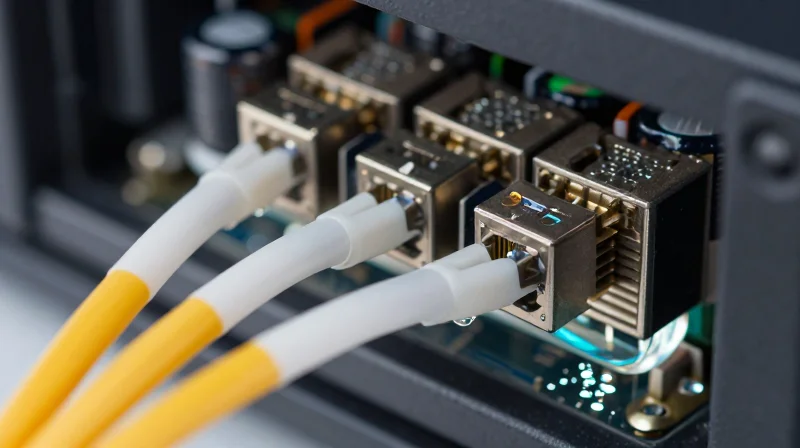
The transition to 800G networking introduces unprecedented thermal densities that push traditional air cooling to its physical limits, often leading to accelerated component degradation; immersion cooling mitigates these risks by submerging hardware in a chemically inert dielectric fluid, effectively isolating sensitive electronics from the primary drivers of hardware failure: oxidation, moisture, and thermal cycling.
Mitigating Chemical and Mechanical Failure Modes
In traditional air-cooled environments, 800G switches and transceivers are exposed to ambient humidity and particulate matter. Over time, this leads to microscopic corrosion on PCB traces and connector pins—a process accelerated by the high operating temperatures of 800G ASICs. Immersion cooling removes oxygen and moisture from the equation entirely. Furthermore, by eliminating the need for high-RPM server fans, immersion cooling removes a constant source of mechanical vibration. These harmonics can cause intermittent signal loss or physical wear on high-density interconnects, which are increasingly fragile at the 800G scale.
Thermal Cycling and Solder Joint Integrity
800G hardware experiences significant 'thermal swing' during load fluctuations. In air-cooled systems, the rapid expansion and contraction of different materials (silicon, ceramic, and copper) put immense strain on BGA (Ball Grid Array) solder joints. Immersion tanks act as a massive thermal heat sink with high heat capacity, ensuring that even during rapid spikes in processing demand, the temperature gradient remains narrow. This isothermal environment drastically reduces the risk of micro-fractures in solder joints, which is one of the leading causes of 'silent' hardware failure in high-speed networking equipment.
| Reliability Factor | Air Cooling | Direct-to-Chip (DLC) | Single-Phase Immersion |
|---|---|---|---|
| Oxidation/Corrosion Risk | High (Air exposure) | Moderate (Humidity present) | Zero (Inert Fluid) |
| Vibration (Fans/Pumps) | High (15k+ RPM fans) | Low (Chassis fans remain) | None (Fanless chassis) |
| Thermal Stability | Low (Wide fluctuations) | High (Targeted cooling) | Excellent (Isothermal) |
| Dust Accumulation | High (Requires filtering) | Moderate (Airflow needed) | None (Sealed environment) |
Common Questions on Hardware Longevity
- Does dielectric fluid degrade 800G optical transceivers?
Modern dielectric fluids are specifically engineered to be chemically compatible with standard networking components. For 800G optics, specifically designed 'immersion-ready' transceivers ensure that the fluid does not interfere with the optical path or seal integrity. - How much can immersion extend the lifecycle of an 800G switch?
Field data suggests a 25% to 40% reduction in hardware failure rates (AFR) compared to air cooling, potentially extending the reliable refresh cycle of core networking assets by 12 to 24 months. - Does removing fans affect the warranty of 800G hardware?
While traditional warranties may require modifications, many OEMs now offer 'immersion-ready' SKUs that are warrantied specifically for use in dielectric tanks, acknowledging the superior reliability of the environment.
Scalability and Future-Proofing for 1.6T Networks

Scalability and Future-Proofing for 1.6T Networks
While 800G optics are currently manageable with advanced air cooling or Direct-to-Chip (DTC) methods, the imminent transition to 1.6T networking introduces thermal densities that exceed the physical limits of traditional heat rejection. Immersion cooling provides a future-proof foundation by leveraging the superior heat capacity of dielectric fluids, enabling seamless scaling to 1,000W+ processors and 40W+ optical transceivers without requiring a total infrastructure overhaul.
The Thermal Leap: 800G vs. 1.6T Requirements
The move to 1.6T is not a linear upgrade; it represents a step-change in heat flux. As port speeds double, the power consumed by the Digital Signal Processor (DSP) and the laser drivers in optical modules rises significantly. When these modules are packed into a 1RU switch, they create concentrated heat zones that air cooling simply cannot penetrate effectively without astronomical energy costs for fan power.
| Metric | 800G Era | 1.6T Era (Projected) | Immersion Advantage |
|---|---|---|---|
| Switch ASIC Power | 500W - 800W | 1,000W - 1,500W | Stable at 1,500W+ |
| Optical Module Power | 15W - 25W | 30W - 45W | Uniform heat removal |
| Rack Density (Max) | 30kW - 50kW | 60kW - 100kW+ | Scalable to 250kW |
| Thermal Throttling Risk | Moderate | High (Air) | Near Zero |
Avoiding the 'Forklift Upgrade' Cycle
Data centers opting for air cooling today for 800G deployments are likely to face a 'cooling wall' within 24 to 36 months as 1.6T hardware becomes the standard. This necessitates a costly 'forklift upgrade'—replacing racks, CRAC units, and aisle containment. Immersion cooling eliminates this cycle. Once the tanks and dielectric fluid infrastructure are in place, they can support multiple generations of hardware, including 3.2T and CPO (Co-Packaged Optics) designs, without modifying the facility-level cooling loop.
- Will 1.6T optical modules be compatible with immersion fluids?
Yes, leading transceiver manufacturers are already testing 1.6T modules in dielectric fluids, focusing on ensuring that materials like thermal interface pads and housing gaskets are chemically compatible. - How does immersion cooling support Co-Packaged Optics (CPO)?
CPO brings the optics inside the switch package, concentrating all heat in a tiny area. Immersion is uniquely suited for CPO because the fluid circulates directly over the optical engines, preventing the hot spots that would otherwise cause signal degradation. - Does 1.6T infrastructure require a different type of dielectric fluid?
Generally, no. The high-performance fluids used for 800G have the latent thermal capacity to handle 1.6T heat loads; the primary adjustment is typically the flow rate or the secondary heat exchanger capacity.
While the transition to immersion cooling represents a shift in data center architecture, the performance gains and TCO savings for 800G deployments are undeniable. Contact our technical team today for a site-specific evaluation of your cooling strategy.