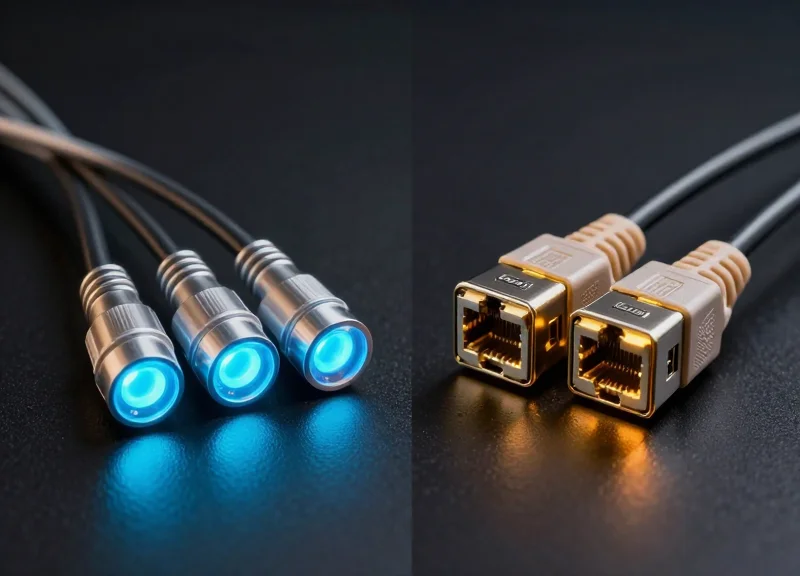
In the race for AI supremacy, the choice between InfiniBand and Ethernet is no longer just a technical preference—it is a strategic financial and operational decision. While GPUs get the glory, the interconnect fabric determines whether those GPUs spend their time computing or waiting for data. We dive deep into the performance metrics and cost structures that define today's AI infrastructure.
The Critical Role of Networking in Distributed AI Training
The Network as the System Backplane
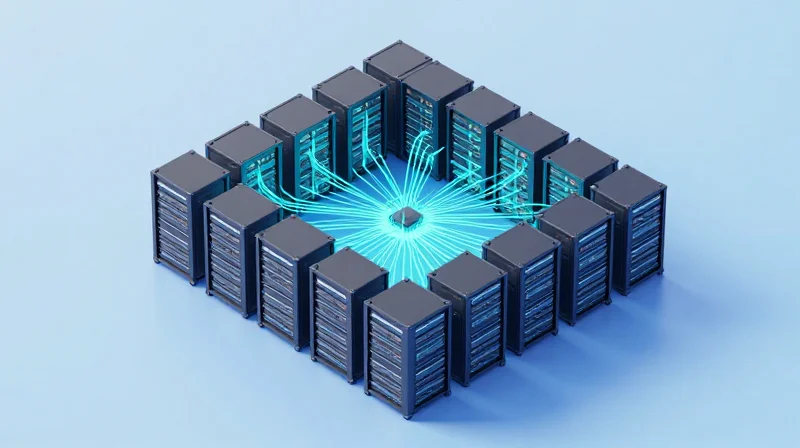
The network is the primary determinant of scalability in distributed AI training, serving as the high-speed fabric that transforms a collection of individual GPUs into a unified computational powerhouse capable of processing billions of parameters. In the era of Large Language Models (LLMs), a single GPU lacks the memory and compute to train modern architectures. Distributed training across thousands of nodes is mandatory, making the interconnect the 'virtual backplane' of the supercomputer. If this interconnect fails to provide sufficient bandwidth or low latency, the GPUs sit idle during synchronization phases, leading to massive inefficiencies in both time and capital expenditure.
Why the Network is the Modern AI Bottleneck
During distributed training, GPUs must constantly exchange information through collective communication primitives like All-Reduce and All-To-All. As model sizes grow, the volume of data transferred between nodes increases exponentially. When the network cannot keep pace with the compute speed of the GPUs, the cluster experiences the 'communication wall,' where adding more GPUs no longer significantly reduces training time.
| Training Phase | Primary Resource | Network Sensitivity |
|---|---|---|
| Forward/Backward Pass | GPU Compute Cores | Low (Internal to Node) |
| Gradient Synchronization | Interconnect Bandwidth | Critical (Cross-Node) |
| Weight Updates | Fabric Latency | Extreme (Sync Barrier) |
Essential Characteristics of AI Interconnects
- What is the importance of RDMA?
Remote Direct Memory Access (RDMA) allows GPUs to access memory on another node without involving the CPU, reducing overhead and drastically lowering latency during data transfers. - Why does tail latency matter more than average latency?
In synchronous training, every GPU must wait for the slowest packet to arrive before proceeding; high tail latency (jitter) can cause the entire cluster to stall. - How does bandwidth affect Model Flops Utilization (MFU)?
Higher bandwidth allows for faster gradient exchanges, ensuring that GPUs spend a higher percentage of their time on computation rather than communication, thus maximizing MFU.
Ultimately, the economic viability of an AI project depends on the network. A cluster with optimized interconnects like InfiniBand or Ultra Ethernet can achieve 60-70% MFU, effectively doubling the training throughput compared to standard Ethernet configurations. For organizations investing millions in hardware, the network is not just a utility—it is a performance multiplier.
InfiniBand: The Lossless Architecture for Maximum GPU Utilization
InfiniBand stands as the gold standard for AI interconnects because it was engineered specifically as a lossless, high-bandwidth fabric rather than a general-purpose communication network. While Ethernet excels at global scale and interoperability, InfiniBand focuses on the internal data center 'east-west' traffic required for distributed GPU computing. Its primary advantage lies in moving data directly between memory spaces without CPU intervention, ensuring that GPUs spend their time calculating gradients rather than waiting for late or dropped packets.
The Mechanics of Lossless Networking: Credit-Based Flow Control
The defining characteristic of InfiniBand is its credit-based flow control mechanism. In a standard Ethernet environment, a sender transmits data until the receiver's buffers are full, at which point the receiver drops excess packets, forcing the sender to retransmit. This 'drop and retry' cycle introduces massive latency spikes known as tail latency. In contrast, InfiniBand switches and adapters communicate via a credit system: a sender only transmits a packet if the receiver has explicitly signaled that it has the buffer space (credits) to accept it. This proactive management ensures zero packet loss due to buffer overflow, which is critical for the synchronized nature of All-Reduce operations in AI training.
RDMA and Kernel Bypass
InfiniBand’s performance is further amplified by Remote Direct Memory Access (RDMA). Traditional networking requires the CPU to manage data movement through the OS kernel and multiple memory copies. InfiniBand allows one GPU to write directly into the memory of another GPU on a different node. By bypassing the kernel and the CPU, InfiniBand reduces latency to sub-microsecond levels and frees up valuable CPU cycles for data preprocessing and job scheduling.
| Feature | InfiniBand (IB) | Standard Ethernet | |||
|---|---|---|---|---|---|
| Flow Control | Credit-based (Lossless) | Packet Drop / Buffer-based | |||
| Latency | Sub-1 microsecond | 10-50 microseconds | |||
| CPU Utilization | Minimal (Native RDMA) | High (TCP/IP Overhead) | Topology Support | Fat-Tree, Dragonfly | Clos (Leaf-Spine) |
The High-Performance Computing (HPC) Heritage
InfiniBand was not born in the AI era; it matured in the world of supercomputing. For decades, it has been the backbone of the world's most powerful scientific clusters. This legacy means that software libraries like the NVIDIA Collective Communications Library (NCCL) are natively optimized for InfiniBand verbs. For AI researchers, this translates to a stable, predictable environment where scaling from 8 GPUs to 80,000 GPUs results in near-linear performance gains.
- Why is zero packet loss so important for LLMs?
In distributed training, GPUs must synchronize their gradients regularly. If a single packet is lost, the entire cluster must wait for the retransmission, causing 'bubbles' of idleness where thousands of GPUs sit doing nothing, costing thousands of dollars per hour. - Can Ethernet mimic InfiniBand's lossless nature?
Yes, through RoCE (RDMA over Converged Ethernet) and Priority Flow Control (PFC), but these require complex configuration and tuning to avoid 'deadlock' scenarios that InfiniBand handles natively at the hardware level. - What are the downsides of InfiniBand?
The primary trade-offs are cost and vendor lock-in. InfiniBand hardware, particularly from market leader NVIDIA (Mellanox), carries a premium price and requires specialized knowledge to maintain compared to ubiquitous Ethernet systems.
Ethernet's AI Evolution: RDMA over Converged Ethernet (RoCE)
Ethernet's AI Evolution: RoCE v2
RoCE (RDMA over Converged Ethernet) is the industry's response to the dominance of InfiniBand in high-performance computing, providing a path for Ethernet to support the low-latency, high-throughput demands of modern AI clusters. By encapsulating InfiniBand transport packets within standard UDP/IP frames, RoCE v2 allows data to bypass the kernel and CPU, significantly reducing overhead and enabling direct GPU memory access across the network. This evolution is what allows standard Ethernet fabrics to compete in the realm of Large Language Model (LLM) training, where synchronization speed is the primary bottleneck.
The Architecture of RoCE v2
Unlike its predecessor, RoCE v2 operates at Layer 3, making it fully routable and suitable for large-scale data center architectures. It works by utilizing a specific UDP port (4791) to carry RDMA payloads. This allows the network to leverage standard IP routing and Equal-Cost Multi-Pathing (ECMP) while maintaining the 'zero-copy' transfer benefit. In this model, the Network Interface Card (NIC) handles the transport layer logic, ensuring that the host CPU remains available for compute tasks rather than managing network interrupts.
| Feature | InfiniBand | RoCE v2 (Ethernet) |
|---|---|---|
| Protocol Stack | Native InfiniBand Layer 2/3 | UDP/IP Encapsulation |
| Lossless Mechanism | Hardware Credit-based | Priority Flow Control (PFC) |
| Congestion Control | Deterministic / Built-in | ECN / DCQCN (Configuration Intensive) |
| Interoperability | Proprietary Ecosystem | Open Standard / Multi-vendor |
The Congestion Management Hurdle
The primary challenge in deploying RoCE v2 is that Ethernet is inherently a 'lossy' fabric. RDMA protocols are sensitive to packet loss; even a 0.1 percent loss rate can lead to catastrophic performance degradation due to retransmission timeouts. To solve this, RoCE requires a 'Lossless Ethernet' configuration using Priority Flow Control (PFC). PFC allows a switch to send a 'pause' frame to the upstream sender when its buffers are nearly full. However, this introduces risks such as head-of-line blocking and PFC storms, where a single congested node can potentially freeze an entire section of the network fabric if not tuned with precision.
- Is RoCE v2 truly 'plug-and-play'?
No. Unlike InfiniBand which is lossless by design, RoCE requires meticulous end-to-end configuration of DCBX, PFC, and ECN across every NIC and switch in the path to prevent congestion collapse. - How does RoCE handle GPU memory?
RoCE utilizes GPUDirect RDMA, allowing the NIC to read and write data directly from the GPU's HBM (High Bandwidth Memory), bypassing system RAM and the CPU entirely. - What is the role of DCQCN in RoCE?
Data Center Quantized Congestion Notification (DCQCN) is the algorithm that combines Explicit Congestion Notification (ECN) and PFC to throttle the sender's rate before buffers overflow, maintaining high throughput without dropping packets.
Latency Benchmarks: Mean Latency vs. Tail Latency

The Performance Gap: Why Mean Latency is a Deceptive Metric
While both InfiniBand and high-end Ethernet (RoCE v2) can deliver sub-microsecond average latencies in point-to-point tests, the performance of an AI cluster is dictated by tail latency—the worst-case delay experienced by the slowest nodes. In distributed training, collective operations such as All-Reduce require every GPU to synchronize; because the entire cluster must wait for the slowest packet to arrive (the 'barrier' effect), a high P99 or P99.9 latency on a single link can degrade the performance of thousands of GPUs simultaneously. InfiniBand’s deterministic, credit-based flow control ensures a tight latency distribution, whereas Ethernet’s reliance on Priority Flow Control (PFC) often leads to 'jitter' and congestion-induced delays.
Comparative Benchmarks: InfiniBand NDR vs. 400GbE RoCE v2
| Metric | InfiniBand NDR (400G) | Ethernet RoCE v2 (400G) | Impact on AI Training |
|---|---|---|---|
| Average (Mean) Latency | 0.6 µs - 0.7 µs | 1.0 µs - 1.2 µs | Minimal impact on small-scale tasks. |
| Tail Latency (P99.9) | 1.2 µs - 1.5 µs | 5.0 µs - 50.0+ µs | Determines the synchronization speed of NCCL/RCCL. |
| Message Rate (Million PPS) | Approx. 330 - 400 | Approx. 200 - 300 | Higher rates allow smaller, frequent updates. |
| Congestion Recovery | Hardware-driven (Native) | Reactive (ECN/PFC) | Ethernet risks 'pause frames' causing head-of-line blocking. |
The Message Rate Bottleneck and CPU Overhead
Beyond pure latency, the message rate—measured in packets per second (PPS)—defines how efficiently a network handles the massive volume of small synchronization messages typical of Large Language Model (LLM) training. InfiniBand adapters are designed with heavy hardware offloading that manages the entire transport layer on the NIC. In contrast, even with RoCE v2, Ethernet often requires more CPU cycles to manage the complex congestion control algorithms (like DCQCN) needed to prevent packet loss. As clusters scale to tens of thousands of GPUs, the overhead of managing these 'lossy' transitions in Ethernet can lead to significant 'long tail' events where communication wait times begin to exceed computation times.
Latency FAQ
- Why does P99 latency matter more than the average?
In AI workloads, GPUs perform 'collective' communication. If 1,023 GPUs finish their work in 10ms but one GPU experiences a P99 latency spike and takes 50ms, all 1,024 GPUs are stalled for 50ms. The slowest path defines the cluster's efficiency. - How does packet loss affect these benchmarks?
InfiniBand is natively lossless. Ethernet is natively lossy. When Ethernet loses a packet, it must retransmit, which can spike latency from microseconds to milliseconds, creating a massive tail that halts AI training cycles. - Can 'Ultra Ethernet' close this gap?
The Ultra Ethernet Consortium (UEC) is working on new transport protocols to replace RoCE v2, aiming to bring more deterministic, InfiniBand-like behavior to Ethernet, but currently, InfiniBand remains the benchmark for stability.
Power Consumption and Thermal Efficiency
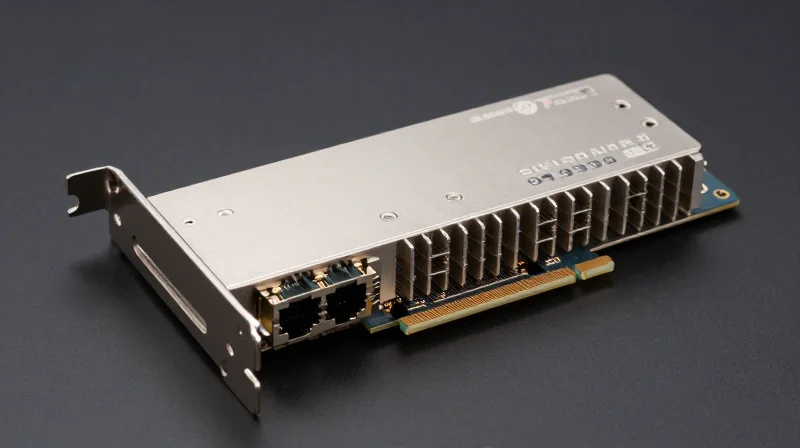
Power Consumption and Thermal Efficiency
InfiniBand typically maintains a slight edge in power efficiency per gigabit of throughput because its architecture is natively designed for low-overhead RDMA and hardware-based transport, whereas high-end Ethernet switches often require more complex silicon to manage congestion control and loss recovery at 800G speeds. While the networking tier represents approximately 10-15% of total AI cluster power consumption, the thermal density of high-radix switches—reaching up to 500W-700W per 1U or 2U unit—necessitates rigorous airflow management or liquid cooling to prevent performance throttling.
The Energy Footprint of High-Radix Switches
Modern AI networking relies on high-radix switches like the NVIDIA Quantum-2 (InfiniBand) and Broadcom Tomahawk 5-based Ethernet platforms. High-radix designs reduce the number of 'hops' in a Fat-Tree topology, which theoretically lowers total power consumption by reducing the number of required switches. However, these chips operate at the limit of air-cooling capabilities. For instance, an 800G Ethernet switch with 64 ports can consume over 2500W when fully loaded with optical transceivers, making the energy efficiency of the switch silicon and the efficiency of the power delivery units (PDUs) critical for operational stability.
| Metric | InfiniBand (NVIDIA Quantum-2) | High-End Ethernet (800G RoCE) |
|---|---|---|
| Typical Max Power (Switch) | ~1000W - 1200W | ~2000W - 2600W |
| Radix (Port Count) | 64 ports (NDR 400G) | 64 ports (800G) / 128 (400G) |
| Power Per Port (Estimated) | 15W - 18W (at 400G) | 25W - 35W (at 800G) |
| Cooling Requirement | High Airflow / Liquid Optional | High Airflow / Liquid Preferred |
| Optical Power Overhead | High (up to 14W per NDR transceiver) | Very High (up to 20W+ per 800G transceiver) |
Optical Transceivers and Thermal Loads
A significant and often overlooked portion of the power budget is consumed by optical transceivers rather than the switch silicon itself. As AI clusters move to 800G and beyond, the power required to convert electrical signals to optical signals (and vice versa) has skyrocketed. Linear Drive Pluggable Optics (LPO) and Co-Packaged Optics (CPO) are emerging as 'alternative' solutions to mitigate this, removing the DSP (Digital Signal Processor) from the pluggable module to save roughly 2W to 4W per port. In a cluster with thousands of links, these marginal gains represent megawatts of saved power and reduced cooling complexity.
- Does InfiniBand always use less power than Ethernet?
Generally yes, at equivalent throughput, because InfiniBand offloads transport logic to the hardware, requiring fewer CPU cycles and less complex switch processing than Ethernet-based RoCE deployments. - How does heat affect AI network performance?
Excessive heat leads to thermal throttling in the switch ASICs or optical modules, which increases bit-error rates (BER) and triggers retransmissions, severely impacting tail latency in training jobs. - What role does liquid cooling play in AI networking?
As switch power exceeds 500W per rack unit, air cooling becomes inefficient. Liquid-to-chip cooling or rear-door heat exchangers are becoming standard for 800G and 1.6T deployments to maintain consistent transceiver temperatures.
Total Cost of Ownership (TCO) Breakdown

Total Cost of Ownership (TCO) Breakdown
The Total Cost of Ownership (TCO) for AI networking is defined by the balance between initial hardware acquisition and the long-term efficiency of the compute cluster; while InfiniBand typically commands a 15% to 30% premium in upfront CAPEX, its ability to maximize GPU utilization often makes it the more cost-effective choice for large-scale training where idle GPU time represents a massive sunk cost.
CAPEX: Hardware and Infrastructure Costs
| Component | InfiniBand (NDR/XDR) | High-End Ethernet (RoCE v2) | Relative Cost Difference |
|---|---|---|---|
| Network Interface Cards (NICs) | $1,200 - $1,800 per port | $800 - $1,200 per port | InfiniBand is ~30% higher |
| Switch Chassis/Fixed | High (Proprietary Silicon) | Moderate (Broadcom/Mellanox) | Ethernet is ~20% lower |
| Cabling (DAC/AOC) | Standardized/Higher Quality | Commodity/Competitive | Negligible at scale |
| Software Licensing | Often bundled/Proprietary | Open (SONiC) or Licensed | Ethernet varies widely |
InfiniBand’s CAPEX is heavily influenced by vendor lock-in, as NVIDIA (Mellanox) dominates the ecosystem, providing a tightly integrated but premium-priced stack. In contrast, Ethernet benefits from a vast ecosystem of white-box switches and open-source operating systems like SONiC, allowing hyperscalers to drive down hardware margins through competitive bidding and multi-vendor sourcing.
OPEX: Engineering Expertise and Maintenance
- Does InfiniBand require specialized engineering staff?
Yes. InfiniBand uses a Subnet Manager and specialized management tools that require specific expertise often distinct from traditional network engineering, potentially increasing payroll costs. - How does tuning impact the OPEX of Ethernet deployments?
Ethernet requires significant manual tuning of PFC (Priority Flow Control) and ECN (Explicit Congestion Notification) to achieve near-lossless performance, leading to higher labor-hours during initial deployment and scaling. - What is the cost implication of proprietary lock-in?
Proprietary lock-in with InfiniBand limits negotiating leverage during upgrades, whereas Ethernet's interoperability allows for more flexible, cost-optimized lifecycle management.
Efficiency-Adjusted Financial Analysis
| Metric | InfiniBand Cluster | Ethernet Cluster | Economic Impact |
|---|---|---|---|
| GPU Idle Time (Tail Latency) | Minimal (<2%) | Variable (5-15%) | InfiniBand saves $M in compute |
| Power/Cooling Per Port | Optimized (Lower) | Standard (Higher) | InfiniBand lower long-term OPEX |
| 3-Year TCO Estimate | Higher Base + Lower OPEX | Lower Base + Higher Tuning | InfiniBand wins at massive scale |
Ultimately, the financial decision hinges on the 'Job Completion Time' (JCT) metric. For organizations running multi-month training jobs on thousands of GPUs, the cost of the network is a small fraction of the total cluster cost; in these scenarios, the performance stability of InfiniBand provides a hedge against the massive financial risks of delayed model delivery or underutilized hardware.
Emerging Alternatives: UEC, Slingshot, and Proprietary Fabrics
The choice for AI infrastructure is no longer limited to standard InfiniBand or commodity Ethernet; instead, a new class of 'AI-optimized' fabrics is emerging. Technologies like the Ultra Ethernet Consortium (UEC) and HPE Slingshot aim to bridge the gap by retaining the cost-effective and interoperable nature of Ethernet while integrating the high-performance, lossless characteristics of InfiniBand. These alternatives are designed to eliminate the 'tail latency' issues that often plague standard RoCE deployments at scale.
The Ultra Ethernet Consortium (UEC)
Formed by industry giants including AMD, Arista, Broadcom, and Meta, the UEC is developing a complete communication stack that replaces the legacy transport layers of standard Ethernet. Its primary goal is to create a more flexible alternative to RDMA (Remote Direct Memory Access) that can handle the out-of-order packet delivery required for massive AI training clusters without the strict, often brittle, requirements of InfiniBand.
HPE Slingshot: High-Performance Ethernet
HPE Slingshot is a specialized interconnect used in some of the world's most powerful supercomputers, such as Frontier. While it is Ethernet-compatible at the frame level, it utilizes proprietary enhancements for hardware-based congestion management and adaptive routing. This allows Slingshot to maintain high throughput even when the network is under heavy utilization, a common scenario in large-scale LLM training.
Comparison of Emerging Fabrics
| Feature | InfiniBand NDR | Ultra Ethernet (UEC) | HPE Slingshot |
|---|---|---|---|
| Vendor Ecosystem | Primarily NVIDIA | Open Multi-vendor | HPE/Cray Ecosystem |
| Congestion Control | Credit-based (Lossless) | Advanced Packet Spraying | Hardware-based Adaptive |
| Interoperability | Restricted | High (Ethernet Based) | High (Ethernet Compatible) |
| Target Workload | Ultra-low Latency HPC | Massive Scale GenAI | Large-scale Supercomputing |
Proprietary Hyper-Scale Interconnects
Beyond industry standards, major cloud providers are building internal fabrics tailored to their specific hardware. Google’s TPU pods utilize a proprietary Optical Circuit Switching (OCS) interconnect that allows for dynamic reconfiguration of the network topology. Similarly, AWS employs its Nitro-based Elastic Fabric Adapter (EFA) to provide specialized OS-bypass capabilities on top of its standard EC2 networking, proving that for the largest players, the 'best' fabric is often one built in-house.
- Will UEC replace InfiniBand?
UEC is positioned as a direct competitor for large-scale AI, though InfiniBand remains the gold standard for latency-sensitive, tightly coupled workloads in the short term. - What is the main advantage of Slingshot?
Slingshot provides the ability to run standard Ethernet traffic and high-performance AI traffic on the same physical fabric without performance degradation. - Why do hyperscalers use proprietary fabrics?
Proprietary fabrics allow for vertical integration with custom silicon (like TPUs or Trainium), optimizing performance and reducing the cost per FLOP compared to commercial off-the-shelf solutions.
Selecting the Right Fabric: A Decision Matrix for AI Architects
Choosing the Foundation: InfiniBand vs. Ethernet Decision Matrix
Selecting the right network fabric is no longer a peripheral hardware choice but a core architectural decision that dictates the performance ceiling of the entire AI stack. For large-scale training of Large Language Models (LLMs) where GPU idle time equates to massive losses in productivity, InfiniBand’s lossless nature and nanosecond latency remain the industry benchmark. Conversely, for inference-heavy workloads or enterprise clusters that prioritize cost and operational familiarity, high-speed Ethernet (400G/800G) utilizing RoCEv2 offers a highly scalable and budget-conscious alternative.
| Selection Criterion | InfiniBand (NDR/XDR) | Ethernet (RoCEv2) | Emerging (UEC/Slingshot) |
|---|---|---|---|
| Primary Use Case | Massive-scale LLM Training | Inference & General AI | HPC & Hyperscale AI |
| Network Topology | Fat-Tree / Dragonfly+ | Leaf-Spine (Clos) | Adaptive Routing/Non-blocking |
| Congestion Control | Hardware-based (Lossless) | PFC/ECN (Software-tuned) | Advanced Packet Spraying |
| Operational Complexity | High (Specialized Skills) | Moderate (Standard DevOps) | High (Early Adopter) |
| Relative TCO | Premium ($$$) | Standard ($$) | Varies ($$$) |
Architectural Priority: Efficiency vs. Universality
Architects must prioritize InfiniBand when 'Job Completion Time' (JCT) is the critical success metric. In clusters exceeding 1,000 GPUs, the overhead of packet loss and retransmissions in standard Ethernet can lead to 'incast' congestion, where the network becomes the primary bottleneck for collective operations like All-Reduce. However, if the engineering team lacks specialized InfiniBand skill sets or if the cluster must integrate seamlessly with an existing IP-based storage and management plane, high-performance Ethernet is the pragmatic choice. The trade-off is typically a 10-20% performance penalty in training efficiency for a significantly lower CAPEX and easier maintenance.
Decision Logic by Workload Profile
- Scenario A: Foundation Model Training
Recommendation: InfiniBand. When training models with 70B+ parameters, the low-latency hardware-offload capabilities of InfiniBand ensure that GPU utilization remains above 70%, maximizing the return on expensive H100/B200 investments. - Scenario B: Distributed Inference & Fine-tuning
Recommendation: Ethernet (400G+). For serving models or fine-tuning (LoRA), the interconnect demands are less rigorous. Ethernet provides the necessary bandwidth while leveraging existing data center monitoring and security tools. - Scenario C: Multi-Tenant AI Cloud
Recommendation: Hybrid or UEC-Ready Ethernet. If the environment must support various customers with diverse workloads, Ethernet's flexibility and superior virtualization support make it the better platform for multi-tenancy.
Architectural FAQs
- Can I switch from Ethernet to InfiniBand later?
It is difficult. InfiniBand requires specific NICs (HCAs), switches, and often different cabling (DAC or AOC). A mid-cycle transition usually requires a full rack-level overhaul. - Does the choice of fabric affect software compatibility?
Mostly no. Frameworks like PyTorch and TensorFlow use NCCL (NVIDIA Collective Communications Library), which abstracts the underlying fabric, though performance tuning parameters will differ significantly between the two. - Is InfiniBand still proprietary?
While managed by the IBTA (InfiniBand Trade Association), the market is heavily dominated by NVIDIA (Mellanox). Choosing InfiniBand often implies a commitment to the NVIDIA ecosystem for the best end-to-end integration.
Choosing between InfiniBand and Ethernet requires balancing immediate performance needs against long-term scalability and cost. Whether you are building a boutique AI cloud or a massive foundation model cluster, the network design will dictate your ROI. Ready to optimize your AI infrastructure? Contact our systems architects for a custom performance audit today.