As the demand for high-density compute rises, IT leaders face a critical crossroads: scale infrastructure using traditional legacy models or pivot toward sustainable, green data center architectures. While green initiatives are often viewed through the lens of corporate social responsibility, the real story lies in operational performance and bottom-line stability.
Defining Green Data Centers in the Modern Landscape

Defining the Green Data Center Paradigm
In the modern digital landscape, a sustainable green data center transcends mere energy efficiency; it represents a holistic commitment to reducing the total carbon impact of data operations. These facilities prioritize Power Usage Effectiveness (PUE) as a primary metric, aiming for ratios as close to 1.0 as possible. By leveraging technologies such as liquid cooling, AI-driven workload management, and modular infrastructure, green data centers minimize 'overhead' energy—the power consumed by non-IT equipment like cooling systems and uninterruptible power supplies (UPS).
Core Pillars of Sustainability
- Energy Optimization
Utilizing advanced thermodynamics and hot-aisle/cold-aisle containment to reduce cooling requirements. - Renewable Integration
Direct sourcing of power from wind, solar, or hydroelectric grids to decouple IT growth from fossil fuel consumption. - Circular Lifecycle Management
Prioritizing hardware longevity and responsible e-waste recycling to minimize embodied carbon.
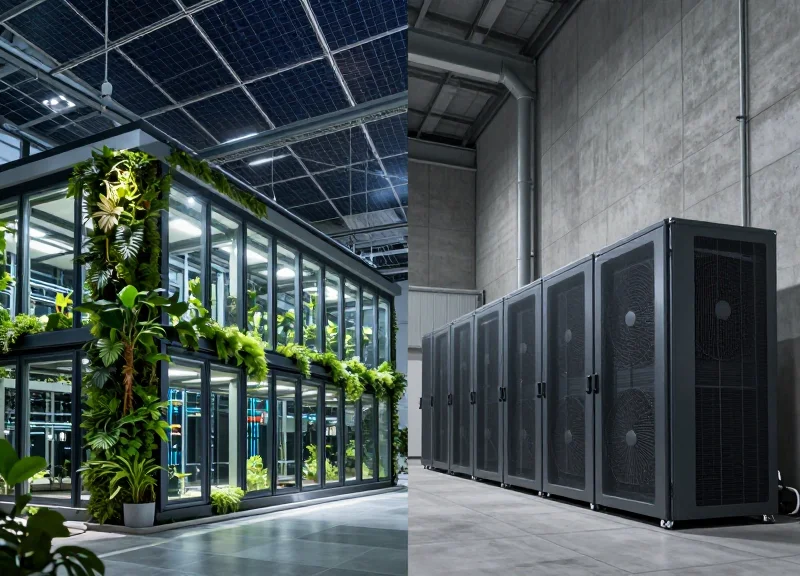
Comparative Metrics: Traditional vs. Green Facilities
| Metric | Traditional Facility | Sustainable Green Center |
|---|---|---|
| Average PUE | 1.6 - 2.0 | 1.1 - 1.3 |
| Cooling Method | CRAC/CRAH Systems | Liquid/Free Cooling |
| Energy Source | Grid (Mixed Carbon) | Renewables (PPA/Direct) |
Achieving these performance benchmarks requires a fundamental shift in capital expenditure (CapEx) toward smarter infrastructure. While the initial investment in high-efficiency hardware and renewable energy procurement may be higher than legacy alternatives, the long-term operational expenditure (OpEx) is significantly reduced through lowered electricity consumption and decreased carbon tax exposure.
Analyzing Energy Efficiency and Power Consumption

The Mechanics of Superior Energy Efficiency
The primary differentiator between sustainable green data centers and legacy infrastructure lies in the Power Usage Effectiveness (PUE) ratio. While traditional centers often suffer from bloated cooling requirements and inefficient power distribution units (PDUs), green facilities utilize AI-driven thermal management, hot/cold aisle containment, and liquid cooling technologies to minimize non-IT energy loads. By reducing the energy overhead required to support the servers themselves, these facilities achieve a PUE nearing 1.0, effectively directing almost all power consumption toward computational output.
Comparative Efficiency Metrics
| Metric | Legacy Data Center | Green Data Center |
|---|---|---|
| Average PUE | 1.8 - 2.5 | 1.05 - 1.2 |
| Cooling Method | Raised floor / CRAC | Free cooling / Liquid immersion |
| Server Utilization | 15% - 30% | 60% - 85% |
| Power Source | Grid-heavy | Renewable / Hybrid |
Optimizing Server Utilization
Hardware power consumption is rarely linear; idling servers draw a significant portion of peak power while performing no useful work. Green data centers mitigate this 'ghost server' syndrome through software-defined infrastructure (SDI) and virtualization platforms. By dynamically migrating workloads to a smaller footprint during low-traffic periods, these facilities allow entire server banks to enter low-power sleep modes, drastically reducing the total carbon footprint per rack.
Common Questions on Power Efficiency
- How does free cooling work in green data centers?
Free cooling utilizes ambient external air or water to dissipate heat instead of power-hungry mechanical refrigeration, significantly lowering the total energy burden during favorable climate conditions. - Does higher server utilization compromise performance?
No, modern orchestration tools use intelligent load balancing to ensure performance remains stable while maximizing hardware density, preventing the bottlenecks often associated with over-provisioned legacy setups. - Can legacy centers be retrofitted for green efficiency?
While full conversion is complex, many legacy centers can improve PUE by upgrading to high-efficiency UPS systems, installing aisle containment curtains, and implementing intelligent sensor monitoring for real-time airflow management.
The Latency Myth: Do Green Facilities Slow You Down?
Debunking the Performance Penalty Myth
A pervasive myth in the data center industry suggests that prioritizing energy efficiency and sustainability forces a trade-off in processing power and latency. In reality, the pursuit of 'green' infrastructure often necessitates the deployment of modern, high-density hardware and optimized airflow management systems that inherently improve performance metrics. Sustainable facilities leverage advanced liquid cooling and AI-driven workload orchestration, which reduce thermal throttling and allow server components to maintain peak clock speeds more consistently than legacy air-cooled environments.
Comparative Latency and Throughput Impact
| Infrastructure Attribute | Legacy Data Center | Green Data Center |
|---|---|---|
| Cooling Method | Traditional HVAC (High Variance) | Liquid/Direct-to-Chip (Stable) |
| Thermal Throttling | Frequent during peaks | Minimized via precision cooling |
| Hardware Density | Low/Moderate | Ultra-High Density |
| Latency Performance | Subject to power constraints | Optimized for high-throughput |
Frequently Asked Questions
- Do green energy sources cause power fluctuations that affect server stability?
No. Modern sustainable facilities employ advanced Battery Energy Storage Systems (BESS) and redundant Uninterruptible Power Supplies (UPS) that condition incoming power from renewable sources, ensuring higher power quality than traditional grid connections. - Does PUE optimization sacrifice server computing cycles?
Quite the opposite. Improving PUE (Power Usage Effectiveness) focuses on reducing overhead power spent on cooling and lighting, freeing up more of the power budget for actual compute, storage, and networking hardware. - Are sustainable data centers slower at the edge?
Sustainability at the edge often utilizes modular, micro-data centers. These units are specifically designed for rapid deployment and proximity to users, which inherently reduces network latency compared to hauling data back to massive, distant legacy centers.
Total Cost of Ownership: Beyond the Initial Capex

While sustainable green data centers often require a higher initial capital expenditure (Capex) due to advanced cooling technologies and renewable energy infrastructure, the true financial viability must be assessed through the lens of Total Cost of Ownership (TCO). Transitioning from legacy models involves upfront costs for high-efficiency hardware and LEED-certified design, but these are quickly recouped through drastic reductions in Power Usage Effectiveness (PUE) and operational expenditure (Opex).
Capex vs. Opex: The Value Equilibrium
| Cost Factor | Legacy Data Center | Green Data Center |
|---|---|---|
| Initial Capex | Moderate (Traditional HVAC/Power) | High (Advanced Cooling/Renewables) |
| Energy Costs (Opex) | High (Inefficient Cooling/Load) | Low (Optimized PUE/Renewable Sources) |
| Maintenance | Frequent/Reactive | Predictive/Automated |
| Asset Lifespan | Short (Rapid Obsolescence) | Extended (Modular/Scalable Design) |
The primary driver of the TCO advantage in green facilities is the elimination of 'energy waste.' Legacy data centers often lose up to 40% of their power to inefficient cooling systems. By contrast, green data centers employ liquid cooling and AI-driven thermal management, which slash electricity bills by 30-50% annually, providing a clear path to amortization of the initial investment within three to five years.
Frequently Asked Questions on Financial Viability
- Does green hardware always cost more upfront?
While specific high-efficiency components command a premium, total project costs are increasingly competitive due to modular design approaches and government tax incentives for sustainable infrastructure. - How does energy volatility impact TCO?
Sustainable data centers mitigate energy price volatility by sourcing power through long-term Power Purchase Agreements (PPAs) or on-site renewable generation, insulating the business from sudden utility market spikes. - Is the TCO benefit strictly limited to electricity savings?
No; extended benefits include lower carbon taxes, better compliance with ESG regulations, increased hardware longevity, and higher brand equity in a market demanding corporate sustainability.
Regulatory Compliance and ESG Benefits
Regulatory Landscape and Carbon Accountability
Governments worldwide are shifting from voluntary reporting to mandatory carbon disclosure frameworks. Organizations relying on legacy data centers face increasing risk as energy-inefficient facilities become liabilities under regulations like the EU's Corporate Sustainability Reporting Directive (CSRD) and the SEC's proposed climate disclosure rules in the United States.
| Regulation | Target Focus | Business Impact |
|---|---|---|
| CSRD (EU) | Scope 1, 2, and 3 emissions | Mandatory reporting of IT supply chain footprint |
| SEC Climate Rules (USA) | Material climate risk | Increased transparency on energy procurement |
| Energy Efficiency Directive | Power Usage Effectiveness (PUE) | Strict operational efficiency thresholds |
Strategic ESG Advantages
Transitioning to green data centers is no longer just a defensive regulatory move; it is a strategic asset for ESG-conscious stakeholders. By lowering the carbon intensity of digital operations, companies improve their standing with ESG rating agencies, attract sustainable investment capital, and strengthen brand equity.
- How does facility selection impact Scope 3 reporting?
Utilizing green data centers shifts the burden of energy management to providers who optimize for renewable energy credits (RECs) and PUE, effectively reducing your indirect Scope 3 carbon footprint. - Can green infrastructure improve capital access?
Yes. Many institutional investors now prioritize 'green bonds' and low-cost financing for firms that demonstrate measurable progress toward net-zero targets. - Does compliance necessitate a complete migration?
Not necessarily. Hybrid approaches, such as moving non-latency-sensitive workloads to green cloud regions, allow for phased compliance without requiring immediate wholesale retirement of legacy hardware.
The path forward involves integrating carbon accounting directly into IT procurement cycles. By prioritizing facilities that provide granular, real-time energy reporting, organizations can transform compliance obligations into a verifiable record of their commitment to sustainable digital transformation.
Reliability and Redundancy in Green Architectures

The evolution of green data centers has fundamentally altered the paradigm of high availability. While historical skepticism suggested that renewable-reliant infrastructures might struggle with intermittent power stability, modern green architectures leverage sophisticated energy storage, decentralized microgrids, and highly efficient cooling topologies to maintain uptime that rivals or surpasses legacy Tier IV data centers.
Resilience Through Architectural Innovation
Green architectures prioritize resilience by integrating hardware redundancy directly into the energy-distribution layer. Unlike traditional facilities that rely heavily on centralized, carbon-heavy uninterruptible power supplies (UPS), green facilities often utilize distributed lithium-ion battery arrays or hydrogen fuel cells. These components provide rapid response times and smoother failover protocols, mitigating the risks associated with grid fluctuations.
| Reliability Metric | Traditional Facility | Green Sustainable Facility |
|---|---|---|
| Power Redundancy | Centralized Diesel Generators | Hydrogen Cells & Energy Storage |
| Cooling Failover | Mechanical Chiller Units | Liquid Cooling & Free Air |
| Grid Dependence | High (Public Grid) | Low (Integrated Microgrid) |
Addressing Common Reliability Concerns
- Does intermittent renewable energy threaten uptime?
No, green facilities use sophisticated energy management software and on-site storage buffers that isolate the critical IT load from external grid volatility, ensuring constant power delivery. - Is liquid cooling less reliable than traditional air cooling?
On the contrary, liquid cooling systems are more efficient at heat dissipation and have fewer moving parts than mechanical air-handling units, leading to reduced maintenance intervals and a lower probability of thermal shutdown. - Can sustainable designs meet Tier IV standards?
Yes, current sustainable designs are engineered to be fault-tolerant with multiple independent distribution paths, meeting and often exceeding industry standards for concurrent maintainability.
By shifting to modular, self-healing infrastructure, green data centers minimize single points of failure. The transition from legacy mechanical cooling to liquid-based or immersion cooling further stabilizes hardware temperatures, directly extending the lifespan of mission-critical servers and reducing the frequency of hardware-related outages.
Scalability and Future-Proofing IT Strategy

The Scalability Imperative for AI and ML Workloads
Modern AI and machine learning workloads demand exceptional power densities that traditional legacy facilities struggle to support. Sustainable green data centers utilize advanced liquid cooling and modular design principles, allowing IT departments to scale compute capacity without hitting the thermal or power ceilings that characterize older infrastructure.
| Feature | Legacy Data Center | Sustainable Green Center |
|---|---|---|
| Cooling Capacity | Limited (Air-cooled) | High (Liquid immersion/Direct-to-chip) |
| Scalability | Rigid, fixed power limits | Modular, elastic load balancing |
| AI Readiness | Insufficient density | Native high-performance support |
Strategic Advantages of Cloud-Native Sustainability
Integrating cloud-native operations with sustainable infrastructure provides a competitive edge through agility. By leveraging intelligent power management software and renewable energy integration, organizations can optimize their IT footprint in real-time based on fluctuating demand and carbon intensity levels.
Frequently Asked Questions
- How do green data centers support future AI growth?
They provide the advanced thermal management required for high-density GPUs and TPUs, ensuring that power delivery remains efficient as performance demands increase. - Is sustainable infrastructure truly future-proof?
Yes, because these facilities are designed with modularity in mind, allowing for component upgrades without requiring complete mechanical overhauls. - Does sustainability limit performance?
On the contrary, green data centers often outperform traditional sites by eliminating inefficient cooling cycles and utilizing AI-driven load management to maximize compute throughput.
Making the Transition: Key Considerations for CTOs
For CTOs, moving to a sustainable data center is not merely an environmental initiative but a fundamental architectural pivot. The transition requires a phased approach that mitigates operational risk while leveraging modern advancements in power usage effectiveness (PUE) and workload efficiency to gain a long-term competitive advantage.
Strategic Assessment and Planning
Before decommissioning legacy assets, CTOs must conduct a granular audit of existing workload profiles. Not every workload is optimized for the high-density cooling requirements often found in green-certified facilities. Identifying 'low-hanging fruit'—such as non-critical batch processing—is the optimal starting point for initial migration to cloud-based or green-colocation environments.
| Phase | Primary Objective | Key Consideration |
|---|---|---|
| Phase 1: Audit | Workload Profiling | Identify carbon-intensive legacy applications. |
| Phase 2: Pilot | Hybrid Migration | Transition non-latency-sensitive workloads. |
| Phase 3: Scale | Full Integration | Consolidate remaining data centers to high-efficiency sites. |
Critical Migration Considerations
- How do I justify the upfront CAPEX of migration?
Focus on TCO (Total Cost of Ownership) reductions through lowered energy consumption, optimized cooling costs, and tax incentives linked to green certifications like LEED or BREEAM. - Will performance suffer during the transition?
Modern green architectures often utilize advanced liquid cooling and optimized hot/cold aisle containment, which can actually increase compute density and improve hardware longevity compared to legacy facilities. - What about vendor lock-in?
Prioritize providers that offer open-standards and transparent reporting, ensuring that your sustainability metrics are portable and verifiable across different platforms.
Implementing Sustainable Governance
Sustainability must be integrated into the IT procurement cycle. By establishing strict green SLAs (Service Level Agreements) with colocation partners or cloud providers, CTOs ensure that their infrastructure remains aligned with corporate ESG mandates. This includes enforcing real-time monitoring of energy consumption, renewable energy credit (REC) sourcing, and water usage effectiveness (WUE) metrics.
Transitioning to sustainable green data centers is no longer an optional climate goal; it is a strategic business decision that optimizes performance and mitigates rising energy costs. By prioritizing energy-efficient infrastructure, your organization can achieve long-term fiscal stability and competitive speed. Ready to modernize your infrastructure? Contact our consulting team today for a comprehensive TCO audit of your current data landscape.