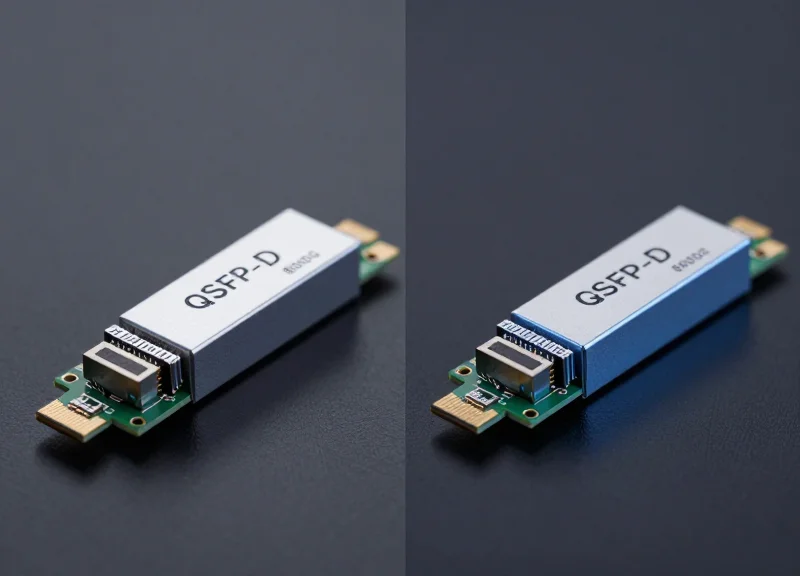
As the demand for hyper-scale bandwidth accelerates, the transition to 800G networking has become a mission-critical objective for global enterprises. Choosing between QSFP-DD800 and OSFP800 is more than a technicality; it is a strategic decision impacting thermal management, backward compatibility, and long-term ROI. Ubytelink stands at the forefront of this transition, providing precision-engineered optical modules designed for the most demanding environments.
The 800G Landscape: Why Form Factor Selection Is Critical

In the rapidly evolving 800G landscape, form factor selection is critical because it defines the operational limits of network hardware, specifically regarding thermal dissipation and infrastructure legacy. As high-performance computing and AI workloads drive power consumption to new heights, the choice between QSFP-DD800 and OSFP800 determines whether a network can sustain high-density throughput without exceeding cooling capacities or requiring a complete overhaul of existing cabling systems. Ubytelink's premium solutions address these challenges by providing high-signal-integrity modules for both standards, ensuring global networks can scale with confidence.
The Industry Split: Performance vs. Compatibility
The transition to 800G has created a bifurcation in the market. On one side, the QSFP-DD800 (Quad Small Form-factor Pluggable Double Density) focuses on maintaining backward compatibility with previous generations of QSFP modules. On the other side, the OSFP (Octal Small Form-factor Pluggable) prioritizes thermal headroom and electrical performance for future-proofing.
| Specification | QSFP-DD800 | OSFP800 |
|---|---|---|
| Backward Compatibility | Native support for QSFP28/QSFP56 | Requires physical adapters |
| Thermal Performance | Standard cooling (up to 25W) | Superior cooling via integrated heatsink (30W+) |
| Size | Narrower, legacy footprint | Slightly wider and deeper |
| Electrical Interface | 8-lane (100G/lane) | 8-lane (100G/lane) |
Key Drivers for Selection
When evaluating Ubytelink 800G solutions, network architects must weigh three primary factors: existing port density, cooling infrastructure, and the projected lifespan of the hardware. QSFP-DD800 is often the preferred choice for operators seeking to maximize density in current chassis designs, while OSFP is gaining dominance in 'greenfield' AI clusters where power consumption per module is expected to rise.
Common Implementation Questions
- Which form factor is more 'future-proof'?
While both support 800G, OSFP is generally considered more future-proof for transitions toward 1.6T and 3.2T due to its superior thermal management and larger physical volume for complex optics. - Can QSFP-DD800 and OSFP interoperate?
Yes, at the protocol level they are both Ethernet-compliant. Interoperability occurs over the fiber link (e.g., using LC or MPO connectors), regardless of the form factor used at the switch port. - How does Ubytelink ensure quality in these high-speed modules?
Ubytelink utilizes premium internal components and rigorous testing protocols to ensure low Bit Error Rates (BER) and optimized power consumption across both QSFP-DD800 and OSFP800 form factors.
Architecture Deep Dive: QSFP-DD800 vs. OSFP800
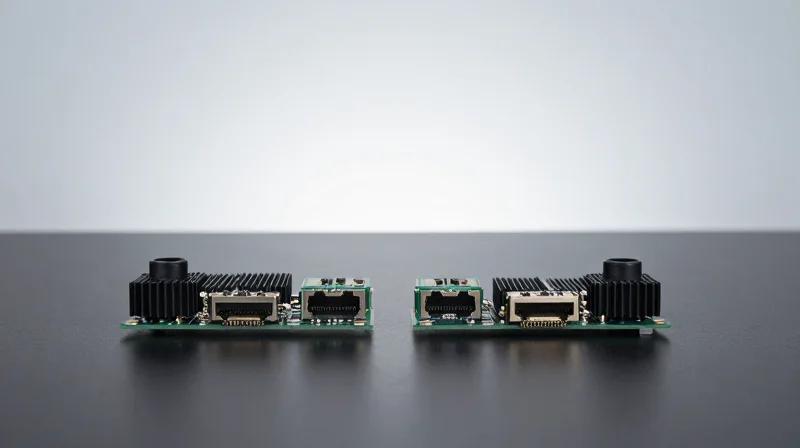
Physical Form Factors and Mechanical Footprint
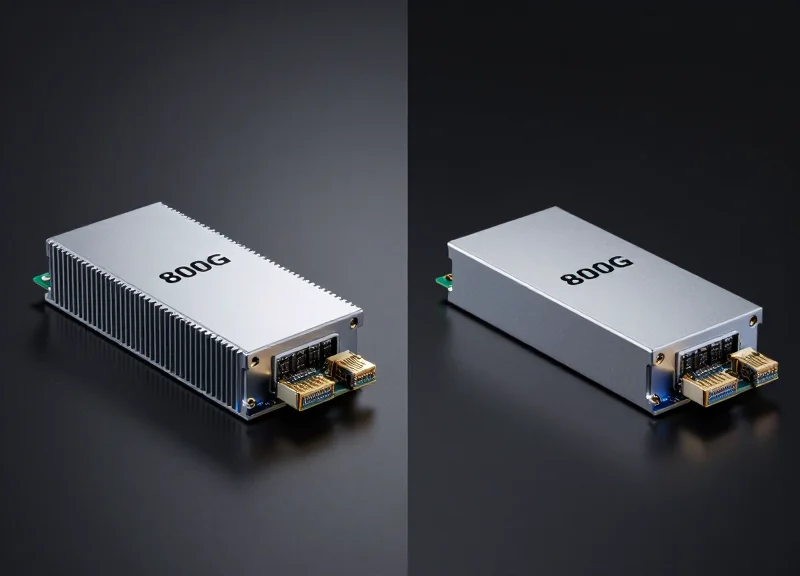
Choosing between QSFP-DD800 and OSFP800 requires an understanding of how their physical dimensions impact switch density and thermal headroom. While QSFP-DD800 focuses on maintaining backward compatibility and high port density within legacy-compatible chassis designs, OSFP800 prioritizes thermal efficiency through a slightly wider and deeper module size that allows for integrated cooling fins.
| Specification | QSFP-DD800 | OSFP800 |
|---|---|---|
| Width | 18.35 mm | 22.58 mm |
| Heat Sink Location | External (Cage-based) | Integrated (Module-based) |
| Backward Compatibility | QSFP28/QSFP56 (Native) | Requires Mechanical Adapter |
| Power Capacity | 18W - 25W Typical | Up to 30W+ |
Electrical Interface and Signal Integrity
Both architectures are designed to support 800 Gbps aggregate throughput using eight lanes of 112G PAM4 SerDes, yet they achieve this via different pin configurations. The QSFP-DD800 utilizes a 'Double Density' approach with two rows of electrical contacts to maintain the legacy QSFP footprint while doubling the lane count. In contrast, the OSFP800 connector features a larger contact pitch and enhanced shielding, which inherently provides superior signal integrity and lower crosstalk in ultra-high-power environments.
Thermal Management Strategies
Thermal management is the defining architectural divide between the two standards. OSFP800 modules include an integrated heat sink directly on the module body, which allows the module to dissipate heat more effectively toward the airflow of the switch. QSFP-DD800 relies on a flat-top design that makes contact with a heat sink built into the switch cage. This means OSFP800 is generally better suited for high-wattage coherent optics or long-reach modules that generate significant heat.
Architecture and Deployment FAQ
- Are OSFP800 modules physically compatible with QSFP-DD800 ports?
No. The OSFP800 is wider and taller than the QSFP-DD800, making them physically incompatible. You must choose the form factor that matches your hardware's cage design. - Which form factor offers better backward compatibility?
QSFP-DD800 offers superior native backward compatibility, allowing legacy QSFP28 and QSFP56 modules to be plugged directly into the 800G ports without adapters. - Why does OSFP800 support higher power levels?
Because the OSFP800 module is larger and features an integrated heat sink, it can handle a higher thermal load—often exceeding 30W—compared to the thermal limits typical of the QSFP-DD800 footprint.
Thermal Management: Solving the 800G Heat Challenge

Thermal Management: Solving the 800G Heat Challenge
At the 800G threshold, power consumption per transceiver typically reaches 14W to 18W, creating significant thermal density challenges that can lead to link failure or reduced hardware lifespan if not addressed. Ubytelink addresses these hurdles by tailoring the mechanical architecture of OSFP800 and QSFP-DD800 to maximize heat transfer efficiency, ensuring stable performance in high-density data center environments.
OSFP800: The Integrated Heat Sink Advantage
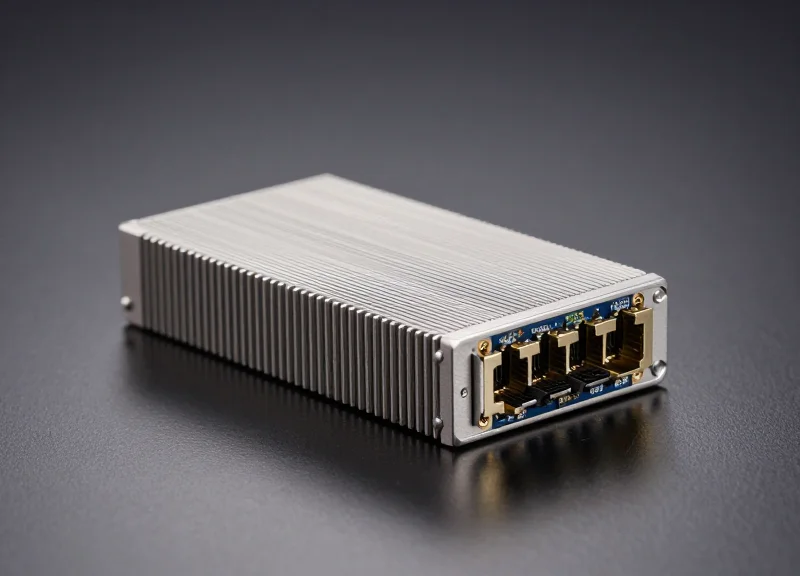
The OSFP800 form factor is inherently designed for superior thermal performance. By integrating the heat sink directly into the module casing, Ubytelink’s OSFP solutions facilitate immediate heat transfer to the airflow. This design allows for higher power envelopes, making it the preferred choice for next-generation AI and HPC clusters where cooling capacity is a primary constraint.
QSFP-DD800: Precision Cooling for High-Density Systems
While QSFP-DD800 lacks the integrated heat sink of OSFP, Ubytelink utilizes advanced thermal interface materials (TIM) and optimized cage designs to ensure compatibility with legacy infrastructure. The focus here is on air-to-module contact and the use of 'riding heat sinks' on the host system to pull heat away from the dense array of ports without sacrificing backward compatibility.
| Thermal Feature | Ubytelink OSFP800 | Ubytelink QSFP-DD800 |
|---|---|---|
| Heat Dissipation Method | Integrated Fin Heat Sink | External Host-Side Heat Sink |
| Power Capacity | Up to 18W-20W | Up to 15W-18W |
| Cooling Efficiency | Superior (Direct Airflow) | High (Interface Dependent) |
| Airflow Direction | Customizable (AFI/AFO) | Standardized |
Thermal Management FAQ
- Why does OSFP have better thermal headroom?
Its larger physical size and integrated fins allow for significantly more surface area contact with cooling air compared to the flatter QSFP-DD profile. - Can Ubytelink QSFP-DD800 modules run in older 400G switches?
Yes, provided the switch power budget and cooling capacity support the higher wattage required by 800G optics; the mechanical fit is identical. - What is the typical operating temperature range?
Ubytelink modules are rated for standard commercial temperatures (0°C to 70°C), with rigorous testing to ensure stability even at the upper limits of thermal density.
Backward Compatibility: Leveraging Existing Infrastructure
Maximizing ROI through Legacy Support
The QSFP-DD800 form factor is engineered specifically to ensure that the transition to 800G does not necessitate a complete overhaul of existing network architecture. By maintaining mechanical and electrical alignment with previous generations, Ubytelink enables operators to mix and match optics of different speeds within the same hardware footprint, protecting massive capital investments in existing switch and router chassis.
Mechanical and Electrical Synergies
QSFP-DD800 utilizes an 8-lane electrical interface that serves as a direct extension of the QSFP-DD 400G standard. This 'Double Density' approach allows the module to fit into system cages designed for legacy QSFP28 (100G) and QSFP56 (200G) modules using passive mechanical adapters or specialized backward-compatible cage designs. In contrast, OSFP800 often requires a complete hardware refresh due to its physically larger dimensions and different connector placement, making it a more disruptive choice for established environments.
| Feature | QSFP-DD800 Compatibility | OSFP800 Compatibility |
|---|---|---|
| Legacy QSFP Support | Full (QSFP28/QSFP56/QSFP-DD) | Requires Adapter/Not Native |
| Cage Backwards Compatibility | Yes (Backward-compatible cages) | No (New cage design required) |
| Port Density Support | Maintains existing port spacing | Requires larger port spacing |
| Investment Protection | High (Protects existing slots) | Moderate (Focuses on future-proofing) |
Reducing Total Cost of Ownership (TCO)
For large-scale data center operators, the ability to leverage existing line cards while upgrading specific ports to 800G is a massive economic advantage. Ubytelink's QSFP-DD800 modules minimize 'rip-and-replace' scenarios, allowing for a phased deployment that aligns with traffic growth rather than a forced hardware cycle. This strategic continuity ensures that the transition to 800G is both technically sound and financially sustainable.
- Can I plug a QSFP28 module into a QSFP-DD800 slot?
Yes, the QSFP-DD800 design allows for legacy modules to be inserted directly into the port, provided the system software and firmware support the lower speed configuration. - Does OSFP800 support any backward compatibility?
OSFP800 can support 400G and 800G natively, but supporting older 100G or 200G QSFP form factors usually requires an OSFP-to-QSFP adapter, which adds physical complexity and cost. - What are the power implications of using legacy modules in 800G slots?
Legacy modules typically consume significantly less power than 800G modules; Ubytelink systems manage this by dynamically adjusting cooling and power delivery based on the module's reported EEPROM data.
Power Efficiency and Sustainable Networking
Power Efficiency and Sustainable Networking
Ubytelink's 800G solutions provide a dual-benefit of high-performance bandwidth and industry-leading energy efficiency, utilizing state-of-the-art semiconductor processes to lower the total cost of ownership and minimize the environmental impact of global network infrastructures.
Optimizing TCO Through Energy-Efficient DSPs
In the landscape of 800G networking, power consumption is a critical factor in determining the long-term viability of hardware deployments. Ubytelink integrates next-generation 7nm and 5nm Digital Signal Processors (DSPs) into its QSFP-DD800 and OSFP800 modules. These advanced nodes significantly reduce the power-per-bit ratio compared to previous generations. By minimizing the electrical draw of each port, Ubytelink enables data center operators to reduce direct electricity costs and repurpose the saved power capacity for additional compute resources, maximizing the utility of the existing power envelope.
| Metric | Ubytelink QSFP-DD800 | Ubytelink OSFP800 | Impact on Sustainability |
|---|---|---|---|
| Typical Power Consumption | 14.0W - 15.5W | 14.5W - 16.5W | Reduced carbon footprint per TB of data |
| Thermal Management | Airflow Optimized | Integrated Heat Sink | Lower facility cooling requirements |
| DSP Efficiency | Ultra-Low Power CMOS | Ultra-Low Power CMOS | Extended hardware lifespan due to lower heat |
Thermal Performance and Facility Cooling Savings
The efficiency of a transceiver extends beyond its own power draw to its impact on the surrounding environment. Ubytelink modules are engineered for optimal thermal dissipation; for example, the OSFP800’s integrated heat sink design allows for more efficient heat transfer into the airflow. This reduced thermal load translates to lower fan speeds on switches and decreased demand on data center cooling systems (CRAC units). The resulting reduction in Power Usage Effectiveness (PUE) contributes to a more sustainable facility and a significant decrease in operational expenditure (OPEX) across the network lifecycle.
Supporting Green Data Center Initiatives
As corporate Environmental, Social, and Governance (ESG) mandates become more stringent, Ubytelink aligns its product roadmap with global sustainability standards. Our modules are designed to comply with RoHS and REACH regulations, ensuring a reduction in hazardous materials. By prioritizing energy-efficient 800G solutions, Ubytelink helps global network providers meet their carbon neutrality goals without sacrificing the throughput required for modern AI and cloud-native workloads.
Power Efficiency & Sustainability FAQ
- How does Ubytelink achieve lower power consumption in its 800G modules?
Ubytelink utilizes highly integrated, low-power DSPs and optimized optical engines that reduce signal attenuation and electrical resistance, resulting in lower power draw per gigabit of data transmitted. - Does reducing power consumption affect the reliability of the link?
No. Ubytelink ensures that energy-efficient designs maintain high signal integrity and low Bit Error Rates (BER) through sophisticated forward error correction (FEC) support and rigorous testing. - Which form factor is better for energy-conscious data centers?
Both provide excellent efficiency. The QSFP-DD800 is ideal for maximizing port density in existing footprints, while the OSFP800 offers superior thermal overhead for environments where cooling efficiency is the primary concern.
Ubytelink Manufacturing Excellence: Beyond Industry Standards

Ubytelink's manufacturing excellence is defined by a 'zero-failure' philosophy that treats every QSFP-DD800 and OSFP800 module as a mission-critical component. While many manufacturers rely on statistical batch testing, Ubytelink implements a comprehensive, unit-by-unit verification process. This approach ensures that the signal integrity, thermal stability, and mechanical durability of our 800G solutions provide the 'Five Nines' reliability required for global hyperscale data centers and telecommunications backbones.
Advanced Testing Protocols: Beyond IEEE Compliance
The transition to 800G networking introduces complexities in signal modulation (PAM4) and thermal management that standard testing often overlooks. Ubytelink addresses these challenges through a multi-stage verification cycle that includes high-temperature aging, automated optical inspection (AOI), and real-world traffic simulation.
| Quality Metric | Industry Standard | Ubytelink Excellence |
|---|---|---|
| Burn-in Testing | Standard 24-hour cycle | Extended 72-hour stress-testing at peak thermal limits |
| Signal Integrity | Batch-based Eye Diagram check | 100% Individual Unit BERT and Eye Margin verification |
| Compatibility | Generic Switch testing | Cross-platform validation (Cisco, Arista, Juniper, NVIDIA/Mellanox) |
| Failure Rate (AFR) | Approx. 1% - 2% | Targeting <0.001% for mission-critical links |
The Five Pillars of Ubytelink Quality Control
- Automated Optical Inspection (AOI)
Utilizing high-resolution imaging to detect microscopic defects in the optical sub-assembly and PCB before final housing. - Thermal Cycling Stress
Modules are subjected to rapid temperature fluctuations to ensure that the solder joints and laser alignment remain stable under the high heat of 800G operations. - Signal Margin Verification
Ensuring that every module operates with a Pre-FEC (Forward Error Correction) Bit Error Rate (BER) that provides significant headroom beyond IEEE requirements. - Mechanical Durability
Testing the pull-tab and latching mechanisms for hundreds of insertion cycles to prevent mechanical failure in high-density environments. - Traceability
Each module is assigned a unique digital ID, allowing Ubytelink to track the specific manufacturing batch, components, and test results throughout the product's lifecycle.
Manufacturing FAQ
- Why is 100% unit testing necessary for 800G modules?
At 800G, the margin for error is incredibly slim. Jitter, signal loss, and thermal fluctuations that were negligible at 100G can cause total link failure at 800G. Unit-by-unit testing is the only way to guarantee stability. - How does Ubytelink ensure compatibility across different brands?
We maintain a massive 'Interoperability Lab' featuring the latest switches from market leaders. Each firmware version is validated against specific vendor OS requirements to ensure 'Plug-and-Play' functionality. - What does 'Five Nines' reliability mean for a network operator?
It translates to less than 5.26 minutes of downtime per year. For global networks, this reliability prevents millions of dollars in lost revenue and service-level agreement (SLA) penalties.
By combining state-of-the-art automated manufacturing with a rigorous human-led quality oversight, Ubytelink provides the assurance that global enterprises need to scale their infrastructure with confidence. Whether choosing QSFP-DD800 or OSFP800, the Ubytelink seal represents a commitment to performance that transcends the datasheet.
Deployment Scenarios: Which Module Should You Choose?
Deployment Scenarios: Which Module Should You Choose?
The decision between Ubytelink QSFP-DD800 and OSFP800 solutions is primarily dictated by your existing switch infrastructure and your long-term roadmap for 1.6T scaling. While both provide 800Gbps throughput, the choice hinges on whether your priority is seamless backward compatibility (QSFP-DD) or advanced thermal headroom for future-proofing (OSFP).
The Case for Ubytelink QSFP-DD800: Density and Continuity
The QSFP-DD800 is the ideal choice for operators who want to maximize their current hardware investment. Because the cage design is backward compatible with QSFP28 and QSFP56, it allows for a mixed-speed environment without requiring hardware replacements or complex adapters. It is particularly effective in high-density 1U switches where port count is at a premium, as it maintains the familiar footprint that has dominated data centers for the last decade.
The Case for Ubytelink OSFP800: Thermal Excellence
OSFP800 is increasingly favored for 'greenfield' deployments—new data center builds that are designed from the ground up for the AI and HPC era. Its slightly larger physical size allows for an integrated heat sink, which significantly improves airflow and cooling efficiency. If your facility anticipates a rapid move toward 1.6T networking, OSFP provides the power envelope and thermal ceiling necessary to support those higher-wattage components safely.
| Feature | Ubytelink QSFP-DD800 | Ubytelink OSFP800 |
|---|---|---|
| Backward Compatibility | Native support for QSFP+/28/56 | Requires mechanical adapters |
| Thermal Dissipation | Standard (Heat sink on cage) | Superior (Integrated fins on module) |
| Power Ceiling | Up to 25W | 30W+ (Built for 1.6T path) |
| Ideal Environment | Enterprise & Brownfield DC | Hyperscale & AI Clusters |
Deployment FAQ
- Can I use QSFP-DD800 modules in an OSFP switch port?
No, they are physically incompatible. However, OSFP-to-QSFP-DD adapters exist for specific use cases, though they may impact thermal performance. - Does OSFP800 improve airflow in the rack?
Yes, because the OSFP module includes its own cooling fins, it reduces the reliance on the switch's internal heat sink, allowing for more efficient front-to-back airflow. - Which module is more cost-effective for 800G?
The module costs are comparable; however, QSFP-DD often results in a lower Total Cost of Ownership (TCO) for existing facilities by avoiding the need for new switch architectures.
Future-Proofing for 1.6T and Beyond

Future-Proofing for 1.6T and Beyond
The migration to 800G is not a final destination but a critical evolutionary step that establishes the power, thermal, and signal integrity protocols necessary for 1.6T and subsequent 3.2T networking environments. By perfecting the balance between high-density port configurations and low-latency throughput in OSFP800 and QSFP-DD800 modules, Ubytelink is actively defining the roadmap for next-generation silicon photonics and 224G-per-lane SerDes technology.
Lessons from 800G: Scaling to 224G SerDes
The primary challenge in moving beyond 800G lies in the transition from 112G to 224G SerDes (Serializer/Deserializer) speeds. The lessons learned from Ubytelink’s current 800G deployments emphasize that signal degradation increases exponentially with frequency. Consequently, the industry is moving toward Linear Drive Pluggable Optics (LPO) and CPO (Co-Packaged Optics) to minimize electrical path lengths. Ubytelink’s 800G solutions already incorporate high-precision DSPs and advanced equalization, providing a stable testing ground for the tighter tolerances required at 1.6T.
| Feature | 800G Standard | 1.6T (Next-Gen) Requirement |
|---|---|---|
| Electrical Lane Speed | 100G/112G per lane | 200G/224G per lane |
| Common Form Factor | QSFP-DD / OSFP | OSFP1600 / QSFP-DD1600 |
| Max Power Dissipation | 15W - 18W | 25W - 30W+ |
| Typical Applications | AI Training / Cloud Core | AIGC / Terabit Switching |
The OSFP Advantage in 1.6T Evolution
While QSFP-DD800 remains highly effective for legacy compatibility, the OSFP form factor is gaining significant momentum for 1.6T roadmaps due to its superior thermal overhead. Ubytelink’s OSFP800 design, which features integrated fins and optimized airflow, anticipates the 25W+ power envelopes that 1.6T modules will inevitably demand. Organizations investing in OSFP800 infrastructure today are essentially simplifying their future cooling and power distribution upgrades for the next decade.
FAQ: Navigating the Road to 1.6T
- Will 800G infrastructure become obsolete when 1.6T arrives?
No. Much like the 100G to 400G transition, 800G will remain a workhorse for edge and distribution layers for years. 1.6T will initially target high-performance AI clusters and hyperscale backbones. - How does Ubytelink ensure 800G modules are 'future-proof'?
By adhering strictly to MSA (Multi-Source Agreement) standards and utilizing high-bandwidth silicon photonics that can be scaled to higher modulation formats (like PAM6 or PAM8) in future iterations. - Is OSFP mandatory for 1.6T?
While not strictly mandatory, the OSFP1600 specification is currently the favored path among major switch vendors because it handles the increased heat of 224G SerDes more efficiently than smaller form factors.
In summary, both QSFP-DD800 and OSFP800 offer unique advantages depending on your specific infrastructure needs. Ubytelink’s commitment to premium quality ensures that regardless of the form factor you choose, your network will benefit from industry-leading performance and stability. Ready to upgrade your backbone? Contact Ubytelink's technical experts today for a tailored 800G solution consultation.