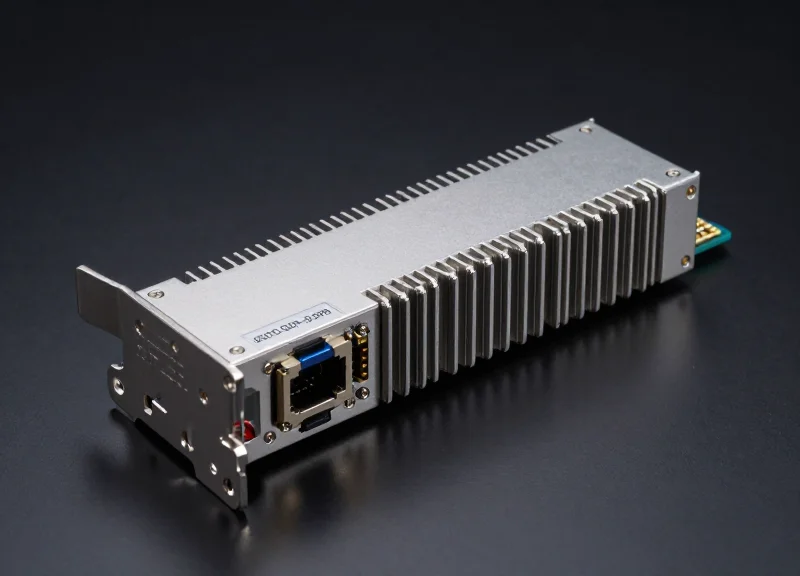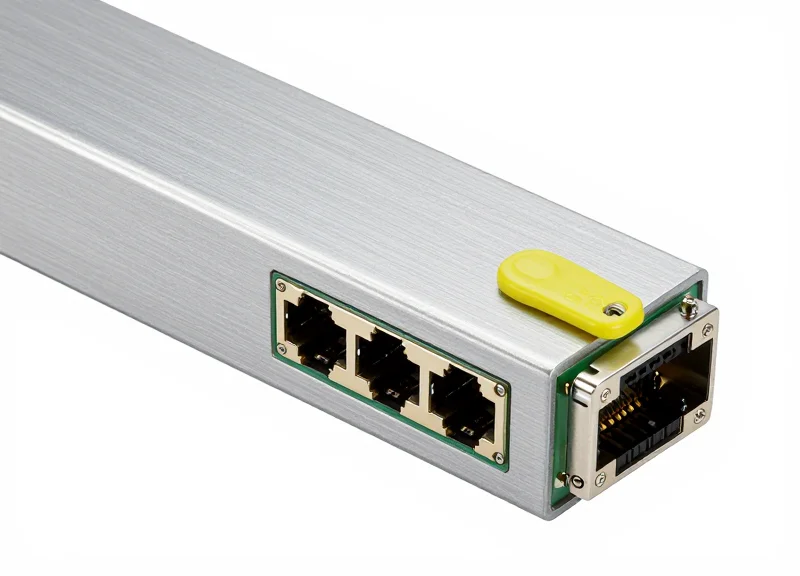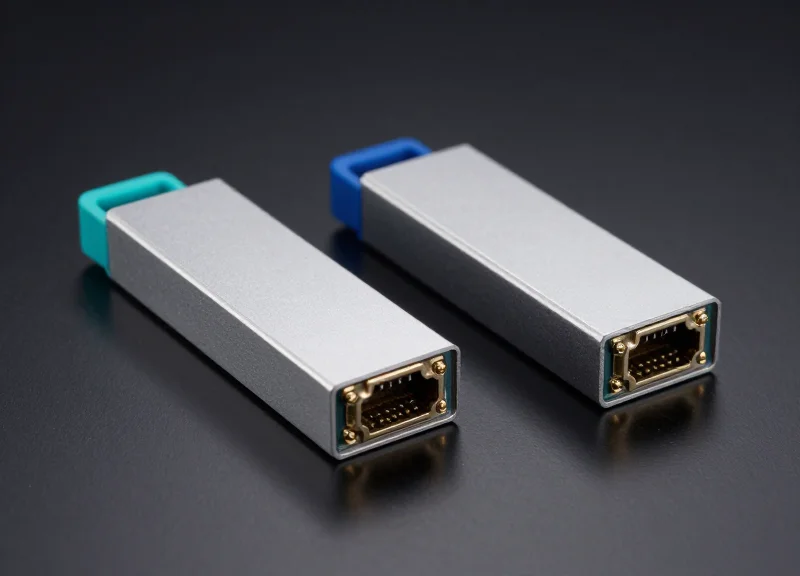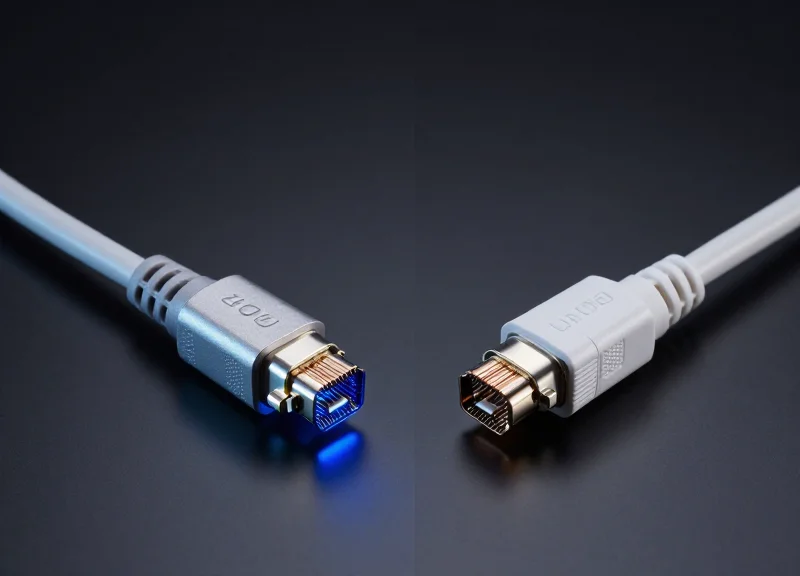
As global 5G deployment accelerates, the demand for high-speed, low-latency fronthaul connectivity has never been higher. Ubytelink addresses the complexities of modern RAN architecture with its premium CPRI/eCPRI modules, ensuring seamless data flow across global networks.
The Evolution of Fronthaul: Transitioning from CPRI to eCPRI

The Evolution of Fronthaul: Transitioning from CPRI to eCPRI
The transition from CPRI to eCPRI is the industry's response to the bandwidth explosion of 5G, moving from rigid, point-to-point synchronous connections to flexible, packet-based Ethernet architectures. By optimizing the functional split between the baseband and the radio unit, eCPRI allows operators to scale their networks while significantly reducing fiber resource consumption. As 5G New Radio (NR) introduces Massive MIMO and wider channel bandwidths, the traditional Common Public Radio Interface (CPRI) reaches its physical and economic limits, necessitating a more efficient transport protocol.
The Limitations of Traditional CPRI
In 4G LTE architectures, CPRI served as a dedicated link between the Baseband Unit (BBU) and the Remote Radio Head (RRH). Because CPRI carries digitized RF signals (IQ data) in a constant bit rate stream, its bandwidth requirement scales linearly with the number of antennas and bandwidth. For 5G, this would require hundreds of Gbps per site—an unsustainable demand for legacy fiber infrastructure that lacks the density to support such massive throughput without astronomical investment.
eCPRI: The 5G Efficiency Breakthrough
eCPRI (Enhanced CPRI) optimizes the fronthaul by moving the functional split point within the Physical (PHY) layer. By processing some radio functions at the antenna site, eCPRI reduces the amount of data sent over the fiber by a factor of ten compared to traditional methods. Furthermore, eCPRI leverages Ethernet as the transport layer, allowing for statistical multiplexing and the use of standard networking hardware to lower Total Cost of Ownership (TCO) while improving overall network agility and scalability.
| Feature | CPRI | eCPRI |
|---|---|---|
| Transport Mechanism | Constant Bit Rate (Synchronous) | Packet-based (Ethernet/IP) |
| Bandwidth Efficiency | Fixed and High Consumption | Flexible and Compressed |
| Topology | Point-to-Point / Daisy Chain | Packet Switched / Mesh / Hub-Spoke |
| 5G Suitability | Limited Capacity | Optimized for Massive MIMO |
Strategic Advantages for Global Networks
For global service providers, adopting Ubytelink CPRI/eCPRI for 5G Solutions ensures that their infrastructure is ready for the high-density traffic of smart cities and industrial IoT. By utilizing eCPRI, networks can transition to a Cloud-RAN (C-RAN) model where baseband processing is centralized. This leads to better interference management, simplified site maintenance, and significant energy savings across the entire Radio Access Network.
- Why can't CPRI support 5G Massive MIMO effectively?
CPRI requires bandwidth proportional to the number of antenna ports. With 64T64R Massive MIMO configurations, the required CPRI data rate would exceed 100 Gbps per link, making it physically and financially impractical compared to eCPRI's compressed packet-based approach. - Does transitioning to eCPRI require specific hardware?
Yes, transitioning to eCPRI requires high-performance transceivers, such as those in the Ubytelink CPRI/eCPRI for 5G Solutions portfolio, and network switches that support Time-Sensitive Networking (TSN) to maintain strict synchronization and low latency.
Critical Role of Optical Modules in 5G Infrastructure
The Physical Layer: Driving 5G NR Performance
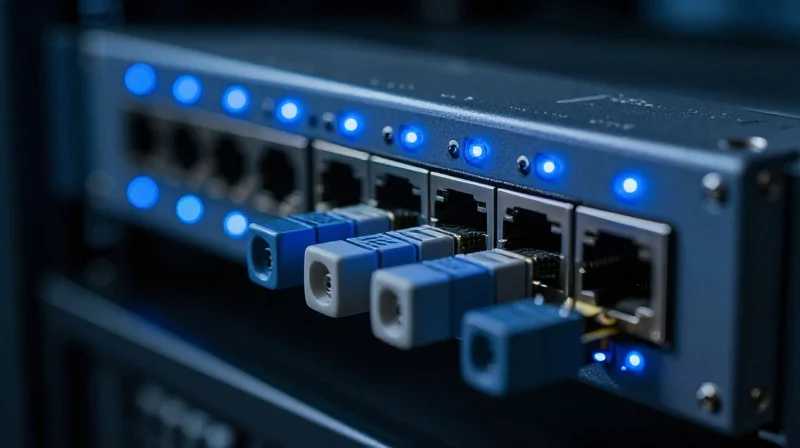
Optical modules serve as the critical hardware link in the physical layer of 5G infrastructure, directly determining the efficiency of data transfer between the Distributed Unit (DU) and the Radio Unit (RU). In the era of 5G New Radio (NR), where technologies like massive MIMO and beamforming are standard, the optical transceivers must handle significantly higher throughput and tighter synchronization requirements than their 4G predecessors. High-performance CPRI/eCPRI modules ensure that the massive influx of data generated at the air interface is transmitted to the core network without bottlenecks or signal degradation.
Impact of Optical Quality on Key Network Metrics
| Network Metric | Impact of Low-Quality Modules | Benefit of Premium Ubytelink Modules |
|---|---|---|
| Latency | Increased jitter and inconsistent packet delivery. | Deterministic, ultra-low latency for time-sensitive 5G apps. |
| Signal Integrity | High Bit Error Rates (BER) leading to retransmissions. | Superior OSNR and clean signal eye-patterns for stable links. |
| Power Efficiency | Excessive heat generation and higher power draw. | Optimized power consumption reducing OpEx in dense sites. |
| Synchronization | Phase and timing errors in TDD networks. | Precise timing support for sub-microsecond synchronization. |
Enabling RAN Densification and Reliability
The architectural shift toward Cloud-RAN (C-RAN) and Virtualized-RAN (v-RAN) necessitates a highly robust fronthaul. As operators densify their networks with small cells and macro sites to achieve 5G coverage goals, the physical layer must withstand diverse environmental stressors. Premium optical modules are not merely connectors; they are specialized components that maintain link budget margins in high-density fiber environments, ensuring that the 'last mile' of the fronthaul remains the strongest link in the chain.
- How does optical module reliability affect 5G availability?
A single module failure in a massive MIMO array can degrade the entire sector's performance. Industrial-grade modules prevent unplanned downtime and costly truck rolls for replacement. - Why is thermal management critical for 5G optical transceivers?
5G RUs are often deployed in harsh outdoor environments. Modules must operate across extended temperature ranges (-40°C to +85°C) to prevent thermal shutdown and signal drifting. - What role does the link budget play in 5G NR?
As speeds increase to 25G and 50G, the margin for error shrinks. High-quality modules provide a superior link budget, allowing for longer fiber runs and more patch points without signal loss.
Ubytelink’s SFP28/SFP56 Portfolio: Engineered for Excellence
Ubytelink’s SFP28/SFP56 Portfolio: Engineered for Excellence
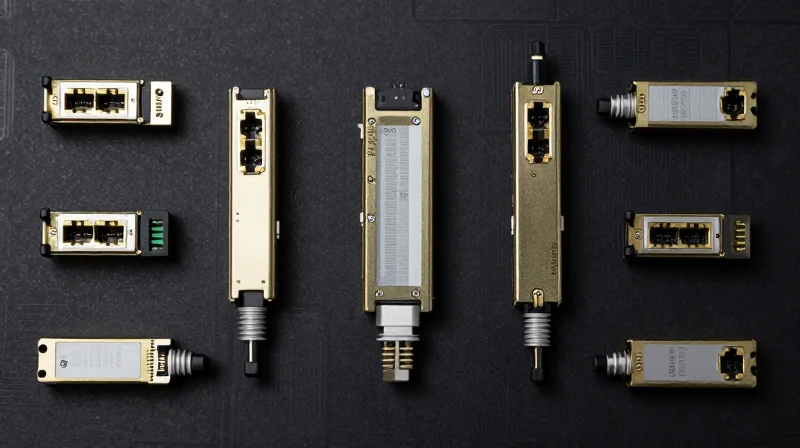
Ubytelink’s SFP28 and SFP56 portfolios represent the pinnacle of optical engineering, specifically tailored to bridge the gap between high-speed data transmission and the stringent thermal constraints of 5G cell sites. By leveraging advanced semiconductor integration and optimized laser drivers, these modules provide the 10Gbps to 50Gbps throughput required for CPRI and eCPRI protocols while maintaining the robust reliability necessary for outdoor, high-density network environments.
Solving the Power and Density Challenge in 5G Nodes
As 5G New Radio (NR) deployments scale, the demand for higher port density in Distributed Units (DU) and Radio Units (RU) often leads to thermal management issues. Ubytelink addresses this by optimizing the internal circuitry of our transceivers to minimize power consumption. Our SFP28 modules typically operate at less than 1.0W per port, which significantly reduces the total heat load on dense line cards. This efficiency is critical for maintaining signal integrity and preventing packet loss in the high-temperature environments characteristic of pole-mounted outdoor enclosures.
| Feature | SFP28 (25G) | SFP56 (50G) |
|---|---|---|
| Typical Power Consumption | < 1.0W | < 1.5W |
| Standard Protocol Support | CPRI Option 10 / eCPRI | eCPRI / 50G Ethernet |
| Max Reach (SMF) | 10km / 20km (LR/ER) | 10km (LR) |
| Operating Temperature | -40°C to +85°C (I-Temp) | -40°C to +85°C (I-Temp) |
Precision Engineering for Long-Haul Reliability
Every Ubytelink module undergoes rigorous testing to ensure compliance with international standards such as IEEE 802.3 and MSA specifications. For 5G fronthaul, we utilize high-performance DML and EML lasers to ensure low jitter and high extinction ratios. This precision engineering ensures that even at distances up to 20km, the bit error rate (BER) remains exceptionally low, satisfying the ultra-reliable low-latency communication (URLLC) requirements of 5G services.
- How does Ubytelink ensure compatibility with Tier-1 OEM equipment?
We maintain an extensive compatibility lab where our SFP28 and SFP56 modules are tested against the latest firmware of major networking vendors to ensure seamless 'plug-and-play' integration without port lockout. - Why is 'Industrial Temperature' (I-Temp) support critical for 5G?
Unlike data center environments, 5G nodes are often exposed to extreme weather. Our I-Temp rated modules are tested from -40°C to +85°C to prevent frequency drift and hardware failure during seasonal temperature swings. - Does Ubytelink support WDM options for fiber-constrained sites?
Yes, our portfolio includes CWDM and DWDM SFP28 solutions, allowing operators to multiplex multiple 25G eCPRI channels over a single fiber pair to maximize existing infrastructure.
Solving the Latency Puzzle in Mission-Critical Applications

Solving the latency puzzle in 5G mission-critical applications requires a physical layer capable of near-instantaneous data throughput with minimal Packet Delay Variation (PDV). Ubytelink CPRI/eCPRI modules achieve this through high-precision Clock and Data Recovery (CDR) mechanisms and optimized signal integrity paths that ensure deterministic timing for Ultra-Reliable Low-Latency Communications (URLLC).
The Architecture of Deterministic Timing
In the transition from 4G to 5G, the tolerance for jitter and timing errors has narrowed significantly. Ubytelink’s SFP28 and SFP56 portfolios are engineered to handle the rigorous demands of the eCPRI protocol, which shifts time-critical processing closer to the edge. By utilizing advanced Integrated Circuits (ICs) that prioritize low-latency pathing, these modules prevent the 'bottleneck' effect often seen in standard-grade hardware during peak traffic bursts.
| Feature | Standard Modules | Ubytelink CPRI/eCPRI Solutions |
|---|---|---|
| Jitter Management | Passive compensation | Active CDR with low-phase noise |
| Synchronization | Variable sync cycles | Synchronous Ethernet (SyncE) & IEEE 1588 support |
| Latency Profile | Non-deterministic | Predictable, ultra-low sub-microsecond |
| Thermal Stability | Performance drifts with heat | Industrial-grade temp compensation (-40°C to 85°C) |
Empowering URLLC via Packet Delay Variation (PDV) Mitigation
Packet Delay Variation is the primary enemy of URLLC services such as autonomous vehicle coordination, remote robotic surgery, and industrial IoT. Ubytelink modules utilize high-quality lasers and photodetectors that maintain stable optical power levels even under high-frequency switching. This stability ensures that the packet arrival time remains consistent, allowing the 5G New Radio (NR) to maintain the strict TDD (Time Division Duplex) frame structures necessary for real-time responsiveness.
- How does Ubytelink ensure synchronization for 5G Fronthaul?
Our modules are designed to support IEEE 1588v2 Precision Time Protocol (PTP), which allows for nanosecond-level synchronization between the Radio Unit (RU) and Distributed Unit (DU). - Why is low latency critical for eCPRI over SFP28?
As bandwidth increases to 25G, any delay in the physical interface can cause buffer overflows or packet loss in the radio processing chain, disrupting the URLLC performance. - Can Ubytelink modules operate in harsh outdoor environments?
Yes, all our 5G solutions are available in Industrial Temperature (I-temp) variants, ensuring that latency remains stable even in extreme weather conditions at the cell tower.
Industrial-Grade Reliability for Global Environments
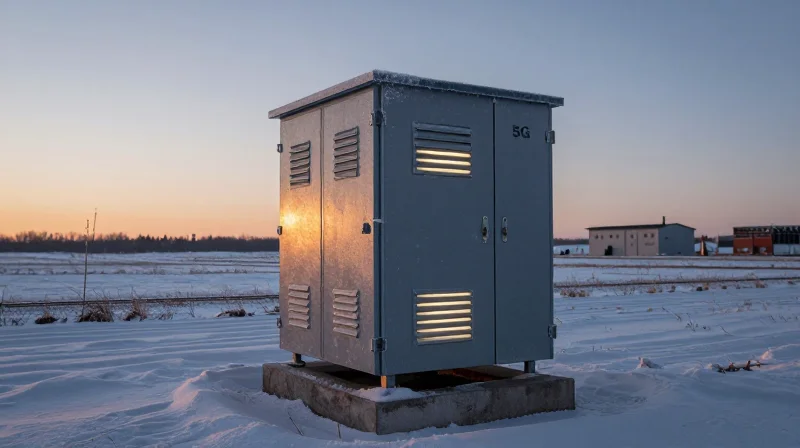
Engineering for Extremes: Why Industrial Grade Matters
Ubytelink CPRI/eCPRI solutions are designed to address the high volatility of outdoor 5G infrastructure, where optical equipment must endure rapid temperature shifts, humidity, and physical vibration without signal degradation. By utilizing industrial-grade internal components and reinforced housing, these modules ensure that the critical front-haul link remains stable whether deployed in sub-zero arctic conditions or high-heat equatorial zones, where standard commercial optics often fail due to thermal runaway or component fatigue.
Thermal Dissipation and Material Integrity
Heat is the primary catalyst for optical longevity issues and Bit Error Rate (BER) instability. Ubytelink employs sophisticated thermal dissipation techniques, including high-thermal-conductivity materials and optimized internal layouts that minimize power consumption while maximizing heat transfer to the transceiver shell. This Industrial Temperature (I-Temp) range—typically -40°C to +85°C—is achieved through rigorous component screening and environmental stress testing (ESS), ensuring that eCPRI 25G and 50G links maintain their precise timing synchronization even under maximum traffic load within sealed Remote Radio Units (RRUs).
| Feature | Commercial Grade (C-Temp) | Ubytelink Industrial Grade (I-Temp) |
|---|---|---|
| Operating Temperature Range | 0°C to 70°C | -40°C to +85°C |
| Deployment Environment | Climate-controlled Data Centers | Outdoor Pole-mount / Unconditioned Cabinets |
| Component Selection | Standard Consumer Grade | Hardened Industrial Grade |
| MTBF (Mean Time Between Failures) | Standard rated | Extended (Enhanced Longevity) |
| Housing Material | Standard Zinc/Plastic Alloys | Corrosion-Resistant Ruggedized Shell |
FAQ: Deploying 5G in Harsh Global Climates
- Why is the -40°C to +85°C range critical for 5G?
Outdoor 5G nodes often lack active cooling systems. Solar loading can push internal temperatures within an RRU far above the ambient air temperature, necessitating a wide operational margin to prevent catastrophic link failure. - How does Ubytelink handle humidity and moisture ingress?
Our modules feature advanced sealing techniques and corrosion-resistant gold plating on connectors, which prevents moisture-induced oxidation and signal loss in coastal or tropical high-humidity regions. - Does industrial-grade design negatively impact power efficiency?
On the contrary, Ubytelink’s industrial modules utilize high-efficiency chipsets that produce less waste heat per gigabit of data transmitted, effectively lowering the total thermal load on the base station's power budget. - Is reliability tested for high-vibration environments?
Yes, Ubytelink modules undergo mechanical shock and vibration testing to ensure they remain seated and functional in urban environments with high traffic vibration or on towers subjected to heavy wind loads.
Ensuring Global Interoperability and Standards Compliance
The Bedrock of 5G Connectivity: Global Standards Compliance
In the complex landscape of 5G infrastructure, global interoperability is not merely a feature—it is a fundamental requirement. Ubytelink CPRI/eCPRI for 5G Solutions ensures that network operators can deploy high-speed fronthaul links without the constraints of vendor lock-in. By strictly adhering to the latest IEEE, ITU-T, and O-RAN Alliance specifications, Ubytelink modules guarantee that signal integrity and timing synchronization remain consistent, regardless of the Radio Unit (RU) or Distributed Unit (DU) hardware being utilized. This adherence to universal standards facilitates a more competitive and innovative ecosystem for telecommunications providers worldwide.
Unified Protocols for Heterogeneous Networks
Modern 5G deployments often rely on equipment from multiple Original Equipment Manufacturers (OEMs). Ubytelink addresses this through rigorous compliance with CPRI and eCPRI specifications, which define the transport of radio data over fiber. By maintaining full compatibility with these industry-standard framing protocols, Ubytelink ensures that high-frequency signals are processed with the necessary precision to maintain link stability and low bit-error rates (BER) across heterogeneous network environments.
| Protocol Standard | Key Compliance Feature | Interoperability Benefit |
|---|---|---|
| CPRI V7.0 | Synchronous mapping of IQ data | Backward compatibility with 4G/LTE legacy systems |
| eCPRI V2.0 | Ethernet-based packetization | Scalable bandwidth for 5G Massive MIMO and O-RAN |
| IEEE 1588v2 (PTP) | Precision Time Protocol support | Sub-microsecond synchronization between nodes |
| O-RAN Open Front-haul | Split Option 7.2x alignment | Seamless integration between multi-vendor RUs and DUs |
Future-Proofing with O-RAN Alignment
As the industry shifts toward Open RAN (O-RAN) architectures, Ubytelink is at the forefront, providing optical solutions that support open interfaces. By aligning with O-RAN Alliance standards, Ubytelink allows operators to mix and match hardware components, fostering a more agile network. This open approach prevents the proprietary 'walled garden' effect, ensuring that Ubytelink modules are ready for the next generation of disaggregated network components.
Standardization and Interoperability FAQ
- How does Ubytelink ensure compatibility with major OEM hardware?
Ubytelink conducts comprehensive Interoperability Testing (IOT) and maintains an extensive library of vendor-specific code signatures, ensuring 'plug-and-play' functionality with major equipment from brands like Ericsson, Nokia, and Samsung. - Does Ubytelink support both legacy and modern fronthaul protocols?
Yes, our modules are dual-compatible, supporting the legacy CPRI standards required for LTE as well as the high-efficiency eCPRI protocols essential for 5G NR deployments. - Are Ubytelink modules compliant with international safety and environmental standards?
Absolutely. All modules meet CE, FCC, and RoHS certifications, ensuring they satisfy global regulatory requirements for safety, electromagnetic interference, and environmental sustainability.
Cost-Effectiveness and Scalability: The Ubytelink Edge

Ubytelink delivers a decisive edge in 5G infrastructure by aligning premium manufacturing standards with a strategic focus on Total Cost of Ownership (TCO), ensuring that high-density network expansions remain financially viable without sacrificing performance.
Optimizing the Total Cost of Ownership (TCO)
While initial capital expenditure (CAPEX) is a critical factor, the long-term success of 5G deployment hinges on operational expenditure (OPEX). Ubytelink CPRI/eCPRI modules are engineered to reduce maintenance cycles and energy consumption. By minimizing hardware failure rates and maximizing thermal efficiency, operators can avoid the recurring costs associated with truck rolls and site visits, which often represent the largest portion of an infrastructure's lifetime cost.
| Metric | Standard Modules | Ubytelink Solutions |
|---|---|---|
| Power Consumption | Higher baseline usage | Optimized low-power design |
| Failure Rate (MTBF) | Standard industrial grade | Extended MTBF for harsh environments |
| Maintenance Frequency | Frequent replacements needed | High-reliability long-term operation |
| Scalability | Manual configuration heavy | Plug-and-play interoperability |
Scalability for Rapid 5G Expansion
Global 5G rollouts require rapid deployment across diverse geographical regions. Ubytelink simplifies this process through high interoperability and a simplified SKU management system. Our modules support a wide range of wavelengths and distances, allowing network architects to standardize their procurement while maintaining the flexibility to meet specific site requirements. This modularity ensures that as bandwidth demands grow, the existing infrastructure can be scaled with minimal architectural overhaul.
Strategic Deployment Considerations
- How does Ubytelink assist in reducing energy costs?
Through the integration of low-power ASICs and advanced thermal dissipation, our modules reduce the cooling requirements at the cell site, lowering the overall energy footprint. - Is the initial investment significantly higher than generic modules?
While Ubytelink positions itself as a premium provider, the cost-per-bit and the reduction in maintenance-related OPEX often result in a lower TCO within the first 18 to 24 months compared to generic alternatives. - Can these modules handle future bandwidth increases?
Yes, our eCPRI solutions are designed with 25G and 50G roadmaps in mind, ensuring that the physical layer can support next-generation 5G-Advanced transition phases.
Future-Proofing Your Network for 6G and Beyond
Future-Proofing Your Network for 6G and Beyond
Future-proofing a network involves more than just meeting current demand; it requires an infrastructure capable of adapting to the exponential growth of data and the inevitable shift toward Terahertz frequencies and AI-driven management. Ubytelink CPRI/eCPRI for 5G Solutions are engineered with this evolution in mind, providing the premium quality and modularity needed to bridge the gap between today’s 5G-Advanced and tomorrow’s 6G architectures. By investing in high-integrity optical components now, operators can ensure their physical layer remains a robust asset rather than a bottleneck as standards evolve.
Anticipating the 6G Paradigm Shift
While 5G focused on Enhanced Mobile Broadband (eMBB) and Ultra-Reliable Low-Latency Communications (URLLC), 6G is expected to push boundaries into integrated sensing, sub-millisecond latency, and peak data rates approaching 1 Tbps. This necessitates an optical layer that can support massive increases in fronthaul throughput without requiring a complete hardware overhaul. Ubytelink's commitment to R&D ensures that current deployments are compatible with the densification and spectrum requirements of the next decade.
| Metric | 5G (Current/Advanced) | 6G (Projected) |
|---|---|---|
| Peak Data Rate | 20 Gbps | 100 Gbps - 1 Tbps |
| User Experienced Latency | 1 ms | 0.1 ms |
| Fronthaul Protocol | eCPRI (Packet-based) | AI-Native / Terabit eCPRI Evolution |
| Connection Density | 1 Million devices/km² | 10 Million devices/km² |
| Reliability | 99.999% | 99.99999% |
Strategic Advantage through Optical Scalability
Ubytelink addresses future demands by focusing on High-Density Wavelength Division Multiplexing (WDM) and next-generation transceiver modules that support 400G and 800G paths. By deploying Ubytelink’s high-bandwidth solutions today, operators ensure that their physical layer can accommodate the software-defined transitions of the future. This approach significantly reduces the 'rip-and-replace' costs associated with next-gen migrations, allowing for a seamless transition where only terminal equipment needs upgrading while the Ubytelink optical backbone remains steadfast.
Future-Proofing FAQ
- How does eCPRI help in the transition to 6G?
eCPRI is inherently packet-based and flexible, allowing for more efficient data transport that can be scaled through virtualization—a core component of 6G’s expected AI-native design. - Will current Ubytelink fiber solutions support 6G speeds?
Yes, Ubytelink products are designed to maximize the potential of existing fiber infrastructure through advanced modulation formats and superior thermal stability, which are critical for high-frequency transmissions. - Why is optical quality critical for future-proofing?
As data rates increase, signal integrity becomes more sensitive to environmental factors. Premium optical components minimize jitter and packet loss, which is vital for achieving 6G's ultra-low latency goals.
Ubytelink provides the backbone for reliable, high-speed 5G connectivity across the globe. Contact our technical sales team today to learn how our CPRI/eCPRI solutions can optimize your mission-critical infrastructure.