As data throughput scales toward Terabit speeds, the architectural placement of security protocols has become a primary bottleneck for global enterprises. Traditional methods like IPSec and MACsec, while robust, often introduce significant latency and power overhead. This article provides a data-driven comparison between Optical Layer Security and conventional alternatives to help network architects optimize for both protection and performance.
Understanding the Hierarchy of Network Security Standards

Network security hierarchy is fundamentally defined by the layer of the Open Systems Interconnection (OSI) model at which encryption and authentication occur. While traditional security models focus on the Network (Layer 3) or Data Link (Layer 2) layers to protect logical segments of data, Optical Network Security operates at the Physical Layer (Layer 1), encrypting the raw bitstream before it is parsed into packets or frames. This structural difference is the primary driver behind variations in latency, throughput, and hardware cost across modern enterprise and service provider infrastructures.
The Physical Foundation: Layer 1 Optical Security
Optical layer encryption, often implemented within the Optical Transport Network (OTN) framework, provides bulk encryption for all traffic passing through a fiber-optic link. Because the encryption occurs at the photonic level, it is protocol-agnostic; it does not matter if the payload is Ethernet, Fibre Channel, or SONET/SDH. This approach eliminates the 'packet overhead' associated with higher-layer protocols, ensuring that the full bandwidth of the optical wavelength is utilized for data transmission without the typical 10-40% performance degradation seen in software-defined alternatives.
Logical Layer Alternatives: MACsec and IPSec
The most common alternatives to optical encryption reside at the higher tiers of the OSI stack. Layer 2 security (MACsec) provides point-to-point encryption between Ethernet-connected devices, while Layer 3 security (IPSec) offers end-to-end protection across routable IP networks. These layers provide more granular control, such as encrypting specific user sessions rather than the entire pipe, but they require significant computational resources to inspect and encapsulate every individual packet, leading to increased jitter and latency in high-speed environments.
| Feature | Layer 1 (Optical) | Layer 2 (MACsec) | Layer 3 (IPSec) |
|---|---|---|---|
| Scope | Protocol-Agnostic / Bulk | Ethernet Frames | IP Packets |
| Latency Overhead | Near-Zero (Nanoseconds) | Low (Microseconds) | Moderate/High (Milliseconds) |
| Data Efficiency | 100% Throughput | ~90-95% Throughput | ~60-80% Throughput |
| Management | Transport/DWDM Layer | Switch/Bridge Layer | Router/Gateway Layer |
Security Hierarchy FAQ
- Does Layer 1 encryption protect against all cyber threats?
No, it specifically protects against physical layer threats like fiber tapping and data interception during transit. It does not replace the need for Layer 7 application security or firewalls. - Can Optical Security and IPSec be used together?
Yes, this is known as a 'Defense-in-Depth' strategy. Layer 1 secures the backbone link, while IPSec secures specific end-to-end paths across the broader internet. - Is Optical encryption more expensive to implement than IPSec?
Initial CAPEX for optical encryption is often higher due to hardware requirements, but OPEX can be lower because it does not require the massive CPU overhead and high-end routing licenses needed for high-speed IPSec tunnels.
Latency Benchmarks: The Speed of Light vs. The Burden of Logic

The Performance Gap: Wire-Speed vs. Packet Processing
The primary performance differentiator between optical encryption and its alternatives is the elimination of the 'store-and-forward' delay. Optical security operates at Layer 1, where encryption occurs at the bit-stream level with zero frame-size dependency. In contrast, Layer 2 (MACsec) and Layer 3 (IPSec) alternatives require the hardware to buffer entire packets, analyze headers, and re-encapsulate data, which inherently introduces latency and throughput degradation proportional to the complexity of the logic applied.
The Nanosecond Advantage of Layer 1
In the realm of high-performance networking, the difference between nanoseconds and milliseconds is transformative. Optical encryption is integrated directly into the transponder's hardware circuitry, allowing it to encrypt data in real-time as it traverses the fiber. This 'wire-speed' performance ensures that the security layer is transparent to the application, maintaining the theoretical maximum speed of the optical link without the overhead of protocol stacks.
| Security Metric | Optical (Layer 1) | MACsec (Layer 2) | IPSec (Layer 3) |
|---|---|---|---|
| Processing Latency | < 10 Nanoseconds | 2 - 50 Microseconds | 1 - 20+ Milliseconds |
| Jitter Profile | Zero (Deterministic) | Low to Moderate | High (Variable) |
| Throughput Efficiency | 100% (No Overhead) | 95% - 98% | 60% - 90% |
| Encryption Method | Bit-level Stream | Frame-level AES | Packet-level Tunneling |
Quantifying the Burden of Logic: Jitter and CPU Overhead
The 'burden of logic' refers to the variable delay, or jitter, introduced when security is managed by software or general-purpose processors. IPSec, while flexible, requires significant CPU cycles to manage security associations and cryptographic transforms. As traffic volume increases, these higher-layer solutions often experience 'tail latency,' where occasional packets are delayed significantly longer than the average, disrupting time-sensitive applications like high-frequency trading or industrial synchronization.
- Does optical encryption impact total network throughput?
No. Because optical encryption occurs at the physical layer without adding headers or changing the frame structure, it maintains 100% wire-speed throughput, unlike IPSec which adds significant packet overhead. - Why is deterministic latency critical for modern enterprises?
Deterministic latency ensures that data arrival times are predictable. This is essential for synchronous data replication, disaster recovery, and real-time financial transactions where microsecond variations can lead to data inconsistency or financial loss. - How does MACsec compare to Optical encryption in terms of speed?
While MACsec is faster than IPSec, it still operates on a per-hop basis and requires frame buffering. This makes it significantly slower than Layer 1 optical encryption, which provides end-to-end security without frame-level processing.
Power Consumption: The Hidden Cost of Software-Defined Security
Power Consumption: The Hidden Cost of Software-Defined Security
While software-defined security (SDS) and virtualized firewalls offer deployment flexibility, they introduce a substantial energy tax because they rely on general-purpose CPUs and Network Processing Units (NPUs) that must perform intensive, cycle-heavy packet inspections. In contrast, optical network security utilizes dedicated Application-Specific Integrated Circuits (ASICs) designed for the sole purpose of wire-speed encryption at the physical layer, resulting in a drastically lower Watt-per-Gigabit profile that remains stable even as throughput scales to 400G or 800G.
Architectural Efficiency: ASIC vs. General Purpose Compute
The disparity in power consumption stems from how data is processed. A traditional firewall or IPSec gateway must de-encapsulate packets, check headers, and apply encryption algorithms using complex logic that consumes many CPU clock cycles per byte. This 'logic-heavy' approach generates significant heat and requires active cooling. Optical encryption engines, however, operate as 'bump-in-the-wire' hardware. They encrypt a continuous bitstream with fixed-function logic gates, bypassing the need for memory buffering and complex context switching, which minimizes the electrical energy required for every bit secured.
Efficiency Benchmarks: Watts per Gigabit (W/Gbps)
| Security Architecture | Estimated Watts per Gbps | Scaling Characteristics | Cooling Requirement |
|---|---|---|---|
| Optical Layer 1 (ASIC) | 0.05W - 0.2W | Linear and efficient | Minimal / Passive |
| IPSec / MACsec (High-end NPU) | 1.5W - 4.0W | Increases with packet complexity | Moderate / Active |
| Software Firewall (x86 Server) | 8.0W - 15.0W | Exponential with throughput | High / Dedicated |
Long-term OPEX and Sustainability Implications
For hyperscale data centers and service providers, the 'hidden cost' of software security manifests in inflated electricity bills and massive cooling requirements. By offloading encryption to the optical layer, organizations can reduce their security-related energy footprint by up to 90%. This not only lowers the Total Cost of Ownership (TCO) but also aligns with corporate ESG (Environmental, Social, and Governance) goals by maximizing the data density per rack without exceeding the power or thermal limits of the facility.
- Why does software security consume more power as traffic grows?
As bandwidth increases, CPUs must run at higher clock speeds or utilize more cores to process packets, leading to a non-linear increase in power consumption and thermal output. - What makes optical ASICs more energy-efficient?
Optical ASICs are hard-wired for specific mathematical operations, allowing them to process data with far fewer transistors and electrical cycles than a general-purpose processor. - How does power efficiency impact hardware lifespan?
Lower power consumption results in lower operating temperatures, which reduces thermal stress on components and significantly extends the Mean Time Between Failures (MTBF) for networking hardware.
Total Cost of Ownership (TCO) Breakdown

The Financial Reality of Layer 1 vs. Layer 3 Security
The Total Cost of Ownership for optical network security is characterized by a higher initial capital expenditure (CAPEX) that is rapidly amortized through significantly lower operational expenses (OPEX) in power, cooling, and recurring licensing fees. While traditional packet-based security solutions often present a lower barrier to entry, their cost trajectory scales aggressively with bandwidth, whereas optical security remains relatively flat across high-capacity deployments.
When evaluating a five-year lifecycle, organizations must look beyond the purchase price of the chassis. Optical solutions utilize dedicated ASICs that perform encryption at the physical layer without the computational overhead required by IPsec or MACsec. This efficiency translates directly into lower utility costs and reduced complexity in the management plane, creating a 'break-even' point typically occurring between months 24 and 30.
5-Year Cost Comparison Matrix
| Cost Component | Optical Security (L1) | Traditional Security (L3/L4) |
|---|---|---|
| Initial Hardware CAPEX | High (Dedicated Optical Gear) | Moderate (Standard Appliances) |
| Throughput Licensing | None (Wire-speed included) | High (Tiered by Gbps/Features) |
| Power & Cooling (5yr) | Low (Specific ASICs) | High (General Purpose CPUs) |
| Maintenance & Support | Predictable Flat Rate | Escalating (Annual Renewals) |
| Lifecycle Refresh | 7-10 Years | 3-5 Years |
Operational Efficiency and Scalability
The scalability of traditional security is its greatest financial liability. As network traffic grows from 100G to 400G and beyond, packet-based firewalls and encryption engines require massive hardware upgrades or additional 'blocks' of throughput licenses. In contrast, optical security is built into the transport layer; the cost to secure a 400G wave is only marginally higher than a 100G wave because the underlying photonic infrastructure does not require the same logic-heavy processing cycles.
TCO Considerations & FAQ
- Does optical security require specialized staff training?
While it requires familiarity with DWDM and transport systems, modern optical security platforms integrate with standard RADIUS/TACACS+ systems, meaning the learning curve for security operations (SecOps) is minimal. - How does the 'Power-per-Bit' impact the bottom line?
Optical ASICs consume up to 70% less power than high-cycle NPUs used in traditional firewalls. Over 5 years in a data center environment, this can result in six-figure savings for high-bandwidth backbones. - What is the impact of software maintenance on TCO?
Traditional security requires frequent patching and firmware updates to address software vulnerabilities. Optical security, operating at the physical layer, has a smaller attack surface and requires fewer, less-disruptive updates.
Scalability and Throughput: Meeting the 800G Challenge
As global data traffic pushes the limits of 800G interfaces, traditional encryption methods like IPsec and MACsec have encountered a definitive performance ceiling. While these technologies served well at 10G and 100G, the sheer volume of packets per second at 800G creates a computational overhead that consumes an unsustainable percentage of hardware resources, leading to packet drops and reduced effective throughput. In contrast, optical layer security (Layer 1 encryption) operates at the physical bit-stream level, ensuring that security is achieved at full wire-speed without sacrificing a single bit of bandwidth.
The 800G Performance Wall: Why Packet-Based Systems Struggle
The primary challenge with scaling security to 800G lies in the 'per-packet' processing tax. Traditional encryption requires the hardware to inspect headers, manage state tables, and wrap each individual packet in secure encapsulations. At 800G, the time window to process a 64-byte packet is less than one nanosecond. Most Network Processing Units (NPUs) and general-purpose CPUs cannot maintain this pace, resulting in a 'performance tax' where the effective throughput of a link is throttled to 50% or 60% of its nominal capacity once encryption is enabled.
| Feature | IPsec (Layer 3) | MACsec (Layer 2) | Optical Encryption (Layer 1) |
|---|---|---|---|
| Effective Throughput | Variable (Highly dependent on packet size) | Fixed (Reduced by overhead) | 100% Wire-Speed (Zero overhead) |
| Scaling to 800G | Extremely difficult (Requires massive CPU clusters) | Complex (Requires high-end ASIC support) | Native (Built into the transponder ASIC) |
| Latency | High (Milliseconds) | Low (Microseconds) | Ultra-Low (Nanoseconds) |
| Throughput Consistency | Fluctuates with traffic type | Relatively stable | Constant bit-rate regardless of traffic |
The Optical Advantage: Bit-Stream Encryption
Optical layer security circumvents the 800G bottleneck by encrypting the entire Optical Transport Network (OTN) frame container rather than individual packets. By utilizing dedicated AES-256 engines integrated directly into the coherent optical transponders, the system treats the data as a continuous stream of bits. This approach ensures that whether the traffic consists of millions of small IoT packets or large data center interconnect (DCI) flows, the encryption engine operates at a constant frequency synchronized with the optical carrier. This provides a deterministic, non-blocking performance profile that is required for mission-critical backbone infrastructure.
Scalability and Future-Proofing
Beyond current 800G requirements, optical encryption offers a clearer path to Terabit Ethernet. Because the encryption logic is decoupled from the network protocol stack, it does not need to be redesigned as new higher-layer protocols emerge. As long as the physical layer can support the baud rate, the encryption ASICs can be scaled to match the optical modulation format, providing a future-proof security architecture that scales linearly with fiber capacity.
- Why is 800G encryption more difficult than 100G?
The packet arrival rate at 800G is eight times faster than at 100G, leaving almost zero margin for the 'lookup-and-process' cycles required by traditional software or NPU-based encryption. - Does optical encryption affect 800G reach or distance?
No. Modern optical encryption is integrated into the coherent DSP (Digital Signal Processor), meaning it does not impact the signal-to-noise ratio or the distance the 800G signal can travel. - Can I use MACsec and Optical Encryption together?
While possible, it is often redundant. Most 800G operators prefer optical encryption alone for backbone links to minimize latency and hardware complexity while maintaining maximum throughput.
Protocol Overhead and Spectral Efficiency
The Zero-Overhead Advantage of Optical Layer Encryption
While traditional encryption methods such as IPSec and MACsec provide robust security, they inevitably introduce 'protocol bloat' by adding headers, trailers, and padding to each data packet, which consumes a portion of the available bandwidth. In contrast, optical layer encryption operates at the physical layer (Layer 1), encrypting the raw bitstream without modifying the packet structure or adding additional bytes to the payload. This ensures that 100% of the network's spectral efficiency is preserved, allowing organizations to utilize the full rated capacity of their 100G, 400G, or 800G links for actual data transmission rather than protocol management.
Comparative Overhead Analysis
To understand the impact on performance, one must look at the specific byte-count increases associated with different layers of the OSI model. IPSec, operating at Layer 3, can add between 50 to 90 bytes of overhead per packet depending on the mode, which significantly reduces 'goodput'—the actual application data transferred. MACsec, at Layer 2, is more efficient but still requires a 32-byte overhead per frame. As packet sizes decrease (e.g., in voice or high-frequency trading traffic), this overhead can consume more than 20% of the total bandwidth.
| Security Protocol | OSI Layer | Overhead per Packet/Frame | Spectral Efficiency |
|---|---|---|---|
| IPSec (ESP) | Layer 3 | 50 - 90 Bytes | Reduced (Variable) |
| MACsec (802.1AE) | Layer 2 | 32 Bytes | Reduced (Fixed) |
| Optical Encryption | Layer 1 | 0 Bytes | 100% (Maximum) |
Impact on Spectral Efficiency and Goodput
Spectral efficiency refers to the information rate that can be transmitted over a given bandwidth in a communication system. In a congested 800G backbone, even a 5% overhead leads to a loss of 40Gbps of usable capacity. Optical encryption maintains the integrity of the OTN (Optical Transport Network) frame, meaning the modulation format and symbol rate are utilized exclusively for the client signal. This efficiency is critical for service providers who must maximize their fiber assets without purchasing additional spectrum or hardware to compensate for encryption-induced bandwidth loss.
- Does optical encryption affect latency if it has no overhead?
No. Because it operates at the physical layer without packet inspection or header insertion, it provides near-zero latency (nanoseconds), whereas protocol-based alternatives introduce millisecond-range delays. - How does 100% efficiency impact the Cost per Bit?
By utilizing the full capacity of the fiber, the cost per bit is minimized. Traditional encryption effectively increases the cost per bit by wasting 5-15% of the pipe on security metadata. - Can Layer 1 security replace MACsec for all use cases?
While Layer 1 is more efficient for point-to-point backhaul and data center interconnects (DCI), MACsec may still be preferred for complex, multi-hop LAN environments where granular port-level security is required.
Quantum-Safe Readiness: Future-Proofing your Fiber
Future-proofing fiber networks against the threat of quantum computing requires a strategic shift from classical asymmetric encryption to quantum-resistant frameworks. Optical network security is uniquely positioned for this transition because it can natively integrate Quantum Key Distribution (QKD) at the physical layer, providing information-theoretic security that does not rely on the computational complexity of mathematical algorithms. Unlike software-based alternatives that introduce significant latency and processing overhead, optical quantum-safe solutions maintain the wire-speed performance required for 400G and 800G backbone infrastructures, ensuring that security does not become a bottleneck for next-generation data throughput.
Comparing Quantum-Safe Pathways: QKD vs. PQC
The industry is currently divided between two primary methods for achieving quantum-safe communication: Post-Quantum Cryptography (PQC) and Quantum Key Distribution (QKD). PQC involves updating software and protocols to use new mathematical problems believed to be resistant to Shor's algorithm. However, QKD utilizes the principles of quantum mechanics—specifically the observer effect—to distribute keys. If an eavesdropper attempts to intercept a quantum key, the quantum state is disturbed, alerting the network operators immediately.
| Feature | Quantum Key Distribution (QKD) | Post-Quantum Cryptography (PQC) |
|---|---|---|
| Security Basis | Laws of Physics (Quantum Mechanics) | Mathematical Complexity |
| Latency Impact | Near-Zero (Hardware Integrated) | High (Algorithmic Processing) |
| Key Exchange | Dedicated Quantum Channel | Standard Digital Packets |
| Implementation | Optical Layer / Physical Layer | Application / Transport Layers |
| Longevity | Immune to future computing power | Subject to algorithmic breakthroughs |
The Optical Advantage in Quantum Readiness
Optical layer security simplifies the adoption of quantum-safe measures by utilizing Wave Division Multiplexing (WDM). By dedicating a specific wavelength (often in the O-band or C-band) to the quantum signal, operators can run quantum-safe key exchanges alongside high-speed data traffic on the same fiber pair. This hardware-centric approach is far more efficient than applying PQC at the software level, which forces every packet to undergo complex cryptographic transformations that can degrade effective bandwidth and increase power consumption in data center environments.
Quantum-Safe Migration FAQ
- Is QKD ready for commercial deployment?
Yes, many telecommunications providers are already piloting QKD-secured optical links for government and financial sectors where long-term data shelf-life is critical and immediate protection against 'harvest now, decrypt later' attacks is required. - Can PQC and QKD work together?
Absolutely. A hybrid approach is often considered best practice, using PQC for authentication and digital signatures while leveraging QKD for high-entropy symmetric key generation at the optical layer. - How does quantum-safe readiness impact total cost of ownership?
While QKD requires an initial hardware investment, it offers lower long-term OPEX compared to PQC by eliminating the performance penalties, increased cooling requirements, and the need for frequent software-crypto updates as mathematical standards evolve.
Deployment Scenarios: When to Choose Which Standard
The choice between optical layer security and software alternatives is rarely binary; instead, it is driven by the specific performance thresholds of the industry in question. While software-based encryption (IPsec/MACsec) provides excellent agility for end-to-end protection across diverse paths, optical encryption is the essential standard for high-capacity, fixed-link infrastructures where the overhead of traditional packet-based security would degrade performance or exceed power budgets.
Financial Services: The Zero-Latency Mandate
In the world of High-Frequency Trading (HFT) and inter-bank settlements, latency is the primary metric of competitive advantage. Software-based encryption introduces jitter and processing delays that can reach several milliseconds under heavy load. Optical network security (Layer 1) is the preferred choice here because it encrypts the entire bitstream at the physical layer, providing wire-speed performance with sub-microsecond latency. This ensures that security does not become a bottleneck for time-sensitive transactions.
Data Center Interconnect (DCI): Maximizing 800G Efficiency
Hyperscale cloud providers managing DCI links at 400G and 800G face a massive 'encryption tax' when using software alternatives. Software encryption requires significant CPU/GPU resources and introduces packet bloat, which reduces effective spectral efficiency. Optical encryption preserves 100% of the payload throughput by operating at the wavelength level. For DCI, the lower Total Cost of Ownership (TCO) is achieved through optical security by reducing the need for additional hardware to handle encryption-induced overhead.
Government and Defense: Physical Layer Sovereignty
For critical infrastructure and national security, the threat of 'harvest now, decrypt later' attacks necessitates Quantum-Safe strategies. While Post-Quantum Cryptography (PQC) algorithms are being integrated into software stacks, government sectors often prioritize the physical security of the fiber itself. Optical network security allows for the integration of Quantum Key Distribution (QKD), providing a hardware-based security layer that is mathematically impossible to intercept without detection.
| Industry Sector | Primary Requirement | Recommended Standard | Key Advantage |
|---|---|---|---|
| Financial / HFT | Ultra-Low Latency | Optical Layer Encryption | Sub-microsecond delay |
| Hyperscale DCI | Maximum Throughput | Optical (Layer 1) | 0% Packet Overhead |
| General Enterprise | Granular Access | Software (IPsec/TLS) | Application-level control |
| Gov / Defense | Quantum Resistance | Optical + QKD | Physical tamper detection |
Deployment Strategy FAQ
- When should I stick with software-based security?
Software security is ideal for highly dynamic environments where traffic passes through third-party networks or where you need to enforce security policies at the individual user or application level. - Is optical security redundant if I already use MACsec?
Not necessarily. While MACsec (Layer 2) is efficient, optical encryption (Layer 1) protects against different threat vectors, such as fiber tapping, and avoids the performance hit that occurs when MACsec is implemented in software rather than dedicated ASICs. - How does cost factor into the choice?
Optical encryption usually has a higher upfront CAPEX for specialized transponders, but lower OPEX in high-bandwidth scenarios because it eliminates the need for expensive, high-power encryption appliances at every node.
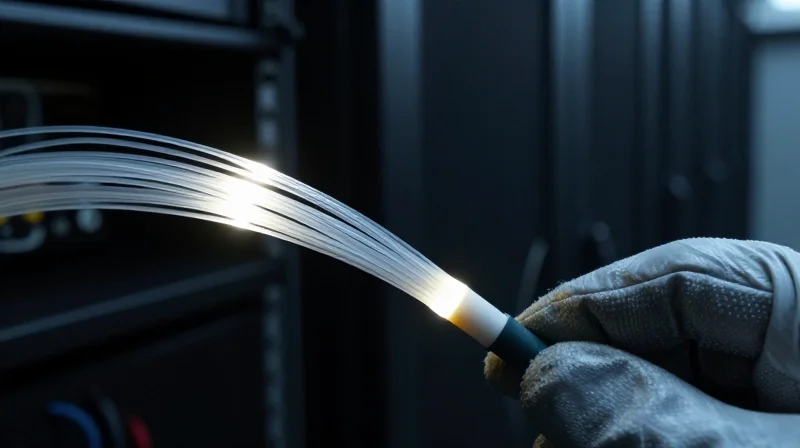
Security Integrity: Defeating Physical Layer Tapping
[生成失败] PermissionDeniedError: Error code: 403 - {'error': {'message': 'user quota is not enough (request id: 20260514101329194280413Nn0bkSLU)', 'type': 'new_api_error', 'param': '', 'code': 'local:insufficient_quota'}}
While traditional security protocols remain essential for the application layer, the physical layer is where performance and efficiency are won or lost. For organizations managing high-capacity links, transitioning to optical network security is no longer an option—it is a competitive necessity. Contact our engineering team today for a custom TCO audit of your network infrastructure.