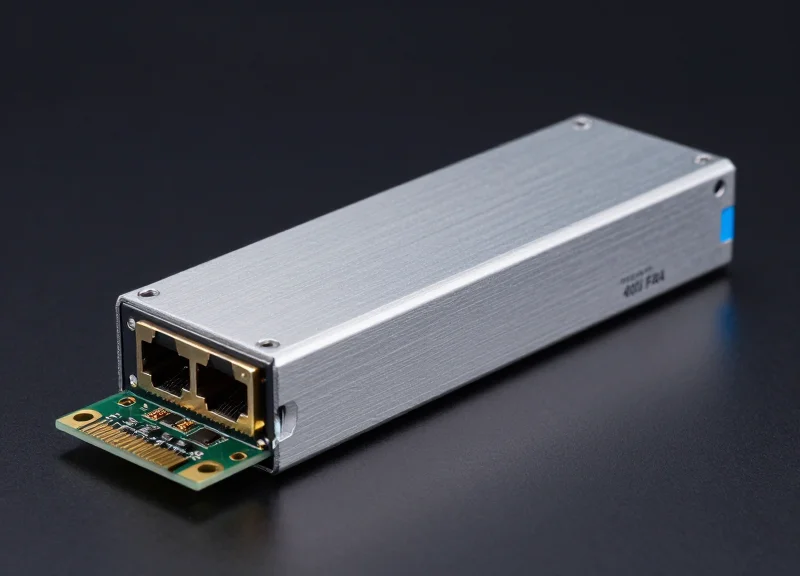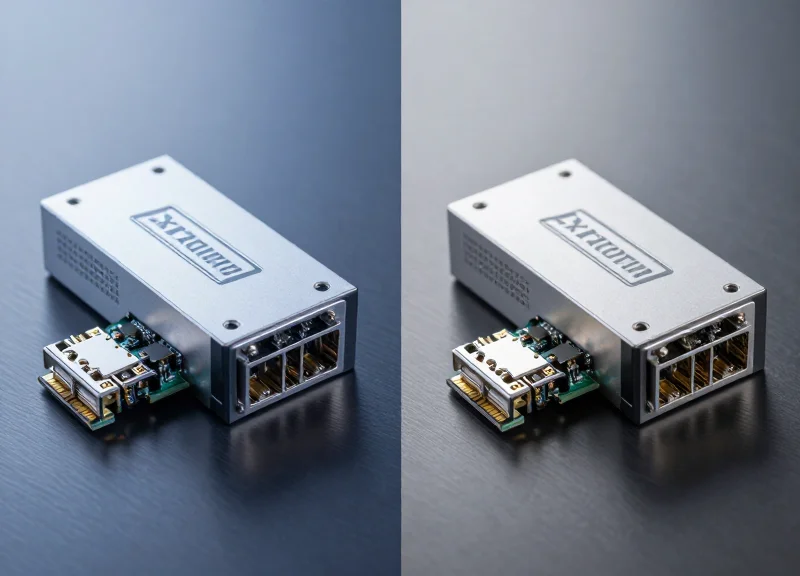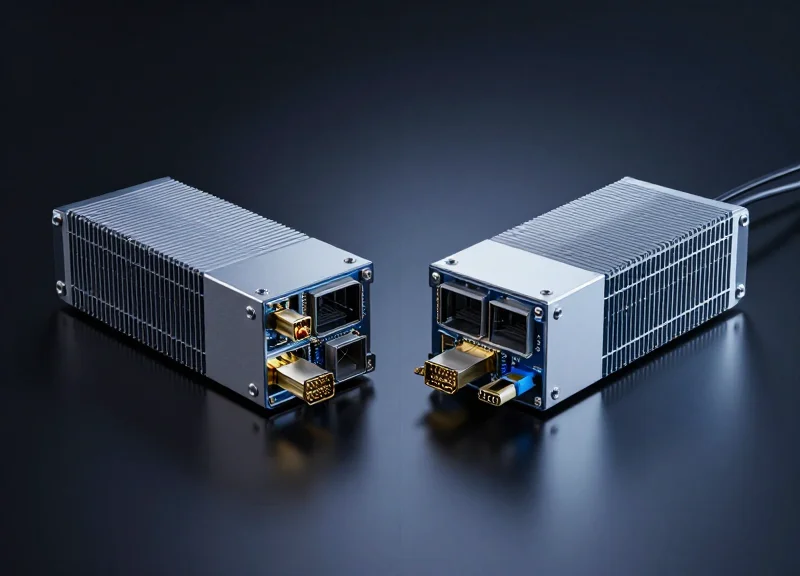
As Large Language Models (LLMs) and generative AI scale to trillions of parameters, the network has transitioned from a supporting component to a primary bottleneck. 800G optical transceivers have emerged as the critical solution for high-bandwidth AI fabric, yet many infrastructure leaders still weigh the upgrade against 400G legacy systems or emerging 1.6T roadmaps. This article provides a veteran perspective on navigating the 800G transition, focusing on the metrics that matter most: performance, efficiency, and financial viability.
The Rise of 800G in AI Architecture
The Rise of 800G in AI Architecture
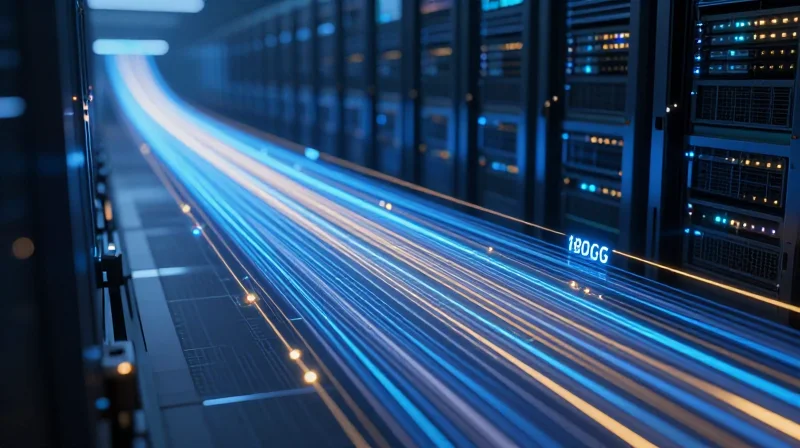
The rapid evolution of Generative AI and Large Language Models (LLMs) has fundamentally shifted the bottleneck of data center performance from individual compute nodes to the interconnect fabric. Unlike traditional cloud workloads that prioritize 'North-South' traffic (server-to-user), AI clusters are defined by massive 'East-West' traffic (GPU-to-GPU). As training sets scale to trillions of parameters, the need for 800G optical transceivers becomes mandatory to prevent networking congestion from stalling expensive H100 or B200 GPU resources. 800G provides the critical throughput required to support high-frequency synchronization and collective communication primitives like All-Reduce and All-to-All.
Contrasting Traditional Data Centers and AI Clusters
Traditional data center architectures often utilize oversubscription ratios to optimize costs, assuming that not all servers will communicate at full capacity simultaneously. In contrast, AI clusters demand non-blocking, fat-tree topologies where every GPU can communicate with any other GPU at full line rate. This paradigm shift requires a doubling of bandwidth every 18 to 24 months, significantly outpacing the traditional cloud's adoption cycle.
| Feature | Traditional Cloud DC | AI Training Cluster |
|---|---|---|
| Primary Traffic Direction | North-South (External) | East-West (Internal GPU-to-GPU) |
| Latency Sensitivity | Moderate (Milliseconds) | Ultra-Low (Microseconds) |
| Network Protocol | TCP/IP | RDMA over Converged Ethernet (RoCE) / InfiniBand |
| Standard Interconnect | 100G / 400G | 800G (Transitioning to 1.6T) |
| Oversubscription | Common (3:1 or higher) | Zero (Non-blocking 1:1) |
Why 400G is No Longer Sufficient for AI
While 400G remains the workhorse for standard enterprise cloud environments, it creates a significant physical footprint and power overhead in large-scale AI fabrics. Moving to 800G allows operators to double the bandwidth density per rack unit, reducing the total number of switches and optical cables required. This is particularly vital in InfiniBand and high-end Ethernet environments where the 'radix' or port count of the switch dictates the size of the layer-2 domain, allowing for larger clusters without adding latency-inducing tiers to the network.
- How does 800G impact GPU utilization?
By providing higher throughput, 800G reduces the 'communication wait time' during distributed training, ensuring GPUs spend more cycles on computation rather than waiting for data packets. - Is 800G only about speed?
No, it is also about density and power efficiency. 800G transceivers often utilize advanced DSPs or LPO (Linear Drive Pluggable Optics) to minimize energy consumption per bit compared to using multiple 400G links. - What is the typical reach for 800G in AI clusters?
Most 800G deployments in AI clusters focus on short-reach (SR8) or DR8 solutions, typically covering 50m to 500m to connect GPUs within the same or adjacent rows.
Technical Standards: OSFP vs. QSFP-DD
Technical Standards: OSFP vs. QSFP-DD
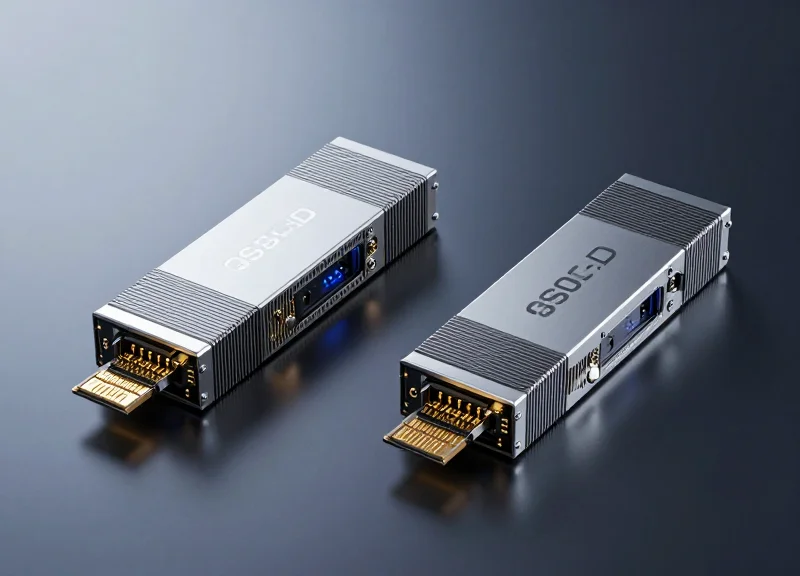
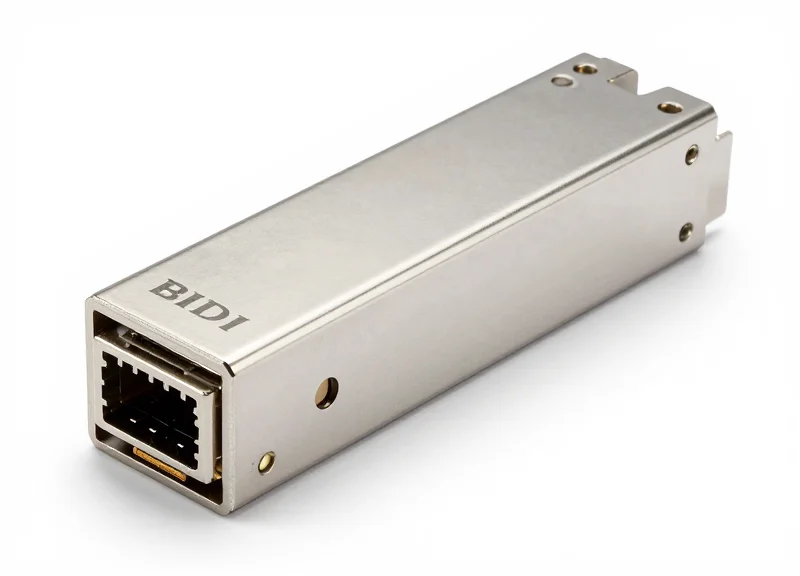
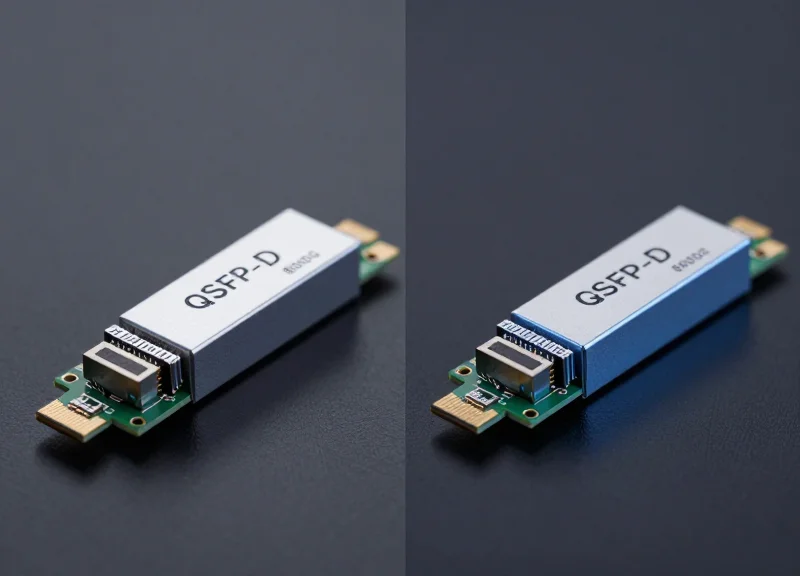
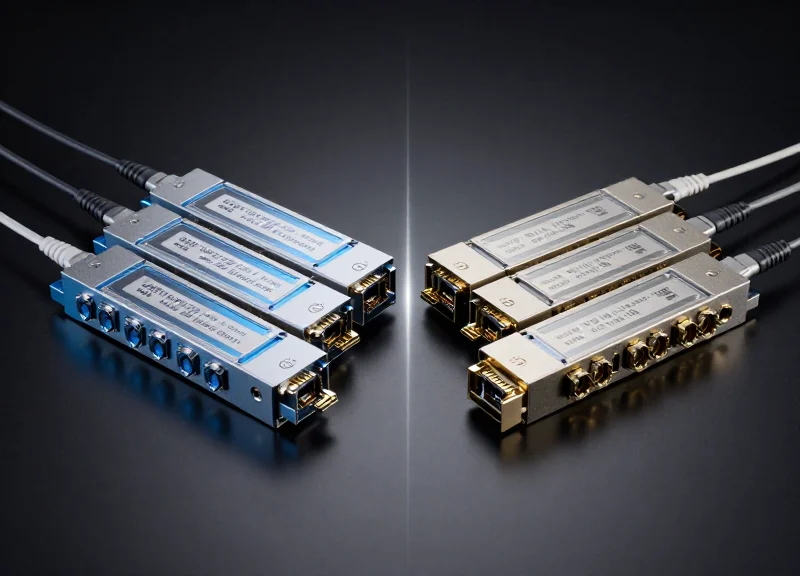
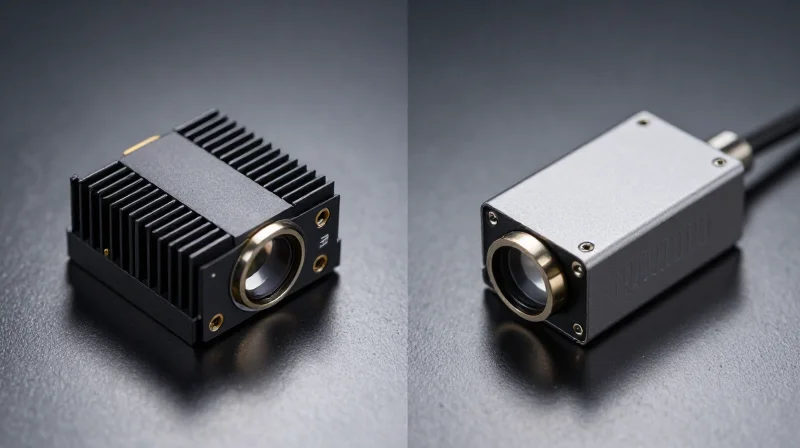
The choice between OSFP (Octal Small Form-factor Pluggable) and QSFP-DD800 (Quad Small Form-factor Pluggable Double Density) defines the physical layer strategy for 800G AI clusters. While both standards deliver the same 800 Gbps aggregate throughput using eight 100G PAM4 lanes, OSFP is increasingly becoming the dominant standard for AI-specific infrastructure, such as NVIDIA’s InfiniBand and high-end Ethernet fabrics. This preference is driven by OSFP's superior thermal management and higher power headroom, which are necessary to sustain the intense, non-stop data bursts characteristic of GPU-to-GPU collective communications.
Physical and Electrical Specifications Comparison
| Feature | OSFP (Octal SFP) | QSFP-DD800 |
|---|---|---|
| Module Width | 22.58 mm | 18.35 mm |
| Integrated Heat Sink | Yes | No (External/Cage-based) |
| Maximum Power Envelope | Up to 30W | Up to 25W |
| Backward Compatibility | Via Adapter Only | Native for QSFP28/56 |
| AI Cluster Adoption | High (Preferred for 800G/1.6T) | High in Cloud/Legacy Environments |
Thermal Management and Power Limits
In AI clusters, the thermal profile of a transceiver is as critical as its data rate. 800G modules utilize advanced Digital Signal Processors (DSPs) and high-power lasers that generate significant heat. The OSFP form factor was designed with a slightly larger footprint and integrated thermal fins, allowing it to dissipate heat directly into the airflow of the switch. This design supports a power envelope of up to 30W, providing a safer margin for the 15W-22W typically required by 800G DR8 or 2xFR4 modules. In contrast, QSFP-DD800 relies on the mechanical cage for heat transfer, which can lead to thermal throttling in high-density 1U switch configurations under the heavy load of AI training models.
- Why is OSFP preferred for NVIDIA Blackwell and Hopper architectures?
NVIDIA utilizes OSFP because its thermal efficiency and power capacity align with the requirements of the high-speed InfiniBand links used to connect thousands of GPUs without signal degradation. - Does QSFP-DD800 offer any advantages in AI environments?
QSFP-DD800 is advantageous for data centers upgrading existing infrastructure, as it maintains backward compatibility with older QSFP modules, reducing the need for new cabling and adapters in general-purpose cloud regions. - Which standard is better for future-proofing?
OSFP is widely considered the more future-proof option for AI, as its design can more easily scale to 1.6T (200G per lane) by accommodating the even higher power demands of next-generation optical engines.
Latency Benchmarks: Minimizing the Tail

800G optical transceivers provide a fundamental performance leap in AI clusters by significantly reducing serialization latency and jitter, which are the primary drivers of the 'long tail' in large-scale model training. By moving from 50G-per-lane to 100G-per-lane (and eventually 200G) signaling, these modules halve the time required to push data onto the physical medium, directly accelerating synchronous collective communication operations that otherwise bottleneck GPU utilization.
Serialization Latency: The Impact of 100G PAM4
In high-performance computing (HPC) and AI, serialization latency—the time it takes to transmit a packet bit-by-bit onto the fiber—is a physical constraint determined by link speed. As AI models grow, the size of gradient transfers increases, making serialization a non-negligible component of the total hop latency. 800G transceivers utilizing 100G PAM4 lanes provide a 2x improvement over standard 400G modules, which typically rely on 50G lanes.
| Metric | 400G (8x50G PAM4) | 800G (8x100G PAM4) | Improvement |
|---|---|---|---|
| Serialization Latency (1500B Packet) | 30.0 ns | 15.0 ns | 50% Reduction |
| Serialization Latency (9000B Jumbo) | 180.0 ns | 90.0 ns | 50% Reduction |
| Typical FEC Latency | ~100-120 ns | ~100-120 ns | Neutral (Standard Dependent) |
Impact on Collective Communication Primitives
AI training relies on collective operations like All-Reduce, All-to-All, and Reduce-Scatter. These operations are synchronous; the entire GPU cluster must wait for the slowest packet (the 'tail') to arrive before proceeding to the next computation cycle. 800G optics minimize this tail by providing higher burst capacity, allowing the network to clear congestion faster. When thousands of GPUs are interconnected, saving 15-50 nanoseconds per hop across a 3-tier Clos topology results in measurable gains in total training time (Theroetical TTT).
LPO and the Quest for Sub-100ns Latency
A significant trend in 800G deployment is the move toward Linear Drive Pluggable Optics (LPO). Standard transceivers use a Digital Signal Processor (DSP) for retiming and equalization, which adds approximately 100ns of latency per module. LPO removes the DSP, relying on the host switch ASIC for signal integrity. This removal can reduce transceiver-level latency by over 70%, making it the preferred choice for latency-sensitive InfiniBand or Ethernet-based backends in AI clusters.
- How does 800G reduce tail latency compared to 400G?
800G reduces tail latency by doubling the bandwidth per lane, which cuts serialization time in half, and by supporting newer protocols that handle Forward Error Correction (FEC) more efficiently to prevent packet retransmissions. - Is the latency difference noticeable in small AI clusters?
In clusters with fewer than 128 GPUs, the difference is marginal. However, in 'Mega-clusters' with 10,000+ GPUs, the cumulative effect of reduced hop latency significantly increases the 'Goodput' of the network. - Do all 800G transceivers offer the same latency benefits?
No. Retimed transceivers (with DSP) have higher latency (~100ns+) than LPO or CPO (Co-Packaged Optics) solutions, which can achieve near-zero additional latency by bypassing heavy digital processing.
Power Efficiency: Performance Per Watt
800G optical transceivers represent a pivotal shift in AI cluster sustainability, delivering a 20% to 50% improvement in performance-per-watt over 400G solutions by leveraging advanced 5nm/4nm Digital Signal Processors (DSPs) and innovative architectures like Linear Drive Pluggable Optics (LPO). As AI clusters scale to tens of thousands of GPUs, the power consumption of the interconnect becomes a primary operational constraint; moving to 800G allows operators to double throughput without a linear increase in power, effectively lowering the carbon footprint per TFLOPS of compute.
Efficiency Benchmarks: 800G vs. Legacy 400G
The transition from 400G to 800G is not merely about speed; it is an exercise in power optimization. While a standard 400G QSFP-DD module typically consumes between 10W and 12W, a modern 800G OSFP module with state-of-the-art DSPs consumes approximately 16W to 18W. When calculated as power per gigabit, 800G optics reduce energy requirements from roughly 27.5mW/Gbps to 21mW/Gbps. This reduction is driven by the use of more efficient CMOS processes for DSP silicon and the integration of higher-performing silicon photonics components.
| Technology Type | Typical Power (W) | Efficiency (mW/Gbps) | Primary Power Driver |
|---|---|---|---|
| 400G QSFP-DD (DSP) | 10W - 12W | 25.0 - 30.0 | 7nm DSP & EML |
| 800G OSFP (DSP) | 16W - 18W | 20.0 - 22.5 | 5nm/4nm DSP & SiPh |
| 800G LPO (Linear Drive) | 8W - 10W | 10.0 - 12.5 | DSP-free Architecture |
| 800G CPO (Co-packaged) | 5W - 7W | 6.2 - 8.7 | Short Reach/Direct Drive |
Architectural Innovations: LPO and CPO
The industry is aggressively pursuing alternatives to traditional DSP-based optics to overcome the 'power wall.' Linear Drive Pluggable Optics (LPO) remove the DSP entirely, relying on the host ASIC for signal compensation. This reduces module power consumption by nearly 50%. Co-packaged Optics (CPO) take this further by integrating the optical engine onto the same package as the switch ASIC, eliminating the need for long, power-hungry electrical traces and reducing the overall system power by up to 30% compared to pluggable alternatives.
- How does 800G improve performance per watt?
800G improves efficiency by doubling bandwidth while only increasing power by approximately 50-60%, thanks to the transition to 5nm DSPs and more efficient laser drivers. - Is LPO ready for large-scale AI deployment?
LPO offers significant power savings but requires rigorous system-level tuning and interoperability testing between the module and the switch ASIC, making it a high-reward but complex alternative. - What is the primary power advantage of CPO?
CPO reduces power by shortening the electrical distance between the compute/switch chip and the optical engine, which significantly lowers the energy required for signal integrity.
The TCO Equation: CapEx vs. OpEx
The TCO Equation: CapEx vs. OpEx
The shift to 800G optical transceivers is driven by a fundamental shift in the cost-per-bit economy; while a single 800G module is more expensive than its 400G predecessor, it delivers double the bandwidth in the same physical footprint, effectively reducing the cost-per-gigabit by approximately 15% to 25% when accounting for reduced switch port consumption and simplified cabling infrastructure.
CapEx: Front-Loading Performance
Capital expenditure at 800G involves more than just the price of the transceiver. It encompasses the high-radix switches required to support these speeds and the high-density fiber plants (typically MPO-16 or dual MPO-12) needed to connect them. However, by utilizing 800G, operators can achieve the same cluster bandwidth with half the number of optical interfaces compared to 400G, leading to significant savings in total hardware units and rack space.
| Metric | 400G Solution (2x) | 800G Solution (1x) | TCO Impact |
|---|---|---|---|
| Cost per Gigabit | Higher (Baseline) | 15-20% Lower | Direct Savings |
| Switch Port Usage | 2 Ports | 1 Port | 50% Footprint Reduction |
| Cabling Complexity | High (More strands) | Reduced (Higher density) | Lower Labor/Material |
| Power Consumption | ~24W (12W x 2) | ~16W - 18W | 25% OpEx Improvement |
OpEx: The Hidden Benefits of Density
Operational expenditure is where 800G infrastructure truly excels, particularly in AI clusters where power and cooling are the primary constraints. Because 800G modules are more power-efficient per gigabit—especially with the emergence of Linear Drive (LPO) solutions that remove the DSP—the heat load per terabit of throughput is lowered. This reduces the energy demand on HVAC systems and lowers the monthly utility overhead for the facility.
- Does 800G require an entire cabling overhaul?
While 800G can utilize existing fiber plants, maximizing its density benefits often requires moving to MPO-16 connectors or higher-grade OSFP/QSFP-DD breakout cables to match the increased port density of modern AI switches. - How does 800G impact switch utilization?
By using 800G, a single 51.2T switch can support 64 ports, allowing for flatter network topologies (fewer tiers), which drastically reduces the number of switches and transceivers needed in the overall fabric. - What is the primary driver for 800G ROI?
The primary driver is the 'Cost-per-Bit-per-Watt.' As AI models grow, the ability to move more data with less power and fewer physical components makes 800G the most viable financial path for hyperscale growth.
In summary, the transition to 800G represents a strategic trade-off: higher initial component costs are offset by a massive reduction in infrastructure overhead. For AI clusters where every milliwatt and every rack unit is a precious resource, the 800G TCO equation favors rapid adoption over the maintenance of legacy 400G systems.
800G Alternatives: DAC, AEC, and AOC
800G Alternatives: DAC, AEC, and AOC
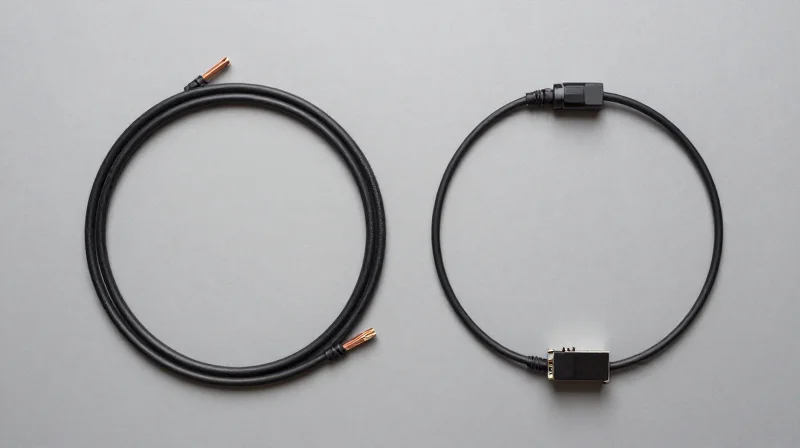
While 800G optical transceivers provide the necessary reach for large-scale fabric connectivity, alternatives like Direct Attach Copper (DAC), Active Electrical Cables (AEC), and Active Optical Cables (AOC) are essential for optimizing the power and cost of short-reach, high-density AI clusters. For intra-rack connections under 7 meters, these non-discrete solutions can reduce power consumption by as much as 10-15W per port, which is critical when scaling GPU clusters that face immediate thermal and power density constraints.
The Copper Constraint: DAC and AEC at 800G
At 800G speeds driven by 112G SerDes, passive Direct Attach Copper (DAC) faces severe physics-based limitations. Signal attenuation increases exponentially with frequency, restricting passive DAC to a maximum of 2 meters. To bridge the gap for 3-7 meter reaches without the cost of optics, Active Electrical Cables (AECs) utilize embedded retimers to clean and amplify the electrical signal. AECs offer thinner, more flexible cabling than DACs, improving airflow in dense AI server racks while maintaining lower latency than DSP-based optical transceivers.
| Feature | Passive DAC | Active AEC | Active AOC | 800G Optical Transceiver |
|---|---|---|---|---|
| Max Reach | 1-2 Meters | 5-7 Meters | Up to 30 Meters | 100m to 2km+ |
| Power (per end) | ~0.1 Watts | ~5 Watts | ~12-14 Watts | ~14-18 Watts |
| Cost Basis | Lowest (1x) | Medium (2-3x) | High (5-7x) | Highest (10x+) |
| Cable Bulk | High (Heavy/Stiff) | Low (Thin/Flexible) | Lowest (Fiber) | Lowest (Fiber) |
| Latency | Nanoseconds | Very Low (Retimed) | Low (DSP-based) | Low (DSP-based) |
The Role of Active Optical Cables (AOCs)
800G AOCs serve as a middle ground for reaches up to 30 meters. Unlike discrete transceivers, AOCs feature permanently attached fiber, which eliminates the risk of connector contamination—a major failure point in AI data centers. While they use similar DSP technology to standard transceivers, they are often tuned for shorter distances, allowing for slightly lower power consumption and higher reliability for row-to-row connectivity within the AI fabric.
- When should I use 800G AEC instead of DAC?
AEC is preferred when the reach exceeds 2 meters or when cable management and airflow are priorities. AEC cables are significantly thinner (30-32 AWG) compared to the thick 26 AWG copper required for 800G DACs. - Are AOCs more reliable than discrete transceivers?
Generally, yes. Because the fiber is factory-sealed into the module, there is no exposure to dust or debris during installation, leading to fewer signal integrity issues and lower maintenance overhead. - Does 800G AEC support breakout configurations?
Yes, AECs are frequently used in breakout modes (e.g., 800G to 2x400G or 8x100G) to connect high-radix switches to individual NICs on AI accelerators.
Compatibility and Interoperability Challenges
Compatibility and Interoperability Challenges
Interoperability in 800G ecosystems is the primary factor in preventing vendor lock-in and ensuring the long-term viability of AI infrastructure. While the transition to 800G is driven by the demand for massive bandwidth, the industry faces significant challenges in aligning mechanical form factors, electrical signaling (112G SerDes), and optical modulation standards across a multi-vendor landscape.
Form Factor Wars: OSFP vs. QSFP-DD800
The choice between Octal Small Form-factor Pluggable (OSFP) and Quad Small Form-factor Pluggable Double Density (QSFP-DD) remains a pivotal decision for cluster architects. OSFP is generally favored in high-performance AI backends due to its superior thermal path and power overhead, whereas QSFP-DD offers a more seamless path for legacy data centers upgrading from 100G and 400G environments.
| Feature | OSFP 800G | QSFP-DD800 |
|---|---|---|
| Backward Compatibility | Requires mechanical adapters for 400G OSFP | Native support for QSFP56/QSFP28 |
| Thermal Management | Integrated heatsink; supports up to 30W | Heatsink on cage; typically limited to 25W |
| Electrical Interface | 8x112G PAM4 | 8x112G PAM4 |
| AI Cluster Adoption | High (NVIDIA InfiniBand/Spectrum-4) | Moderate (Ethernet-based Leaf/Spine) |
Backward Compatibility and the SerDes Transition
The shift to 800G relies on 112G-per-lane SerDes technology. A major compatibility challenge arises when connecting 800G ports to older 400G switches that utilize 56G SerDes. While 'gearbox' chips within the transceiver or switch can translate these speeds, they introduce additional latency and power consumption—a significant drawback for latency-sensitive AI training workloads. Native 400G/800G interoperability is best achieved when both ends of the link support the same lane speeds via breakout cables (e.g., 1x800G to 2x400G).
Multi-Vendor Ecosystem and MSA Standards
Multi-Source Agreements (MSAs) are the foundation of interoperability, ensuring that a transceiver from Vendor A works in a switch from Vendor B. However, as transceivers become more complex—particularly with the advent of Linear Drive Pluggable Optics (LPO)—the reliance on host-side DSP tuning increases. This 'tight coupling' between the optical module and the switch ASIC can lead to interoperability issues that standard MSA definitions do not fully address yet.
- Can 800G transceivers communicate with 400G modules?
Yes, this is typically handled via breakout configurations (e.g., 800G DR8 to 2x 400G DR4) or through ports that support multi-rate speeds, provided the optical modulation (PAM4) is consistent. - What is the impact of LPO on interoperability?
Linear Drive Pluggable Optics (LPO) remove the internal DSP, making them highly dependent on the specific switch ASIC. This reduces cross-vendor interoperability compared to traditional DSP-based modules. - Are fiber types a compatibility concern at 800G?
While OS2 single-mode fiber remains the standard for long-reach 800G (DR8/2xFR4), short-reach multi-mode applications (SR8) require high-quality OM4 or OM5 fiber to mitigate modal dispersion at high data rates.
Roadmap to 1.6T: Is 800G a Stopgap?

800G optical transceivers are not a stopgap, but rather the essential architectural baseline for the current generation of hyperscale AI clusters. While 1.6T technology is rapidly approaching, 800G represents the most stable and cost-optimized intersection of 112G SerDes maturity, thermal management, and manufacturing yield, making it the indispensable choice for immediate GPU scaling.
The Drive Toward 1.6T: 224G SerDes and Beyond
The evolution to 1.6T is fundamentally tied to the industry's shift from 112G to 224G SerDes (Serializer/Deserializer) technology. As next-generation switching silicon—such as Broadcom’s Tomahawk 5 and NVIDIA’s Spectrum-4—reaches its limits, the demand for higher per-lane speeds becomes critical. 1.6T transceivers will leverage eight lanes of 224G PAM4 to double the bandwidth density of current 800G modules, which primarily use eight lanes of 112G.
| Metric | 800G (Mainstream) | 1.6T (Emerging) |
|---|---|---|
| Electrical Interface | 8x112G PAM4 | 8x224G PAM4 |
| Form Factor | OSFP, QSFP-DD | OSFP, OSFP-XD |
| Power Consumption | 14W - 17W | 25W - 30W+ |
| Deployment Status | Mass Production / Mature | Early Sampling / Prototype |
| Ideal Use Case | H100/B100 GPU Clusters | Next-Gen 102.4T Switches |
Is Skipping 800G a Viable Strategy?
For most enterprises, skipping 800G in favor of waiting for 1.6T is a high-risk strategy that could lead to significant compute bottlenecks. 1.6T modules face steep hurdles in thermal dissipation and signal integrity that may delay their cost-effective adoption until 2026. Deploying 800G today ensures that AI training clusters can operate at peak performance using a proven ecosystem, while the hardware for 1.6T matures in the background.
Future-Proofing and FAQ
- Can 1.6T modules be used in current 800G switches?
No. 1.6T modules require 224G SerDes electrical lanes, which are not backward compatible with the 112G electrical interfaces found in current 800G-capable switches. - Will 800G remain relevant after 1.6T launches?
Yes. Much like 100G and 400G coexist today, 800G will remain the standard for mid-tier AI clusters and spine-to-leaf connections where the power and cost overhead of 1.6T are not yet justified. - What are the biggest challenges for 1.6T adoption?
Power consumption and heat are the primary obstacles. A 1.6T module can consume over 25 watts, requiring advanced liquid cooling or specialized OSFP-XD (Extra Density) heat sinks to maintain operational stability.
Ultimately, the roadmap to 1.6T is a continuation of the efficiencies gained at 800G. Organizations should view 800G as the prerequisite for mastering the high-speed optical networking skills required for the 1.6T era, rather than a temporary distraction.
In summary, while 800G represents a significant capital investment, its ability to reduce latency and power consumption per gigabit makes it indispensable for competitive AI training clusters. Organizations must weigh their specific cluster size and cooling capabilities against these technical advantages. Ready to optimize your AI networking fabric? Contact our engineering team for a detailed hardware audit and custom 800G implementation strategy.