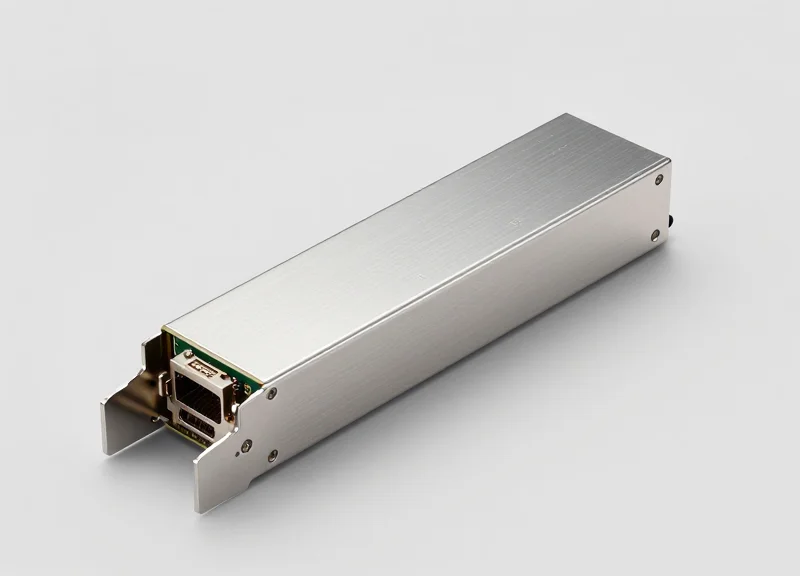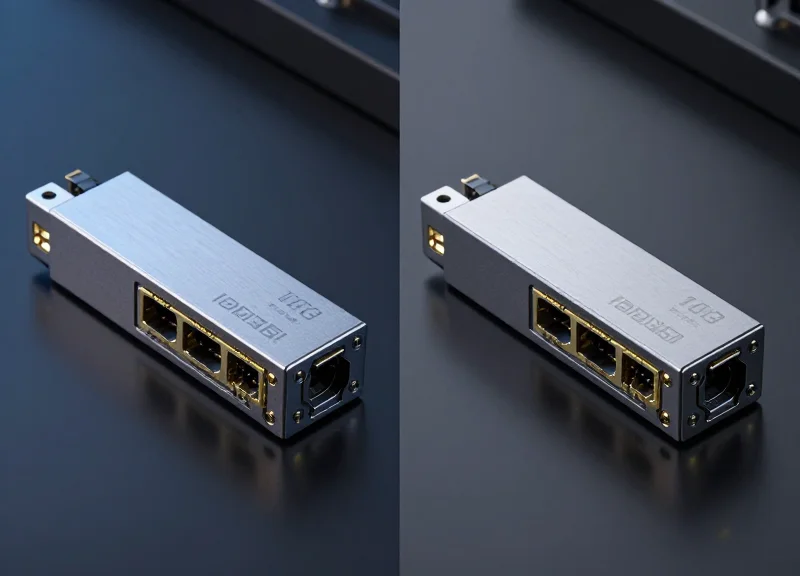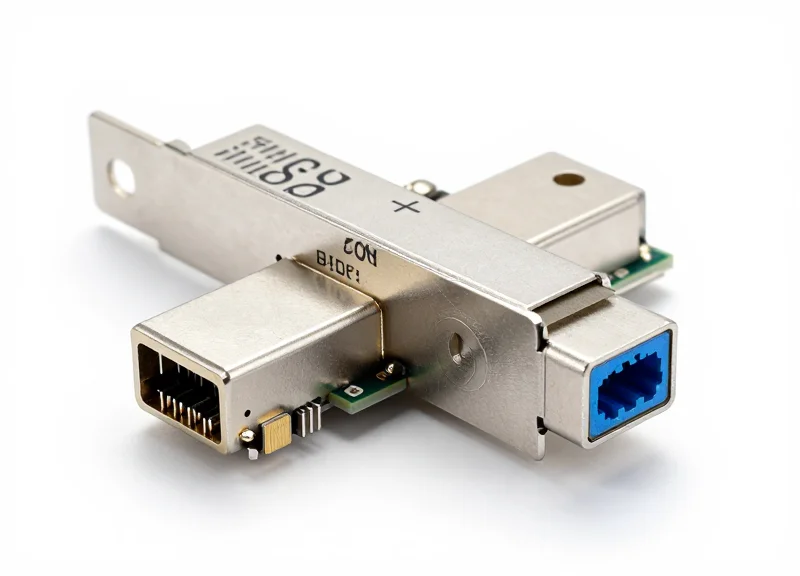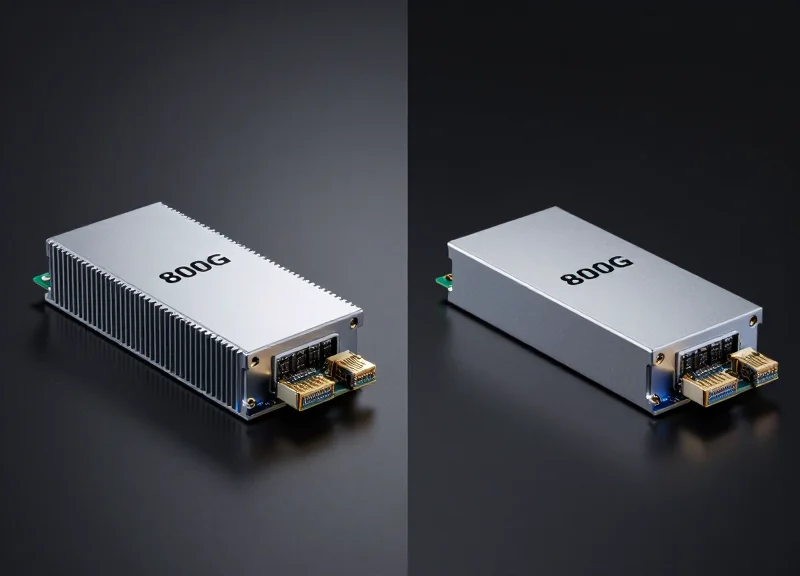
The shift to 800G networking is no longer a future roadmap—it is a current deployment reality for AI/ML clusters and hyperscale data centers. However, choosing the right form factor involves navigating a complex landscape of thermal management, power efficiency, and architectural longevity. This article analyzes the three-way battle between OSFP, QSFP-DD, and emerging alternatives to help infrastructure leads make data-driven decisions.
The Evolution of 800G Form Factors

The Shift to 800G Connectivity: The New Data Center Baseline
The transition to 800G is no longer an optional upgrade but a fundamental requirement for hyperscale data centers grappling with the exponential demands of Artificial Intelligence (AI) and Machine Learning (ML). As Large Language Models (LLMs) grow in complexity, the underlying network infrastructure must provide massive bandwidth with minimal latency. 800G Ethernet provides the necessary throughput by leveraging 112G SerDes technology, allowing for higher data density per rack unit and optimizing the power-to-performance ratio compared to previous generations.
The Architectural Challenge: Why Form Factors Had to Evolve
As the industry moved from 100G and 400G to 800G, the primary bottlenecks were thermal management and signal integrity. Traditional QSFP (Quad Small Form-factor Pluggable) designs faced significant challenges in dissipating the heat generated by 800G optics, which can exceed 15-20W per module. This necessitated a split in design philosophies: the evolution of the existing QSFP footprint into QSFP-DD (Double Density) and the introduction of the entirely new OSFP (Octal Small Form-factor Pluggable) standard.
| Feature | QSFP-DD | OSFP |
|---|---|---|
| Physical Width | Lower (High Density) | Higher (Robust) |
| Backward Compatibility | Native to QSFP28/400G | Requires Adapter |
| Thermal Capacity | Up to 15-18W | Up to 15-25W+ |
| Connector Type | 2-row 76-pin | 60-pin per side |
Comparing the Design Philosophies of OSFP and QSFP-DD
QSFP-DD was designed with legacy in mind. By maintaining the same physical width as its predecessors, it allows network operators to reuse existing faceplate designs and ensures backward compatibility with 400G QSFP optics. In contrast, OSFP was engineered from the ground up for performance. It is physically wider and deeper, allowing for integrated heat sinks directly on the module. This makes OSFP particularly attractive for the high-power requirements of the next generation, including future 1.6T transitions.
- Why did 800G require new form factors?
The jump to 800G required 112G electrical lanes and significantly higher power consumption, which necessitated enhanced thermal dissipation and tighter signal integrity that older QSFP standards could not provide. - Is OSFP or QSFP-DD more common in 800G deployments?
Currently, both are widely used. QSFP-DD is often preferred in traditional enterprise networking for its backward compatibility, while OSFP is gaining dominance in AI clusters due to its superior cooling capabilities.
OSFP: Optimized for Thermal Excellence
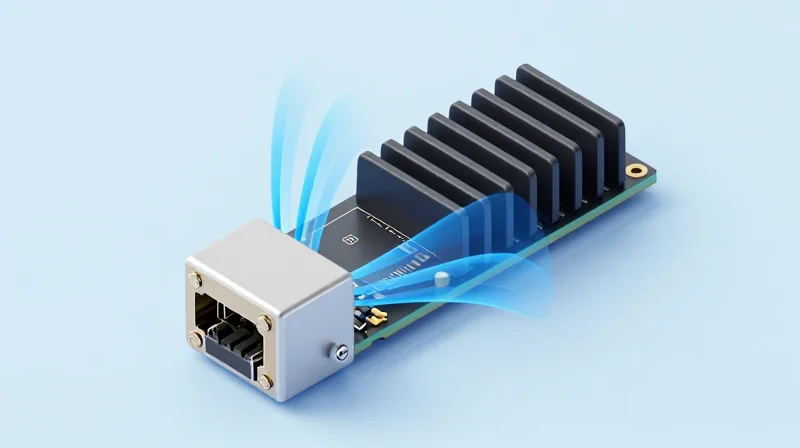
The OSFP (Octal Small Form-factor Pluggable) represents a fundamental shift in optical module design, prioritizing thermal efficiency to handle the extreme power densities of 800G and 1.6T architectures. Unlike previous generations that relied heavily on the switch chassis for cooling, the OSFP module incorporates a high-performance integrated heat sink directly into its casing. This design choice allows the module to dissipate heat more effectively, maintaining optimal operating temperatures even as power consumption climbs toward 20W or 30W per port.
The Integrated Heat Sink: A Paradigm Shift
Traditional form factors like QSFP-DD utilize a flat top surface that interfaces with a heat sink attached to the equipment cage. While effective for lower speeds, this creates a thermal resistance layer at the interface. OSFP eliminates this bottleneck by featuring an 'integrated heat sink' design where cooling fins are part of the module body. This allows airflow from the switch fans to pass directly over the module's fins, significantly increasing the surface area for heat exchange.
| Thermal Metric | OSFP (800G) | QSFP-DD (800G) |
|---|---|---|
| Integrated Heat Sink | Yes (Module-based fins) | No (Rides on cage heatsink) |
| Max Power Dissipation | Up to 30W (v4.0+) | Typically 15W - 25W |
| Thermal Resistance | Lower (Direct airflow) | Higher (Interface dependent) |
| 1.6T Upgrade Path | Seamless physical transition | Requires significant redesign |
Thermal Readiness for 1.6T Transitions
As the industry looks toward 1.6T (1600G) speeds, the power requirements are expected to exceed 35W per module. The OSFP's larger physical dimensions (slightly wider and deeper than QSFP-DD) provide the necessary volume to house complex DSPs and advanced photonics while managing the resulting heat. This 'thermal headroom' makes OSFP the preferred choice for hyperscale data centers that require a stable long-term roadmap from 800G to 1.6T without a complete overhaul of their cooling infrastructure.
- Does OSFP require specialized cooling systems?
No, it is designed to work with standard front-to-back or back-to-front airflow, but it is more efficient at utilizing that airflow than legacy designs. - How does OSFP's size impact density?
While OSFP is slightly larger, it still supports 32 ports per 1U front panel, matching the density of QSFP-DD while providing superior thermal performance. - Is OSFP backwards compatible?
OSFP requires an adapter to support QSFP modules, as its physical slot is larger and the electrical interface is optimized for higher-speed signaling.
QSFP-DD: Prioritizing Backward Compatibility
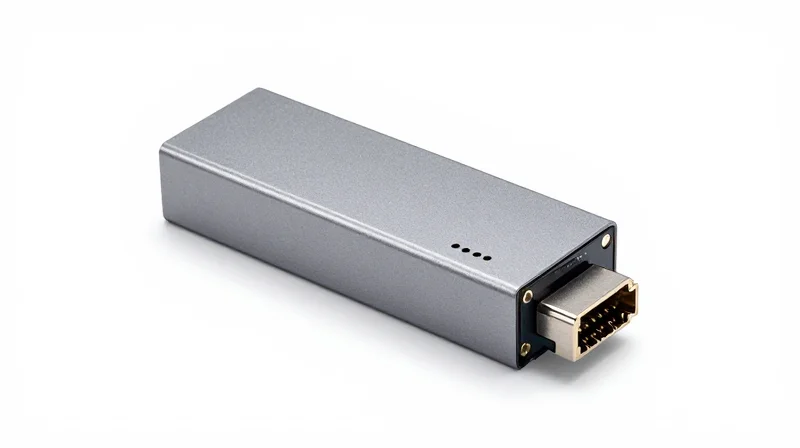
QSFP-DD: Prioritizing Backward Compatibility
The Quad Small Form-factor Pluggable Double Density (QSFP-DD) stands as the industry's answer to the need for high-density 800G connectivity that respects the massive capital investment already embedded in existing QSFP-based infrastructures. By doubling the number of electrical lanes from four to eight, QSFP-DD achieves 800Gbps throughput while maintaining a form factor that is physically compatible with legacy QSFP28 and QSFP56 modules. This design philosophy prioritizes operational continuity, allowing network operators to mix and match module generations within the same system cage without requiring expensive hardware overhauls.
The Mechanics of Double Density
To achieve 800G within the classic QSFP footprint, the QSFP-DD MSA (Multi-Source Agreement) introduced a second row of electrical contacts. While the external dimensions remain nearly identical to its predecessors, the internal interface utilizes 8 lanes of 100G PAM4. This allows for a seamless transition where a QSFP-DD port can support an 800G transceiver or, through the use of a simple adapter or native port backwards compatibility, a legacy 100G or 400G module.
| Feature | QSFP28 | QSFP56 | QSFP-DD800 |
|---|---|---|---|
| Max Bandwidth | 100 Gbps | 200 Gbps | 800 Gbps |
| Electrical Lanes | 4 x 25G (NRZ) | 4 x 50G (PAM4) | 8 x 100G (PAM4) |
| Backward Compatibility | N/A | QSFP28 | QSFP28/56/DD400 |
| Typical Power | 3.5W - 5W | 5W - 7W | 12W - 18W |
Thermal Challenges and Design Considerations
Unlike the OSFP form factor, which includes an integrated heat sink, the QSFP-DD relies primarily on the system's cage and external cooling mechanisms. This makes the QSFP-DD slightly more sensitive to thermal management at the 800G level, where power consumption can reach 18W or higher. However, advancements in cage design and the use of 'riding heat sinks' have mitigated these concerns, making it a viable choice for high-density leaf-and-spine switches where space is at a premium.
Frequently Asked Questions
- Can a QSFP-DD port support legacy QSFP modules?
Yes, QSFP-DD is designed to be backward compatible. A standard QSFP28 or QSFP56 module can be plugged into a QSFP-DD port, though it will only utilize the first four lanes of the electrical interface. - How does QSFP-DD compare to OSFP in terms of density?
QSFP-DD generally offers higher port density because it is slightly smaller. It allows for up to 36 ports in a 1U chassis, whereas OSFP often requires more spacing for thermal management. - What is the primary benefit of choosing QSFP-DD for 800G?
The primary benefit is the lower total cost of ownership (TCO) derived from reusing existing network architectures and the simplified logistics of maintaining a single, consistent form factor across different speed tiers.
Performance Benchmarking: Latency and Signal Integrity
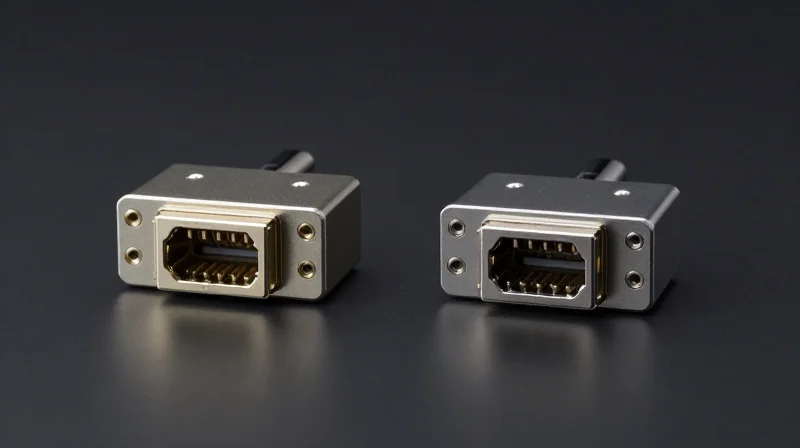
In the transition to 800G networking, the OSFP form factor demonstrates a marginal but critical advantage in signal integrity over QSFP-DD due to its larger connector pitch and optimized internal layout, which reduces crosstalk and insertion loss in high-frequency 112G-per-lane architectures. While both standards achieve the required performance for modern data centers, the OSFP's physical design provides more headroom for the inevitable shift toward 224G SerDes and 1.6T speeds.
Signal Integrity and Path Loss at 112G
Signal integrity (SI) is the primary constraint when moving from 56G to 112G SerDes. As frequencies increase, the tolerance for impedance mismatches and trace lengths decreases. The OSFP connector is specifically engineered to handle higher frequencies with lower return loss. Because the OSFP module is slightly larger, it allows for better trace routing and spacing, which significantly mitigates electromagnetic interference (EMI) and near-end crosstalk (NEXT).
| Metric | 800G OSFP (112G SerDes) | 800G QSFP-DD (112G SerDes) |
|---|---|---|
| Connector Insertion Loss | ~1.2 dB @ 28 GHz | ~1.5 dB @ 28 GHz |
| Crosstalk Margin | Higher (Better isolation) | Standard (Tight spacing) |
| Impedance Control | Excellent (92-100 Ohm) | Good (85-110 Ohm) |
| Thermal Impact on SI | Low (Integrated heatsink) | Moderate (Dependent on cage) |
Latency Profiles: DSP and FEC Overhead
Latency in 800G optics is less a function of the physical form factor and more a result of the Digital Signal Processing (DSP) and Forward Error Correction (FEC) algorithms required to maintain a viable bit error rate (BER). However, because OSFP generally maintains a cleaner signal profile, it can theoretically operate with less aggressive equalization at the host level, potentially reducing the overall power-to-latency ratio in massive-scale fabrics.
- Does OSFP have lower latency than QSFP-DD?
The physical propagation delay difference is nanosecond-level and negligible. The primary latency driver is the DSP chip used inside the module, which is often identical across both form factors. - How does signal integrity affect 1.6T readiness?
OSFP’s superior signal-to-noise ratio (SNR) at 112G makes it the preferred candidate for 1.6T (224G SerDes) because it provides the necessary electrical margins that the tighter QSFP-DD layout struggles to maintain. - What role does the PCB material play in these benchmarks?
Regardless of form factor, 800G performance requires ultra-low-loss PCB materials like Megtron 7. OSFP’s design allows for slightly shorter trace lengths in certain switch configurations, further aiding signal clarity.
Power Consumption: The Silent Budget Killer

At the 800G threshold, power consumption ceases to be a secondary technical spec and becomes a primary driver of Total Cost of Ownership (TCO). While individual modules may only draw between 16W and 24W, the cumulative effect in a high-density 32-port or 64-port switch creates a thermal density that challenges traditional air-cooling limits, often requiring a 1:1.2 or 1:1.5 ratio of cooling energy for every watt consumed by the optics.
Comparative Power Profiles: OSFP vs. QSFP-DD
The power envelope of an 800G module is largely dictated by the Digital Signal Processor (DSP). However, the form factor influences how efficiently that power is managed. OSFP modules, with their integrated heat sinks, generally allow for better thermal dissipation, which can lead to slightly lower fan speeds and reduced system-level power consumption compared to the more cramped QSFP-DD alternative.
| Module Type | Typical Power (800G DR8) | Max Power Envelope | Thermal Dissipation Method |
|---|---|---|---|
| QSFP-DD800 | 16W - 19W | 20W | Flat top, relies on internal/cage heatsink |
| OSFP800 | 15W - 18W | 24W+ | Integrated riding heat sink (Fin design) |
| LPO (Linear Drive) | 8W - 10W | 12W | No DSP; significantly reduced thermal load |
The Cooling Multiplier and Operational Expense
Data center operators must account for the 'Cooling Multiplier.' For every watt of power consumed by an 800G transceiver, the facility incurs additional costs for the precision air conditioning (CRAC) or liquid cooling systems required to remove that heat. In high-density AI clusters, the shift from 400G (averaging 12W) to 800G (averaging 18W) represents a 50% increase in power demand per port, which can push existing Power Usage Effectiveness (PUE) ratings to their breaking point.
Alternative Efficiency: The Rise of LPO
To combat the 'silent budget killer' of power consumption, Linear Drive Pluggable Optics (LPO) have emerged as a compelling alternative. By removing the power-hungry DSP from the module and relying on the host ASIC for signal integrity, LPO can reduce module power consumption by up to 50%. This not only lowers the electricity bill but also simplifies the thermal design of the switch, potentially extending the lifespan of the hardware.
- Does OSFP consume more power than QSFP-DD?
Not necessarily; the power consumption is driven by the internal components like the DSP. However, OSFP can handle higher power (up to 24W-30W) more effectively due to its superior heat sink design, making it the preferred choice for future 1.6T upgrades. - How does 800G power draw affect rack density?
Increased power draw per port limits the number of switches per rack. Operators may find themselves 'power-capped'—unable to fill a rack to its physical capacity because the power delivery or cooling capacity is exceeded. - Why is the DSP the main power consumer?
The DSP performs complex electronic dispersion compensation and FEC (Forward Error Correction) required to maintain signal integrity at 112G per lane speeds, which is computationally intensive and thermally demanding.
Beyond Traditional Pluggables: LPO and CPO
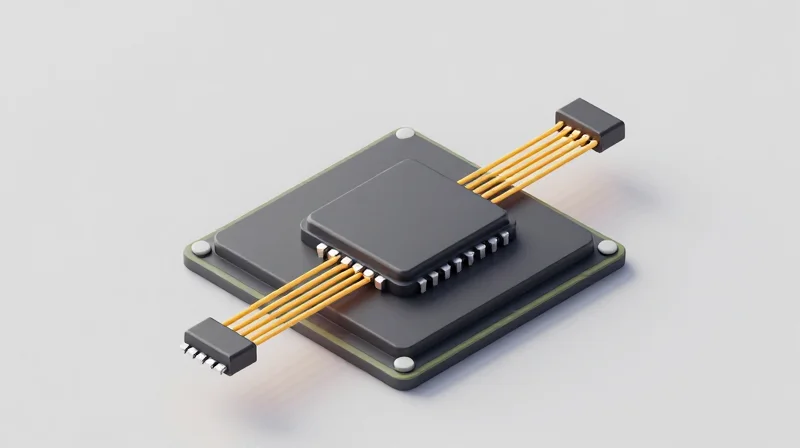
As data centers hit the 'power wall' with 800G and beyond, traditional pluggable modules—which rely on integrated Digital Signal Processors (DSPs)—face significant thermal and cost challenges. Linear Drive Pluggable Optics (LPO) and Co-Packaged Optics (CPO) represent the primary architectural shifts designed to bypass these limitations. While LPO eliminates the DSP to reduce power and latency within the existing pluggable framework, CPO integrates optical engines directly onto the switch package, radically shortening the electrical path and maximizing density for future 1.6T and 3.2T scaling.
Linear Drive Pluggable Optics (LPO): Efficiency via Simplicity
LPO modules remove the internal DSP, relying instead on high-performance analog components and the host switch’s SerDes to manage signal integrity. This 'linear drive' approach can reduce module power consumption by approximately 25-50% compared to traditional DSP-based optics. Furthermore, by bypassing the re-timing process of a DSP, LPO achieves sub-nanosecond latency, making it highly attractive for high-frequency trading and AI/ML training clusters where every microsecond of synchronization counts.
Co-Packaged Optics (CPO): The Ultimate Integration
CPO represents a more radical departure from the pluggable status quo. By mounting the optical engines on the same substrate as the ASIC, CPO eliminates the long electrical traces between the switch chip and the front panel. This proximity reduces signal loss and allows for significantly higher port density. While current 800G deployments largely favor pluggable form factors (OSFP/QSFP-DD) due to serviceability and established supply chains, CPO is widely viewed as the inevitable solution for the 51.2T and 102.4T switch generations where thermal density exceeds the limits of air cooling.
Comparative Analysis: Traditional vs. LPO vs. CPO
| Feature | Traditional DSP Pluggable | Linear Drive (LPO) | Co-Packaged Optics (CPO) |
|---|---|---|---|
| Power Consumption | High (15-25W+ per module) | Medium-Low (8-12W per module) | Lowest (Integrated) |
| Latency | Standard (DSP-induced lag) | Ultra-Low (Analog-only path) | Ultra-Low (Shortest path) |
| Serviceability | Hot-swappable, mature | Hot-swappable, emerging | Challenging (Integrated/Fixed) |
| Interoperability | Broad (Standards-based) | Host-dependent (Limited) | Proprietary/Ecosystem-locked |
Frequently Asked Questions: The Future of Optical Connectivity
- Will LPO replace traditional 800G pluggables?
Not entirely. While LPO is excellent for power and latency, its reliance on the host SerDes means it lacks the robustness of DSP-based optics for long-reach applications or heterogeneous hardware environments. - Is CPO ready for production environments?
CPO is currently in the early adoption and pilot phase. Most 800G implementations still use OSFP or QSFP-DD, but CPO is expected to gain significant market share as switch capacities reach 1.6T and 3.2T per port. - What are the main drawbacks of CPO?
The primary concerns are the lack of standardized field serviceability—if one optical engine fails, the entire switch package may need replacement—and the current complexity of the multi-vendor manufacturing ecosystem.
TCO Analysis: CAPEX vs. OPEX

Calculating the Total Cost of Ownership (TCO) for 800G networking requires a move beyond simple price-per-port metrics. While the Capital Expenditure (CAPEX) for transceivers and switches remains the most visible cost, the Operational Expenditure (OPEX) generated by power consumption, cooling requirements, and hardware reliability often accounts for more than 60 percent of the total cost over a five-year lifecycle. In the 800G era, the physical design of the form factor (OSFP vs. QSFP-DD) directly influences these operational costs through thermal management capabilities and power efficiency.
CAPEX Factors: Initial Hardware Investment
The primary CAPEX drivers include the cost of the 800G pluggable modules, the corresponding switch silicon, and the physical cabling infrastructure. Currently, QSFP-DD modules often hold a slight edge in initial purchase price due to their backward compatibility and established manufacturing ecosystem. However, OSFP optics, while sometimes commanding a premium for their integrated heat sinks, provide a better bridge to 1.6T, potentially reducing future hardware replacement costs. Alternatives like Linear Drive Pluggable Optics (LPO) represent a significant CAPEX shift; while they eliminate the cost of the DSP within the module, they require more sophisticated and expensive switch ASICs to manage signal integrity.
OPEX Factors: Power, Cooling, and Maintenance
OPEX in 800G environments is dominated by the 'Power Tax.' A standard 800G transceiver consumes between 14W and 18W. When multiplied by hundreds of ports in a leaf-spine architecture, the electricity cost is staggering. Furthermore, every watt consumed by the optic requires additional power for the cooling system. OSFP modules generally offer lower OPEX in high-density environments because their superior thermal dissipation allows cooling fans to run at lower speeds. In contrast, QSFP-DD may require more aggressive, energy-intensive airflow management to prevent thermal throttling under peak loads.
| Cost Driver | QSFP-DD 800G | OSFP 800G | LPO (Alternative) |
|---|---|---|---|
| Module Unit Cost | Moderate | Moderate-High | Low-Moderate |
| Switch Port Cost | Standard | Standard | High (Specialized ASIC) |
| Power Consumption | 16W - 19W | 14W - 17W | 8W - 10W |
| Cooling Complexity | High | Moderate | Low |
| 5-Year TCO Profile | High OPEX | Balanced | Lowest OPEX |
Strategic Financial Considerations
- How does port density affect TCO?
Higher density increases heat concentration. OSFP's ability to handle up to 15W+ more efficiently than QSFP-DD can lead to significant savings in data center cooling infrastructure costs over time. - Is LPO a viable cost-saving alternative?
Yes, but it shifts the cost. While you save on module CAPEX and significantly reduce power OPEX, you must invest in higher-quality host platforms and more rigorous testing for interoperability. - What is the impact of backward compatibility on TCO?
QSFP-DD's backward compatibility reduces CAPEX by allowing the reuse of existing 400G infrastructure, but this must be weighed against the potential OPEX penalties of its tighter thermal constraints.
Strategic Selection: AI Clusters vs. Cloud Networking

Strategic selection of 800G hardware is dictated by the thermal envelope of the environment and the specific demands of the workload: OSFP is the undisputed leader for high-heat AI training clusters due to its superior power dissipation, while QSFP-DD remains the pragmatic choice for legacy-compatible cloud networking. For organizations prioritizing power efficiency and latency in dedicated AI back-ends, emerging alternatives like Linear Drive Pluggable Optics (LPO) offer a compelling middle ground by removing the DSP and reducing heat at the port level.
AI and ML Training: Why OSFP Dominates the Compute Fabric
In AI/ML environments, such as those utilizing NVIDIA H100/B200 clusters, the interconnect is under constant, high-utilization stress. These workloads generate significant heat, often requiring optical modules to handle 25W to 30W. OSFP's larger physical size and integrated heatsink allow for significantly better airflow and cooling efficiency. This thermal headroom is not just a luxury; it is a requirement for future-proofing, as the roadmap to 1.6T and 3.2T will likely rely on the OSFP footprint to manage even higher power densities without thermal throttling.
Standard Cloud Spine-Leaf: The Case for QSFP-DD
For general-purpose data centers running traditional cloud applications, the primary concern is often the Total Cost of Ownership (TCO) and infrastructure continuity. QSFP-DD800 provides a seamless transition because its cages are backward compatible with QSFP56 and QSFP28 modules. This allows network operators to upgrade their switch fabric incrementally, utilizing existing fiber and lower-speed modules where 800G is not yet required, thereby optimizing CAPEX during the transition phase.
| Feature | OSFP (Preferred for AI) | QSFP-DD (Preferred for Cloud) | LPO (Alternative) |
|---|---|---|---|
| Max Power Dissipation | Up to 30W+ | Up to 25W | ~15-18W |
| Backward Compatibility | Requires Adapter | Native (QSFP series) | Form-factor dependent |
| Ideal Workload | GPU-to-GPU Clusters | Standard Leaf-Spine | Ultra-low Latency AI |
| Thermal Management | Integrated Heatsink | Rely on Cage/System | Low Heat Signature |
The Rise of Alternatives: When to Pivot to LPO
Linear Drive Pluggable Optics (LPO) are emerging as the 'third path' for specific AI use cases. By removing the DSP from the optical module, LPO reduces both power consumption and latency by approximately 25%. However, this comes at the cost of interoperability, as the switch-side SerDes must be specifically tuned to handle the signal integrity. Strategic selection of LPO is currently recommended only for fixed, single-vendor AI back-end fabrics where performance-per-watt is the critical metric over modular flexibility.
Strategic Selection FAQ
- Can I use OSFP modules in a QSFP-DD switch?
No, they are physically incompatible. You must choose the switch hardware based on the form factor you intend to standardize on for that specific tier of the network. - Which is better for liquid-cooled environments?
OSFP is generally preferred in liquid-cooled racks because its design is more robust for high-density configurations where airflow is restricted and heat must be moved efficiently to cold plates. - Is QSFP-DD becoming obsolete?
Not at all. While OSFP is winning the AI race, QSFP-DD remains the dominant standard for 400G/800G enterprise and service provider networks due to its massive installed base.
Future-Proofing Your Infrastructure
Future-proofing 800G infrastructure is not merely about current throughput, but about selecting a physical and electrical architecture—specifically OSFP or high-performance QSFP-DD—that provides the thermal headroom and signal integrity necessary to support the 224G-per-lane SerDes required for the 1.6T and 3.2T generations.
Thermal Capacity: The Deciding Factor for 1.6T
As data centers look toward 1.6T, thermal management becomes the primary bottleneck. While 800G QSFP-DD is efficient for current cloud architectures, the OSFP form factor offers a clear path forward due to its integrated heat sink and larger surface area. This design allows OSFP to handle the 30W+ power envelopes expected in 1.6T transceivers, whereas QSFP-DD faces significant cooling challenges at those densities. Investing in OSFP-ready cages now ensures that the same physical infrastructure can host next-generation modules without a complete redesign of the cooling system.
| Feature | 800G OSFP | 800G QSFP-DD | 1.6T Preparedness |
|---|---|---|---|
| Max Power Dissipation | Up to 15W-30W | Up to 12W-25W | OSFP holds 20% advantage |
| SerDes Support | 112G (224G Capable) | 112G (Limited 224G) | OSFP preferred for 224G |
| Backward Compatibility | Via Adapters | Excellent (Native) | QSFP-DD wins on legacy |
| Thermal Management | Integrated Heat Sink | Rely on Cage/System | OSFP superior for AI/HPC |
Integrating LPO and CPO into Long-Term Roadmaps
For organizations focused on the 3.2T horizon, the discussion shifts from traditional pluggables to Linear Drive Pluggable Optics (LPO) and Co-Packaged Optics (CPO). LPO provides an intermediate step, reducing power consumption by removing the DSP, which is critical for scaling AI clusters. However, CPO represents the ultimate future-proofing strategy for massive-scale fabrics, as it moves the optical engine closer to the switch silicon. Early adoption of modular system architectures that can accommodate both pluggable and co-packaged solutions will be the hallmark of resilient infrastructure.
- Can 800G QSFP-DD support 1.6T upgrades?
While technically possible through the QSFP-DD1600 specification, it requires extreme precision in thermal management and may face density limitations compared to OSFP. - Is OSFP backward compatible with QSFP optics?
Yes, through the use of mechanical adapters, OSFP cages can support QSFP modules, making it a flexible choice for mixed-speed environments. - How does 224G SerDes impact current 800G investments?
Current 800G systems use 112G SerDes. Future-proofing requires ensuring that switch silicon and PCB materials (like low-loss laminates) are chosen with the transition to 224G signaling in mind.
Deciding between OSFP and QSFP-DD depends on your specific thermal requirements and existing port legacy. While OSFP offers a smoother path to 1.6T, QSFP-DD provides unmatched flexibility for current-gen upgrades. Ready to optimize your 800G infrastructure? Contact our engineering team today for a custom TCO assessment and hardware validation.