As hyperscale data centers and enterprises transition to 400G to meet exploding bandwidth demands, the choice of optical transceivers becomes a multi-million dollar decision. Network architects often face the dilemma: pay the premium for OEM modules or risk compatibility with alternatives? This article leverages 20 years of Silicon Valley networking expertise to provide a deep-dive comparison into latency, power consumption, and the true Total Cost of Ownership (TCO) between Arista compatible 400G solutions and their industry counterparts.
The 400G Ecosystem: Arista's Role in High-Density Networking

Arista Networks has established itself as a cornerstone of the 400G ecosystem by engineering high-density switching platforms that bridge the gap between legacy infrastructure and future-proof bandwidth. By leveraging its Extensible Operating System (EOS), Arista provides a unified management layer that simplifies the deployment of complex 400G optics, allowing for granular telemetry and automation across diverse form factors like OSFP and QSFP-DD.
Form Factor Divergence: OSFP vs. QSFP-DD in Arista Hardware
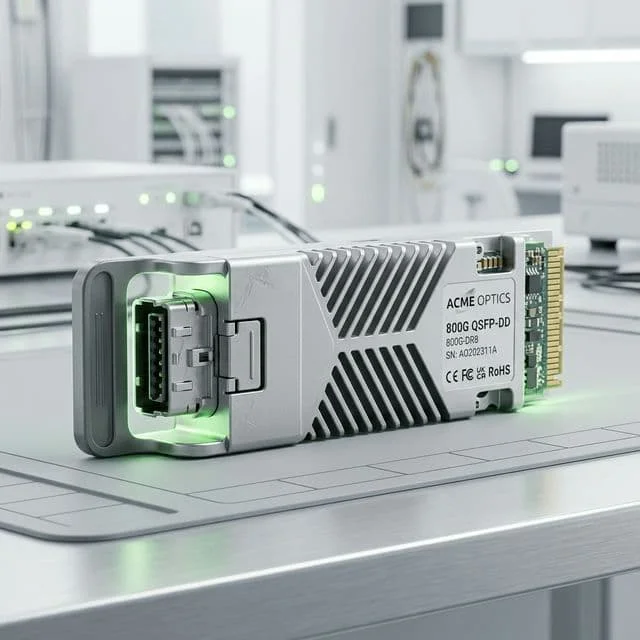
Unlike competitors who often commit to a single standard, Arista’s portfolio—including the 7060X4 and 7280R3 series—is designed to accommodate the industry's split between OSFP (Octal Small Form-factor Pluggable) and QSFP-DD (Quad Small Form-factor Pluggable Double Density). While OSFP was championing superior thermal management and a path to 800G, QSFP-DD gained traction for its backward compatibility with QSFP28 modules.
| Feature | OSFP (Arista Preferred) | QSFP-DD (Industry Standard) |
|---|---|---|
| Thermal Capacity | Up to 15W (Integrated Heat Sink) | Up to 12W (Relies on Cage/Heatsink) |
| Backward Compatibility | Requires Adapter | Native Support for QSFP28 |
| Future Roadmap | Optimized for 800G/1.6T | Iterative path to 800G |
| Density | 32 Ports per 1U | 36 Ports per 1U |
The Fragmentation of the 400G Transceiver Market
The 400G market is significantly more fragmented than previous generations due to the proliferation of Multi-Source Agreements (MSAs) and the varying power requirements of coherent vs. non-coherent optics. Arista EOS plays a critical role here, as it must support a wide array of modulation techniques (like PAM4) and ensure interoperability between OEM-branded optics and third-party 'Arista Compatible' solutions that offer equivalent performance at a lower price point.
- Why does Arista support two different 400G form factors?
Arista supports both to give operators a choice between the thermal efficiency of OSFP for high-power long-reach links and the backward compatibility of QSFP-DD for existing 100G/200G environments. - How does Arista EOS handle third-party 400G optics?
EOS uses a 'Service Mode' or specific CLI commands to allow non-Arista coded optics to function, though it provides the most comprehensive telemetry data when using fully compatible programmed modules. - What is the impact of market fragmentation on OpEx?
Fragmentation increases the need for rigorous validation. Network architects must choose between the 'plug-and-play' assurance of expensive OEM optics and the significant cost savings of validated compatible alternatives.
Anatomy of a Compatible Transceiver: Quality vs. Cost
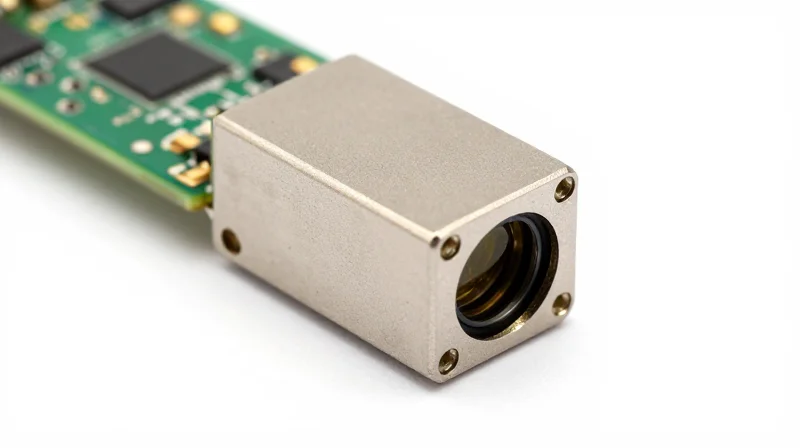
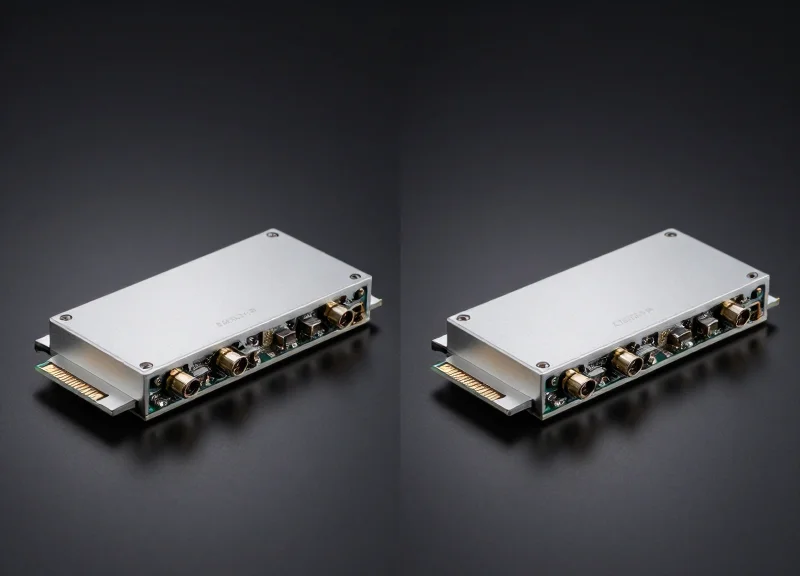
The performance disparity between a premium Arista-compatible 400G module and a low-cost 'white-box' alternative is determined by the quality of the silicon and the precision of the firmware coding. While both may visually adhere to OSFP or QSFP-DD form factors, premium compatibles utilize identical components to OEM modules—such as Marvell or Broadcom DSPs and high-grade EML lasers—ensuring that the high-frequency signaling required for 400GbE remains within the tight PAM4 modulation tolerances required by Arista's high-density switching silicon.
The Internal Anatomy: Laser Quality and DSP Selection
At 400G speeds, signal integrity is significantly more fragile than at 10G or 100G. High-tier compatibles prioritize 'Grade A' lasers and advanced Digital Signal Processors (DSPs) designed to mitigate chromatic dispersion. Conversely, 'white-box' alternatives often utilize 'binned' components—parts that pass basic functional tests but exhibit higher jitter or thermal output. These sub-par components lead to higher Bit Error Rates (BER), forcing the Forward Error Correction (FEC) on Arista switches to work harder, which can introduce latency and intermittent packet loss in high-throughput environments.
EEPROM Coding and EOS Integration
Beyond physical hardware, the EEPROM (Electrically Erasable Programmable Read-Only Memory) serves as the 'identity card' for the module. Arista's Extensible Operating System (EOS) is engineered to perform rigorous checks for Digital Optical Monitoring (DOM) capabilities and specific vendor strings. A premium compatible module is programmed with sophisticated firmware that mimics OEM behavior precisely. This ensures the module is recognized natively without necessitating the 'service unsupported-transceiver' command, which can complicate troubleshooting and sometimes affect the data displayed in telemetry dashboards.
| Feature | White-Box Generic | Premium Arista Compatible | Arista OEM |
|---|---|---|---|
| DSP/Laser Source | Variable/Unbranded | Tier 1 (Broadcom/Marvell) | Tier 1 (Broadcom/Marvell) |
| EEPROM Coding | Generic / Multi-vendor | Arista-Specific (EOS Synced) | Proprietary Arista |
| Power Consumption | Often >12W (High Heat) | Optimized <10W | Optimized <10W |
| Typical Price | 15-20% of OEM | 35-50% of OEM | 100% (MSRP) |
Frequently Asked Questions Regarding Compatibility
- Does using a compatible module void my Arista warranty?
No. Under global consumer and enterprise protection laws, a manufacturer cannot void a hardware warranty for using third-party components. However, the manufacturer may decline to support the specific third-party module itself if it is found to be the cause of a network issue. - What is the primary risk of using 'white-box' 400G optics?
Thermal instability is the greatest risk. Lower-quality DSPs often draw more power and generate excessive heat, which can lead to premature failure of the module or even damage the port circuitry on expensive Arista 7060X or 7280R series switches. - Why is DOM support critical for 400G?
Digital Optical Monitoring (DOM) allows administrators to view real-time metrics like transmit/receive power and temperature. Premium compatibles ensure this data is accurately passed to EOS, which is vital for predictive maintenance in 400G data centers.
Latency Benchmarks: Do Compatibles Slow Down Your Fabric?

In high-density 400G environments, the notion that compatible transceivers 'slow down' the network is a technical misconception; latency is a function of the Digital Signal Processor (DSP) and the physical medium, not the vendor's branding. High-tier compatible modules utilize the same industry-standard chipsets from manufacturers like Broadcom and Marvell that are found in OEM Arista optics, resulting in identical nanosecond-level performance profiles.
The DSP Factor: Where Latency is Born
400G optics rely on Pulse Amplitude Modulation 4-level (PAM4) signaling, which requires a Digital Signal Processor (DSP) to manage signal integrity. The latency in a 400G link is primarily dominated by two factors: the DSP's processing time and the Forward Error Correction (FEC) algorithm. Because the DSP architectures (such as the 7nm or 5nm nodes) are consistent across both Arista-branded and high-quality compatible modules, the 'hop' through the transceiver remains constant, typically ranging from 20ns to 100ns depending on the specific module type.
Comparative Latency Benchmarks
| Module Type | Arista OEM Latency | Compatible Latency | Primary Latency Driver |
|---|---|---|---|
| 400G-SR8 | ~20-30 ns | ~20-30 ns | VCSEL Driver / PAM4 Encoding |
| 400G-DR4 | ~50-80 ns | ~50-80 ns | DSP Retiming / Silicon Photonics |
| 400G-FR4 | ~80-110 ns | ~80-110 ns | DSP Gearboxing & FEC Processing |
HFT and AI Workloads: Why Jitter Matters More
For High-Frequency Trading (HFT) and AI training clusters utilizing RDMA over Converged Ethernet (RoCE), consistent latency (low jitter) is often more critical than the absolute latency value. Compatible modules that use sub-par components can suffer from higher Bit Error Rates (BER), forcing the switch's KP4 FEC to work harder to correct errors. While the hardware latency is the same, an increased BER can lead to retransmissions or 'tail latency' spikes. Therefore, the choice between OEM and compatible should focus on the quality of the optical assembly rather than the perceived speed of the interface.
Common Latency & Performance Myths
- Does 'unsupported' status mean slower speeds?
No. Arista EOS may flag a transceiver as 'unsupported' if the EEPROM is not coded correctly, but it does not artificially throttle the bit rate or increase signal processing time. - Does the form factor (OSFP vs QSFP-DD) impact latency?
The form factor is purely mechanical and electrical; it has no impact on latency. The latency is entirely determined by the optical engine and the DSP chipset inside. - Can compatibles cause packet loss in 400G fabrics?
Only if the module fails to meet IEEE 802.3bs signal-to-noise ratio standards. High-tier compatibles undergo rigorous BER testing to ensure they match OEM performance in high-stress AI environments.
Power Consumption Dynamics: The Thermal Impact on Opex
Power Consumption Dynamics: The Thermal Impact on Opex
In a 400G ecosystem, the transceiver is a primary thermal variable that dictates the efficiency of the entire network fabric. While individual module power draw might seem negligible, the cumulative effect in a 32-port or 64-port Arista switch can fluctuate between manageable heat dissipation and a thermal bottleneck that forces fans to run at maximum RPM, leading to increased power consumption and hardware wear. High-tier Arista compatible optics leverage advanced 7nm or 5nm DSP architectures to minimize this footprint, often outperforming lower-cost generics that utilize older, power-hungry chipsets.
Comparative Power Profiles by Module Type
Power consumption varies significantly across different 400G form factors and reach specifications. Modern QSFP-DD modules are designed to operate within specific power classes, but real-world performance often varies based on the efficiency of the laser driver and the Digital Signal Processor (DSP) integration.
| Module Type | Arista OEM Spec (Typical) | Premium Compatible (Typical) | Generic/White-Box (Typical) |
|---|---|---|---|
| 400G-SR8 | 7.5W - 9.0W | 7.8W | 9.5W - 11W |
| 400G-DR4/FR4 | 10.0W - 12.0W | 10.5W | 12.5W - 14W |
| 400G-ZR/ZR+ | 15.0W - 19.0W | 16.5W | 20.0W+ |
The 1.5W Rule: Scaling to the Rack
A marginal difference of 1.5W to 2.0W per transceiver might seem trivial in isolation, but at scale, the numbers are stark. In a standard leaf-spine architecture using 32-port switches, an extra 2W per port adds 64W of direct heat per switch. When accounting for the Cooling Power Usage Effectiveness (PUE) ratio—typically around 1.5x—every 1W of heat generated by the optic requires an additional 0.5W of energy to remove that heat. For a data center with 100 switches, choosing less efficient optics can result in an annual Opex increase of thousands of dollars purely in electricity and cooling overhead.
- How does high power consumption affect transceiver longevity?
Excessive heat is the primary enemy of optoelectronics. Transceivers running at the edge of their thermal envelope experience faster laser degradation and higher failure rates, leading to increased replacement costs and potential downtime. - Why do some compatible modules consume more power than OEM versions?
Lower-tier manufacturers often use older-generation DSPs or uncooled EML lasers that are cheaper to produce but less energy-efficient. Premium compatibles match the latest silicon benchmarks to maintain parity with OEM power profiles. - Can Arista EOS monitor these power metrics in real-time?
Yes, high-quality compatible optics support Digital Optical Monitoring (DOM/DDM), allowing Arista EOS to provide real-time telemetry on voltage, current, and temperature, which is critical for identifying 'hot' ports before they fail.
Interoperability and the Multi-Vendor Challenge

In modern spine-leaf architectures, the assumption of a single-vendor ecosystem is increasingly rare. Arista compatible 400G optics must not only perform within Arista EOS environments but also seamlessly interface with hardware from Cisco, Juniper, and Mellanox. High-quality compatible modules achieve this by utilizing standardized MSA-compliant hardware while implementing sophisticated firmware that manages the nuances of link discovery and PAM4 signaling across heterogeneous platforms.
Link Discovery and Autonegotiation Challenges
The transition to 400G introduced PAM4 modulation, which is significantly more sensitive to signal integrity issues than the NRZ modulation used in 100G. When an Arista compatible 400G QSFP-DD module is plugged into a Cisco or Juniper port, the 'handshake'—involving autonegotiation and link training (AN/LT)—is where most failures occur. If the compatible module's firmware does not precisely emulate the expected vendor-specific I2C responses, the host OS may throttle the port or refuse to bring the link up entirely.
Comparative Performance in Multi-Vendor Links
| Metric | Arista Compatible 400G | Cisco/Juniper OEM | Generic White-Box | ||||
|---|---|---|---|---|---|---|---|
| Link Up Time (Avg) | < 2.5 Seconds | < 2.0 Seconds | Variable (3-10s) | Pre-FEC Error Rate | 1.0E-07 to 1.0E-09 | 1.0E-08 to 1.0E-10 | 1.0E-05 to 1.0E-07 |
| DOM/Telemetry Support | Full (A0h/A2h Support) | Native Support | Limited/Inaccurate | ||||
| AN/LT Compatibility | High (Multi-Code Opts) | Guaranteed | Moderate |
Managing Bit Error Rates (BER) and FEC
Maintaining a healthy Pre-Forward Error Correction (Pre-FEC) BER is critical in 400G networks. In a mixed environment, such as an Arista 7060X4 leaf connecting to a Mellanox Spectrum-3 spine, compatible optics must ensure that the optical power levels and dispersion compensation are within a narrow margin. Lower-tier alternatives often suffer from 'flapping' links because their BER fluctuates just above the FEC limit, causing the switch to cyclically reset the port, a phenomenon less frequent with high-specification Arista compatible modules.
Interoperability FAQ
- Will using compatible optics void my Arista or Cisco warranty?
No. Under the Magnuson-Moss Warranty Act in the US (and similar laws globally), manufacturers cannot void a hardware warranty simply for using third-party components, though they may decline support for the specific optical link itself. - How do compatible modules handle 'Vendor Lock-in' software features?
Premium compatible 400G optics use 'Multi-Code' technology, where the EEPROM can be programmed with multiple vendor identities to bypass port-security lockdowns in various host switches. - Can I mix Arista Compatible and OEM optics on the same link?
Yes, provided both optics adhere to the same IEEE 802.3bs or 802.3cm standards. The primary challenge is ensuring the DSPs on both ends can synchronize their equalization taps effectively.
Total Cost of Ownership (TCO) Breakdown

Total Cost of Ownership (TCO) Breakdown
The true cost of 400G optics extends far beyond the initial purchase price, encompassing power consumption, sparing ratios, and the administrative overhead of vendor management. While Arista OEM optics offer a 'single pane of glass' support experience, Arista compatible alternatives typically reduce CAPEX by 60% to 80%, allowing data center operators to over-provision hardware or reinvest in redundant pathing that enhances overall network resilience more effectively than an OEM warranty alone.
CAPEX Comparison: The Immediate Financial Impact
In a 400G deployment, optics can represent up to 30% of the total hardware budget. The following table illustrates the pricing delta for common 400G form factors based on average market rates for Tier-1 compatible vendors versus OEM list prices.
| Optic Type | Arista OEM List (Est.) | Tier-1 Compatible | CAPEX Savings % |
|---|---|---|---|
| 400G-SR8 QSFP-DD | $1,800 - $2,200 | $450 - $600 | 72% |
| 400G-DR4 QSFP-DD | $2,500 - $3,200 | $750 - $950 | 70% |
| 400G-FR4 QSFP-DD | $4,500 - $5,500 | $1,200 - $1,600 | 71% |
Sparing Strategies and OPEX Mitigation
Critics of compatible optics often cite the risk of hardware failure and the lack of Arista TAC support for third-party glass. However, a 'Self-Sparing' model—where an operator maintains 10% on-site inventory—is financially superior to paying for OEM support contracts on every port. By keeping spares on the rack, Mean Time To Repair (MTTR) is reduced from 24 hours (typical OEM RMA) to minutes.
| Cost Factor | OEM Model (N+1 Support) | Compatible Model (10% Spares) | TCO Advantage |
|---|---|---|---|
| Initial Unit Cost | High ($$$$) | Low ($) | Compatible |
| Sparing Cost | Included in Support Fee | Low (Inventory Capex) | Compatible |
| Admin Overhead | Low (Single Vendor) | Moderate (Multi-Vendor) | OEM |
| 3-Year Lifecycle Cost | 100% Baseline | 35% of Baseline | Compatible |
- Does using compatible 400G optics void my Arista switch warranty?
No. Under the Magnuson-Moss Warranty Act in the US (and similar laws globally), a manufacturer cannot void a hardware warranty simply for using third-party components. Arista TAC may ask you to use an OEM optic to troubleshoot a specific port issue, but the switch itself remains covered. - How does the power efficiency of compatibles affect long-term OPEX?
Modern Tier-1 compatibles use the same underlying chipsets (e.g., Broadcom, Marvell) as OEM optics. If the wattage draw is identical (roughly 12W for 400G-DR4), the cooling and power costs remain neutral between the two options. - What is the primary risk of using low-cost alternatives?
The risk is 'Firmware Drift.' Arista frequently updates EOS, which can occasionally lock out non-coded optics. To mitigate this, ensure your provider offers a coding tool (like an optics programmer) to update the EEPROM in the field.
Reliability and MTBF: Statistical Realities of 400G Optics
The Statistical Parity of 400G Optical Reliability
The assumption that OEM-branded 400G optics offer inherently superior reliability is increasingly decoupled from the statistical reality of modern silicon photonics. Because both Arista and high-tier compatible providers source their Digital Signal Processors (DSPs), lasers, and photodetectors from the same global semiconductor foundries—such as Broadcom, Marvell, or Inphi—the Mean Time Between Failures (MTBF) for these components is virtually identical across the supply chain. In a 400G environment, reliability is a function of thermal management and manufacturing precision rather than a software-defined brand lock.
Comparative Reliability Metrics: OEM vs. High-Tier Compatible
When evaluating reliability, it is critical to distinguish between 'Infant Mortality' (failures within the first 48 hours of deployment) and long-term MTBF. High-tier compatible 400G optics undergo rigorous EEPROM coding and stress testing that often exceeds standard OEM batch sampling, leading to field failure rates that are statistically indistinguishable from branded alternatives.
| Reliability Metric | Arista OEM 400G | High-Tier Compatible | Generic White-Box |
|---|---|---|---|
| Typical MTBF (Hours) | 1,500,000 - 2,000,000 | 1,500,000 - 1,850,000 | 800,000 - 1,200,000 |
| Annualized Failure Rate (AFR) | <0.5% | <0.6% | 1.5% - 3.0% |
| Burn-in Testing Protocol | Standard Batch Testing | 100% Component Stress | Limited / Sampling |
| Component Sourcing | Tier-1 Fabs | Tier-1 Fabs | Tier-2/3 Fabs |
Silicon Photonics and the Evolution of Uptime
The transition to 400G has seen a shift toward Silicon Photonics (SiPh), which integrates multiple optical functions onto a single silicon chip. This reduces the number of discrete components and physical connections, which were historically the primary points of failure in 10G and 100G optics. For Arista users, this means that the reliability 'floor' has risen significantly; as long as a compatible vendor utilizes a proven SiPh platform, the likelihood of a mechanical failure is drastically reduced, regardless of the vendor's label.
Common Reliability Concerns and Realities
- Do compatible optics have higher failure rates due to firmware?
No. Firmware issues usually manifest as 'Link-Down' events during initial installation due to DOM (Digital Optical Monitoring) mismatch, not hardware failure. Once a compatible module is correctly coded for EOS (Arista's Extensible Operating System), its hardware reliability is identical to the OEM equivalent. - Does the 400G heat profile impact compatible optics more?
Thermal performance is based on the module's power consumption and heat sink design. High-quality compatibles use the same low-power DSPs as OEMs, ensuring they stay within the thermal envelope of Arista 7060/7280 series switches. - Is MTBF actually verified by third parties?
Reputable compatible vendors provide Telcordia GR-468 reliability reports, which use accelerated aging tests to validate MTBF claims, providing the same statistical assurance as OEM documentation.
Ultimately, the decision to use Arista-compatible 400G optics shouldn't be a gamble on reliability. By focusing on vendors that provide transparent batch testing data and utilize Tier-1 silicon, network architects can achieve five-nines availability (99.999%) while significantly lowering the capital expenditure required for 400G migration.
Warranty and Support: Navigating the Magnuson-Moss Act
The Truth About Arista Warranties and Third-Party Optics
The Magnuson-Moss Warranty Act provides critical legal protection for enterprise network operators, ensuring that Arista cannot legally void a switch's warranty simply because a compatible 400G optical module is used. While Arista Technical Assistance Center (TAC) may require you to demonstrate that the third-party optic is not the primary cause of a specific hardware fault before proceeding with an RMA, the presence of a non-Arista branded transceiver is never grounds for a blanket denial of service or warranty cancellation. Understanding this legal framework is the first step in successfully integrating cost-effective compatible solutions without sacrificing operational security.
Navigating Support Calls with Arista TAC
When engaging with Arista TAC for troubleshooting, transparency combined with data is your best tool. If a port-level issue arises, the standard procedure for any OEM is to isolate variables. TAC may ask you to swap the compatible module with an Arista-branded 'Golden' module to rule out the optic as the failure point. To avoid delays, it is a recommended best practice to keep a small inventory of OEM modules—known as a 'support kit'—to quickly validate whether a fault lies with the optics or the switch hardware before even opening a ticket.
| Common OEM Support Claim | Legal & Technical Reality |
|---|---|
| Using third-party optics will void the entire chassis warranty. | Illegal. Under the Magnuson-Moss Act, a manufacturer cannot condition a warranty on the use of their own brand of parts. |
| Arista TAC will refuse to troubleshoot any system with compatible optics. | False. Support will assist with OS, routing, and chassis issues, though they may require isolation for port-specific faults. |
| Compatible 400G optics can damage the switch backplane. | Highly Unlikely. MSA-compliant optics follow the same electrical and thermal specifications as OEM-branded modules. |
Strategic Sparing: The Proactive Alternative
For 400G deployments, the cost savings realized from compatible optics (often 70-80% lower than OEM pricing) enable a more resilient 'self-sparing' strategy. Rather than waiting for a 24-hour OEM RMA process, organizations can afford to maintain a 10% on-site spare inventory. This approach reduces Mean Time To Repair (MTTR) significantly, as a failed optic can be replaced in minutes by on-site staff, rendering the complexities of OEM support contracts secondary to actual network uptime.
Warranty and Support FAQ
- Can Arista deny an RMA for a power supply failure because I use third-party optics?
No. They must prove that the third-party optic directly caused the failure of the power supply, which is technically impossible under normal operating conditions. - What is 'Support Lock-in'?
It is a marketing strategy where OEMs imply that only their modules are safe to use, creating a psychological barrier to choosing lower-cost, standard-compliant alternatives. - Should I hide the use of compatible optics from TAC?
No. Be upfront but prepared. Have your test results and a 'known good' Arista module ready to prove the fault is with the switch if necessary.
Future-Proofing: From 400G to 800G and Beyond
Future-proofing a high-performance network is not merely about buying the latest speed; it is about building a modular architecture where the optical layer can evolve independently of the switching silicon. Choosing Arista-compatible 400G optics today allows enterprises to master the complexities of PAM4 modulation and 100G-per-lane signaling, creating a seamless operational runway toward 800G and 1.6T deployments without the financial constraints of proprietary vendor lock-in.
The Roadmap to 800G and Beyond
As data centers shift toward 800G, the industry is converging on OSFP and QSFP-DD800 form factors. The lessons learned during the 400G deployment phase—specifically regarding thermal management and power consumption—become even more critical at 800G. Compatible optics providers are often at the forefront of this curve, offering early access to MSA-compliant designs that match or exceed the performance of OEM modules at a fraction of the cost.
| Feature | 400G Ethernet (Current) | 800G Ethernet (Emerging) | 1.6T Ethernet (Future) |
|---|---|---|---|
| Main Form Factor | QSFP-DD / OSFP | OSFP / QSFP-DD800 | OSFP-XD / Co-Packaged |
| Electrical Lane Speed | 50G / 100G PAM4 | 112G PAM4 | 224G PAM4 |
| Typical Power (per module) | 10W - 12W | 16W - 24W | 25W - 35W+ |
| Key Use Case | Spine-Leaf Interconnect | AI/ML Fabric | Hyperscale Core |
Maximizing Lifecycle Value Through Compatibility
The transition from 400G to 800G represents a doubling of density that requires a rethink of CAPEX allocation. By utilizing compatible 400G optics, organizations can reallocate saved budget toward the 800G-ready switching fabric. Furthermore, high-quality compatible optics are designed to follow Multi-Source Agreements (MSAs), ensuring that the fiber plant and patch panels installed today remain compatible with the transceivers of tomorrow.
Infrastructure Readiness: Fiber and Power
Future-proofing also extends to the physical layer. 800G often utilizes the same MPO-12 or LC duplex cabling as 400G but requires tighter tolerances for signal integrity. Testing compatible 400G modules in your specific environment today serves as a 'stress test' for your cabling infrastructure, identifying potential attenuation issues before they become critical failures during an 800G upgrade.
Frequently Asked Questions
- Will my current 400G compatible optics work in 800G switches?
Most 800G switches offer backward compatibility for 400G modules via 'breakout' modes or legacy port support, provided the form factor (e.g., QSFP-DD) is physically compatible. - Does switching to compatible optics impact my path to 1.6T?
No. In fact, it enhances it by allowing you to adopt a multi-vendor strategy early, ensuring you are not reliant on a single OEM's release timeline for 1.6T modules. - How does 800G affect the power budget compared to 400G?
800G modules consume significantly more power (up to 24W). Using high-efficiency compatible optics can help manage the overall thermal load of the switch chassis.
In conclusion, Arista compatible 400G optics offer a high-performance, cost-effective alternative to OEM modules when sourced from reputable providers who prioritize rigorous testing and EEPROM customization. By understanding the nuances of latency and power consumption, data center managers can significantly reduce TCO without compromising network integrity. Are you ready to optimize your network fabric? Contact our engineering team today for a compatibility audit or to request a test sample for your Arista 7060X4 environment.