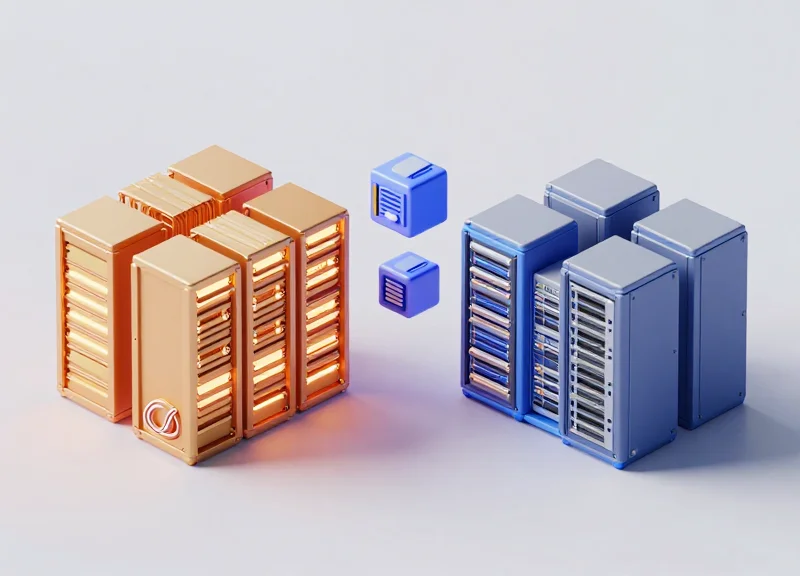
As artificial intelligence shifts from a niche experimental tool to the backbone of enterprise operations, the limitations of traditional data center architectures have become a primary bottleneck. In this guide, we break down why legacy infrastructure often fails under AI workloads and how purpose-built AI architectures redefine performance through lower latency, optimized power delivery, and a radically different Total Cost of Ownership (TCO) model.
The Evolution of Infrastructure: CPU-Centric vs. GPU-Centric Design
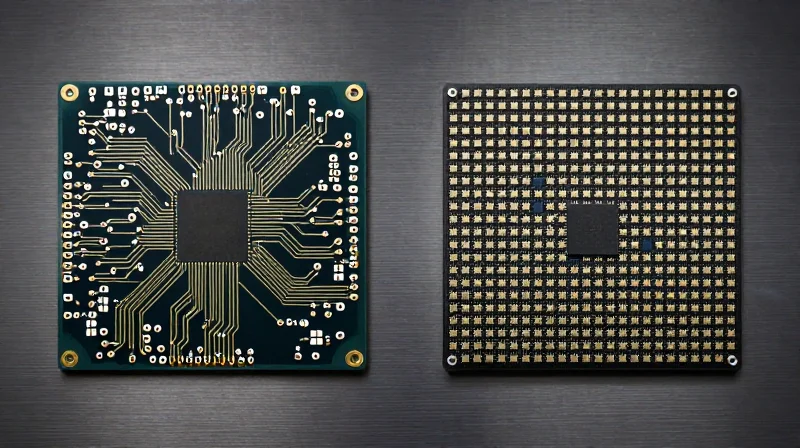
The evolution of data center infrastructure represents a paradigm shift from optimizing for general-purpose serial task latency to maximizing massive parallel processing throughput. While traditional architectures treat the Central Processing Unit (CPU) as the primary orchestrator for diverse logic tasks, AI-centric designs reposition the Graphics Processing Unit (GPU) or specialized Accelerators as the core compute engine. This transition is driven by the mathematical nature of deep learning, which favors thousands of simple, simultaneous operations over the complex, sequential execution logic found in standard server environments.
Serial Logic vs. Parallel Throughput
Traditional CPU-centric design follows the 'thin and fast' approach: a few highly optimized cores designed to minimize the time it takes to complete a single thread of execution. This is ideal for legacy enterprise applications, databases, and operating system management. Conversely, AI data center architecture adopts a 'wide and deep' approach. Because training a Large Language Model (LLM) involves trillions of matrix multiplications, the GPU-centric model utilizes a massively parallel architecture where thousands of smaller cores execute the same instruction across multiple data points simultaneously (SIMD).
| Feature | CPU-Centric (Traditional) | GPU-Centric (AI-Optimized) |
|---|---|---|
| Primary Goal | Low Latency for Serial Tasks | High Throughput for Parallel Tasks |
| Core Count | 16–128 Large, Complex Cores | Thousands of Small, Efficient Cores |
| Memory Architecture | Large Cache, DDR System Memory | High-Bandwidth Memory (HBM3/HBM3e) |
| Interconnects | Standard PCIe / Ethernet | NVLink / InfiniBand / Ultra Ethernet |
| Power Density | 500W–1kW per Server | 5kW–10kW+ per Accelerator Node |
The Impact on System-Level Infrastructure
Moving to a GPU-centric design is not merely about changing the processor; it requires a total reimagining of the data center envelope. High-performance AI clusters require significantly higher memory bandwidth to prevent 'starving' the GPUs of data. Furthermore, the bottleneck shifts from individual server performance to the 'fabric'—the high-speed interconnects like InfiniBand that allow thousands of GPUs to act as a single massive computer. This shift also necessitates advanced cooling solutions, such as direct-to-chip liquid cooling, as the thermal output of a single AI rack can exceed 100kW, far surpassing the 15kW limit of traditional air-cooled racks.
- Can traditional CPU servers still be used for AI?
Yes, for simple inference or small models, but they are economically and performance-inefficient for training or large-scale LLM deployment compared to GPU-centric designs. - Why is High Bandwidth Memory (HBM) critical in GPU-centric design?
AI models require massive datasets to be moved constantly between storage and the processor; standard DDR memory cannot provide the speed necessary to keep GPUs fully utilized. - What is the primary cost driver in the shift to GPU architecture?
Beyond the high cost of the accelerators themselves, the increased requirements for power delivery, specialized networking fabric, and advanced cooling systems significantly raise CAPEX.
Latency Benchmarks: The Critical Role of Interconnects
The Network as the AI Backplane
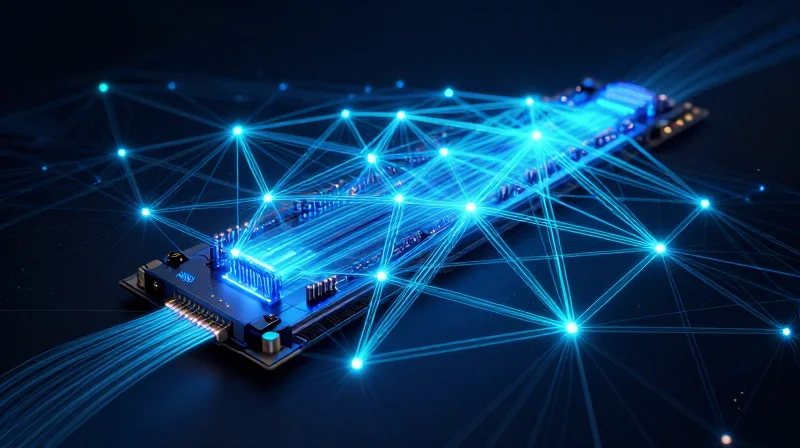
In a modern AI data center, the network is not merely a transport layer but an extension of the compute fabric itself. Unlike traditional workloads where latency is masked by asynchronous operations, AI training involves massive 'All-Reduce' synchronization tasks where every GPU must wait for its peers to finish a computation step. Consequently, the choice of interconnect—typically InfiniBand or RoCE v2—determines whether expensive GPU resources operate at 95% efficiency or sit idle for half their cycle waiting for data packets to arrive over congested, high-overhead legacy TCP/IP routes.
| Network Protocol | Typical Latency (Node-to-Node) | CPU Overhead | Congestion Control | Ideal Use Case |
|---|---|---|---|---|
| Standard TCP/IP | 10 - 50 microseconds | High (Kernel involved) | Reactive (Packet drop) | General-purpose web apps |
| RoCE v2 (Ethernet) | 1.5 - 5 microseconds | Low (Zero-copy) | PFC / ECN | Cost-effective AI clusters |
| InfiniBand (NDR) | < 1 microsecond | Zero (Hardware offload) | Proactive (Credit-based) | Tier-1 LLM Training |
RDMA and the Elimination of the CPU Tax
Remote Direct Memory Access (RDMA) is the technological pillar that separates AI-ready architectures from legacy designs. By allowing a network adapter to transfer data directly from the memory of one GPU to the memory of another without involving the CPU or the operating system kernel, RDMA eliminates multiple data copies and context switches. This bypass mechanism reduces 'tail latency'—those outlier spikes that cause entire clusters to stall—ensuring that the network provides the deterministic performance required for thousands of synchronized nodes.
Interconnect Comparison FAQ
- Why is InfiniBand preferred over RoCE for massive clusters?
InfiniBand uses a credit-based flow control at the hardware level, which prevents congestion before it happens. This makes it intrinsically lossless and more predictable than RoCE, which relies on Priority Flow Control (PFC) over standard Ethernet and can be prone to 'congestion spreading' at very large scales. - Can I use standard 100GbE for AI workloads?
While possible for small-scale inference, standard 100GbE lacks RDMA capabilities. This results in significantly higher CPU utilization and latency, often making it 3 to 5 times slower than RoCE-enabled Ethernet for distributed training tasks. - What is the cost-to-performance trade-off?
InfiniBand hardware typically commands a 20-30% price premium over RoCE-capable Ethernet. However, for billion-parameter models, the reduction in total training time often results in a lower Total Cost of Ownership (TCO) because fewer GPUs are needed to meet the same deadline.
As model sizes continue to grow, the latency bottleneck shifts from the internal GPU bus (NVLink) to the scale-out interconnect. Organizations must choose between the specialized, high-performance ecosystem of InfiniBand or the more flexible, multi-vendor landscape of RoCE v2 based on their specific scale, budget, and engineering expertise.
Power Density and Cooling: Beyond the 10kW Rack
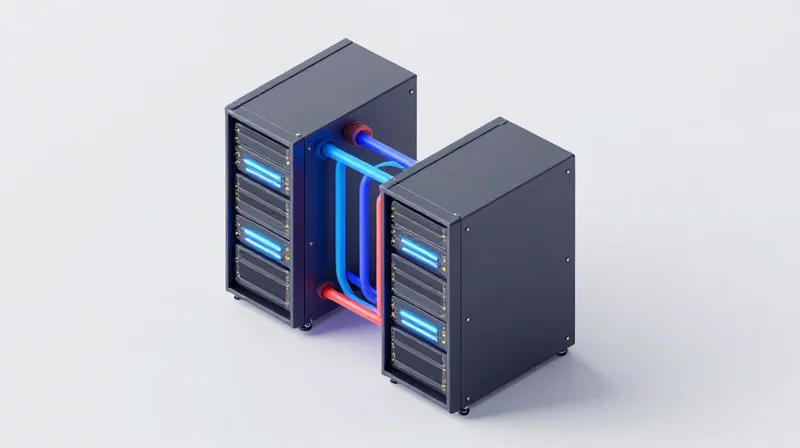
The fundamental constraint in modern AI architecture is no longer just compute cycles, but the ability to deliver massive power and remove the resulting heat within a compact footprint. While traditional data centers were engineered for 5kW to 15kW per rack, NVIDIA H100 and Blackwell B200 clusters push these requirements to 40kW, 60kW, or even 120kW per rack. This 10x increase in power density renders traditional air-cooling methods physically incapable of maintaining thermal equilibrium, necessitating a paradigm shift toward advanced liquid cooling technologies that interface directly with the silicon.
The Thermal Wall: Why Air Cooling Fails AI
Standard air cooling relies on Computer Room Air Conditioning (CRAC) units and cold-aisle/hot-aisle containment. However, air has low thermal conductivity. At densities above 20kW, the volume of air required to cool a rack becomes so great that the fan power consumption (parasitic load) destroys the facility's Power Usage Effectiveness (PUE) and creates acoustic levels that are unsafe for human operators. High-performance AI chips like the B200, with a Thermal Design Power (TDP) exceeding 1,000W per GPU, simply cannot be cooled by air alone without massive throttling, leading to significant performance loss on expensive capital investments.
| Metric | Legacy Data Center | AI-Optimized Data Center |
|---|---|---|
| Typical Rack Density | 5kW - 12kW | 40kW - 120kW+ |
| Primary Cooling Mode | CRAC / Forced Air | DLC (Direct-to-Chip) / RDHX |
| Heat Removal Medium | Air | Water / Dielectric Fluid |
| PUE Target | 1.5 - 2.0 | 1.1 - 1.2 |
| Infrastructure Cost | Lower Initial CapEx | Higher CapEx / Lower OpEx |
Advanced Cooling Mechanisms: DLC and RDHX
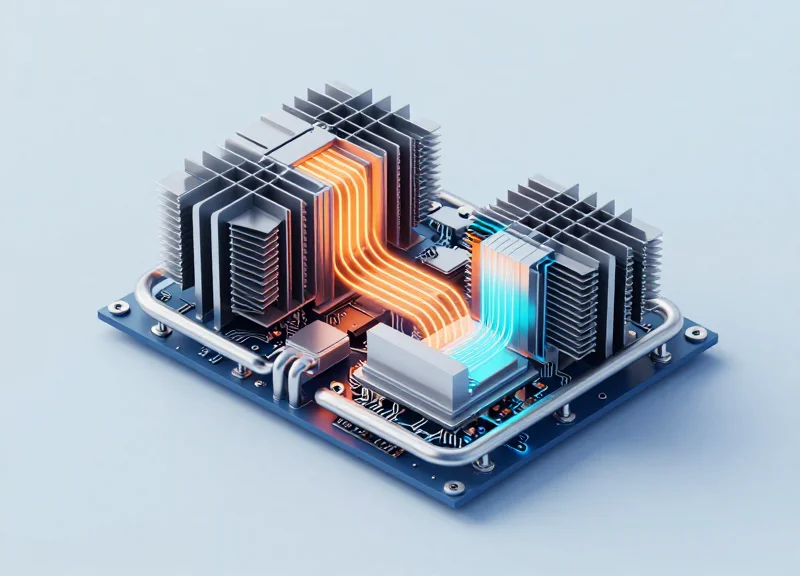
To support the H100 and B200 architectures, two primary technologies have emerged: Direct-to-Chip (DLC) and Rear Door Heat Exchangers (RDHX). DLC utilizes a cold plate placed directly on the GPU/CPU, circulating liquid to carry heat away with 100x the efficiency of air. RDHX, conversely, acts as a radiator at the back of the rack, capturing heat before it enters the room. In many flagship AI clusters, a hybrid approach is used, where DLC handles the high-TDP chips while RDHX manages the remaining ambient heat from memory and networking components.
- Can legacy data centers be retrofitted for 40kW+ AI racks?
Retrofitting is difficult due to floor load limits and the lack of existing liquid piping (Facility Water System). Most legacy sites require secondary Cooling Distribution Units (CDUs) to bridge the gap. - What is the impact of liquid cooling on PUE?
Liquid cooling significantly lowers PUE because liquid is more efficient at heat transfer than air, reducing the energy needed for high-speed fans and massive chillers. - Does the Blackwell B200 require liquid cooling?
Yes, for maximum performance and density, the B200 is designed with liquid cooling as a primary specification to prevent thermal throttling of its 1200W peak draw.
TCO Analysis: Capex vs. Opex in AI Environments
Analyzing the TCO of AI data center architecture reveals a fundamental shift from general-purpose computing: while traditional data centers balance costs across a wide array of services, AI environments are defined by extreme capital concentration in high-performance silicon and low-latency networking, followed by aggressive operational scaling in power and thermal management. Organizations must weigh the 5x to 10x increase in upfront hardware costs against the potential for significantly higher research throughput and the long-term energy efficiencies found in specialized cooling infrastructures.
Capex: Front-Loaded Accelerator and Fabric Costs
Acquisition costs in AI environments are dominated by the GPU or TPU clusters and the specialized fabrics required to maintain non-blocking communication between them. Unlike standard enterprise servers, where the CPU and RAM represent the bulk of the cost, an AI node’s value is concentrated in its accelerators (e.g., NVIDIA H100 or B200) and the high-radix switches required for InfiniBand or RoCE v2 fabrics. These components do not just command a premium price; they also require specialized rack architectures that can support weights exceeding 3,000 lbs, further increasing initial facility costs.
| Cost Category | Standard Enterprise (Per Rack) | AI-Optimized (Per Rack) |
|---|---|---|
| Hardware Capex | $50,000 - $150,000 | $1,500,000 - $4,000,000 |
| Power Density | 5kW - 15kW | 40kW - 120kW |
| Cooling Architecture | Traditional CRAC (Air) | DLC or Rear-Door Heat Exchangers |
| Networking Cost | ~10% of Total Capex | ~25% of Total Capex |
Opex: The Power-Density Tax and Thermal Efficiency
Operational expenditure in AI data centers is primarily driven by the 'Power Usage Effectiveness' (PUE) at scale. Traditional air-cooled facilities often struggle with PUE ratings above 1.5 when faced with high-density AI loads, leading to massive electricity waste. AI-native architectures, utilizing direct-to-chip liquid cooling (DLC), can drive PUE down to 1.1 or lower. While liquid cooling requires higher initial maintenance expertise, the reduction in fan power and improved silicon reliability typically result in an Opex break-even point within 18 to 24 months of deployment.
Hidden Costs: Checkpointing and Idle Talent
The most overlooked Opex factor is the cost of 'work-in-progress' loss. In Large Language Model (LLM) training, a single hardware failure can halt a cluster of 5,000+ GPUs. The time spent on 'checkpointing'—saving the model state to storage—and the subsequent recovery time represents significant hidden costs. If an architecture lacks the resiliency to handle frequent component failures, the cost of 'idle talent' (data scientists waiting for cluster recovery) can exceed the actual cost of the electricity consumed during that window.
- Is cloud-based AI Opex always better than on-premise Capex?
Cloud Opex is ideal for bursty workloads or short-term R&D. However, for 24/7 production training, the 'cloud premium' often exceeds on-premise TCO within 12-14 months, especially when data egress fees are factored in. - How does liquid cooling impact long-term Opex?
Liquid cooling reduces the failure rate of high-wattage components by maintaining more consistent junction temperatures, lowering long-term replacement costs and downtime penalties. - What is the impact of networking on AI TCO?
Inadequate networking creates 'tail latency' that leaves expensive GPUs idle. Investing more in Capex for InfiniBand often lowers Opex by reducing the total time-to-train for complex models.
Performance Bottlenecks: Memory Wall and I/O Constraints
Performance Bottlenecks: Memory Wall and I/O Constraints
In modern AI workloads, the hardware's ability to process data has far outpaced the ability of traditional system architectures to deliver it. This disparity creates the 'Memory Wall,' a bottleneck where GPUs and AI accelerators spend significant cycles idle, waiting for data to be fetched from system RAM or storage. While standard data center architectures rely on commodity DDR5 memory and traditional PCIe-based storage, AI-first architectures utilize High Bandwidth Memory (HBM) and NVMe storage fabrics to provide the massive throughput required for training Large Language Models (LLMs).
The Memory Wall: HBM vs. Standard DDR Memory
High Bandwidth Memory (HBM) is integrated directly onto the GPU package, drastically reducing the physical distance data must travel. Unlike DDR5, which connects to the CPU via a motherboard bus, HBM uses a wide 1024-bit interface and TSVs (Through-Silicon Vias) to achieve terabytes of bandwidth. This is critical for transformer-based models where the entire model weight set must be accessed repeatedly during inference and training. In standard architectures, the reliance on the CPU and its slower memory controllers creates a 'von Neumann bottleneck' that effectively caps the performance of even the fastest accelerators.
| Metric | Standard Architecture (DDR5) | AI Architecture (HBM3e) |
|---|---|---|
| Peak Bandwidth | Approx. 50-100 GB/s per channel | Up to 4.8 TB/s per GPU |
| Physical Integration | DIMM Slots on Motherboard | On-package stacked DRAM |
| Latency Profile | High (due to bus distance) | Ultra-Low (vertical stacking) |
| Primary Use Case | General Purpose Computing | Deep Learning & High-Performance Computing |
Solving I/O Starvation with NVMe Storage Fabrics
Data starvation also occurs at the storage layer. Standard architectures often use TCP/IP-based storage protocols that introduce significant CPU overhead and latency. In contrast, AI architectures employ NVMe-over-Fabrics (NVMe-oF) and technologies like GPUDirect Storage (GDS). These allow the GPU to bypass the CPU entirely when pulling data from high-speed flash storage. By establishing a direct path between the NVMe drive and GPU memory, AI clusters can sustain the high-speed data ingestion rates necessary for multi-modal training without overloading the host processor.
Architecture Comparison FAQ
- What is the 'Memory Wall' in AI computing?
It refers to the performance gap between the speed of the processor and the speed of the memory. In AI, if memory bandwidth cannot keep up with GPU compute power, the processor remains underutilized. - Why can't standard SSDs keep up with AI workloads?
Standard SSDs often rely on the CPU to manage data transfers. Under heavy AI loads, the CPU becomes a bottleneck, whereas AI architectures use RDMA and GPUDirect to move data directly to the GPU. - Does HBM increase the cost of AI data centers?
Yes, HBM is significantly more expensive than DDR5 due to its complex manufacturing and packaging process, contributing to the higher Capex of AI-optimized infrastructure.
Scalability and Modular Design: Building for the Future
The Shift from Incremental Growth to Modular Velocity
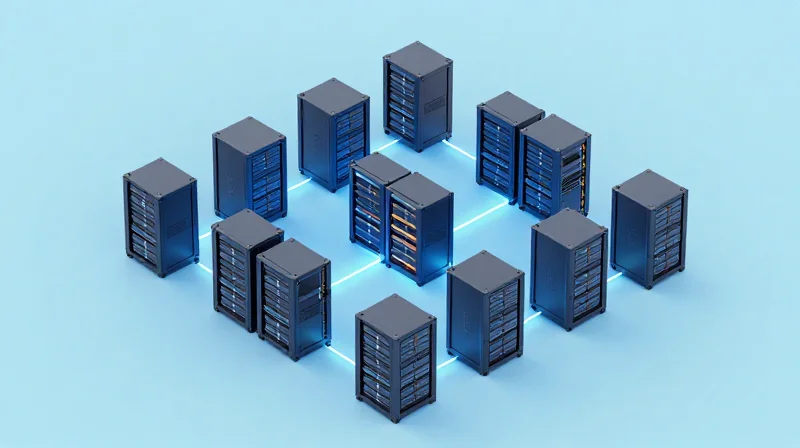
In the context of high-performance computing, scalability is not merely the addition of hardware but the preservation of architectural integrity at scale. AI data center architecture utilizes a 'Pod-based' approach—pre-integrated, standardized units of compute, networking, and storage—to ensure that as capacity grows, performance remains predictable. Unlike traditional architectures where expansion often leads to increased latency and management complexity, modular AI designs treat the data center as a single, composable system rather than a collection of disparate silos.
Comparing Scalability Models: Pods vs. Silos
| Feature | Pod-Based AI Architecture | Traditional Siloed Expansion |
|---|---|---|
| Scalability Unit | Standardized Pods (Multi-rack) | Individual Servers/Racks |
| Interconnect Performance | Consistent (Non-blocking fabric) | Degrades as hop counts increase |
| Deployment Speed | Rapid (Pre-validated configs) | Slow (Manual integration/tuning) |
| Resource Utilization | High (Pool-based resources) | Variable (Islanded resources) |
| Cooling Adaptation | Liquid-ready by design | Retrofitted air cooling |
Eliminating the 'Tax' on Large-Scale Clusters
Traditional enterprise architectures often suffer from a 'scaling tax,' where every new rack added provides diminishing returns due to network congestion and software overhead. AI architectures mitigate this through non-blocking fabrics like InfiniBand or RoCE (RDMA over Converged Ethernet). By utilizing a leaf-spine topology within a modular pod, architects can maintain equidistant communication between any two GPUs in the cluster, effectively eliminating the architectural bottlenecks that plague siloed server rooms.
Future-Proofing through Disaggregation
The future of modular design lies in disaggregated infrastructure, where compute, memory, and storage are decoupled. This allows operators to scale specific resources independently. For instance, if an AI model's parameters grow faster than its compute requirements, an architect can expand the memory tier without over-provisioning GPUs. This level of granular control is virtually impossible in traditional, server-centric environments where resources are fixed to a specific motherboard.
Scalability FAQ
- Why is pod-based design better for AI than traditional rack-by-rack expansion?
Pod-based designs use pre-validated configurations that include optimized networking and cooling, ensuring that the entire 'pod' functions as a single high-performance unit, reducing deployment errors and performance variability. - How does modular design impact Total Cost of Ownership (TCO)?
While initial Capex may be higher for modular infrastructure, it significantly lowers Opex by simplifying management, reducing the time to deploy new capacity, and maximizing energy efficiency through integrated cooling. - Can traditional data centers transition to a modular AI architecture?
Transitioning requires a significant overhaul of power and cooling density, but many organizations adopt a 'hybrid-modular' approach by dedicating specific zones of their facility to high-density AI pods.
Reliability and E-E-A-T: Trusting Your AI Backbone
Reliability in an AI context transcends simple hardware uptime; it is the fundamental assurance that the architectural fabric can maintain data integrity and deterministic performance during massive parallel processing tasks. Unlike traditional alternatives that often struggle with the 'silent data corruption' inherent in high-scale computing, purpose-built AI architectures integrate end-to-end error checking and lossless networking to ensure that the weights and biases of a model remain untainted throughout the training and inference lifecycle.
The Architecture of Trust: Integrity and Precision
Establishing E-E-A-T (Experience, Expertise, Authoritativeness, and Trustworthiness) for AI services requires an infrastructure that eliminates non-deterministic variables. Standard enterprise architectures often rely on 'best-effort' Ethernet, which can lead to packet loss and jitter—factors that directly contribute to training instability. AI-specific architectures utilize RDMA (Remote Direct Memory Access) over InfiniBand or RoCE to create a 'lossless' environment, ensuring that the data used to train a model is exactly what the hardware receives, thereby protecting the model's authoritativeness.
| Reliability Metric | AI-Optimized Architecture | Legacy Data Center Alternatives |
|---|---|---|
| Network Protocol | Lossless (InfiniBand / RoCE v2) | Lossy (Standard TCP/IP Ethernet) |
| Error Correction | End-to-End CRC & Multi-bit ECC | Basic SECDED ECC |
| Performance Consistency | Deterministic / Jitter-free | Variable / Shared Resources |
| Data Integrity Check | Hardware-accelerated validation | Software-defined checksums |
Long-Term Reliability and Mission-Critical AI
For mission-critical deployments, such as medical diagnostics or autonomous financial systems, the 'Trust' component of E-E-A-T is non-negotiable. AI architectures are designed with modularity and redundant power-to-cooling ratios that specifically account for the thermal spikes of H100 or B200 clusters. Traditional server rooms, if pushed to these limits, often experience thermal throttling, which can cause subtle timing errors in the GPU sync process, leading to degraded model accuracy over time.
FAQ: Architectural Impacts on AI Reliability
- How does infrastructure impact AI model hallucinations?
While hallucinations are often algorithmic, hardware-induced data corruption during the training phase can permanently 'poison' model weights, leading to unpredictable outputs that undermine trust. - Why is lossless networking critical for E-E-A-T?
Lossless networking prevents data re-transmission delays, ensuring that the gradient updates across thousands of GPUs remain synchronized, which is vital for maintaining the mathematical precision of the model. - Does an AI-optimized architecture reduce operational downtime?
Yes, by utilizing predictive telemetry and specialized hardware monitoring, these architectures can identify failing HBM or NVLink components before they cause a total system crash during a multi-week training run.
Verdict: When to Stick with Traditional Standards
Verdict: When to Stick with Traditional Standards
Specialized AI data center architecture is an expensive, high-maintenance powerhouse that is often overkill for the majority of enterprise operations. While the industry buzz emphasizes GPU-dense clusters and InfiniBand fabrics, traditional standards—characterized by x86-based compute, standard leaf-spine Ethernet topologies, and tiered NAS/SAN storage—remain the gold standard for reliability and cost-efficiency in general-purpose computing. If your primary workloads are CPU-bound, rely on legacy monolithic applications, or involve data processing that does not require massive parallelization, the leap to an AI-first architecture will likely yield a negative return on investment.
Workload Suitability: Traditional vs. AI-Optimized
| Workload Characteristic | Traditional Architecture | AI-Optimized Architecture |
|---|---|---|
| Primary Compute Task | Serial processing, SQL queries, Web logic | Parallel processing, Tensor operations |
| Networking Demand | Standard 10/25/100GbE (TCP/IP) | Low-latency RoCE or InfiniBand |
| Storage Profile | I/O balanced, high capacity focus | Ultra-high throughput, NVMe-oF |
| Cost Structure | Predictable OPEX, lower initial CAPEX | Extreme CAPEX, high power/cooling costs |
| Scalability Needs | Incremental, per-server basis | Pod-based or Cluster-wide expansion |
The Economic Argument for Enterprise Standards
Cost remains the most significant barrier to AI architecture adoption. Beyond the astronomical price of H100 or B200 GPUs, the hidden costs of AI infrastructure include specialized cooling systems (DLC or RDHx), significantly higher power density requirements per rack, and the need for specialized networking expertise. For businesses running ERP systems, CRM platforms, and standard web applications, traditional architectures provide a mature ecosystem with a wide talent pool and lower total cost of ownership (TCO). Furthermore, many 'AI features' within software-as-a-service (SaaS) products are already offloaded to the provider's cloud, making it unnecessary for the end-user to maintain AI-grade hardware locally.
Infrastructure Selection FAQ
- Can I run small AI models on traditional hardware?
Yes. Small-scale inference and fine-tuning of modest models can often be handled by modern CPUs with AVX-512 extensions or by adding a few standard L4 GPUs to existing enterprise servers, avoiding the need for a full architectural overhaul. - When is InfiniBand networking a waste of money?
InfiniBand is unnecessary if your workloads do not require frequent all-reduce or all-to-all communication between dozens of GPUs. For most general enterprise applications, standard Ethernet is more than sufficient. - Is power consumption a valid reason to avoid AI architecture?
Absolutely. An AI rack can pull 40kW to 100kW, requiring specialized power distribution and cooling that most older data centers cannot support without multi-million dollar retrofits. - Does traditional architecture offer better data security?
Not necessarily better security, but better-understood security perimeters. Traditional environments have mature, well-documented security protocols, whereas AI clusters often introduce new vulnerabilities in data pipelines and model weight storage.
Ultimately, the decision should be driven by the data. If the percentage of your compute budget dedicated to large-scale model training is less than 20%, maintaining a traditional architecture supplemented by public cloud burst capacity for AI tasks is the most fiscally responsible path.
Navigating the complexities of AI infrastructure requires more than just high-end hardware; it demands a holistic architectural strategy that balances performance with fiscal responsibility. Whether you are scaling LLM training or deploying edge inference, choosing the right foundation is the most critical decision of the decade. Ready to optimize your data center for the AI era? Contact our engineering team for a custom TCO audit and architectural consultation.