As data consumption skyrockets, the jump from 100G to 400G is no longer optional—it is a competitive necessity. Navigating this migration requires more than just hardware; it requires a strategic procurement partner. At Ubytelink, we help you bridge the bandwidth gap with high-performance modules, wholesale economics, and bespoke engineering solutions.
The Strategic Shift: Why 100G to 400G Migration is Essential in 2026

The Strategic Shift: Why 100G to 400G Migration is Essential in 2026
In 2026, the transition from 100G to 400G Ethernet has moved from a speculative upgrade to a strategic requirement for enterprise and hyperscale data centers. The primary driver is the fundamental change in how data is processed; the explosion of Artificial Intelligence (AI) and Large Language Models (LLMs) has created a baseline bandwidth demand that 100G infrastructures can no longer support without significant latency and congestion. By migrating to 400G, operators can achieve four times the throughput of 100G in the same rack space, providing the necessary density to handle modern high-performance computing (HPC) workloads.
Market Drivers: AI, Cloud, and High-Density Traffic
The rapid adoption of AI-driven applications requires massive data transfer speeds between GPU clusters and storage arrays. While 100G was the gold standard for the previous decade, it lacks the 'per-lane' efficiency required for modern leaf-spine architectures. 400G technology, utilizing PAM4 modulation and QSFP-DD or OSFP form factors, allows for higher radix switches, meaning fewer cables, fewer points of failure, and simplified management for network administrators.
| Metric | 100G Ethernet (Legacy) | 400G Ethernet (2026 Standard) |
|---|---|---|
| Throughput per Port | 100 Gbps | 400 Gbps |
| Modulation | NRZ / PAM4 | PAM4 (56G/112G) |
| Power Consumption | Higher per Gbps | Lower (Approx. 40% more efficient) |
| Latency | Higher at scale | Ultra-low for AI/ML workloads |
| Standard Form Factor | QSFP28 | QSFP-DD / OSFP |
The Economic Case for Wholesale Migration
Procuring 400G components wholesale in 2026 offers a distinct financial advantage. As manufacturing has matured, the price-per-gigabit for 400G optics has reached a parity point with 100G, making the 'Buy 100G to 400G Migration Wholesale' strategy highly effective for lowering Total Cost of Ownership (TCO). Bulk pricing on transceivers (DR4, FR4, SR8) and active optical cables (AOCs) allows organizations to future-proof their infrastructure while significantly reducing power-per-bit costs.
- Is 100G still viable for edge computing?
While 100G remains useful for edge nodes and smaller enterprise branches, it is increasingly viewed as an access-layer technology rather than a core backbone solution. - Why is wholesale pricing critical for 400G?
The sheer volume of transceivers required for a 400G leaf-spine fabric means that custom quotes and bulk pricing can save enterprises up to 30% compared to retail-tier procurement. - What is the impact on power efficiency?
400G optics are designed to be much more efficient per gigabit of data moved, which is essential as data centers face stricter environmental and power-draw regulations in 2026.
Technical Foundations of 400G Transceiver Form Factors
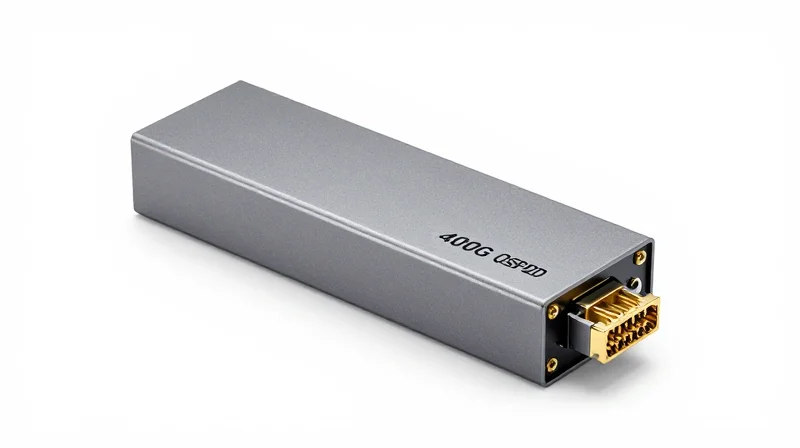
The transition from 100G to 400G is fundamentally driven by the evolution of transceiver form factors that can handle quadruple the bandwidth without requiring a quadruple increase in physical space or power consumption. At the core of this migration are two primary standards: Quad Small Form-factor Pluggable Double Density (QSFP-DD) and Octal Small Form-factor Pluggable (OSFP). Both utilize PAM4 (Pulse Amplitude Modulation 4-level) signaling to achieve 50G or 100G per lane, but they differ significantly in their physical design, thermal properties, and backward compatibility paths for legacy 100G QSFP28 infrastructure.
Comparing 400G Form Factors: QSFP-DD vs. OSFP
| Feature | QSFP28 (100G) | QSFP-DD (400G) | OSFP (400G) |
|---|---|---|---|
| Electrical Lanes | 4 x 25G NRZ | 8 x 50G PAM4 | 8 x 50G PAM4 |
| Backward Compatibility | N/A | Native (QSFP28/QSFP+) | Requires Adapter |
| Module Width | 18.35 mm | 18.35 mm | 22.58 mm |
| Max Power Consumption | ~5W | Up to 15W | Up to 15W+ |
| Thermal Management | Basic Cooling | High-Density Airflow | Integrated Heat Sink |
QSFP-DD: The Industry Favorite for 100G Compatibility
QSFP-DD has emerged as the preferred choice for many wholesale buyers due to its 'double density' approach. By adding a second row of electrical contacts, it maintains the same footprint as the standard QSFP module. This allows a 400G QSFP-DD port to be backward compatible with 100G QSFP28 modules. For organizations managing a phased migration, this native compatibility is a massive cost saver, allowing for 'pay-as-you-grow' scaling where existing 100G hardware can reside alongside new 400G links in the same switch chassis.
OSFP: Designed for Superior Thermal Performance
While slightly wider and deeper than QSFP-DD, the OSFP form factor was designed with the future 800G and 1.6T transitions in mind. Its most notable feature is the integrated heat sink, which significantly improves thermal dissipation. In high-performance computing (HPC) environments where modules run at maximum power constantly, the OSFP's ability to stay cool prevents thermal throttling and extends the lifespan of the optics. However, because of its larger size, it is not natively backward compatible with QSFP28 ports without a mechanical adapter, making it a more common choice for greenfield 400G deployments.
Technical FAQ for Wholesale Procurement
- How does PAM4 differ from NRZ in 400G modules?
NRZ (Non-Return to Zero) uses two signal levels to represent bits, whereas PAM4 uses four levels. This allows PAM4 to transmit twice as much data in the same timeframe, which is the technical breakthrough that makes 400G possible over 8 lanes of 50G. - Is QSFP-DD backward compatible with all 100G modules?
Yes, a QSFP-DD port can accept 40G QSFP+ and 100G QSFP28 modules. The system will simply ignore the second row of pins, making it highly versatile for mixed-speed environments. - Why is thermal management such a high priority for 400G?
400G transceivers consume significantly more power (up to 15W) compared to 100G modules (3-5W). Without advanced cooling like that found in OSFP or optimized airflow in QSFP-DD, the heat can cause signal degradation or hardware failure in high-density rack configurations.
Wholesale Procurement: Maximizing ROI on Your Network Infrastructure
The Financial Imperative of Bulk 400G Procurement
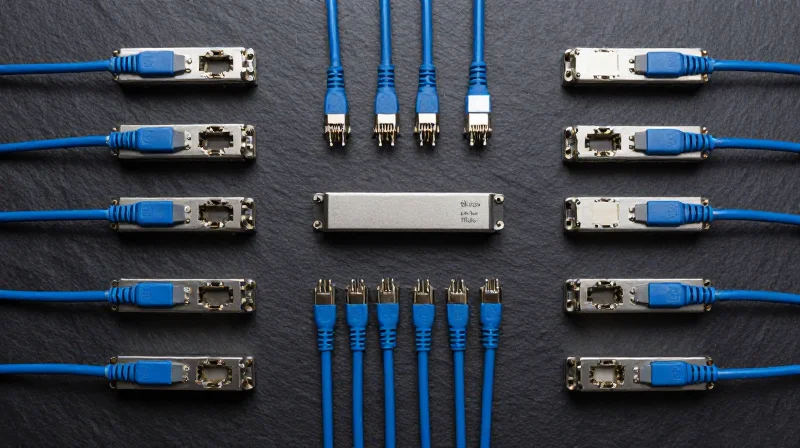
As data centers transition to 400G, the sheer volume of transceivers, DACs, and AOCs required can result in prohibitive costs if sourced through traditional retail channels. Wholesale procurement is not merely about volume; it is a strategic financial tool that lowers the cost-per-bit and accelerates the return on investment (ROI). By securing custom quotes for bulk orders, enterprises can align their capital expenditure (CAPEX) with deployment phases, ensuring that the migration from 100G remains economically viable even as traffic demands scale exponentially.
Tiered Pricing and Custom Quotations
Wholesale models typically utilize tiered pricing structures where the unit cost decreases as the order volume increases. This is particularly critical for 400G migration, where the price delta between individual components and bulk batches can range from 15% to 35%. Custom quotations allow procurement teams to negotiate beyond standard price lists, incorporating value-added services such as batch testing, personalized labeling, and staggered delivery schedules to match data center build-outs.
| Procurement Metric | Retail/Small Batch | Wholesale/Bulk Pricing |
|---|---|---|
| Cost per 400G Module | Standard List Price | Negotiated Volume Discount |
| Supply Chain Priority | Standard Lead Times | Allocated Inventory Reserved |
| Logistics/Shipping | Per-item Costs | Consolidated Bulk Freight |
| Customization | Limited / Generic | Custom Coding / EEPROM |
Long-term ROI and Operational Efficiency
Beyond the initial purchase price, wholesale procurement enhances operational efficiency. Standardizing on a single batch of transceivers ensures consistency in firmware and performance across the fabric, reducing the complexity of troubleshooting. Furthermore, volume purchasing allows for a buffer stock strategy, mitigating the risks of supply chain disruptions that often plague the high-demand 400G market.
- How do bulk orders impact lead times for 400G optics?
Bulk orders often grant customers priority in production queues, though they require longer-term planning to ensure manufacturing capacity is reserved and logistical windows are met. - Can custom quotes include mixed orders of 100G and 400G?
Yes, most wholesale providers offer hybrid quotes that allow for a phased migration, balancing legacy 100G maintenance with new 400G infrastructure deployments. - What are the typical volume thresholds for wholesale pricing?
While thresholds vary by manufacturer, wholesale benefits usually begin at 50 to 100 units for high-value 400G modules, with additional price breaks at higher increments.
Custom OEM/ODM Solutions: Tailoring Hardware to Your Unique Architecture
Custom OEM/ODM solutions are the cornerstone of successful high-density migrations, moving beyond generic hardware to provide components that are mathematically and physically optimized for a specific data center environment. In the transition from 100G to 400G, hardware must often navigate proprietary host-system requirements, unique thermal constraints, and specific software-defined networking (SDN) protocols. By utilizing tailored hardware, operators can ensure that every transceiver, DAC, and AOC operates with maximum efficiency and zero compatibility friction.
Precision Firmware Tuning and Multi-Vendor Compatibility
The most significant challenge in 400G wholesale procurement is ensuring interoperability across a multi-vendor ecosystem. Standard optics often trigger 'unsupported transceiver' errors in restrictive OS environments. Ubytelink addresses this through deep-level firmware customization, where each module is coded with the specific EEPROM signatures required by brands like Cisco, Arista, Juniper, and NVIDIA (Mellanox). This tuning extends to Digital Optical Monitoring (DOM) parameters, ensuring that telemetry data remains accurate and actionable across the entire fabric.
Hardware Modifications for Advanced Architectures
Beyond software, physical modifications can be critical for large-scale deployments. This includes the development of custom heat sink designs for OSFP modules to manage extreme thermal loads in high-density racks, or the creation of non-standard lengths for Direct Attach Cables (DACs) to reduce cable clutter and improve airflow. For wholesale partners, these modifications ensure that the hardware fits the infrastructure, rather than forcing the infrastructure to adapt to the hardware.
| Feature Capability | Standard Wholesale Optics | Ubytelink Custom OEM/ODM |
|---|---|---|
| EEPROM Coding | Generic/Fixed | Vendor-Specific Proprietary Coding |
| Physical Branding | Generic Labeling | Private Label, Custom Pull-Tabs & Colors |
| Cable Specifications | Fixed Lengths (1m, 3m, 5m) | Bespoke Lengths and Jacket Materials |
| Thermal Management | Standard Integrated Heat Sinks | Custom Fin Designs for High-Airflow |
Custom Solutions FAQ
- Can you provide custom-branded pull-tabs for 400G modules?
Yes, we offer private labeling services that include custom colors for pull-tabs and bespoke laser etching on the transceiver casing to align with your corporate branding. - Is it possible to optimize power consumption via firmware?
We can tune firmware parameters to adjust the power envelope of 400G QSFP-DD modules, helping to meet specific Green Data Center energy targets without sacrificing signal integrity. - What is the lead time for custom hardware modifications?
While standard wholesale orders ship quickly, custom OEM/ODM solutions typically require an additional 2-4 weeks for engineering validation and prototyping, depending on complexity.
The Economic Advantage of ODM for Wholesale
While custom engineering involves initial R&D, the long-term ROI is substantial. By eliminating the need for third-party 'compatibility' bridges and reducing failure rates through rigorous architectural alignment, the Total Cost of Ownership (TCO) for 400G migration drops significantly. Wholesale partners benefit from a product that is uniquely theirs, providing a competitive edge in both performance and market positioning.
Interoperability and Testing: Ensuring Seamless Integration
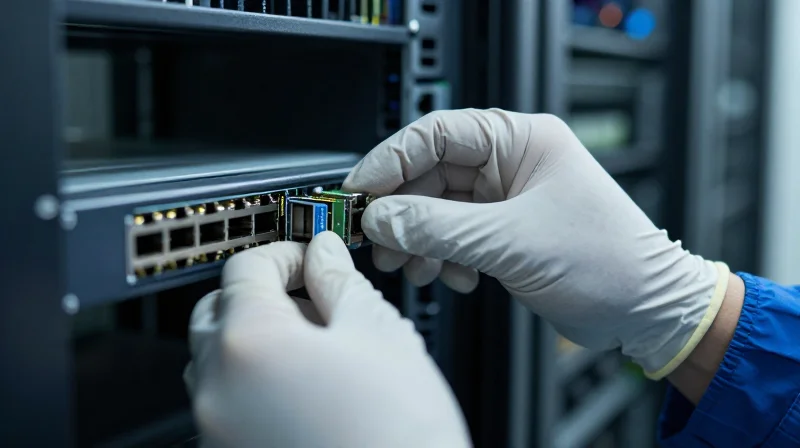
Interoperability and Testing: Ensuring Seamless Integration
Successful migration from 100G to 400G architectures hinges on the seamless integration of new high-speed optical modules with existing infrastructure. Interoperability is not merely a convenience; it is a critical requirement that prevents network downtime and ensures that multi-generational hardware can communicate without packet loss or signal degradation. At Ubytelink, we mitigate the risks of complex deployments by providing optics that are 100% compatible with the industry's leading switching platforms, ensuring your wholesale investment translates into immediate operational performance.
Eliminating Vendor Lock-in with Multi-Vendor Compatibility
Vendor lock-in often forces enterprises into restrictive pricing and long lead times. Ubytelink breaks this cycle by offering optical solutions pre-coded and tested for specific vendor environments. Whether your data center utilizes Cisco’s Nexus series, Arista’s 7000 series, or Juniper’s PTX routers, our 400G transceivers are engineered to match original manufacturer specifications, including EEPROM coding and specific firmware handshakes required for port recognition.
| Feature | OEM-Branded Optics | Ubytelink Wholesale Solution |
|---|---|---|
| Compatibility | Single-Vendor Only | Multi-Vendor / Universal Support |
| Firmware Tuning | Proprietary / Static | Customizable to Network Architecture |
| Procurement Cost | Premium Pricing (300%+ Markup) | Wholesale / Direct Pricing |
| Lead Times | Often 8-12 Weeks | Rapid Deployment / In-Stock |
| Warranty Support | Manufacturer Specific | Comprehensive Multi-Platform Support |
Rigorous Testing Protocols for 400G Reliability
400G networking demands much tighter tolerances than 100G due to the use of PAM4 (Pulse Amplitude Modulation 4-level) signaling. To ensure signal integrity, Ubytelink employs a multi-stage testing protocol. Every module undergoes Bit Error Rate (BER) testing, eye diagram analysis to verify optical clarity, and real-world switch environment stress testing. This ensures that when you purchase in bulk, every single unit meets the stringent performance metrics required for high-frequency trading, AI clusters, and cloud-scale environments.
- Will using Ubytelink optics void my Cisco or Arista warranty?
No. Under the Magnuson-Moss Warranty Act in the US and similar international competition laws, manufacturers cannot void a hardware warranty simply for using third-party components unless the component specifically caused the damage. - How do you handle firmware updates on host switches?
Our engineering team continuously monitors OEM firmware updates. We provide optics with the latest coding revisions to ensure that even after a switch OS update (such as Cisco NX-OS or Arista EOS), the modules remain recognized and operational. - Can I mix 100G and 400G modules in the same chassis?
Yes, provided your switch hardware supports mixed-rate line cards. Our testing ensures that our 400G modules can interoperate with legacy 100G ports via breakout cables or backwards-compatible QSFP-DD modes.
Addressing Power Consumption and Cooling in 400G Migration

Addressing Power Consumption and Cooling in 400G Migration
Migrating from 100G to 400G represents a paradigm shift in data center energetics, as the power consumption per port can increase by more than 300%. While 100G QSFP28 modules typically operate within a 3.5W to 5W envelope, 400G QSFP-DD optics can reach 12W to 20W depending on the reach and complexity of the Digital Signal Processor (DSP). Successfully addressing these thermal challenges requires a multi-layered strategy involving advanced hardware selection, optimized airflow dynamics, and a shift toward high-efficiency silicon photonics to prevent localized hotspots and equipment failure.
Comparing Power Profiles: 100G vs. 400G Modules
| Module Type | Form Factor | Typical Power Consumption | Thermal Management Need |
|---|---|---|---|
| 100G SR4/LR4 | QSFP28 | 3.5W - 4.5W | Standard Airflow |
| 400G DR4/FR4 | QSFP-DD | 10W - 12W | Enhanced Heatsinks |
| 400G ZR/ZR+ | QSFP-DD | 15W - 20W | Active Cooling / Liquid |
| 400G SR8 | OSFP | 12W - 14W | Integrated Fins |
Critical Strategies for Thermal Management
To mitigate the heat generated by high-density 400G switches, operators must look beyond traditional cooling. The integration of QSFP-DD and OSFP form factors has introduced new mechanical designs, such as integrated heat sinks and improved thermal interface materials (TIMs). For wholesale deployments in 2026, selecting modules that utilize 7nm or 5nm DSP technology is crucial, as these smaller process nodes offer significantly better performance-per-watt ratios, directly reducing the cooling burden on the facility.
- Airflow Optimization
Utilizing front-to-back or back-to-front airflow configurations that match the data center's hot/cold aisle containment strategy to ensure consistent intake temperatures. - Silicon Photonics Integration
Adopting silicon photonics-based optics which consolidate multiple discrete components onto a single chip, reducing overall power draw and heat dissipation compared to traditional discrete designs. - Precision Monitoring
Implementing real-time telemetry via DDMI (Digital Diagnostic Monitoring Interface) to track module temperatures and adjust fan speeds dynamically at the chassis level.
Cooling and Power Efficiency FAQ
- How does 400G heat affect optical performance?
Excessive heat increases the laser's threshold current and degrades the Signal-to-Noise Ratio (SNR), leading to higher Bit Error Rates (BER) and potential link instability if temperatures exceed the 70°C commercial threshold. - Is OSFP better than QSFP-DD for cooling?
OSFP is generally considered to have superior thermal performance due to its larger surface area and integrated heat sink fins, making it a preferred choice for the highest-wattage 400G and 800G applications. - What is the impact of power consumption on wholesale TCO?
Power and cooling can account for up to 40% of the Total Cost of Ownership (TCO). Choosing energy-efficient modules during a wholesale migration can result in thousands of dollars in annual OpEx savings per rack.
Supply Chain Resilience: How Ubytelink Ensures Timely Delivery
Ubytelink ensures timely delivery for 100G to 400G migration projects by maintaining a vertically integrated supply chain that bypasses the traditional bottlenecks of single-source procurement. By controlling the manufacturing process from raw component sourcing to final assembly, and positioning inventory in strategic global logistics hubs, we provide a reliable buffer against the volatility of the semiconductor market, ensuring that bulk orders for QSFP-DD and OSFP modules are fulfilled without the 20-to-40-week lead times common among traditional vendors.
Diversified Manufacturing and Raw Material Buffering
The transition to 400G requires specialized high-speed silicon and advanced laser components that are often subject to shortages. Ubytelink mitigates this risk by maintaining long-term contracts with multiple Tier-1 foundry partners. Unlike distributors that operate on a 'just-in-time' model, we utilize a 'just-in-case' inventory strategy for critical components like DSP chips and TOSA/ROSA assemblies, allowing us to maintain production continuity even during regional supply chain disruptions.
Comparative Lead Times and Logistics Performance
| Product Category | Standard Industry Lead Time | Ubytelink Wholesale Lead Time | Logistics Hub Availability |
|---|---|---|---|
| Standard 400G QSFP-DD (SR8/DR4) | 12 - 24 Weeks | 2 - 4 Weeks | US, EU, HK Stock |
| Custom Encoded/Labeled Modules | 16+ Weeks | 3 - 5 Weeks | On-site Customization |
| Bulk 100G/400G DAC & AOC | 8 - 12 Weeks | 1 - 2 Weeks | Regional Warehouse |
| Specialized Coherent Optics (ZR/ZR+) | 26 - 52 Weeks | 8 - 12 Weeks | Strategic Reserve |
Supply Chain FAQs for Wholesale Buyers
- How does Ubytelink handle global shipping during peak demand?
We utilize a multi-modal logistics approach, partnering with top-tier carriers like DHL and FedEx while maintaining our own customs brokerage agreements to expedite clearances in North America and EMEA. - Can I reserve inventory for multi-stage 400G rollouts?
Yes. For wholesale clients, we offer 'Inventory Staging' where your specific hardware is allocated and stored in our local warehouses to be released according to your project's deployment phases. - What happens if a specific component faces a global shortage?
Our engineering team provides immediate cross-compatible alternatives that meet or exceed the original specifications, ensuring your migration schedule remains unaffected by localized chip shortages.
Future-Proofing Your Investment for the 800G Roadmap

Future-Proofing Your Investment for the 800G Roadmap
The transition from 100G to 400G is not a final destination but a critical architectural step toward the 800G and 1.6T era. To maximize the ROI of your 2026 wholesale procurement, it is essential to select hardware that balances current performance with forward-looking scalability. By prioritizing form factors like QSFP-DD and OSFP that have clear 800G evolution paths, and investing in high-lane-count fiber cabling, enterprises can avoid 'forklift upgrades' when the next bandwidth cycle arrives.
Strategic Choice: QSFP-DD vs. OSFP for 800G Readiness
The choice between QSFP-DD and OSFP at the 400G stage dictates your future thermal management and density capabilities. While QSFP-DD offers the advantage of backward compatibility with legacy 100G QSFP28 modules, OSFP is engineered with superior thermal headroom, making it a favorite for the eventual jump to 800G and beyond in high-power environments like AI data centers.
| Feature | QSFP-DD (400G) | OSFP (400G/800G Ready) |
|---|---|---|
| Backward Compatibility | Native with QSFP28/QSFP56 | Requires Adapter for QSFP |
| Thermal Capacity | Up to 12-14 Watts | Up to 15-20+ Watts |
| 800G Evolution | QSFP-DD800 (Uses 100G Lanes) | Native 800G Design |
| Best Use Case | Enterprise & Cloud Migration | Hyperscale & AI Training |
Cabling Infrastructure: Laying the Groundwork
Future-proofing at the physical layer involves moving toward Single-Mode Fiber (SMF) and high-density MPO-16 connectors. While Multimode Fiber (MMF) remains viable for short reaches, the 800G roadmap heavily favors SMF to handle the increased signal integrity requirements of PAM4 modulation and Coherent optics. Opting for MPO-16 or MPO-32 cabling today ensures that your patch panels and trunk lines can support the parallel lanes required for 800G without re-pulling fiber.
- Will 400G switches purchased today support 800G modules?
Most current 400G switches are limited by their ASIC capacity (e.g., 12.8Tbps or 25.6Tbps). However, 800G-ready switches often support 400G modules today, providing a high-capacity backbone that can be populated with faster optics as prices drop. - How does 112G SerDes technology impact my migration?
The shift from 56G to 112G SerDes is the technical foundation for 800G. Ensuring your 400G transceivers are compatible with next-gen SerDes architectures will simplify port mapping and breakout configurations in the future. - Is it worth waiting for 800G instead of buying 400G wholesale now?
No, 400G currently offers the best balance of cost-per-bit and ecosystem maturity. 800G remains in the early adoption phase with higher premiums; migrating to 400G now provides immediate ROI while establishing the necessary OSFP/QSFP-DD infrastructure.
Migrating from 100G to 400G is a complex but rewarding evolution for your business. By leveraging wholesale pricing and professional OEM/ODM services, you can scale efficiently while maintaining peak performance. Ready to optimize your network? Contact Ubytelink today for a custom quote and secure the best bulk pricing for your 2026 infrastructure goals.