As global data traffic surges, the transition to 800G networking is no longer a luxury but a necessity for mission-critical infrastructure. Choosing between OSFP and QSFP-DD form factors is a pivotal decision for network architects. This guide leverages decades of Silicon Valley expertise to dissect these technologies and showcase how Ubytelink's premium solutions ensure maximum uptime and performance.
The Dawn of the 800G Era: Why Form Factor Matters

The Dawn of the 800G Era: Why Form Factor Matters
The transition to 800G connectivity represents a fundamental architectural shift in data center networking, where the physical design of the transceiver—the form factor—becomes as important as the data rate itself. As Ubytelink 800G OSFP and QSFP-DD solutions enter the global market, the choice between these standards dictates a network's thermal efficiency, port density, and its ability to support the massive throughput required by Large Language Models (LLMs) and hyperscale cloud environments.
The Drivers of 800G Adoption
The primary catalyst for 800G adoption is the unprecedented demand for bandwidth driven by Artificial Intelligence (AI) and Machine Learning (ML). Legacy 400G infrastructures are increasingly becoming bottlenecks for GPU clusters that require rapid data exchange. 800G modules, utilizing 112G SerDes technology, allow network operators to double their capacity without doubling their physical footprint, provided they select a form factor that can handle the increased power consumption.
| Feature | 400G Ethernet | 800G Ethernet |
|---|---|---|
| Max Throughput | 400 Gbps | 800 Gbps |
| Typical SerDes | 56G PAM4 | 112G PAM4 |
| Power Consumption | ~10-12W | ~14-24W |
| Primary Use Case | Cloud Core / Spine | AI Clusters / Hyperscale |
Physical Constraints: The Thermal Challenge
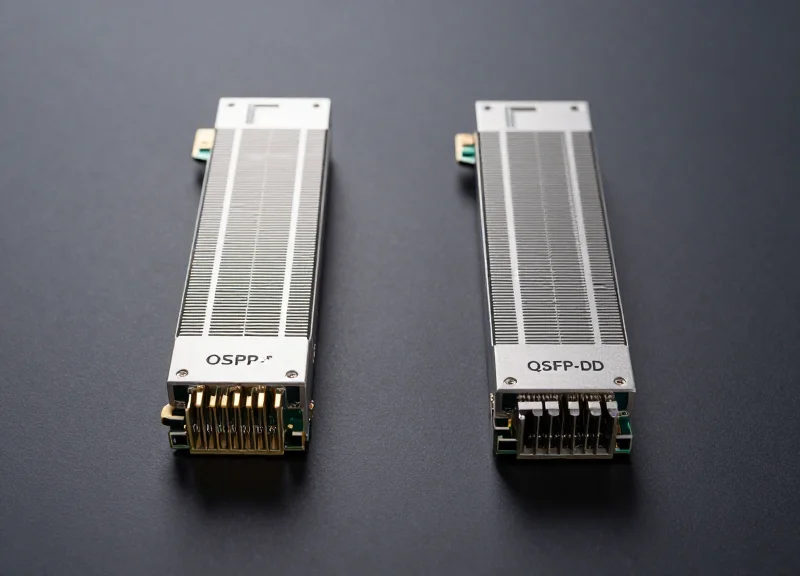
As transceivers move from 400G to 800G, power consumption rises significantly, often reaching 18W to 24W per module. This heat must be dissipated effectively to prevent signal degradation and hardware failure. This is why the form factor matters: the OSFP design incorporates integrated heat sinks for superior cooling, while the QSFP-DD relies on refined thermal paths to maintain backwards compatibility. Ubytelink’s premium solutions focus on optimizing these physical traits to ensure stable performance in high-density rack configurations.
- Why is 800G necessary for modern data centers?
Modern AI workloads require massive East-West traffic capacity. 800G provides the necessary headroom to reduce latency and prevent congestion in GPU-to-GPU communication. - How does form factor impact infrastructure longevity?
The form factor determines cooling requirements and switch port density. Choosing the wrong standard can lead to thermal throttling or the need for expensive cooling upgrades sooner than expected. - Is backwards compatibility a priority for 800G?
Yes, particularly for QSFP-DD, which aims to support 400G modules in 800G ports, whereas OSFP prioritizes maximum thermal headroom for future 1.6T transitions.
OSFP Decoded: Optimized for Heat and Power
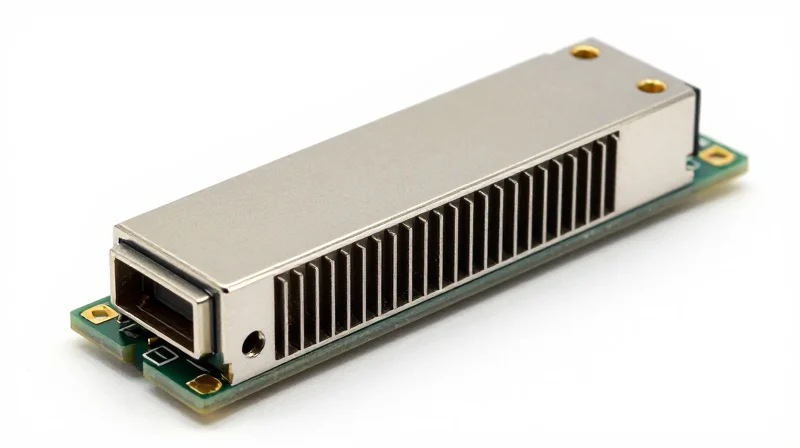
The Octal Small Form-factor Pluggable (OSFP) is specifically engineered to overcome the thermal bottlenecks of 800G connectivity by integrating a dedicated heat sink directly onto the module's exterior. This design choice allows the OSFP form factor to support much higher power envelopes—reaching up to 15-20W per port—making it the ideal choice for high-performance computing (HPC) and artificial intelligence clusters that demand peak reliability under heavy workloads.
Superior Thermal Management: The Integrated Heat Sink
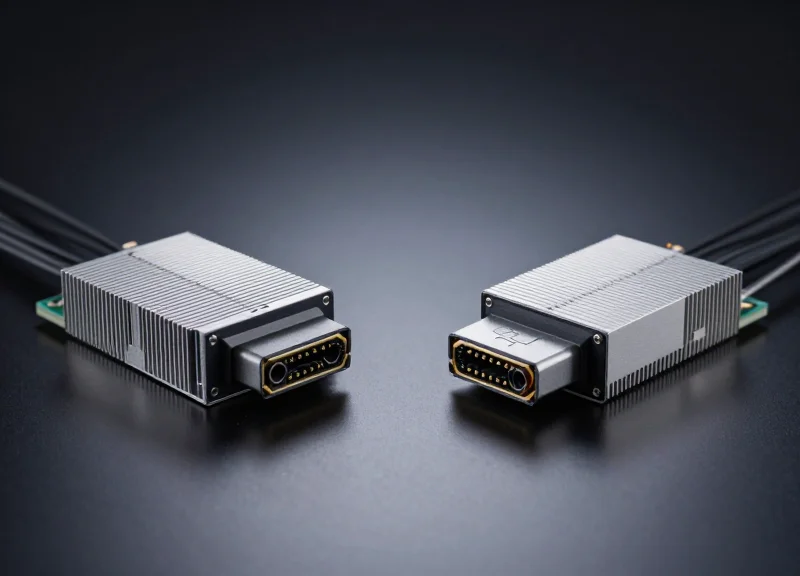
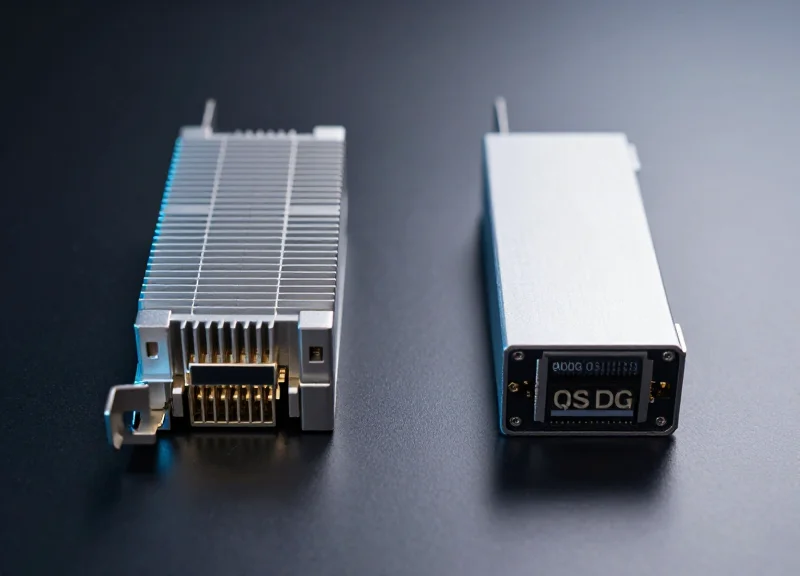
Unlike the QSFP-DD, which relies on the switch chassis and external cooling mechanisms, the OSFP module features an integrated finned heat sink. This architectural difference is critical; it maximizes the surface area exposed to the device's airflow, allowing heat to be drawn away from the sensitive Digital Signal Processor (DSP) and laser components more efficiently. This passive cooling advantage ensures that OSFP modules can operate at lower internal temperatures, extending the lifespan of the optical components.
| Feature | OSFP Specification | QSFP-DD Specification |
|---|---|---|
| Max Power Rating | 15W - 20W (Typical) | 12W - 14W (Typical) |
| Thermal Dissipation | Integrated module heat sink | External cage-dependent |
| Width/Size | Slightly wider/longer | Standard legacy compatibility |
| 1.6T Scalability | Excellent (Native support) | Requires significant modification |
Power Delivery and Signal Integrity
As transceivers move toward 800G and eventually 1.6T, the electrical power requirements rise alongside the need for cleaner signals. The OSFP connector is designed with a wider pin pitch, which reduces cross-talk and improves electrical performance. This robust electrical interface supports the high-current demands of next-generation 5nm and 3nm DSPs without sacrificing signal integrity, providing a stable foundation for Ubytelink's premium 800G solutions.
Common OSFP Implementation Questions
- Does OSFP require specialized cooling hardware?
No, OSFP modules utilize standard switch airflow. However, their integrated heat sinks allow them to function more effectively in high-density environments where airflow might be restricted compared to legacy modules. - Can OSFP be converted to QSFP-DD?
While the form factors are physically different, OSFP-to-QSFP-DD adapters and breakout cables allow for interoperability between different equipment types within the same network fabric. - Is OSFP the default standard for AI back-ends?
Increasingly, yes. Many leading AI infrastructure providers favor OSFP for its ability to handle the sustained high-power draws typical of intensive GPU-to-GPU training traffic.
QSFP-DD Explained: The Path of Least Resistance

QSFP-DD Explained: The Path of Least Resistance
QSFP-DD (Quad Small Form-factor Pluggable Double Density) 800G serves as the evolutionary successor to the widely adopted QSFP56 and QSFP28 standards. By adding a second row of electrical contacts, the form factor doubles the lane count from four to eight, effectively reaching 800Gbps using 100G SerDes technology. For many network operators, QSFP-DD represents the 'path of least resistance' because it preserves the density and mechanical footprint of previous generations while providing a massive leap in bandwidth.
The Advantage of Ecosystem Continuity
The primary driver behind QSFP-DD adoption is its seamless backward compatibility. A QSFP-DD port is mechanically designed to accept standard QSFP modules, allowing legacy 40G, 100G, and 400G optics to function in the same physical slots. This protection of existing hardware investments makes it an ideal choice for enterprise environments and brownfield data centers where heterogeneous hardware must coexist without requiring a forklift upgrade of the entire switching fabric.
| Feature | QSFP-DD 400G | QSFP-DD 800G |
|---|---|---|
| Electrical Lanes | 8 x 50G PAM4 | 8 x 100G PAM4 |
| Typical Power Consumption | 12W - 14W | 16W - 18W |
| Module Compatibility | QSFP+/QSFP28/QSFP56 | Full QSFP Family Support |
| Connector Type | 2-row Electrical Pin | 2-row Electrical Pin (Optimized) |
Engineering for 800G Performance
While QSFP-DD offers superior port density, scaling to 800G requires sophisticated signal integrity and thermal management. Ubytelink 800G QSFP-DD solutions utilize high-performance DSPs and optimized internal layouts to stay within the power envelopes required by current cooling infrastructures. By maintaining the compact form factor without the integrated heat sink of the OSFP, QSFP-DD relies on the system-level cooling of the switch, making it highly efficient for standard rack configurations.
- Is QSFP-DD 800G compatible with OSFP?
No, they are physically different form factors. QSFP-DD is smaller and uses a different cage design than OSFP. - Can I plug a QSFP28 module into a QSFP-DD 800G port?
Yes, QSFP-DD ports are designed to be backward compatible with all previous QSFP modules, including QSFP28 (100G) and QSFP56 (200G). - What is the main benefit of QSFP-DD over OSFP for 800G?
The primary benefit is the ability to maintain existing cabling infrastructures and the flexibility to use legacy modules in new high-speed switches.
Thermal Performance: The Battle of Cooling Efficiency
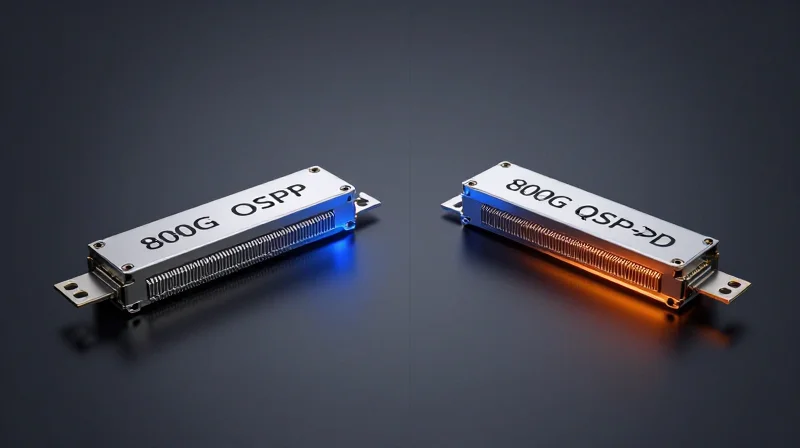
Thermal performance is the ultimate arbiter of performance in 800G networking, as heat dissipation directly correlates with transceiver lifespan and signal integrity. While both OSFP and QSFP-DD are engineered to handle the high-wattage demands of 800G optics, their approaches differ significantly: the OSFP’s integrated heat sink provides a superior thermal path for high-power modules, whereas QSFP-DD relies more heavily on the switch's cage-side cooling infrastructure to maintain operational temperatures.
The OSFP Thermal Advantage: Integrated Cooling Design
OSFP transceivers are physically larger than their QSFP-DD counterparts, a design choice that prioritizes airflow and thermal mass. By incorporating cooling fins directly onto the module housing, OSFP reduces the thermal resistance between the internal optical engine and the ambient air. This integrated heat sink allows OSFP to comfortably support power envelopes exceeding 15W and even 20W. This headroom is critical for high-performance 800G DSPs and future-proofs the infrastructure for the eventual transition to 1.6T networking, where power demands will rise further.
QSFP-DD Thermal Management: The Challenge of Density
QSFP-DD faces a more constrained thermal environment due to its smaller surface area and the absence of built-in cooling fins. Instead, it utilizes a 'riding heat sink' mechanism located on the equipment cage. While this design maintains backward compatibility with QSFP legacy systems, it requires more aggressive airflow from the chassis fans to achieve the same cooling efficiency as OSFP. In fully populated 800G switches, this can lead to higher power consumption for the cooling system itself and potential thermal throttling if airflow is not precisely managed.
| Feature | 800G OSFP | 800G QSFP-DD |
|---|---|---|
| Heat Sink Type | Integrated (Built-in Fins) | External (Cage-mounted) |
| Thermal Resistance | Low (High Dissipation Efficiency) | Moderate (Requires Optimized Airflow) |
| Max Power Support | Up to 30W (Future-Ready) | Typically 12W - 15W (Up to 25W with Type 2) |
| Airflow Impact | Aerodynamic (Reduces Internal Turbulence) | Standard (Density-dependent) |
FAQ: Addressing Heat Concerns in 800G Deployments
- Why is heat dissipation the leading cause of transceiver failure?
Excessive heat accelerates the degradation of the laser diode and causes timing jitter in the DSP. In 800G optics, where components are packed tightly, effective cooling is the only way to prevent bit error rate (BER) spikes and hardware burnout. - Can QSFP-DD handle high-power ZR/ZR+ modules?
Yes, but it requires specialized 'Type 2' cages with enhanced thermal interfaces. For ultra-long-haul 800G ZR modules that pull high wattage, OSFP is often the safer choice due to its superior native thermal path. - Does OSFP’s size affect switch port density?
While OSFP is slightly wider, modern 1U switches can still accommodate 32 OSFP ports, matching the density of QSFP-DD while providing much better thermal headroom for the system.
Density and Scalability in the Modern Data Center

Density and Scalability in the Modern Data Center
The primary challenge in modern data center design is achieving maximum port density without compromising the thermal stability or electrical integrity of the network. While both 800G OSFP and QSFP-DD are designed to fit into standard 1U switch chassis, their scalability is dictated by their physical width and power handling capabilities. Ubytelink solutions are engineered to ensure that whether a provider chooses the backward-compatible path of QSFP-DD or the performance-first path of OSFP, the signal remains clean and the hardware remains scalable for the next generation of silicon.
Port Density and Physical Constraints
In a standard 19-inch rack unit (1RU), space is the ultimate premium. QSFP-DD maintains the traditional width that allows for up to 36 ports in a single row. OSFP is slightly wider, which traditionally limited density to 32 ports. However, recent innovations in 'OSFP-XD' (Extra Density) and optimized chassis cooling have begun to close this gap, allowing OSFP to compete more directly on a port-per-unit basis.
| Feature | QSFP-DD (800G) | OSFP (800G) |
|---|---|---|
| Module Width | 18.35 mm | 22.58 mm |
| Max Ports (1RU Single Row) | 36 Ports | 32 Ports |
| Max Power per Port | 15W - 25W | 30W+ |
| 1.6T Ready | Challenging (Thermal limits) | Native Design Support |
The Roadmap to 1.6T and Beyond
As we look toward 1.6T, OSFP holds a distinct advantage. Its larger physical size and superior heat dissipation allow it to accommodate the increased power demands of 200G-per-lane signaling. While QSFP-DD is working on its own evolution (QSFP-112 and QSFP-DD1600), the engineering overhead required to keep these modules cool in a high-density environment is significantly higher. Ubytelink's 800G OSFP modules are already built with the thermal headroom required for these future high-speed transitions, making them the preferred choice for greenfield 'AI-scale' data centers.
- Can QSFP-DD support 1.6T?
While theoretically possible through the QSFP-DD1600 specification, the thermal management required for such a small form factor makes it difficult to implement in high-density 1RU switches compared to OSFP. - Which form factor offers better ROI for scalability?
QSFP-DD offers better ROI for existing infrastructures due to backward compatibility. However, OSFP offers better long-term ROI for operators building new, high-performance clusters intended to last through several hardware generations. - How does Ubytelink ensure quality across these densities?
Ubytelink utilizes high-precision manufacturing to ensure that even at maximum port density, crosstalk and electromagnetic interference (EMI) are minimized through superior shielding and material selection.
Ubytelink's Manufacturing Excellence: Beyond Standard Specs

Ubytelink’s 800G solutions go beyond the baseline specifications defined by MSAs (Multi-Source Agreements) to address the real-world challenges of high-density data centers. While generic modules may meet functional requirements in ideal conditions, Ubytelink focuses on durability, thermal resilience, and signal integrity through a vertically integrated supply chain and exhaustive validation cycles that significantly reduce the Total Cost of Ownership (TCO) for global network operators.
Tier-1 Component Strategy: The Building Blocks of Quality
The performance of an 800G transceiver is fundamentally limited by its internal hardware. Ubytelink utilizes high-grade EML (Electro-absorption Modulated Lasers) and advanced Silicon Photonics engines sourced exclusively from top-tier fabrication plants. By integrating low-power Digital Signal Processors (DSPs) with optimized error-correction algorithms, we ensure that our OSFP and QSFP-DD modules maintain lower power consumption and higher jitter tolerance than standard market alternatives, preventing premature component degradation.
The Ubytelink Testing Advantage
| Testing Parameter | Standard Industry Requirement | Ubytelink Premium Protocol |
|---|---|---|
| High-Temperature Endurance | Case temp 0°C to 70°C | Extended stress testing up to 85°C case temp |
| Signal Integrity (BER) | 1E-12 before FEC | Optimized to <1E-15 for cleaner data paths |
| Interoperability Testing | Basic MSA compliance | Cross-vendor verification with 50+ switch/router brands |
| Burn-in Process | Sample-based testing | 100% units subjected to high-load burn-in for 48-72 hours |
Validation for High-Capacity Deployment Scenarios
Our manufacturing excellence extends to the physical layer. Each module undergoes rigorous TDR (Time Domain Reflectometry) and optical spectrum analysis to ensure that every photon is accounted for. This meticulous approach prevents common issues such as link flapping and packet loss, which are often prevalent in generic 800G modules when operated at peak capacity in thermally constrained environments.
- How does Ubytelink ensure compatibility across different hardware platforms?
We maintain an extensive compatibility lab featuring the latest hardware from major networking vendors to verify firmware handshakes and optical performance before shipping. - What is the expected failure rate of Ubytelink 800G modules?
Due to our 100% burn-in policy and strict component selection, our field failure rate (AFR) is consistently maintained below 0.01%. - Are Ubytelink modules optimized for energy efficiency?
Yes, our latest 800G designs utilize next-generation DSPs that reduce heat output and energy consumption by up to 15% compared to generic alternatives.
Total Cost of Ownership (TCO) Considerations
Total Cost of Ownership (TCO) Considerations
Achieving a sustainable return on investment in 800G deployments requires an analysis that transcends the unit price of optics, focusing instead on the holistic lifecycle costs including energy consumption, thermal overhead, and the frequency of replacement cycles. Ubytelink’s OSFP and QSFP-DD solutions are engineered to minimize these hidden expenses through superior power-per-bit efficiency and high-reliability manufacturing processes.
Balancing Capital Expenditure (Capex) and Operational Savings
While Capex is often the most visible metric, Opex—specifically power and cooling—frequently accounts for a larger share of the budget over a five-year window. QSFP-DD modules typically offer lower initial Capex due to their backward compatibility with existing 400G ports, whereas OSFP often requires new cages but offers better thermal performance. Ubytelink closes the gap by providing premium components that reduce power draw, lowering the energy bill for the entire rack.
| TCO Factor | Ubytelink 800G OSFP | Ubytelink 800G QSFP-DD |
|---|---|---|
| Power Consumption | Optimized for 14-16W; lower heat generation. | Standardized at 12-14W; higher heat density. |
| Cooling Costs | Lower (integrated heatsink reduces fan speed requirements). | Moderate (requires high-velocity chassis airflow). |
| Service Life (MTBF) | Extended via superior thermal dissipation. | High reliability through premium DSP selection. |
| Backward Compatibility | Requires adapters for legacy integration. | High (native support for legacy QSFP form factors). |
Reliability and the Cost of Downtime
The most significant hidden cost in high-speed networking is unplanned downtime. Ubytelink mitigates this risk by employing rigorous burn-in testing and selecting EML lasers with high thermal stability. By reducing the failure rate compared to generic white-label optics, network operators save on the labor costs of site visits, the logistical expense of RMAs, and the potential revenue loss associated with link failures.
- How does power consumption affect TCO in 800G networks?
Each additional watt per module can add hundreds of dollars in electricity and cooling costs over the product's lifespan; Ubytelink modules use advanced DSPs to keep power draw at the lower end of the specification. - Why is the OSFP form factor considered 'future-proof' for TCO?
OSFP supports up to 1.6T transitions with minimal infrastructure changes, protecting the initial investment in cages and thermal management systems. - Does premium quality really reduce maintenance costs?
Yes, by utilizing higher-grade optical sub-assemblies (TOSA/ROSA), Ubytelink reduces the probability of bit error rate (BER) degradation, which leads to fewer maintenance alerts and manual interventions.
Ultimately, the choice between OSFP and QSFP-DD depends on the specific thermal limits of the data center and the existing legacy footprint. However, regardless of form factor, Ubytelink’s focus on premium manufacturing ensures that the total cost of ownership remains predictable and optimized for high-density global networks.
Strategic Selection: Which One is Right for You?
The choice between Ubytelink 800G OSFP and QSFP-DD is primarily dictated by your existing hardware architecture and your facility's cooling capacity. While both form factors deliver the same 800Gbps throughput, the 'right' solution for your global network depends on whether you prioritize seamless backward compatibility with legacy QSFP systems or require the superior thermal headroom necessary for the next generation of 1.6T networking.
Comparing Form Factors by Use Case
| Feature | 800G QSFP-DD | 800G OSFP | |||
|---|---|---|---|---|---|
| Primary Advantage | Backward Compatibility | Thermal Efficiency & Roadmap | Heat Dissipation | Standard (Internal) | Superior (Integrated Fin/Heatsink) |
| Backward Compatibility | Native (QSFP28/QSFP56) | Requires Adapter | Future Proofing | Limited Path to 1.6T | Designed for 1.6T Evolution |
| Ideal Environment | Enterprise & Standard Cloud | AI Clusters & HPC Data Centers |
Strategic Decision Framework
When deploying Ubytelink 800G solutions, IT leaders should evaluate their decision based on three pillars: Infrastructure Heritage, Thermal Thresholds, and The 1.6T Horizon. If your network relies heavily on existing QSFP28 or QSFP56 infrastructure, the QSFP-DD form factor allows for high-density upgrades without replacing cables or using complex adapters. However, for greenfield AI deployments where power density exceeds 15-20W per module, OSFP’s integrated heat sink is the technically superior choice to prevent thermal throttling.
- When should I prioritize Ubytelink 800G QSFP-DD?
Choose QSFP-DD when you need to maintain compatibility with existing 100G and 400G QSFP ports within the same switch chassis, ensuring a lower CapEx on accessories and simplified inventory management. - When is Ubytelink 800G OSFP the better investment?
OSFP is the better investment for high-performance computing (HPC) and AI/ML fabrics where maximum airflow and a clear upgrade path to 1.6T are critical for long-term ROI. - Can I mix both form factors in one network?
Yes, provided the switch or router hardware supports both, or through the use of Ubytelink’s high-quality breakout cables and adapters that bridge the physical interface gap. - How does Ubytelink ensure quality across both formats?
Regardless of the form factor, Ubytelink utilizes the same premium internal components and rigorous testing protocols to ensure 100% interoperability and zero-packet-loss performance.
Final Verdict for Global Network Architects
For global networks looking to optimize for current efficiency, QSFP-DD remains the industry workhorse. For those building the foundation of the next decade's AI-driven internet, OSFP is the strategic choice. Ubytelink provides premium solutions for both, ensuring that your selection is backed by the highest manufacturing standards in the industry.
Navigating the complexities of 800G infrastructure requires more than just hardware; it requires a partner dedicated to quality and engineering excellence. Whether you prioritize the thermal headroom of OSFP or the legacy compatibility of QSFP-DD, Ubytelink provides the reliability your mission-critical network demands. Contact our engineering team today to architect your next-generation 800G solution.