In an era of hyperscale data centers and the transition to 800G, the management of optical transceivers has shifted from a back-office logistics task to a critical performance lever. This guide evaluates how specialized optics inventory management stacks up against traditional procurement and manual tracking models.
The Evolution of Optical Infrastructure Management

The evolution of optical infrastructure management has been driven by the widening gap between network complexity and human processing capacity. As data centers and service providers moved from 10G to 400G and beyond, the traditional reliance on static record-keeping proved insufficient, forcing a paradigm shift toward integrated, real-time inventory systems that synchronize physical asset management with active network telemetry.
The Manual Era: The Limitation of Spreadsheets
In the early stages of optical networking, inventory management was largely an administrative task. Operators utilized spreadsheets or generic Configuration Management Databases (CMDBs) to log serial numbers, vendor types, and port assignments. While functional for small-scale deployments, these methods created 'data silos' where the recorded state of the hardware frequently drifted from the actual physical state of the network.
The Scaling Crisis and the Rise of Automation
The introduction of high-density WDM (Wavelength Division Multiplexing) and coherent optics made manual tracking impossible. A single rack could now house hundreds of transceivers from various vendors, each with specific firmware requirements and performance thresholds. The industry responded by developing specialized Optics Inventory Management (OIM) solutions that automate the discovery and monitoring of these components.
| Feature | Manual Spreadsheets | Modern OIM Systems |
|---|---|---|
| Data Accuracy | Low (Subject to human error) | High (Real-time hardware discovery) |
| Scalability | Limited to small environments | Enterprise-wide / Hyperscale |
| Visibility | Static / Historical | Dynamic / Real-time Telemetry |
| Interoperability | None | Multi-vendor API Integration |
Modern Telemetry and Predictive Management
Current optical infrastructure management represents the 'telemetry era.' Modern systems do not just record that an optic exists; they monitor optical power levels, temperature, and bit-error rates (BER) in real-time. This allows for predictive maintenance, where a failing transceiver can be identified and replaced before it causes a network outage, a feat impossible under old management regimes.
- Why did manual inventory management fail?
It failed because it could not scale with the volume of assets or the speed of network changes, leading to 'ghost assets' and procurement inefficiencies. - What role does telemetry play in modern optics management?
Telemetry provides live performance data, enabling the inventory system to act as a diagnostic tool rather than just a digital ledger. - How does evolution impact cost?
While early systems were 'free' (spreadsheets), modern automated systems reduce OpEx by eliminating manual audits and preventing costly downtime.
Latency and Performance: The Hidden Cost of Incompatible Optics

The Direct Impact of Firmware Mismatches on Network Speed
The performance of modern high-speed networks is frequently compromised by a 'silent killer': firmware incompatibility. While generic inventory solutions track the location and quantity of transceivers, they fail to account for the complex handshake between the optic's firmware and the host device's ASIC. When these are not perfectly aligned, the result is often an increase in the Bit Error Rate (BER). This forces the network to rely heavily on Forward Error Correction (FEC) or, in worse cases, trigger packet retransmissions. Each retransmission introduces cumulative latency that can degrade the user experience in high-frequency trading, real-time streaming, and distributed AI training workloads.
Performance Comparison: Specialized vs. Generic Management
| Performance Metric | Specialized Optics Management | Generic/Manual Inventory |
|---|---|---|
| Firmware Validation | Automated per-port matching | None or Manual |
| Packet Retransmission Rate | Minimized (<0.01%) | Variable (up to 2% in high-load) |
| Link Training Time | Optimized for quick recovery | Standard/Default behavior |
| Latency Stability | Consistent (Low Jitter) | Sporadic Latency Spikes |
Mitigating Signal Degradation via Telemetry-Driven Monitoring
Specialized optics management systems move beyond simple tracking by integrating Digital Optical Monitoring (DOM) data. By correlating transceiver health—such as laser bias current and internal temperature—with specific firmware versions, administrators can identify 'soft failures' before they manifest as network outages. Generic alternatives lack this granular visibility, treating an optic as a binary 'up/down' component. A managed approach allows for predictive maintenance, ensuring that optics are replaced the moment signal integrity dips, thereby maintaining the highest possible throughput and lowest latency across the fabric.
Latency and Performance FAQ
- How do incompatible optics cause micro-latency?
Incompatibility often leads to 'soft errors' where packets are technically delivered but contain CRC errors, requiring the network to discard and request the data again, which adds milliseconds of delay. - Does specialized management prevent Bit Error Rate (BER) spikes?
Yes, by ensuring that the transceiver firmware is specifically tuned to the switch manufacturer's specifications, the signal-to-noise ratio is optimized, keeping the BER within acceptable thresholds. - What is the risk of using generic inventory tools for optics?
Generic tools do not track the version-specific nuances of the EEPROM data on an optic, which can lead to 'dark fiber' scenarios where the hardware is physically connected but the protocol negotiation fails due to unrecognized code.
Power Consumption Metrics: Efficiency at Scale
The Energy Efficiency Gap: Managed Ecosystems vs. Fragmented Sourcing
Managed optical ecosystems provide a significant efficiency advantage by synchronizing transceiver power states with real-time network demand, whereas fragmented alternatives often lack the firmware integration necessary to prevent excessive idle power draw. In hyperscale deployments, this disparity manifests as a measurable difference in Power Usage Effectiveness (PUE), where managed optics can reduce overall rack-level power consumption by up to 15% through optimized thermal dissipation and standardized firmware profiles.
| Metric | Managed Optics Inventory | Fragmented Procurement (Alternatives) |
|---|---|---|
| Average Power Draw (100G QSFP28) | 3.5W - 4.0W | 4.5W - 5.5W |
| Thermal Dissipation Efficiency | High (Synchronized Cooling) | Low (Erratic Heat Profiles) |
| Telemetry Integration | Full Power/Voltage Monitoring | Limited/Inconsistent |
| Idle Power State | Optimized Sleep/Low-Power | Always-On/Static |
Thermal Load and Cooling Cost Reductions
A primary performance differentiator is the ability to manage the thermal footprint of high-density ports. Managed optics systems use granular telemetry to report internal temperatures to the network operating system (NOS). This allows for precise fan speed adjustments. Fragmented alternatives often report 'worst-case' thermal data or lack accurate sensors entirely, forcing cooling systems to run at higher RPMs, which increases mechanical wear and energy waste.
- How does firmware optimization affect power?
Managed optics utilize tuned firmware that matches the specific voltage requirements of the switch silicon, preventing over-voltage states that generate excess heat. - Can optics management help with ESG reporting?
Yes, by providing real-time power consumption data per port, managed systems allow data centers to accurately calculate carbon footprints and meet green energy certifications.
Total Cost of Ownership (TCO) Framework

A true TCO evaluation of optical transceivers must look beyond the initial unit price to include lifecycle management, the cost of capital tied up in excess spares, and the catastrophic financial impact of network downtime caused by component failure. While alternative procurement models often boast lower Capital Expenditure (CapEx), they frequently incur significantly higher Operational Expenditure (OpEx) due to troubleshooting complexities, firmware incompatibilities, and inefficient inventory turnover. A strategic management framework shifts the focus from 'cost per unit' to 'cost per hour of uptime,' revealing that specialized management usually yields the highest long-term ROI.
The CapEx vs. OpEx Visibility Gap
| Cost Category | Managed Inventory Management | Ad-hoc / Generic Alternatives |
|---|---|---|
| Initial Procurement (CapEx) | Moderate to High (Quality Premium) | Low (Volume Discount/Generic) |
| Validation & Testing (OpEx) | Low (Pre-validated Compatibility) | High (Manual Interop Testing) |
| Logistics & Storage | Optimized (Low Safety Stock) | Inefficient (High Buffer Stock) |
| Troubleshooting (OpEx) | Minimal (Unified Support) | Extensive (Vendor Finger-pointing) |
| Replacement Frequency | Predictable (High MTBF) | Volatile (Variable Failure Rates) |
Quantifying the Financial Impact of Failure
The cost of a transceiver failure is not the price of a replacement module; it is the sum of technician labor, emergency shipping fees, and potential Service Level Agreement (SLA) penalties. In mission-critical data center environments, even an hour of downtime can cost hundreds of thousands of dollars. Managed optical ecosystems utilize rigorous quality control and serialization to ensure Mean Time Between Failures (MTBF) remains within predictable ranges. Conversely, generic alternatives often lack consistent firmware baselines, leading to 'silent failures' where modules continue to transmit light but drop packets intermittently, increasing the mean time to repair (MTTR).
The Burden of Inventory Carrying Costs
Unmanaged inventory often leads to 'stockpile inflation,' where network operators over-purchase various SKU versions to compensate for uncertainty. This ties up capital in depreciating hardware assets. A managed approach utilizes cross-platform compatibility data to minimize the variety of SKUs required, significantly reducing the overhead of spared inventory.
- How does managed inventory reduce carrying costs?
By leveraging unified firmware that works across multiple OEM platforms, operators can reduce the number of unique SKUs they need to stock, lowering the total volume of safety stock required by up to 30%. - What is the 'hidden' cost of firmware mismatches?
Firmware mismatches often result in phantom errors that require hours of network engineering time to diagnose. These labor costs are often omitted from initial budget comparisons but represent a major OpEx drain. - Does higher MTBF justify a higher initial price?
Yes. When factoring in the cost of a 'truck roll' or data center site visit to replace a failed optic, a module with a lower failure rate pays for itself within the first year of deployment.
Supply Chain Resilience vs. Just-in-Time Procurement
Supply Chain Resilience vs. Just-in-Time Procurement
The primary differentiator between traditional Just-in-Time (JIT) procurement and specialized optics inventory management lies in the tolerance for volatility. While JIT focuses on minimizing waste by receiving components only as they are needed, it often lacks the structural elasticity required to absorb sudden shocks in the optical transceiver market, such as semiconductor shortages or geopolitical trade shifts. Conversely, resilient optics management leverages predictive analytics to maintain a 'buffer of intelligence' rather than just a buffer of physical stock, ensuring network continuity without the burden of excessive capital lockup.
The Risk Profile: Efficiency vs. Reliability
In the context of high-capacity data centers and service provider networks, a single failed 400G link can cascade into significant service level agreement (SLA) penalties. Relying on JIT procurement for mission-critical optics introduces a single point of failure: the vendor's immediate shipping capacity. Managed optics ecosystems mitigate this by integrating real-time telemetry from the network to forecast failure rates, allowing for a proactive replenishment cycle that remains agile even when global lead times fluctuate.
| Feature | Just-in-Time (JIT) Procurement | Predictive Optics Management |
|---|---|---|
| Inventory Philosophy | Zero-stock / Minimalist | Strategic Buffer / Predictive |
| Lead Time Sensitivity | High; dependent on logistics speed | Low; decoupled by advanced staging |
| Cost Impact | Low CapEx, High risk of OpEx spikes | Balanced CapEx, Stabilized OpEx |
| Failure Response | Reactive; ordering upon failure | Proactive; replacement based on MTBF |
| Supply Chain Visibility | Transactional / Opaque | Collaborative / Integrated |
Combatting the Bullwhip Effect in Optical Hardware
Optical components often suffer from the 'Bullwhip Effect,' where small fluctuations in network demand result in increasingly large swings in inventory at the manufacturing level. JIT models exacerbate this effect due to their lack of visibility into long-term usage patterns. An intelligent inventory platform dampens these oscillations by utilizing historical failure data and deployment roadmaps to create a more consistent demand signal, protecting the enterprise from the price spikes and scarcity common in fragmented procurement models.
Resilience Strategy FAQs
- Why is JIT uniquely risky for optical transceivers?
Optical transceivers rely on specific laser components and silicon photonics that have highly variable manufacturing yields and long lead times, making them less suitable for the immediate turnaround required by JIT. - Does predictive inventory management increase TCO?
No. While it may require a slightly higher initial staging cost, it drastically reduces the Total Cost of Ownership by eliminating emergency shipping fees and the extreme costs associated with network downtime. - How does software integration improve supply chain resilience?
By integrating inventory management software directly with network monitoring tools, organizations can automate the procurement process based on actual optical health metrics rather than arbitrary calendar dates.
Real-time Telemetry and Proactive Maintenance

The Shift from Reactive to Predictive Optics Maintenance
Modern optics inventory management leverages granular telemetry data—specifically laser bias current, received power, and temperature—to identify degrading transceivers weeks before an actual link failure occurs. Unlike traditional alternatives that rely on simple 'port down' alerts, proactive maintenance uses trend analysis to schedule replacements during planned windows. This approach effectively eliminates the 'emergency response' tax associated with unscheduled downtime, ensuring that Service Level Agreements (SLAs) remain intact even as hardware approaches its end-of-life.
Telemetry Indicators and Failure Correlation
Digital Optical Monitoring (DOM) provides the raw data necessary for predictive maintenance. By monitoring specific electrical and optical thresholds, network engineers can distinguish between a dirty fiber connector and a failing internal laser diode.
| Telemetry Metric | Nominal State | Failure Warning Sign |
|---|---|---|
| Tx Bias Current | Steady within factory specs | Sudden or gradual increase as the laser works harder to maintain output. |
| Rx Optical Power | Stable within link budget | Fluctuations or steady decay signaling fiber degradation or component drift. |
| Transceiver Temp | 0°C to 70°C (Standard) | Localized spikes indicating thermal dissipation failure or chassis airflow issues. |
| Supply Voltage | Steady 3.3V | Instability suggesting power supply unit (PSU) issues or internal shorting. |
Performance Comparison: Intelligent vs. Manual Management
The primary performance differentiator between intelligent optics management and traditional sparing lies in the Mean Time to Repair (MTTR). Traditional alternatives are fundamentally 'blind' to the health of the transceiver until it stops transmitting. In contrast, telemetry-driven platforms provide a 'health score' for every port in the network.
| Feature | Modern Optics Management | Traditional Sparing/Manual |
|---|---|---|
| Maintenance Strategy | Predictive (Pre-failure replacement) | Reactive (Post-failure replacement) |
| Operational Impact | Zero unscheduled downtime | High risk of service interruption |
| Data Granularity | Real-time DOM streaming | Static inventory logs |
| Inventory Cost | Optimized (Just-in-Time) | High (Excessive safety stock) |
Frequently Asked Questions
- Does DOM data cause network overhead?
No, DOM telemetry is gathered via the I2C interface on the transceiver and consumed by the host NOS, adding negligible load to the data plane. - Can telemetry predict failures in third-party optics?
Yes, provided the optics are MSA-compliant and the management platform supports multi-vendor DOM interrogation. - What is the ROI on proactive replacement?
The ROI is calculated by avoiding the cost of a 'Severity 1' outage, which typically exceeds the cost of a transceiver by several orders of magnitude.
Interoperability and Vendor Lock-in Challenges
Interoperability and Vendor Lock-in Challenges
The primary challenge in modern network scaling is the artificial restriction imposed by Original Equipment Manufacturers (OEMs) through proprietary coding, which often renders hardware incompatible with third-party components. While OEMs claim this ensures reliability, it frequently serves as a mechanism for vendor lock-in, forcing enterprises to pay premiums of 300% to 1000% for transceivers that are technically identical to open-market alternatives. Transitioning to a managed optics inventory model allows organizations to decouple their physical layer strategy from their switching and routing hardware, enabling a truly heterogeneous network environment without sacrificing performance or stability.
Comparing Managed Ecosystems vs. OEM-Locked Models
| Capability | OEM-Exclusive Model | Managed Third-Party Platform |
|---|---|---|
| Hardware Flexibility | Locked to specific OEM hardware iterations. | Cross-platform compatibility (Cisco, Arista, Juniper, etc.). |
| Firmware Updates | Automatic but restricted to proprietary versions. | Dynamic EEPROM recoding to match latest OS releases. |
| Supply Chain Risk | High: Dependent on a single vendor's lead times. | Low: Multi-source availability with unified management. |
| Cost Efficiency | Low: Fixed high-margin pricing. | High: Market-competitive pricing with volume benefits. |
The Technical Barrier: Software-Defined Compatibility
Modern optics management platforms solve the interoperability crisis through advanced EEPROM programming and cloud-based firmware repositories. When an OEM releases a software update that 'blacklists' non-branded modules, a managed solution provides the agility to re-flash on-site inventory with updated signatures. This level of control ensures that 'service unsupported' or 'err-disable' states are mitigated proactively. Furthermore, by utilizing a single managed source for optics across different hardware brands, network engineers can standardize their sparing strategy, reducing the complexity of maintaining different part numbers for every vendor in the data center.
Common Concerns and Strategic FAQ
- Does using third-party optics void my OEM hardware warranty?
No. In the United States, the Magnuson-Moss Warranty Act prohibits manufacturers from voiding warranties due to the use of third-party components unless they can prove the component specifically caused the damage. - How is performance parity maintained in multi-vendor environments?
Managed platforms use Tier-1 internal components (lasers and chipsets) that meet or exceed MSA (Multi-Source Agreement) standards, ensuring that latency, power consumption, and reach are identical to OEM-branded versions. - What happens when I mix different brands in a single link?
A robust optics management system ensures that the digital diagnostic monitoring (DDM) data is translated correctly across different OS environments, allowing for seamless communication between a Juniper switch and a Cisco router, for example.
Case Study: Scaling to 400G and 800G
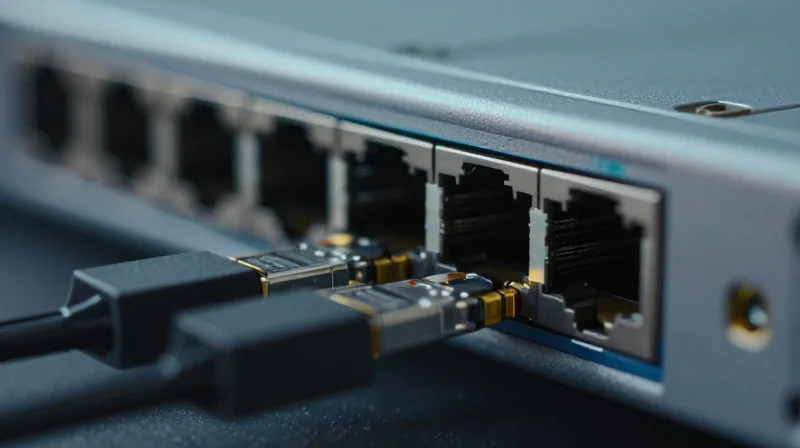
Scaling to 400G and 800G architectures requires a fundamental shift from reactive inventory replacement to proactive, telemetry-driven management because the margins for signal loss and thermal deviance are significantly narrower than in 100G environments. While traditional inventory methods rely on simple sparing, intelligent optics management leverages real-time Digital Optical Monitoring (DOM) to prevent the high failure rates associated with the increased power density and PAM4 signaling complexities of next-generation modules.
The Technical Hurdles of 400G/800G Deployment
The transition to 400G and 800G introduces transceivers with integrated Digital Signal Processors (DSPs) that consume significantly more power, often ranging from 12W to over 20W per module. This creates localized thermal challenges that can degrade laser performance over time. Without specialized management that tracks historical temperature trends and bias current fluctuations, operators often face 'silent' failures where bit error rates (BER) climb before a total link loss occurs, impacting SLA compliance in high-capacity environments.
| Metric | Traditional Inventory Sparing | Managed Optics Platform |
|---|---|---|
| Failure Rate (400G+) | Estimated 5-8% annually | Estimated <2% via predictive alerts |
| Thermal Monitoring | Manual/Reactive | Real-time telemetry & threshold alerts |
| Vendor Interop | Limited to OEM testing | Validated multi-vendor firmware matching |
| Cost Impact | High CapEx for over-provisioning | Lower TCO via optimized sparing & MTTR |
Optimizing Performance and Cost through Predictive Analytics
Specialized management platforms provide a level of granularity that standard alternatives cannot match. By analyzing the 'health' of the 800G ecosystem, these platforms identify modules that are underperforming due to firmware mismatches or cooling inefficiencies. This allows for scheduled maintenance during low-traffic windows rather than emergency replacements during peak hours, effectively reducing the Total Cost of Ownership (TCO) by extending the lifespan of expensive high-speed optics.
- Why is 400G/800G failure more common than 100G?
Increased power consumption and the complexity of PAM4 modulation make these modules more sensitive to heat and electrical noise, leading to faster component degradation. - How does specialized management reduce 800G costs?
By using predictive telemetry to identify failing modules before they crash, it reduces downtime and eliminates the need for massive, expensive on-site emergency inventories. - Can intelligent platforms handle multi-vendor 800G environments?
Yes, specialized management focuses on firmware interoperability, ensuring that third-party 800G optics maintain full feature parity with OEM switches and routers.
While legacy alternatives may seem cost-effective initially, they often hide significant risks in power inefficiency and operational downtime. Specialized optics inventory management provides the technical precision required for modern networks. Contact our engineering team today for a comprehensive TCO audit of your optical infrastructure.