As AI and machine learning workloads push data center bandwidth to its limits, the transition to 800G connectivity is no longer optional. However, choosing between QSFP-DD800 and OSFP800 involves complex trade-offs in thermal management, backward compatibility, and long-term cost. This guide breaks down the technical nuances to help you optimize your high-speed networking architecture.
The Evolution of 800G: Understanding the Form Factor War
The Rise of 800G: From 400G Evolution to Next-Gen Bandwidth
The transition to 800G represents a pivotal moment in optical networking, driven primarily by the insatiable bandwidth demands of AI/ML clusters and hyperscale cloud environments. While 400G relied on 56G PAM4 SerDes, 800G leverages 112G SerDes technology, effectively doubling throughput per lane. This evolution necessitated a critical choice for data center architects: maintain backward compatibility with legacy QSFP infrastructure via QSFP-DD800 or adopt the newer, thermally superior OSFP800 design to accommodate the increasing power demands of next-generation optics.
QSFP-DD800 vs. OSFP800: Architectural Philosophies
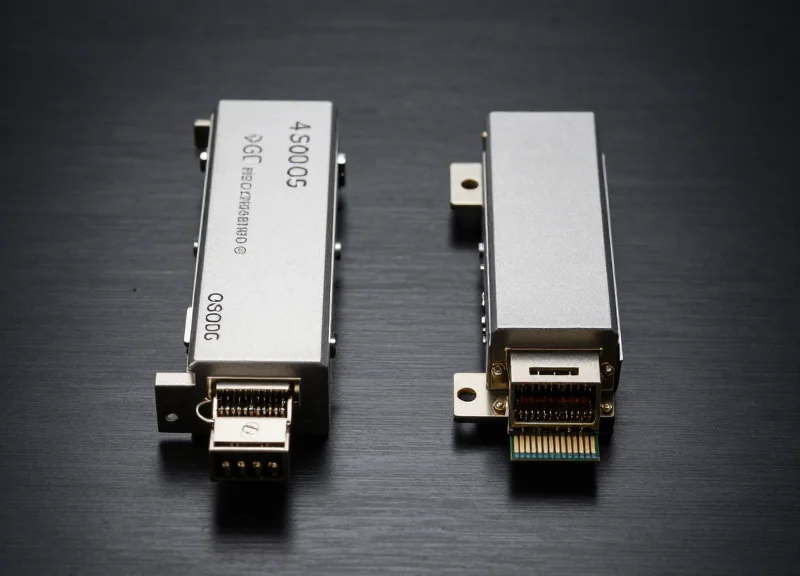
The competition between QSFP-DD800 and OSFP800 stems from two distinct engineering goals. QSFP-DD (Quad Small Form-factor Pluggable Double Density) was designed to maximize port density and provide seamless backward compatibility with existing QSFP modules. OSFP (Octal Small Form-factor Pluggable) was engineered from the ground up to address the thermal limitations of high-speed optics, offering more physical space and integrated cooling to support future transitions to 1.6T.
| Feature | QSFP-DD800 | OSFP800 |
|---|---|---|
| Lanes | 8 Lanes @ 112G PAM4 | 8 Lanes @ 112G PAM4 |
| Thermal Limit | 12-14W per module | 15-20W+ per module |
| Backward Compatibility | Native (SFP/QSFP family) | Requires adapter for QSFP |
| Module Width | 18.35mm | 22.58mm |
The Thermal Battleground
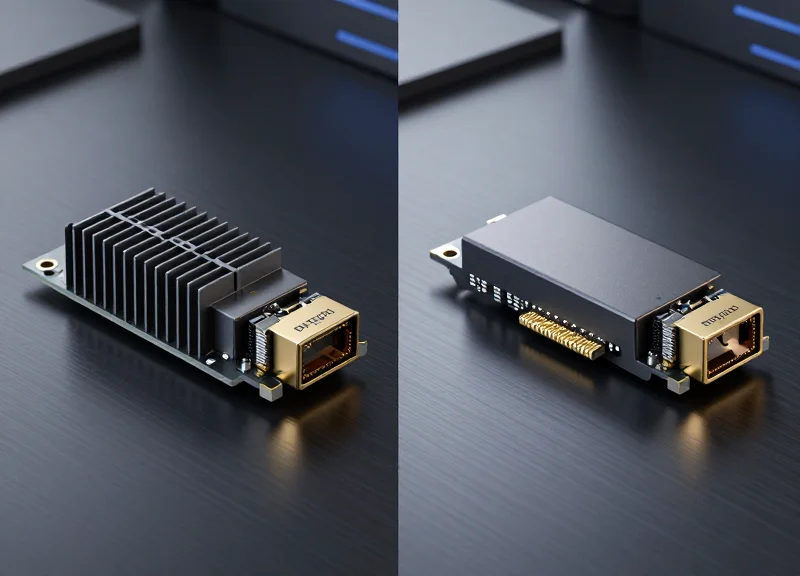
As data rates increase, power consumption rises proportionally, making heat dissipation the most significant factor in the form factor war. OSFP800 modules feature an integrated heatsink, which significantly improves the thermal interface and allows for higher power envelopes. This makes OSFP particularly suited for long-distance 800G optics that consume more power. Conversely, QSFP-DD800 maintains the status quo of chassis-side cooling, which simplifies module design but places more pressure on the switch's airflow management system.
- Is QSFP-DD800 backward compatible with 400G?
Yes, QSFP-DD800 ports are natively backward compatible with QSFP-DD 400G and standard QSFP28 modules, making it a favorite for phased upgrades. - Which form factor is better for AI clusters?
OSFP800 is gaining significant traction in AI clusters due to its superior thermal performance, which is critical when thousands of GPUs are interconnected at maximum bandwidth. - Does 800G require new cabling?
While fiber types like SMF and MMF remain the same, the electrical SerDes upgrade to 112G often requires shorter DAC lengths or a shift to Active Copper Cables (ACC).
QSFP-DD800: Density and Legacy Integration
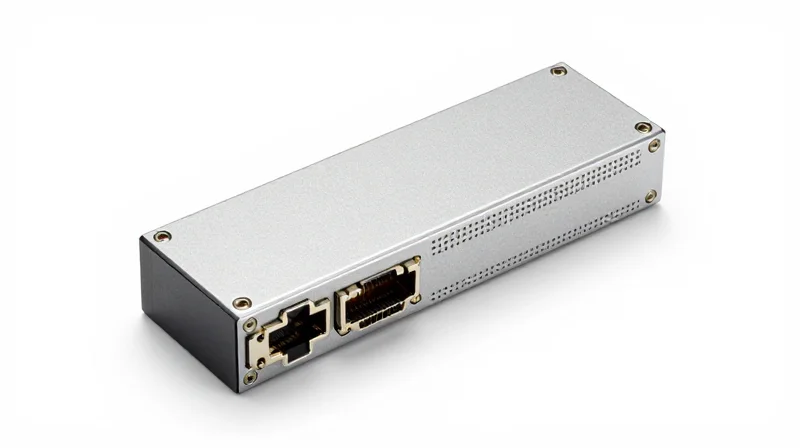
QSFP-DD800: Density and Legacy Integration
QSFP-DD800 represents the most seamless path to 800G for data centers already standardized on the QSFP ecosystem, offering a unique combination of high-density port configurations and 100% mechanical backward compatibility. Unlike competing form factors that require entirely new cage designs and patch cables, QSFP-DD800 utilizes the 'Double Density' architecture to provide eight lanes of 100G PAM4 while maintaining the same faceplate footprint as previous QSFP28 and QSFP56 modules. This allows network operators to maximize bandwidth-per-rack-unit without a radical overhaul of their physical layer infrastructure.
The Architecture of Backward Compatibility
The defining characteristic of QSFP-DD800 is its two-row electrical interface. By adding a second row of contacts behind the traditional QSFP pins, the MSA (Multi-Source Agreement) group succeeded in doubling the lane count from four to eight without increasing the width of the module. This design choice ensures that a QSFP-DD800 port can natively accept legacy QSFP+, QSFP28 (100G), and QSFP56 (200G) transceivers. This 'plug-and-play' capability for older optics simplifies the migration phase, allowing operators to upgrade switches while reusing existing fiber links and lower-speed transceivers where high-speed 800G is not yet required.
| Feature | QSFP-DD800 | OSFP800 |
|---|---|---|
| Backward Compatibility | Native (Legacy QSFP) | Requires Adapter/Special Cage |
| Electrical Lanes | 8 x 100G PAM4 | 8 x 100G PAM4 |
| Port Density (1U) | Up to 36 Ports | Up to 32-36 Ports (Design Dependent) |
| Module Width | 18.35 mm | 22.58 mm |
Density Advantages and Thermal Trade-offs
Because QSFP-DD800 modules are narrower than OSFP modules, they facilitate higher port density in specific switch architectures, particularly those utilizing high-radix ASICs. However, this smaller footprint presents a 'thermal density' challenge. Packing 800Gbps of throughput into a compact shell means that power dissipation (often exceeding 15W-20W per module) must be managed carefully. While OSFP designs often include integrated heat sinks, QSFP-DD800 relies heavily on the switch's internal cooling system and optimized cage airflow. For most standard enterprise and cloud data centers, the legacy integration benefits outweigh these thermal complexities, provided the cooling infrastructure is modern.
- Can QSFP-DD800 support 400G modules?
Yes, it is fully backward compatible with QSFP-DD 400G (8x50G) and legacy 4-lane QSFP modules like 100G QSFP28. - Is an adapter needed for legacy cabling?
No, the mechanical design of the QSFP-DD800 cage allows legacy QSFP modules to slide in and engage with the primary row of pins directly. - What is the primary use case for QSFP-DD800?
It is best suited for high-density leaf/spine switches where physical space on the faceplate is at a premium and legacy equipment must be supported.
OSFP800: Thermal Management and Power Efficiency
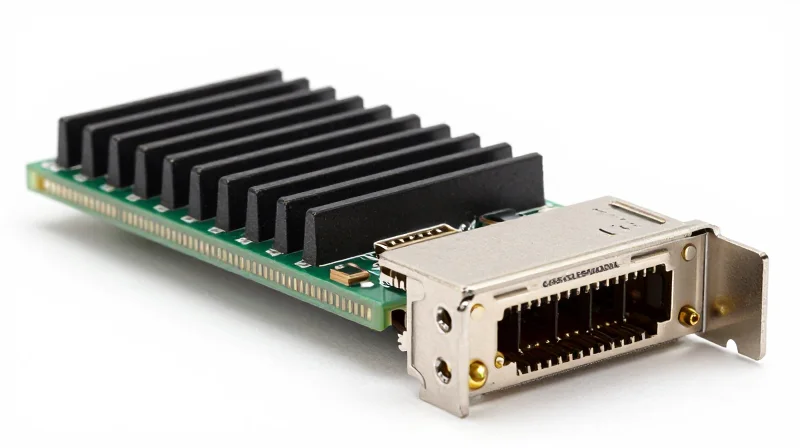
OSFP800: Thermal Management and Power Efficiency
OSFP800 differentiates itself from smaller form factors by prioritizing thermal headroom, utilizing a larger physical volume and a built-in heat sink to effectively dissipate the substantial heat generated by 800G Digital Signal Processors (DSPs) and high-speed optical engines.
The Structural Advantage of Integrated Cooling
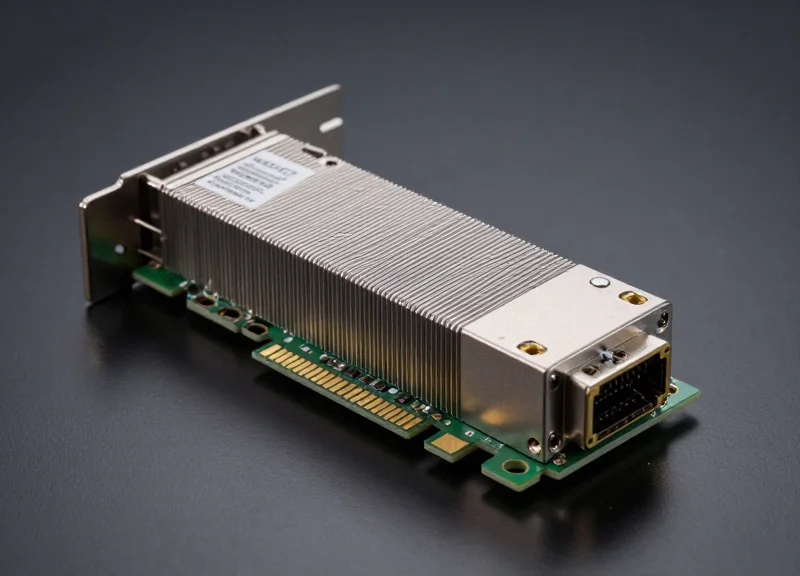
The defining characteristic of the OSFP800 is its integrated heat sink. In traditional QSFP-DD designs, a 'riding' heat sink is typically attached to the equipment cage, creating a thermal interface layer that can impede heat transfer. OSFP eliminates this barrier by making the cooling fins part of the module body itself. This allows airflow to pass directly over the module's internal hot zones, facilitating power envelopes that can comfortably exceed 15W per port. This thermal efficiency is critical for maintaining signal integrity in long-reach optics and coherent modules.
| Thermal Metric | OSFP800 | QSFP-DD800 |
|---|---|---|
| Heat Sink Design | Integrated (On-Module) | External (Riding on Cage) |
| Module Width | 22.58 mm | 18.35 mm |
| Max Power Capacity (Air Cooled) | 15W - 25W | 12W - 18W |
| Thermal Path Efficiency | Direct Airflow Contact | Interface-Dependent |
Power Efficiency and Operational Impact
Thermal management is inextricably linked to the overall power efficiency of the data center. When a module runs cooler, its internal components—specifically the laser driver and transimpedance amplifier (TIA)—operate within more efficient electrical ranges. Furthermore, because OSFP modules require less aggressive cooling from the switch chassis, operators can often run system fans at lower RPMs. This reduction in cooling overhead directly lowers the Total Cost of Ownership (TCO) by reducing the 'tax' that thermal management places on the power budget.
- Does OSFP800 require special airflow considerations?
Yes, while OSFP is thermally efficient, its larger size requires specific faceplate layouts. It is optimized for front-to-back airflow patterns common in hyperscale environments. - How does OSFP800 thermal capacity affect 1.6T transitions?
The OSFP roadmap was designed with 1.6T in mind; its current thermal capacity provides a much more stable transition to higher-speed signaling than the more constrained QSFP footprint. - Is the integrated heat sink compatible with all switches?
The integrated heat sink requires a cage design that leaves the top of the module exposed to the airflow path, which is a standard feature of OSFP-compliant hardware.
Latency Benchmarks: Signal Integrity in High-Speed Links

Latency Benchmarks: Signal Integrity in High-Speed Links
At 800G speeds, latency is primarily a byproduct of the Digital Signal Processor (DSP) and Forward Error Correction (FEC) mechanisms required to stabilize 112G PAM4 signaling. While the physical propagation delay across the copper or fiber within QSFP-DD800 and OSFP800 modules is nearly identical, the 'effective latency' experienced by the network is heavily influenced by how each standard manages signal-to-noise ratios (SNR) and thermal stability.
The 112G PAM4 SerDes Bottleneck
The transition from 56G to 112G per lane signaling halves the unit interval (UI), making the signal twice as sensitive to jitter and crosstalk. To compensate for this, 800G transceivers rely on sophisticated DSPs that perform equalization. These DSPs introduce a processing delay, typically ranging from 100ns to 200ns. OSFP800’s superior thermal management often allows its DSPs to operate at more consistent clock speeds, potentially reducing the occurrences of retransmissions caused by thermal-induced bit errors.
| Performance Metric | QSFP-DD800 (112G PAM4) | OSFP800 (112G PAM4) | Impact on Network |
|---|---|---|---|
| Typical DSP Latency | ~150ns - 250ns | ~150ns - 250ns | Standard processing overhead |
| Signal Integrity (SNR) | Moderate (High Density) | Higher (Lower Jitter) | Influences Bit Error Rate (BER) |
| FEC Requirement | KP4 FEC (Mandatory) | KP4 FEC (Mandatory) | Adds ~100ns to total link delay |
| Thermal Throttling Risk | Higher | Lower | Can lead to intermittent latency spikes |
Forward Error Correction (FEC) and Total Link Delay
Because 112G PAM4 links are inherently 'noisy,' KP4 FEC is mandatory to achieve a post-FEC Bit Error Rate (BER) of <1e-15. The combination of FEC and DSP processing means that 800G links generally exhibit higher latency than previous 100G or 400G generations. For ultra-low latency applications like High-Frequency Trading (HFT), the choice between QSFP-DD and OSFP may hinge on the specific DSP silicon used within the module rather than the mechanical shell.
- Does OSFP800 have lower latency than QSFP-DD800?
In a controlled environment, the latency is identical. However, in high-density chassis, OSFP's better cooling can prevent DSP performance degradation, leading to more stable latency under heavy load. - How does 112G SerDes affect signal integrity?
112G SerDes reduces the eye opening in PAM4 signaling, making it much harder to distinguish between voltage levels. This requires more aggressive equalization, which increases power consumption and heat. - Can FEC be disabled to reduce latency?
Generally no. At 800G (112G per lane), the raw BER is too high for the link to stay up without FEC. Emerging 'lightweight' FEC protocols are being explored for specific sub-800G niche cases.
Power Consumption: The Hidden Cost of 800G

Transitioning to 800G optics represents a pivotal shift in data center economics where power density, rather than port density, becomes the primary constraint. While 800G modules offer a superior Watt-per-Gigabit ratio compared to 400G predecessors, the absolute power consumption per module—ranging from 14W to 18W—creates unprecedented thermal challenges that dictate the choice between OSFP800 and QSFP-DD800.
The Watt-per-Gigabit Efficiency Paradox
On a purely metrics-driven basis, 800G transceivers are more efficient than 400G modules. An 800G DR8 module consuming 16W averages 0.02W per Gbps, whereas a 400G DR4 module at 12W averages 0.03W per Gbps. This 33% improvement in efficiency is significant for large-scale deployments. However, the 'hidden cost' lies in the aggregate heat load; a standard 1RU switch with 32 ports of 800G optics can generate over 500W of heat from the transceivers alone, necessitating aggressive and power-hungry cooling strategies.
| Metric | QSFP-DD800 | OSFP800 | CPO (Alternative) |
|---|---|---|---|
| Typical Power Draw | 14W - 17W | 15W - 18W | 10W - 12W |
| Thermal Dissipation | Cage-mounted Heat Sink | Integrated Heat Sink | Direct Liquid/Cold Plate |
| Airflow Resistance | Higher (Smaller Surface) | Lower (Aerodynamic) | Minimal (Internal) |
| Cooling OPEX | Higher (Fan Speed) | Moderate | Lowest |
Thermal Management: OSFP vs. QSFP-DD
The physical architecture of the OSFP800 form factor provides a distinct advantage in thermal management. By integrating the heat sink directly into the module housing, OSFP800 increases the available surface area for heat exchange and allows for a more streamlined airflow path. In contrast, QSFP-DD800 modules rely on a heat sink attached to the switch cage. This design, while essential for backward compatibility, creates more thermal resistance. For data centers operating at the edge of their cooling capacity, the OSFP800's ability to run at lower fan speeds can result in a 5-10% reduction in total system power consumption.
Power and Cooling FAQ
- How does 800G power consumption affect OPEX?
Every watt consumed by an optical module requires additional power for cooling. High-wattage 800G modules increase the 'cooling multiplier,' where $1 spent on optics power can require $0.50 to $1.00 in cooling costs depending on PUE. - Can QSFP-DD800 handle the heat of 1.6T upgrades?
QSFP-DD800 is generally considered to be at its thermal limit with 800G. For future 1.6T transitions, many operators are pivoting to OSFP due to its superior 30W+ thermal headroom. - Is Co-Packaged Optics (CPO) a viable alternative for power savings?
CPO significantly reduces power by moving the optical engine closer to the ASIC, eliminating the need for high-power SerDes drivers, but it remains a niche solution due to manufacturing and serviceability hurdles.
Total Cost of Ownership (TCO) Breakdown
The Total Cost of Ownership (TCO) for 800G infrastructure is not merely the sum of transceiver unit prices, but a complex calculation of energy efficiency, cooling requirements, and the cost of backward compatibility. While QSFP-DD800 often offers lower initial CAPEX due to its compatibility with existing QSFP ecosystems, OSFP800 potentially yields lower OPEX in high-density environments due to its superior thermal efficiency, which reduces the strain on data center cooling systems.
CAPEX: Procurement and System Integration
Capital expenditures for 800G deployments are driven by the transceiver modules and the corresponding switch silicon. QSFP-DD800 benefits from a mature manufacturing ecosystem, often leading to slightly more competitive volume pricing. However, integrating OSFP800 may require new line cards or specialized adapters if the existing infrastructure is purely QSFP-based. Investors must weigh the 'plug-and-play' convenience of QSFP-DD against the 'future-ready' physical design of OSFP, which is better suited for the eventual transition to 1.6T speeds.
OPEX: The Energy and Cooling Premium
Operating expenses at 800G are dominated by power consumption. Each module can pull between 14W and 18W; in a fully loaded 32-port 1U switch, this generates significant heat. OSFP800's larger surface area and integrated heat sink allow for more efficient airflow, which can translate to a 5-10% reduction in fan-related power consumption at the chassis level compared to high-density QSFP-DD setups that require aggressive, power-hungry cooling profiles.
| Cost Component | QSFP-DD800 Profile | OSFP800 Profile | 5-Year TCO Impact |
|---|---|---|---|
| Initial Module Cost | Moderate-High | Moderate-High | Primary CAPEX driver |
| Cooling Infrastructure | High Requirements | Optimized Efficiency | Significant OPEX variance |
| Energy Consumption | ~16W-18W per port | ~15W-17W per port | Cumulative energy debt |
| Backward Compatibility | Native (QSFP+/28/56) | Requires Adapters | Migration cost reduction |
Lifecycle Maintenance and Reliability
Over a 5-year period, the Mean Time Between Failures (MTBF) becomes a critical cost factor. Excessive heat is the primary enemy of optical components. OSFP’s thermal headroom generally leads to lower junction temperatures for the laser drivers and DSPs, potentially extending the lifespan of the modules and reducing the frequency of truck rolls for component replacement. Conversely, QSFP-DD800 may face higher replacement costs in poorly ventilated racks where thermal throttling or heat-induced degradation occurs more frequently.
TCO Frequently Asked Questions
- Does QSFP-DD800 save money on cabling?
Yes, because it is backward compatible with QSFP28 and QSFP56, existing fiber plants and patch panels can often be reused without expensive rework, reducing initial deployment costs. - Is the OSFP800 power efficiency enough to justify its cost?
In massive scale-out AI clusters, the marginal gains in cooling efficiency per module aggregate into thousands of dollars in annual savings on data center utility bills. - How do maintenance costs compare between the two?
OSFP800 generally has a reliability edge in high-heat scenarios, but QSFP-DD800 benefits from a larger pool of third-party vendors, which can drive down the cost of replacement parts through competition.
Market Alternatives: QSFP112 and Proprietary Standards
Market Alternatives: QSFP112 and Proprietary Standards
While QSFP-DD800 and OSFP800 are the primary contenders for high-density 800G adoption, QSFP112 and various proprietary interconnects provide essential alternatives for environments requiring specific power profiles, backward compatibility, or vertical integration. QSFP112, in particular, leverages the 112G SerDes technology found in 800G systems but maintains a four-lane architecture, making it a critical bridge for 400G deployments that prioritize signal integrity and reduced complexity over maximum aggregate bandwidth.
The QSFP112 Value Proposition
QSFP112 is often viewed as the successor to QSFP56. By utilizing four 112G PAM4 lanes, it achieves 400G throughput with a significantly simpler electrical path compared to older 8-lane 400G solutions. For data centers that are not yet ready to transition their entire fabric to 800G, QSFP112 allows for the use of the same high-speed SerDes silicon used in 800G switches while maintaining the familiar QSFP footprint and thermal management strategies.
| Feature | QSFP112 | QSFP-DD800 | OSFP800 |
|---|---|---|---|
| Electrical Lanes | 4 x 112G | 8 x 112G | 8 x 112G |
| Max Throughput | 400 Gbps | 800 Gbps | 800 Gbps |
| Primary Advantage | Lower Complexity/Power | Backward Compatibility | Thermal Efficiency |
| Typical Application | 400G High-Speed Breakouts | Cloud/Enterprise Core | AI/HPC Clusters |
Proprietary Standards and Custom AI Interconnects
Beyond industry-standard MSAs, proprietary interconnects are gaining traction in vertically integrated AI stacks. Companies like NVIDIA utilize customized versions of existing form factors (such as the LinkX product line) to optimize for specific protocols like NVLink. These proprietary standards often focus on extreme low latency and specialized shielding that might not be available in general-purpose QSFP-DD or OSFP modules. Furthermore, some hyperscalers explore custom form factors that integrate Co-Packaged Optics (CPO) to bypass the thermal and electrical limits of pluggable modules entirely.
- How does QSFP112 help in 800G transitions?
It allows operators to use 112G-per-lane switch silicon to drive 400G links, simplifying the hardware design and providing a direct breakout path from 800G ports to 400G end-nodes. - Are proprietary standards a risk for enterprise users?
Yes, they typically lead to vendor lock-in and higher costs, though they may offer performance optimizations for specific AI workloads that standard MSAs cannot yet match. - Will QSFP112 replace QSFP-DD?
Unlikely. QSFP112 is a 4-lane solution suited for 400G, while QSFP-DD remains the standard for 8-lane high-density 800G and beyond.
Infrastructure Compatibility: Switch and Cable Interoperability
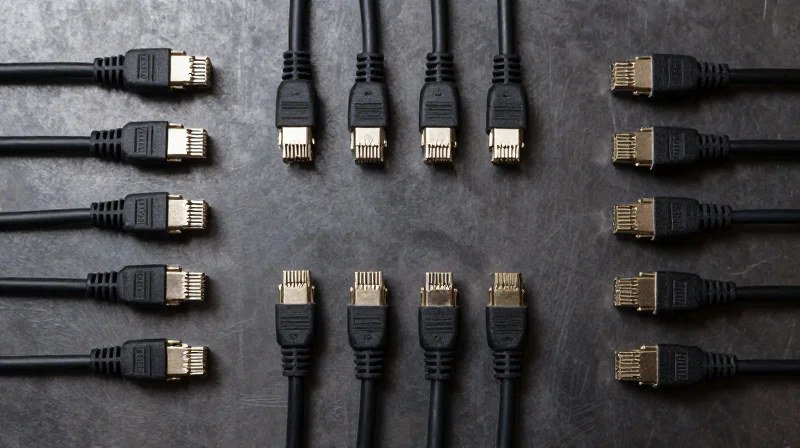
Infrastructure Compatibility: Switch and Cable Interoperability
The transition to 800G is not merely a speed upgrade but a decision between two distinct physical infrastructures; while QSFP-DD800 excels in maintaining legacy port density and backward compatibility, OSFP800 offers the thermal headroom necessary for the most demanding high-radix switch environments.
Switch Port Density and Physical Constraints
Modern 25.6T and 51.2T switches dictate the physical layout of the front panel. QSFP-DD800 maintains the same footprint as its predecessors, allowing for 32 to 36 ports in a 1U chassis. This density is attractive for standard enterprise racks. Conversely, the OSFP800 form factor is slightly wider and deeper. While it still permits 32 ports in 1U, the integrated heat sink on the OSFP module allows the switch chassis to operate with less aggressive cooling fans, potentially reducing the overall noise and power profile of the switch infrastructure.
| Feature | QSFP-DD800 | OSFP800 |
|---|---|---|
| Backward Compatibility | High (QSFP28/56/112) | Requires Mechanical Adapters |
| Max Power Dissipation | Up to 18-20W | Up to 24-30W |
| Switch Ports (1U) | 32-36 Ports | 32 Ports |
| Connector Type | MPO-16, Dual MPO-12, LC | MPO-16, Dual MPO-12, LC |
Ecosystem Availability: DAC, AOC, and Optics
The availability of interconnects for both standards is reaching parity, but use cases vary. Direct Attach Copper (DAC) cables for 800G are limited to approximately 2 meters due to signal integrity challenges at 112G SerDes, favoring the OSFP800's superior shielding. Active Optical Cables (AOCs) are widely available for both, filling the gap for distances up to 30 meters. For long-reach requirements, optical transceivers (DR8, 2xFR4, and SR8) are the primary choice, with QSFP-DD800 currently enjoying a slightly broader install base in brownfield data centers, while OSFP800 dominates in new, large-scale AI clusters.
- Can I plug a QSFP-DD800 module into an OSFP800 port?
No, they are physically incompatible. However, OSFP-to-QSFP adapters exist to allow older QSFP modules to work in OSFP ports, whereas QSFP-DD ports are natively backward compatible with QSFP modules. - Is DAC performance identical between both standards?
While the electrical performance is similar, the OSFP800 design typically offers better EMI shielding and thermal dissipation for passive copper at the 800G limit, which can be critical for high-density top-of-rack deployments. - Which standard is more future-proof for 1.6T?
OSFP is generally viewed as more future-proof for 1.6T transitions due to its larger physical size and ability to handle the significantly higher heat loads expected in next-generation silicon.
Future-Proofing: The Path to 1.6T and Beyond
Future-Proofing: The Path to 1.6T and Beyond
The transition to 1.6T represents a fundamental shift in optical networking, primarily driven by the move from 100G to 200G SerDes per lane. While both QSFP-DD and OSFP have successfully scaled to 800G, OSFP holds a definitive edge in the 1.6T roadmap because its larger physical footprint and integrated thermal management are better suited to house the high-power DSPs (Digital Signal Processors) required for 200G-per-lane signaling. For data center operators, choosing between these standards today requires an understanding of how these mechanical envelopes will handle the 25W to 40W power requirements of the next generation.
Comparative Readiness for 1.6T Transition
| Feature | QSFP-DD1600 | OSFP1600 / OSFP-XD |
|---|---|---|
| Max Power Dissipation | Approx. 25W-28W | 30W to 40W+ |
| Lane Configuration | 8 x 212.5 Gbps | 8 x 212.5 Gbps (or 16 for XD) |
| Thermal Solution | External Riding Heat Sink | Integrated or Riding Heat Sink |
| 1.6T Design Maturity | In Development | High (OSFP-XD Sampling) |
The OSFP-XD (Extra Density) variant further distances itself from the QSFP-DD ecosystem by offering the potential for 1.6T and even 3.2T in a single port by doubling the lane count to 16. While QSFP-DD1600 is technically feasible, the thermal 'bottleneck' of the smaller module size necessitates highly efficient cooling or lower-power silicon that may not be available in the first wave of 1.6T hardware. Consequently, hyperscale environments prioritizing long-term scalability are increasingly gravitating toward OSFP as the primary 800G standard to ensure a seamless hardware path to 1.6T.
Future-Proofing FAQ
- Will QSFP-DD800 ports support 1.6T transceivers?
Standard QSFP-DD800 ports are designed for 100G SerDes. While a QSFP-DD1600 transceiver might be physically compatible with some cages, the electrical interface and thermal capabilities of 800G-era switches will likely not support 1.6T speeds. - Why is OSFP considered the leader for 1.6T?
The larger volume of the OSFP module allows for better airflow and more surface area for heat dissipation. As DSP power consumption increases with 224G PAM4 signaling, this thermal 'headroom' becomes the deciding factor for reliability. - Is backward compatibility maintained in the 1.6T era?
Yes, both OSFP1600 and QSFP-DD1600 roadmaps emphasize backward compatibility with their respective 800G and 400G predecessors through the use of adapters or dual-speed ports.
Navigating the 800G landscape requires balancing immediate compatibility needs with long-term thermal and power scaling requirements. While QSFP-DD800 offers unmatched density for legacy systems, OSFP800 is rapidly becoming the standard for greenfield AI clusters. Contact our technical engineering team today for a customized TCO analysis and a pilot evaluation of 800G optics for your data center.