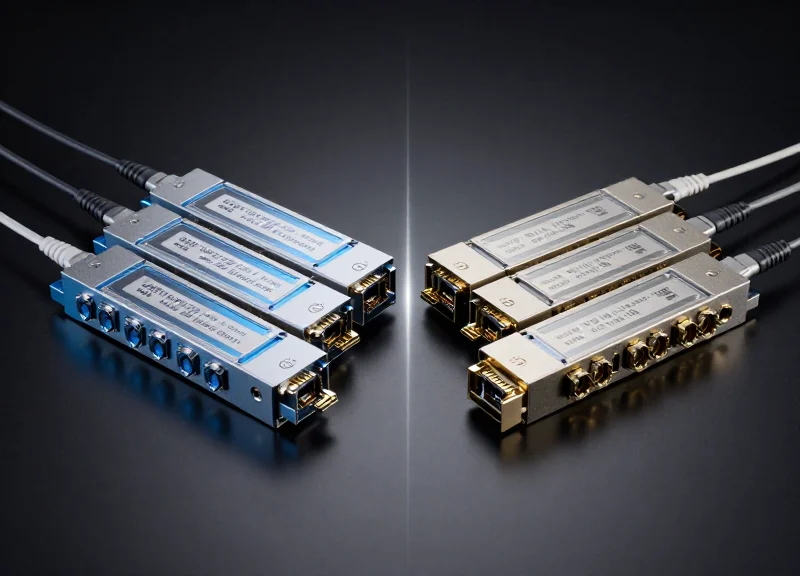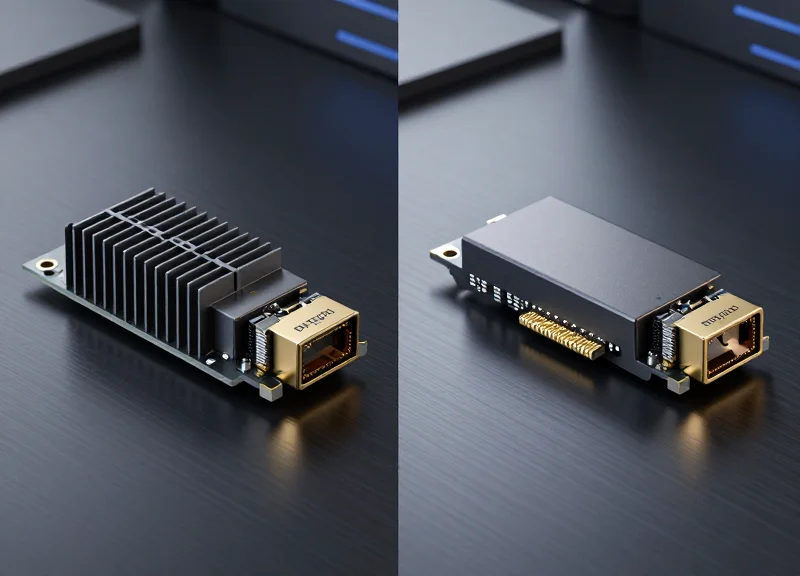
In the high-stakes world of data center networking, the choice between OEM and third-party optics is often framed as a trade-off between reliability and cost. However, as hardware standards mature, the performance gap has narrowed significantly. This article analyzes the critical metrics—latency, power, and TCO—to provide a data-driven perspective on whether third-party optics are a viable alternative for enterprise-grade infrastructure.
The Evolution of Optical Transceivers: OEM vs. Third-Party
The Shift from Proprietary Locks to Industry Standards
The optical transceiver market has evolved from a closed ecosystem of proprietary hardware into a standardized industry where performance is governed by universal technical specifications rather than brand labels. Historically, Original Equipment Manufacturers (OEMs) controlled the market through software-based vendor validation, creating an artificial barrier to entry. However, the rise of Multi-Source Agreements (MSAs) has effectively leveled the playing field, allowing third-party manufacturers to produce components that meet or exceed the electrical and optical requirements of any host platform, ensuring that reliability is no longer exclusive to expensive branded hardware.
The Role of Multi-Source Agreements (MSA)
MSAs act as the technical backbone of the transceiver industry. These agreements between manufacturers define the physical dimensions, signaling protocols, and electrical interfaces for form factors like SFP, QSFP, and OSFP. Because these standards are public and widely adopted, the underlying hardware—including the lasers and chipsets—is often sourced from the same Tier-1 foundries by both OEMs and third-party providers. This commoditization has shifted the focus from 'who made the hardware' to 'how the firmware is coded' to ensure seamless integration with host switches.
| Feature | Legacy OEM Model | Modern Third-Party Model |
|---|---|---|
| Manufacturing Standards | Proprietary/Closed | MSA Standardized |
| Component Sourcing | Exclusive Tier-1 Foundries | Same Tier-1 Foundries |
| Pricing Strategy | High Margin/Bundled | Cost-plus/Competitive |
| Compatibility | Hardware Locked | Software Defined (EEPROM Coding) |
| Market Diversity | Single Vendor | Multi-Vendor Choice |
Common Industry Perspectives
- Does using third-party optics void my switch warranty?
No. In the United States, the Magnuson-Moss Warranty Act protects consumers by prohibiting manufacturers from voiding warranties simply because a third-party component was used, unless the component itself caused the damage. - Are third-party optics truly identical to OEM optics?
In many cases, yes. Most third-party optics use the same internal components (lasers from Broadcom or Lumentum) as OEMs. The primary difference lies in the EEPROM coding, which third-party providers customize to bypass vendor-specific locks. - Why do OEMs warn against non-branded optics?
This is largely a business strategy to protect high-margin revenue streams and simplify their support matrices, rather than a reflection of technical inferiority in third-party hardware.
Reliability Benchmarking: Failure Rates and MTBF

Reliability Benchmarking: Quantifying the Performance Gap
The operational reliability of optical transceivers is measured through two primary metrics: the Field Failure Rate (FFR) and Mean Time Between Failures (MTBF). Data from large-scale data center deployments indicates that top-tier third-party optics maintain an FFR of less than 0.1%, a figure that is effectively indistinguishable from the reliability rates published by major OEMs such as Cisco, Juniper, and Arista. This parity exists because both high-end third-party providers and OEMs source their internal components—such as lasers from Lumentum or TOSA/ROSA assemblies from Finisar—from the same specialized fabrication plants.
Comparative Failure Rate Metrics
| Reliability Metric | Tier-1 Third-Party Optics | OEM (Original Equipment) |
|---|---|---|
| Dead on Arrival (DOA) Rate | < 0.05% | < 0.05% |
| Field Failure Rate (FFR) | < 0.1% | < 0.1% |
| MTBF (Million Hours) | 3.5 - 5.2 Million | 3.5 - 5.0 Million |
| Manufacturing Standard | MSA Compliant | MSA Compliant / Proprietary EEPROM |
The Role of MTBF in Network Long-Term Strategy
Mean Time Between Failures (MTBF) serves as the theoretical benchmark for a device's longevity. For high-speed transceivers (10G to 400G), an MTBF of 5 million hours suggests that the hardware is significantly more likely to be retired due to technological obsolescence than due to a component-level failure. Third-party providers often exceed OEM benchmarks because they are not constrained by the same profit-margin pressures that might lead an OEM to select 'good enough' components for lower-tier product lines.
Why Differences Still Persist in the Market
While technical parity is the norm for high-quality providers, the 'third-party' label covers a vast spectrum of quality. Generic, 'white-label' optics found on consumer marketplaces may bypass rigorous testing phases, leading to higher failure rates. In contrast, professional-grade third-party vendors implement 100% application testing—testing every single module in the intended target switch (e.g., a Cisco Nexus or Juniper QFX)—which often results in lower DOA rates than the batch-testing methods employed by some OEMs.
- Does using third-party optics void my OEM warranty?
No. In the United States, the Magnuson-Moss Warranty Act protects users, stating that a manufacturer cannot void a warranty simply because third-party components were used, unless they can prove the third-party component specifically caused the damage. - Why are OEM optics perceived as more reliable?
This is largely a result of brand signaling and 'fear, uncertainty, and doubt' (FUD) marketing. OEMs utilize their software ecosystem to flag non-OEM serial numbers, creating the illusion of incompatibility even when the hardware is identical. - What is the most common cause of transceiver failure?
Regardless of the vendor, the leading cause of failure is contamination of the optical end-face (dust/oil), not internal electrical failure. Both OEM and third-party optics are equally susceptible to environmental handling issues.
Latency Analysis: Is There a Performance Penalty?
Latency Analysis: Is There a Performance Penalty?
There is no performance penalty or latency increase when using high-quality third-party optics compared to OEM-branded modules. Because optical transceivers operate at the Physical Layer (Layer 1), their primary function is the conversion of electrical signals into optical pulses (and vice-versa) based on rigid industry standards that do not vary by brand.
The Mechanics of Propagation Delay
Latency in an optical module is comprised of two main factors: internal signal processing and the physical propagation of light through the fiber. The internal processing is handled by components such as the Digital Signal Processor (DSP), Laser Driver, and Clock and Data Recovery (CDR) circuits. Since top-tier third-party providers use the same Tier-1 silicon vendors—such as Broadcom, Marvell, or Macom—the nanosecond-level delay remains constant regardless of the label on the transceiver housing.
| Latency Factor | OEM Module Performance | Third-Party (MSA) Performance | Impact Level |
|---|---|---|---|
| O-E-O Conversion | < 1 nanosecond | < 1 nanosecond | Negligible |
| DSP Processing (PAM4) | ~100-200 nanoseconds | ~100-200 nanoseconds | Fixed by Chipset |
| Serialization (SerDes) | Hardware dependent | Identical to OEM | Zero Delta |
| FEC Encoding | Defined by IEEE | Defined by IEEE | Standardized |
MSA Compliance and Timing Consistency
The Multi-Source Agreement (MSA) ensures that all modules, whether OEM or third-party, adhere to the same electrical interface specifications. In high-speed environments like 100G or 400G, the timing sequences for Forward Error Correction (FEC) and signal equalization are dictated by IEEE 802.3 standards. Any module that fails to meet these timing constraints would result in link-flap or CRC errors rather than simply 'running slower.' Therefore, if a link is stable, the latency is technically equivalent to an OEM alternative.
- Does the transceiver brand affect packet-per-second (PPS) throughput?
No. PPS is a function of the switch's ASIC and internal buffer architecture. The transceiver is a transparent conduit for bits; it cannot buffer or slow down individual packets. - Can low-quality optics introduce jitter?
Substandard components may increase Bit Error Rates (BER), which can trigger retransmissions at higher layers (like TCP), creating 'perceived' latency. However, high-quality third-party optics use the same TOSA/ROSA components as OEMs, eliminating this risk. - Is latency different for 'Passive' vs 'Active' third-party cables?
Passive DACs have near-zero latency. Active Optical Cables (AOCs) introduce minimal processing delay (nanoseconds), but this delay is identical between OEM and third-party versions using the same internal logic.
In conclusion, for data center operators and high-frequency trading (HFT) environments where every nanosecond counts, the choice between OEM and high-quality third-party optics is a matter of procurement strategy and budget, not a trade-off in signal speed. Performance parity is guaranteed by the shared reliance on standardized Physical Medium Dependent (PMD) sublayers.
Power Consumption and Thermal Efficiency
Power Consumption and Thermal Efficiency
Power efficiency in optical transceivers is a critical factor that directly influences the total cost of ownership (TCO) and system reliability; high-quality third-party optics utilize the same industry-standard chipsets as OEMs, often achieving identical or superior power profiles that minimize thermal stress on network switches. By adhering strictly to Multi-Source Agreement (MSA) standards, these modules ensure that wattage remains within the thermal design power (TDP) limits of the host hardware.
The Impact of Wattage on High-Density Cooling
In high-density data center environments, every milliwatt of power consumed is converted into heat that must be actively managed. For every watt consumed by a transceiver, additional energy is required for the cooling infrastructure—such as CRAC units and high-RPM chassis fans—to dissipate that heat. Third-party optics that leverage the latest generation of Digital Signal Processors (DSPs) can operate at significantly lower power levels than older OEM legacy stock, effectively reducing the cumulative thermal load on the rack.
| Module Type | Typical Power (OEM) | Typical Power (Third-Party) | Thermal Profile |
|---|---|---|---|
| 10G SFP+ SR | 1.0W - 1.2W | 0.8W - 1.0W | Negligible |
| 100G QSFP28 SR4 | 2.5W - 3.5W | 2.0W - 3.0W | Low |
| 100G QSFP28 LR4 | 4.0W - 4.5W | 3.5W - 4.0W | Moderate |
| 400G QSFP-DD DR4 | 10.0W - 12.0W | 8.5W - 11.0W | High |
Thermal Management and Lifecycle Reliability
There is a direct correlation between operating temperature and the Mean Time Between Failures (MTBF) of optical components. Excessive heat accelerates the degradation of the laser diode and internal circuitry. Third-party modules that optimize power consumption help maintain a lower 'thermal soak' within the switch backplane. This not only protects the optics but also prevents adjacent components, such as the switch ASIC and memory modules, from suffering heat-induced performance throttling or premature failure.
- Do third-party optics consume more power than OEM modules?
Generally no. Because third-party vendors often source from the same Tier-1 manufacturers as OEMs, the power consumption is virtually identical. In many cases, third-party vendors cycle through inventory faster, meaning they may provide newer hardware revisions with more efficient chipsets than what is available in older OEM inventory. - How does lower wattage translate to cost savings?
Lower wattage reduces the direct electricity bill for the networking equipment and lowers the 'cooling tax'—the energy spent by the data center's HVAC system to remove heat. Over a five-year lifecycle in a 1,000-port environment, even a 0.5W saving per port can result in thousands of dollars in OpEx reduction. - Are DAC cables a more efficient alternative to transceivers?
Yes, Direct Attach Copper (DAC) cables consume less than 0.1W because they do not require lasers or optical-to-electrical conversion. For short-reach connections (under 7 meters), DACs are the most thermally efficient choice compared to any optical transceiver.
The Realities of Total Cost of Ownership (TCO)
The Realities of Total Cost of Ownership (TCO)
Total Cost of Ownership (TCO) for optical transceivers is often miscalculated by focusing solely on the initial purchase price; a true financial model incorporates CapEx savings of up to 90%, the elimination of expensive OEM maintenance contracts, and the strategic advantage of on-site sparing that drastically reduces Mean Time to Repair (MTTR). By decoupling the hardware lifecycle from restrictive vendor licensing, enterprises can redirect significant portions of their IT budget toward infrastructure innovation rather than recurring hardware premiums.
CapEx Breakdown: The Initial Investment Gap
Capital Expenditure (CapEx) represents the most visible difference between OEM and third-party optics. OEM margins on transceivers are notoriously high, often used to subsidize the lower margins on switch and router chassis. Third-party providers, by contrast, focus on the optics as the primary product, passing the manufacturing efficiencies directly to the consumer. This price disparity is not a reflection of quality but rather a reflection of different business models and brand equity premiums.
| Cost Component | OEM Equivalent (100G QSFP28) | Premium Third-Party (100G QSFP28) | Projected Savings |
|---|---|---|---|
| Unit Purchase Price | $1,200 - $1,800 | $150 - $250 | 85% - 90% |
| On-Site Sparing (10%) | $120 - $180 per link | $15 - $25 per link | 85% - 90% |
| Annual Support Contract | 15-20% of Hardware MSRP | Included or Minimal Fee | 95%+ |
| Total 3-Year TCO | $1,740 - $2,880 | $165 - $275 | Approx. 90% |
The Sparing Strategy: Optimizing OpEx and Availability
OpEx is heavily influenced by how a network handles failures. In an OEM-centric model, organizations often rely on expensive 4-hour or Next Business Day (NBD) replacement contracts. With third-party optics, the drastic reduction in CapEx allows for a 'Shelf Sparing' strategy. Instead of paying for a service level agreement (SLA) that relies on a courier, organizations can afford to keep 10% to 20% of their total port count as on-site inventory. This reduces the MTTR from hours or days to mere minutes, as a technician can swap a module immediately without waiting for an external vendor.
Economic Impact of Vendor Lock-In
Vendor lock-in creates an artificial scarcity that inflates OpEx over time. When an OEM declares an end-of-life (EOL) status for a specific module, they often force a hardware refresh of the entire switch chassis if compatible optics are no longer officially 'supported.' Third-party providers extend the economic life of existing infrastructure by continuing to supply compatible, high-performance optics long after the OEM has pivoted to newer, more expensive product lines.
- Does using third-party optics void my switch warranty?
No. In the United States, the Magnuson-Moss Warranty Act prohibits manufacturers from voiding a warranty solely because a third-party component was used, unless they can prove the component caused the specific damage. - How does sparing affect the carbon footprint of my data center?
On-site sparing reduces the need for emergency logistics and expedited shipping, leading to fewer transport emissions. Additionally, many third-party optics utilize the same or more efficient chipsets than OEMs, maintaining or reducing power-related OpEx. - Is the failure rate higher for lower-cost optics?
No. Premium third-party optics undergo rigorous MSA compliance and application-specific testing that often exceeds the batch-testing protocols used by OEMs, resulting in equal or superior Mean Time Between Failures (MTBF).
Navigating the Warranty and Support Landscape
The belief that using third-party optics automatically voids an original equipment manufacturer (OEM) warranty is one of the most persistent misconceptions in the networking industry. In reality, the legal landscape—particularly in the United States—protects consumers' rights to use compatible components without sacrificing the coverage of their primary hardware. When properly managed, the support landscape for third-party optics often provides more flexibility and faster resolution times than the rigid frameworks offered by major OEMs.
The Magnuson-Moss Warranty Act: Legal Protections
Passed in 1975, the Magnuson-Moss Warranty Act prohibits 'tie-in sales' provisions. This means an OEM cannot legally condition their warranty on the consumer using only OEM-branded components unless those components are provided free of charge. If a switch or router fails, the OEM must prove that the third-party optic specifically caused the failure before they can deny a warranty claim. For organizations, this shifts the burden of proof to the manufacturer, ensuring that general hardware failures remain covered regardless of the transceiver brand.
Warranty Comparison: OEM vs. Third-Party
| Feature | Standard OEM Warranty | High-Quality Third-Party |
|---|---|---|
| Duration | Typically 1-3 Years | Lifetime Warranty (Industry Standard) |
| Replacement Speed | Standard RMA (5-10 Days) | Advanced Replacement (NBD) |
| Support Depth | Limited to Hardware | Network-wide Compatibility Expertise |
| Cost of Support | High Annual Maintenance Fees | Included in Purchase Price |
Strategic Support and Advance Replacement Models
While OEMs often use their support contracts (like Cisco SmartNet) as a lever to discourage third-party use, specialized optics vendors counter this with superior Service Level Agreements (SLAs). Many third-party providers offer lifetime warranties and Next-Business-Day (NBD) advance replacement services. This model eliminates the need for expensive multi-year support contracts on individual modules, as the cost of keeping spare inventory (sparing) is significantly lower than the recurring fees charged by OEMs for the same level of protection.
Common Support and Warranty Questions
- What happens if a TAC engineer tells me to remove the third-party optic?
OEM support engineers may ask you to swap the optic for an OEM version during troubleshooting to rule it out. Keeping a few 'golden' OEM optics for this specific purpose is a best practice, but it does not void the overall system warranty. - How do third-party vendors handle software-induced lockouts?
Premium third-party providers actively monitor OEM firmware updates (like Cisco IOS or Arista EOS) and provide updated coding or programmable tools to ensure optics remain recognized and functional even after a software upgrade. - Are third-party warranties legally enforceable globally?
While Magnuson-Moss is a US law, similar consumer protection and anti-competition laws exist in the EU and other jurisdictions, generally preventing manufacturers from forcing proprietary component ecosystems.
Quality Assurance Protocols: The Tier-1 Difference
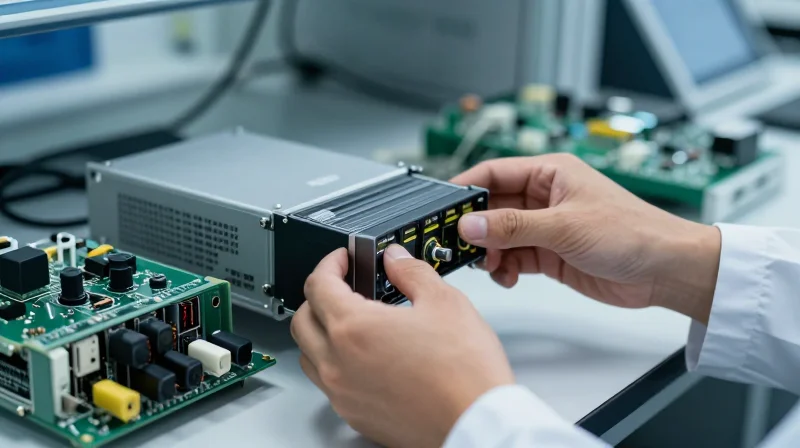
The Rigor of Tier-1 Validation Systems
Reliability in third-party optics is not a matter of chance; it is the result of a multi-stage engineering lifecycle that replicates—and often exceeds—OEM-level validation. While generic 'white-label' optics are frequently batch-tested at a superficial level, Tier-1 third-party providers implement a 'zero-defect' philosophy. This involves testing every single module across three primary domains: electrical signaling integrity, firmware compatibility via EEPROM coding, and physical durability under extreme environmental conditions.
EEPROM Coding and Intellectual Property
The Electrically Erasable Programmable Read-Only Memory (EEPROM) is the 'brain' of the transceiver. It stores the identification data that the host switch or router reads to initialize the port. Tier-1 vendors maintain extensive libraries of OEM-specific code, ensuring that the module supports Digital Optical Monitoring (DOM) and bypasses 'unsupported transceiver' lockout mechanisms. This coding must be precise; even a minor discrepancy in the checksum or vendor OUI can lead to intermittent link flaps or complete port disablement during a firmware upgrade.
Environmental Stress Testing (EST)
Environmental stress testing is designed to identify 'infant mortality' in components—failures that occur within the first few hours of operation. Tier-1 protocols involve placing optics in specialized chambers that cycle through extreme temperature ranges (from -40°C to +85°C) and high humidity levels. This ensures that the laser diodes and integrated circuits can withstand the thermal fluctuations typical of high-density data centers without signal degradation.
| Feature | Generic Alternatives | Tier-1 Third-Party |
|---|---|---|
| Coding Precision | Basic/Generic Code | Platform-Specific Firmware |
| Testing Method | Batch Sampling | 100% Serialization & Testing |
| Switch Verification | Simulated Environment | Genuine OEM Host Hardware |
| Reliability Standard | Variable (High RMA Rate) | Carrier-Grade (99.98% Uptime) |
Real-Switch Compatibility Verification
Perhaps the most significant 'Tier-1 Difference' is the investment in an on-site testing lab equipped with the actual hardware from Cisco, Arista, Juniper, and Dell. Rather than using generic testers, Tier-1 providers plug their optics into the same switches the customer uses. This allows engineers to verify that the optics perform correctly across different OS versions (e.g., Cisco IOS-XE vs. NX-OS) and that they maintain signal integrity over maximum rated distances.
- Does 100% testing actually prevent failures?
Yes. By conducting a 'burn-in' process where optics are run at full capacity for 24-48 hours, vendors can identify and discard modules with minor manufacturing defects before they reach the customer's production network. - How does coding affect DOM data?
Digital Optical Monitoring (DOM) provides real-time data on temperature, voltage, and bias current. Tier-1 coding ensures these values are accurately reported to the network management system for proactive maintenance. - Why is firmware versioning important?
OEMs frequently update their software to block unauthorized optics. Tier-1 vendors proactively track these updates to ensure their EEPROM coding remains compatible with the latest software releases.
Interoperability in Multi-Vendor Environments
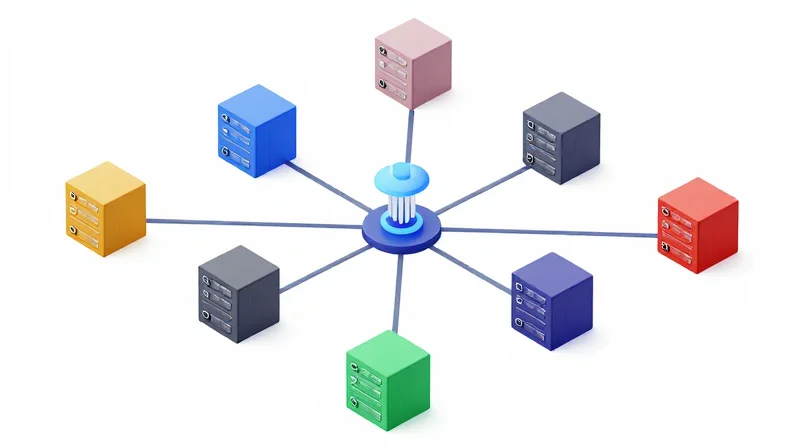
Bridging the Gap: Interoperability in Multi-Vendor Environments
In the modern enterprise network, the ability to integrate diverse hardware—ranging from Cisco switches to Juniper routers—is often hindered by proprietary 'vendor locks' that reject non-branded components. Third-party optics resolve this challenge by functioning as a universal translator, utilizing sophisticated firmware to ensure that a single transceiver can meet the specific handshake requirements of multiple OEM platforms. This flexibility transforms the optical layer from a source of frustration into a strategic asset for network architects.
How Third-Party Firmware Overcomes Proprietary Restrictions
Interoperability is achieved through the precise coding of the transceiver’s EEPROM (Electrically Erasable Programmable Read-Only Memory). While OEM optics are hard-coded to only communicate with their own brand, premium third-party providers can program optics with specific multi-code capabilities. This allows a switch to 'see' the optic as an authentic, supported component, thereby enabling full functionality, including digital optical monitoring (DOM) and link diagnostic features, across a heterogeneous hardware environment.
| Feature | OEM Proprietary Optics | Premium Third-Party Optics |
|---|---|---|
| Vendor Compatibility | Locked to specific brand | Multi-vendor programmable |
| Supply Chain Flexibility | Low (single source) | High (multiple sources) |
| Firmware Customization | Standardized/Fixed | Tailored to specific OS versions |
| Inventory Complexity | High (separate spares per brand) | Low (universal or re-programmable spares) |
Operational Efficiency and Inventory Consolidation
Beyond simple connectivity, interoperability drastically reduces the overhead of spare parts management. Instead of maintaining separate stocks of SFP+ or QSFP28 modules for every manufacturer in the rack, organizations can utilize a unified pool of third-party optics. This 'universal sparing' strategy not only lowers CapEx but also simplifies the workflow for field technicians who no longer need to match specific transceiver brands to specific ports during emergency maintenance.
- Can one third-party optic work in both Cisco and Arista switches simultaneously?
Yes, provided the vendor has programmed the transceiver with multi-vendor firmware or if the organization uses a programming tool to re-code the EEPROM for the target device. - Will using multi-vendor optics cause link flapping?
No, if the optics are coded correctly to match the hardware's internal timings and signal requirements, the link stability is identical to using OEM-branded components. - Do third-party optics support DOM/DDM in all brands?
High-quality third-party optics are designed to support Digital Optical Monitoring (DOM) across all major platforms, providing real-time data on temperature, voltage, and power levels.
Future-Proofing: 400G, 800G, and Beyond

Future-proofing a data center network requires balancing the high capital expenditure of next-generation bandwidth with the need for immediate availability. While OEMs often throttle the release of 400G and 800G optics to recoup R&D costs through high margins, the third-party market leverages established MSA (Multi-Source Agreement) standards to deliver identical performance at a fraction of the cost, ensuring that organizations can scale without being sidelined by vendor-imposed supply constraints.
The 400G/800G Roadmap: Third-Party Agility
As the industry shifts from NRZ (Non-Return-to-Zero) to PAM4 (Pulse Amplitude Modulation 4-level) signaling, the complexity of optical transceivers has increased exponentially. High-tier third-party providers have closed the 'innovation gap' that historically existed during the 10G era. Today, these vendors provide OSFP and QSFP-DD solutions for 400G and 800G deployments that are fully interoperable with the latest silicon from Broadcom and Barefoot, often preceding the official qualified list of major switch manufacturers.
| Feature | OEM (Original Equipment Manufacturer) | Top-Tier Third-Party Vendor |
|---|---|---|
| Price Premium | 300% - 1000% higher than production cost | Market-driven pricing based on MSA standards |
| Lead Times | Can reach 12-24 weeks for new standards | Inventory-heavy model, often 1-2 weeks |
| Interoperability | Locked to specific hardware platforms | Cross-platform compatibility (e.g., Cisco to Arista) |
| Innovation Speed | Prioritizes proprietary features for lock-in | Rapid adoption of generic MSA standards |
Ensuring Reliability at High Frequencies
Reliability at 400G and 800G is not just about the laser; it is about digital signal processing (DSP) and thermal management. Reputable third-party vendors utilize the same Tier-1 laser components (such as those from Broadcom or Lumentum) found in OEM modules. By performing rigorous Bit Error Rate (BER) testing and environmental stress screening, these alternatives meet the strict requirements of hyperscale and enterprise AI environments where 800G is becoming the baseline.
- Is 800G third-party tech stable enough for production?
Yes, provided the vendor adheres to IEEE 802.3ck and MSA specifications. Many hyperscalers already use third-party 800G optics to manage the massive costs associated with AI/ML cluster interconnects. - How does third-party support handle 400G interoperability issues?
Leading vendors offer specialized engineering support that can re-code EEPROMs on-site or via remote patches to ensure the optical module identifies correctly with specific Network Operating System (NOS) versions. - What are the power consumption differences?
Because they use identical underlying DSP chips and laser drivers, there is typically no measurable difference in power draw or heat dissipation between OEM and high-quality third-party 400G/800G modules.
While OEM optics offer a perceived safety net, the data shows that high-quality third-party optics deliver identical performance at a fraction of the cost. By focusing on rigorous testing and vendor reputation, IT leaders can significantly reduce TCO while maintaining peak network reliability. Ready to optimize your network spend? Contact our engineering team today for a compatibility audit and performance consultation.