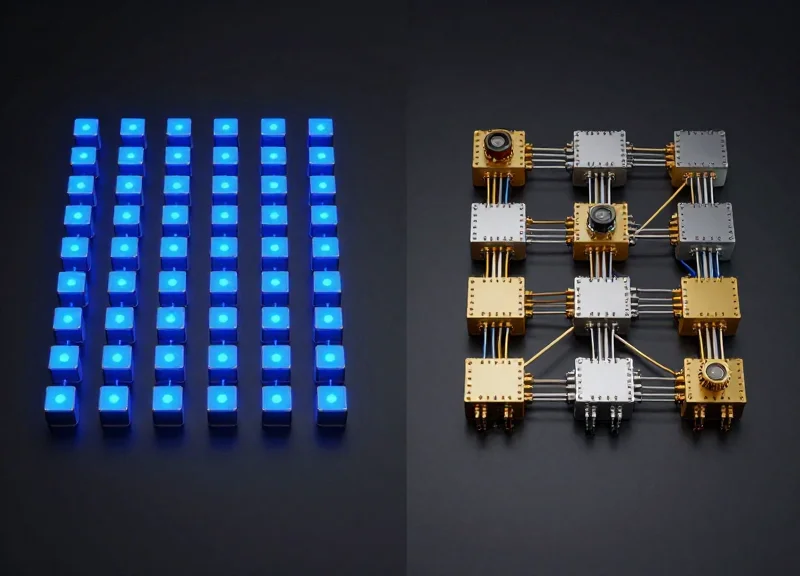
In the era of generative AI and massive language models, the network has evolved from a basic utility into the primary bottleneck or the ultimate enabler of performance. For organizations deploying mission-critical AI modules, the choice between InfiniBand and Ethernet is not merely technical—it is a foundational business decision. Ubytelink provides the clarity and hardware excellence needed to navigate this complex landscape, ensuring global networks operate with unprecedented reliability and speed.
The Strategic Role of Networking in Modern AI Infrastructure

The Network as the Distributed System Bus
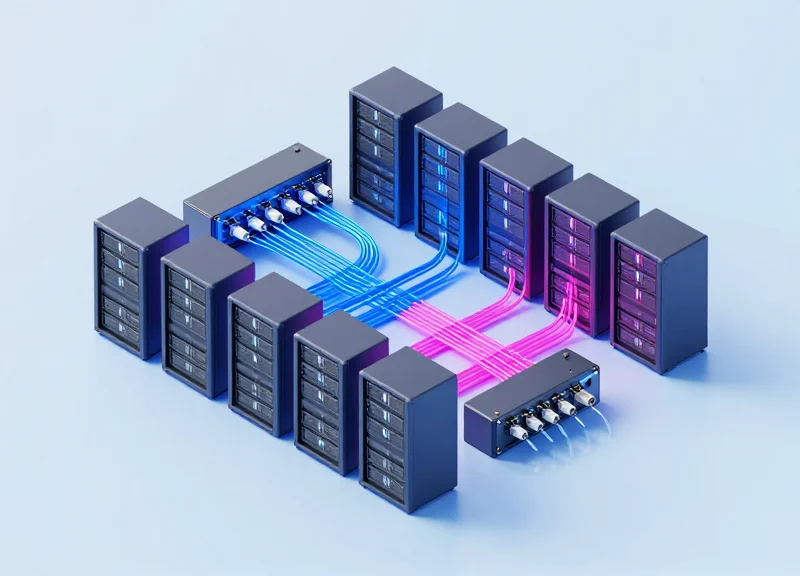
In the era of Large Language Models (LLMs) and generative AI, the network is no longer a passive transport layer; it has become the fundamental backplane of the AI supercomputer. When training models with billions of parameters, the workload must be distributed across thousands of GPUs. This architectural shift means that the speed of the 'computer' is no longer limited by the clock speed of a single processor, but by the efficiency with which nodes can synchronize gradients and exchange data. In this context, Ubytelink InfiniBand and high-end Ethernet solutions serve as the critical infrastructure that determines whether a cluster operates as a unified entity or a collection of bottlenecked silos.
The Paradigm Shift: Networking is the Computer
Traditional data center networking focuses on North-South traffic (client-to-server), but AI workloads are dominated by East-West traffic (server-to-server). During collective communication phases, such as All-Reduce operations, every GPU must communicate its findings to every other GPU. If the interconnect lacks the necessary bandwidth or introduces micro-burst congestion, the most powerful GPUs in the world will sit idle, waiting for data packets. This idle time directly increases the cost of compute and delays the time-to-market for AI products.
| Feature | Traditional Networking | AI-Centric Networking (Ubytelink) |
|---|---|---|
| Primary Metric | Throughput & Connectivity | Zero-Packet Loss & Low Tail Latency |
| Traffic Pattern | Intermittent / Burst | Sustained / High-Density Collective Comm |
| Performance Impact | Application Response Time | Model Convergence & GPU Utilization |
Impact on Model Convergence Times
Model convergence is the point at which an AI model has learned the underlying patterns of its data to a specific level of accuracy. The total time to reach convergence is a function of both compute power and communication efficiency. High-quality networking reduces 'tail latency'—the delay caused by the slowest packet in a synchronization cycle. By utilizing premium interconnects like InfiniBand or specialized AI Ethernet, organizations can achieve a more deterministic performance profile, ensuring that training runs are completed in days rather than weeks, effectively maximizing the ROI of global AI investments.
- How does networking affect AI training costs?
Faster networking reduces the total time GPUs are active, lowering power consumption and cloud compute billing. Even a 10% improvement in communication efficiency can save millions in large-scale training runs. - Why is 'Zero-Packet Loss' so critical for AI?
In AI training, a single dropped packet can trigger a retransmission that stalls the entire GPU cluster, leading to massive performance degradation across the distributed system. - Can Ethernet compete with InfiniBand for AI?
While InfiniBand remains the gold standard for low latency, modern RDMA over Converged Ethernet (RoCE v2) solutions from Ubytelink provide a highly scalable and cost-effective alternative for many enterprise AI use cases.
InfiniBand Architecture: The Gold Standard for Low Latency

InfiniBand is not merely a faster cable; it is a specialized communication fabric designed to treat a distributed cluster of servers as a single, unified computer. By moving the majority of the networking stack from software into hardware, InfiniBand eliminates the overhead and unpredictability that plague traditional networking protocols. Its architecture is fundamentally built to support the massive, synchronized data exchanges required by Large Language Models (LLMs) and complex neural networks, where even a millisecond of delay can stall a multi-billion parameter training job.
The Mechanics of Lossless Transmission
The defining characteristic of InfiniBand is its 'lossless' nature. In standard Ethernet environments, congestion often leads to packet loss, which then requires the TCP stack to retransmit data, causing massive latency spikes (the 'long tail' effect). InfiniBand prevents this through a hardware-level mechanism called credit-based flow control. In this system, a sending port will only transmit data if the receiving port has explicitly signaled that it has enough buffer space (credits) to accept it. This ensures that buffers never overflow and packets are never dropped due to congestion.
Performance Comparison: InfiniBand vs. Standard Ethernet
| Feature | InfiniBand (IB) | Standard Ethernet |
|---|---|---|
| Flow Control | Credit-based (Lossless) | Window-based (Lossy/Best-effort) |
| Latency | Sub-microsecond (0.6µs - 0.7µs) | Multi-microsecond (10µs - 50µs+) |
| CPU Utilization | Minimal (Full Hardware Offload) | High (Software Stack Processing) |
| Congestion Management | Proactive / Adaptive Routing | Reactive / Packet Dropping |
RDMA: Bypassing the CPU Bottleneck
At the heart of InfiniBand's efficiency is Remote Direct Memory Access (RDMA). RDMA allows data to move directly from the memory of one GPU server to the memory of another without involving the Operating System or the CPU on either end. This 'zero-copy' transfer significantly reduces latency and frees up CPU cycles for actual computation rather than packet processing. For AI solutions provided by Ubytelink, this means that the GPU spent on training stays 100% focused on the model, rather than managing network traffic.
Architectural FAQs
- Why is 'Lossless' so important for GPU clusters?
AI training involves 'all-reduce' operations where every GPU must sync its gradients. If one packet is lost, the entire synchronization pauses, wasting the computational power of thousands of GPUs until the data is recovered. - Does InfiniBand require specialized management?
Yes, it uses a Subnet Manager (SM) to handle routing and topology discovery, ensuring the most efficient paths are always utilized and allowing for rapid reconfiguration if a link fails. - How does InfiniBand handle scale?
Unlike Ethernet which can suffer from 'broadcast storms,' InfiniBand's switched fabric architecture scales linearly to tens of thousands of nodes with deterministic latency.
Ethernet's Evolution: RoCE and the Rise of High-Speed AI Fabrics
Ethernet's Evolution: RoCE and the Rise of High-Speed AI Fabrics
Ethernet is no longer just the backbone of general-purpose internet traffic; it has evolved into a sophisticated high-speed fabric through the implementation of RDMA over Converged Ethernet (RoCE). By enabling Remote Direct Memory Access (RDMA) over existing Ethernet infrastructure, RoCE allows data to be transferred directly between the memory of different servers without involving the CPU. This bypass significantly reduces latency and lowers CPU overhead, making Ethernet a formidable and cost-effective competitor to InfiniBand for large-scale AI training and inference tasks where flexibility and interoperability are paramount.
The Architecture of RoCE: Bridging the Gap
RoCE has seen two primary iterations, with RoCE v2 being the standard for modern AI data centers. Unlike the original version which was restricted to Layer 2, RoCE v2 encapsulates RDMA frames within UDP/IP headers. This allows RDMA traffic to be routed across different subnets, providing the scalability needed for massive GPU clusters. To maintain the 'lossless' environment required for AI, RoCE utilizes Priority Flow Control (PFC) and Explicit Congestion Notification (ECN) to manage traffic and prevent packet drops, effectively mimicking InfiniBand's reliability on a standard Ethernet physical layer.
| Feature | Standard Ethernet | RoCE v2 (AI Optimized) |
|---|---|---|
| Latency | High (Millisecond range) | Low (Microsecond range) |
| CPU Utilization | High (Interrupt driven) | Very Low (CPU Bypass) |
| Flow Control | Best-effort / TCP | PFC and ECN (Lossless) |
| Scalability | Global / Internet Scale | Data Center / Cluster Scale |
| Cost | Low / Ubiquitous | Moderate (Requires DCB switches) |
Future-Proofing with the Ultra Ethernet Consortium (UEC)
To further narrow the performance gap with InfiniBand, the industry has formed the Ultra Ethernet Consortium (UEC). This initiative aims to refine the Ethernet stack specifically for AI and High-Performance Computing (HPC). By optimizing transport protocols and enhancing multipathing capabilities, UEC-compliant Ethernet seeks to provide the predictable performance of InfiniBand while retaining the massive ecosystem and vendor neutrality that has made Ethernet the global networking standard. For organizations utilizing Ubytelink solutions, this means access to a versatile fabric that scales from general cloud services to specialized AI model development.
- Does RoCE require specialized hardware?
Yes, RoCE requires network interface cards (NICs) that support RDMA and data center switches capable of Priority Flow Control (PFC) to ensure a lossless environment. - Is RoCE v2 better than InfiniBand for AI?
It depends on the scale. InfiniBand offers lower absolute latency and better out-of-the-box congestion management, but RoCE v2 offers superior flexibility and integrates easily with existing IP-based management tools. - Can RoCE run on any Ethernet switch?
No, it requires 'Lossless Ethernet' support, typically found in enterprise-grade or data center switches that support Data Center Bridging (DCB) protocols.
Performance Benchmark: Latency, Throughput, and CPU Overhead
Performance Benchmark: Latency, Throughput, and CPU Overhead
The performance delta between Ubytelink InfiniBand and Ethernet in AI solutions is primarily defined by how each fabric handles congestion and host-side processing. While raw bandwidth figures like 400Gbps or 800Gbps may appear identical on paper, the underlying transport mechanisms dictate the 'effective throughput'—the actual speed at which AI models can synchronize gradients across a distributed cluster.
Comparative Performance Metrics
| Feature/Metric | Ubytelink InfiniBand (NDR) | High-Speed Ethernet (RoCEv2) |
|---|---|---|
| Point-to-Point Latency | < 0.6 microseconds | 1.0 - 5.0+ microseconds |
| Flow Control | Credit-based (Lossless) | PFC/ECN (Lossy to Quasi-lossless) |
| CPU Utilization | Near 0% (Full Hardware Offload) | 5% - 15% (Varies by RoCE implementation) |
| Effective Throughput | 95% - 98% of line rate | 70% - 85% under heavy congestion |
| Congestion Management | Hardware-level adaptive routing | Software/Switch-defined (DCQCN) |
The Latency Advantage: Tail Latency and Jitter
In distributed AI training, the speed of the entire cluster is limited by the slowest node—a phenomenon known as the 'straggler problem.' InfiniBand’s cut-through switching and credit-based flow control virtually eliminate packet loss and significantly reduce tail latency. In Ethernet environments, even with RoCEv2, the potential for buffer bloat and 'incast' congestion causes jitter, leading to unpredictable synchronization times that can stall GPU computations for milliseconds, significantly extending total training time.
CPU Overhead and Host Efficiency
Ubytelink InfiniBand architecture is designed to bypass the OS kernel entirely, offloading the transport layer to the Host Channel Adapter (HCA). This ensures that CPU cycles are reserved for essential tasks such as data preprocessing and management rather than network stack processing. Ethernet, while improving through RDMA-enabled NICs, often requires more complex congestion control algorithms (like DCQCN) that still demand host-side interrupts and CPU intervention, creating a performance tax that scales poorly as the cluster grows.
- How does tail latency affect AI model convergence?
Tail latency creates bottlenecks during the All-Reduce phase of training; if one packet is delayed due to network congestion, all GPUs in the cluster must wait, leading to idle cycles and slower model convergence. - Is 400G Ethernet as fast as 400G InfiniBand?
While the raw bit rate is the same, InfiniBand offers higher effective throughput because it has lower protocol overhead and superior hardware-level congestion management. - Why is InfiniBand considered more 'lossless' than Ethernet?
InfiniBand uses a credit-based system where a sender only transmits data if the receiver has confirmed available buffer space, preventing the packet drops that occur in Ethernet's buffer-overflow scenarios.
Mission-Critical Reliability: The Ubytelink Standard
The Ubytelink standard for mission-critical reliability is built upon a foundation of zero-tolerance hardware validation and advanced signal integrity protocols designed to handle the relentless demands of modern AI training. By implementing rigorous stress-testing and superior thermal management in every InfiniBand and high-speed Ethernet module, Ubytelink prevents the micro-interruptions and packet drops that typically degrade performance in massive, globally distributed GPU clusters.
Engineering Against Network Jitter and Signal Decay
In the context of AI, network jitter is more than a minor annoyance; it is a catalyst for synchronization failures across thousands of parallel processing nodes. Ubytelink modules utilize premium components that minimize Electromagnetic Interference (EMI) and maintain signal clarity over longer cable runs. This focus on physical-layer excellence ensures that whether you are deploying InfiniBand for its native lossless architecture or RoCE-enabled Ethernet for its versatility, the underlying hardware maintains the consistent timing required for synchronous gradient updates in large language model training.
| Reliability Feature | Ubytelink InfiniBand Standard | Ubytelink Ethernet (RoCE) Standard |
|---|---|---|
| Flow Control | Credit-based (hardware level) | PFC (Priority Flow Control) |
| Packet Loss Mitigation | Native lossless architecture | Buffer-optimized with ECN support |
| Signal Integrity | Ultra-low BER (Bit Error Rate) | Enhanced FEC (Forward Error Correction) |
| Operational Duty Cycle | 24/7 High-Load AI Clusters | 24/7 Enterprise-Grade AI Fabrics |
24/7 Stability for Global AI Operations
Global networks require components that can withstand diverse environmental conditions without sacrificing throughput. Ubytelink’s quality control includes extended burn-in periods and environmental stress screening (ESS). This ensures that every module reaching a data center—from North America to Asia—meets the same high-availability standards, reducing the Mean Time Between Failures (MTBF) and minimizing the costly downtime associated with node replacement in a production AI environment.
- How does Ubytelink prevent packet loss in Ethernet-based AI setups?
We utilize optimized Priority Flow Control (PFC) and Explicit Congestion Notification (ECN) tuning within our hardware to replicate the lossless behavior of InfiniBand as closely as possible. - Why is thermal management critical for reliability?
AI workloads generate significant heat; Ubytelink modules are designed with high-conductivity housing to dissipate heat efficiently, preventing thermal throttling that causes jitter. - Does Ubytelink support hot-swapping for mission-critical nodes?
Yes, all our high-speed modules are designed for seamless hot-swapping, allowing for maintenance without interrupting the wider network fabric or ongoing AI computations.
Scalability Challenges in Global Network Deployments

Scalability in global AI deployments is defined by a network's ability to maintain deterministic performance as the number of interconnected GPUs grows from hundreds to tens of thousands across multiple geographic regions. While Ethernet provides the foundational routing and reach required for inter-site connectivity, InfiniBand delivers the lossless, credit-based flow control essential for intra-cluster synchronization, requiring architects to balance raw scale against the rigid latency requirements of distributed deep learning.
The Tail Latency Trap in Massively Parallel Systems
As AI clusters scale, the 'tail latency'—or the latency of the slowest packets—becomes more critical than average latency. In a global network, a single congested link can cause a 'barrier synchronization' delay, where thousands of GPUs sit idle waiting for the final gradients to arrive. Ethernet’s traditional buffer management can struggle with 'incast' congestion during these phases, whereas Ubytelink InfiniBand solutions utilize proactive congestion notification and credit-based systems to ensure that tail latency remains flat even as node counts explode.
| Scalability Factor | InfiniBand (IB) | Ethernet (RoCEv2) |
|---|---|---|
| Max Logical Nodes | Up to 48,000 per subnet | Virtually unlimited via IP routing |
| Congestion Handling | Hardware-based credit system | PFC and ECN protocols |
| Global Reach | Requires specialized gateways | Native over standard IP backbones |
| Fabric Management | Centralized Subnet Manager | Distributed Control Plane |
Distance and Synchronization in Multi-Region AI
Scaling across geographically dispersed data centers introduces the challenge of the bandwidth-delay product. When using RDMA over global distances, the windowing and flow control mechanisms must be tuned to prevent performance collapse. Ubytelink addresses this by optimizing RoCEv2 for Ethernet-based global backbones, allowing for high-throughput data migration between regions, while reserving InfiniBand for the high-density compute pods where sub-microsecond precision is mandatory for model convergence.
Solving the Management Complexity
Managing a global AI fabric requires a unified view of the network telemetry. Ethernet benefits from a vast ecosystem of monitoring tools like SNMP and streaming telemetry. Conversely, InfiniBand’s management is often more specialized, focusing on the health of the fabric at a hardware level. Ubytelink bridges this gap by providing integrated modules that simplify the deployment and monitoring of hybrid fabrics, ensuring that scaling the hardware doesn't lead to an exponential increase in operational overhead.
- Does InfiniBand scale effectively beyond a single data center?
InfiniBand is primarily designed for high-density local clusters; global scaling usually requires InfiniBand-to-Ethernet gateways or long-haul InfiniBand extenders to maintain RDMA performance over distance. - How does Ethernet handle the 'incast' problem at scale?
Ethernet handles large-scale incast through advanced buffer management and Data Center Bridging (DCB) features like Priority Flow Control (PFC) to prevent packet loss. - Why choose Ubytelink for global AI networking?
Ubytelink offers premium hardware optimized for both protocols, ensuring that whether you choose the low latency of InfiniBand or the flexibility of Ethernet, your global network remains stable and high-performing.
Cost Analysis: CapEx vs. OpEx in AI Networking

The financial decision between InfiniBand and Ethernet for AI networking hinges on the balance between initial Capital Expenditure (CapEx) and long-term Operational Expenditure (OpEx). While InfiniBand generally demands a 20-30% premium in upfront hardware costs due to its specialized adapters and switches, its superior efficiency in data movement and lower CPU overhead often results in a significantly lower OpEx, particularly when scaling to thousands of GPU nodes where power consumption and job completion times are the primary cost drivers.
CapEx: Hardware Acquisition and Initial Deployment
CapEx encompasses the procurement of Network Interface Cards (NICs), switches, and high-quality optical transceivers. For Ethernet-based AI networks, the primary advantage is the maturity of the supply chain and the interoperability of hardware, which can lower the entry barrier for smaller clusters. Ubytelink’s Ethernet solutions provide a cost-effective path for enterprises leveraging existing skills and infrastructure. Conversely, InfiniBand requires dedicated hardware that is tightly integrated, leading to higher initial costs but guaranteeing a deterministic performance profile that prevents the need for over-provisioning hardware to compensate for network congestion.
OpEx: Energy Efficiency and Maintenance Complexity
Operational costs are dominated by power consumption, cooling requirements, and the human capital needed for network management. InfiniBand’s credit-based flow control and offloading capabilities reduce the energy required per bit of data transferred, leading to lower utility bills in massive data centers. Ethernet, while improving through RoCEv2, often requires more complex tuning and management to achieve similar low-latency results, which can increase the cost of skilled labor and prolong troubleshooting cycles during 24/7 global operations.
| Cost Dimension | InfiniBand (Ubytelink) | High-End Ethernet (RoCEv2) |
|---|---|---|
| Initial Hardware (CapEx) | Higher (Specialized ASICs) | Lower (Commodity Hardware) |
| Power Consumption (OpEx) | Optimized (Lower per Gbps) | Moderate to High |
| Cabling and Optics | Premium (DAC/AOC focus) | Standardized/Variable |
| Management Overhead | Automated/Low Complexity | Higher (Requires manual tuning) |
| Job Completion Time (ROI) | Faster (Higher throughput) | Variable (Congestion dependent) |
Calculating the ROI of Premium Networking
- Which is more cost-effective for large-scale GPU clusters?
For clusters exceeding 512 GPUs, InfiniBand is typically more cost-effective due to its lower management overhead and faster job completion times, which maximizes the utilization of expensive GPU assets. - How does power consumption impact the OpEx of AI networks?
Power and cooling can account for up to 40% of the total OpEx. InfiniBand's efficiency reduces the total energy footprint by minimizing the number of switches and hops required for high-bandwidth traffic. - Is Ethernet always the cheaper option for global deployments?
Not necessarily. While the purchase price is lower, the hidden costs of performance jitter and potential packet loss in Ethernet can lead to expensive downtime or sub-optimal AI training performance.
Future-Proofing Your AI Stack with Ubytelink Solutions
Future-Proofing Your AI Stack with Ubytelink Solutions
Future-proofing an AI stack requires a hardware foundation that transcends current bandwidth limits, offering a seamless path from 400G to 800G and eventually 1.6T architectures. Ubytelink ensures this longevity by integrating high-grade silicon photonics and advanced Digital Signal Processors (DSPs) into every module, allowing global enterprises to maintain high-performance interconnects even as GPU and NPU technologies evolve. By focusing on superior thermal management and signal integrity, Ubytelink's solutions minimize the need for frequent hardware refreshes, providing a stable backbone for the next generation of generative AI and large-scale machine learning.
Bridging the Gap Between NDR and XDR Standards
As the industry shifts toward InfiniBand XDR and ultra-high-speed Ethernet standards, the physical layer must adapt to stricter power and latency requirements. Ubytelink modules are engineered to meet these rigorous specifications today, ensuring that investments in cabling and transceivers remain relevant for years rather than months.
| Feature | Standard Commodity Modules | Ubytelink Premium Solutions |
|---|---|---|
| Component Grade | Variable binning, standard reliability | Tier-1 lasers and low-loss DSPs |
| Thermal Threshold | Standard operating range (0-70°C) | Enhanced heat dissipation for 24/7 loads |
| Protocol Support | Fixed generation (e.g., 400G only) | Multi-rate capable and backwards compatible |
| Error Correction | Basic FEC support | Advanced error handling for zero-packet loss |
Sustainability and Lifecycle Management
Environmental impact and energy efficiency are now core components of AI network strategy. Ubytelink’s focus on low-power consumption per bit directly translates to lower cooling costs and a reduced carbon footprint for massive data center deployments. By extending the mean time between failures (MTBF), Ubytelink reduces electronic waste and simplifies the long-term maintenance cycle for global IT teams.
- Will Ubytelink modules work with next-generation 1.6T switches?
Ubytelink is actively developing modules using advanced form factors like OSFP1600 to ensure that our current design philosophy aligns with the roadmap of major switch manufacturers. - How does Ubytelink ensure compatibility across different vendor hardware?
We utilize universal EEPROM coding and rigorous interoperability testing in multi-vendor environments to guarantee 'plug-and-play' performance with NVIDIA, Arista, and Cisco platforms. - Does Ubytelink support both copper and optical future-proofing?
Yes, we provide a complete spectrum of DAC, AEC, and optical solutions, allowing architects to choose the most cost-effective medium for specific reach and latency requirements.
Decision Framework: Selecting the Best Fabric for Your Use Case
Selecting the right fabric for your AI solution is a multifaceted decision that hinges on the specific communication patterns of your models and the geographic distribution of your data centers. While InfiniBand is engineered for the extreme low-latency requirements of large-scale distributed training, Ethernet has evolved through RoCE v2 to provide a versatile and cost-effective alternative for inference and multi-tenant environments. The following framework simplifies this choice by aligning technical specifications with business-critical outcomes.
Fabric Selection Matrix: Matching Protocol to Workload
| Workload Type | Recommended Fabric | Primary Metric | Ubytelink Strategic Value |
|---|---|---|---|
| LLM Pre-training (>100B params) | InfiniBand (NDR/HDR) | Zero Packet Loss / Latency | Premium low-latency modules for maximum GPU utilization. |
| Distributed Fine-tuning | InfiniBand or High-End Ethernet | Throughput / Jitter | High-density interconnects to support rapid iterative cycles. |
| Global Inference & Edge AI | Ethernet (RoCE v2) | Compatibility / OpEx | Cost-effective optics for wide-area network distribution. |
| Multi-tenant Cloud Services | Ethernet | Scalability / Flexibility | Standardized transceivers for seamless vendor interoperability. |
Strategic Decision Factors
When deploying Ubytelink solutions, consider the 'Communication-to-Computation' ratio. If your AI workload spends more than 20% of its time on 'All-Reduce' or 'All-to-All' collective operations, the overhead of Ethernet—even with RoCE—can significantly degrade performance compared to InfiniBand's native RDMA capabilities. However, for organizations building a global network where ease of maintenance and integration with existing fiber-optic backbones are paramount, Ethernet offers a lower barrier to entry and greater flexibility in hardware sourcing.
Scaling for the Future: Hybrid Approaches
Modern AI architectures often utilize a hybrid approach. Many Tier-1 data centers deploy InfiniBand for the 'Backend' GPU-to-GPU fabric where performance is non-negotiable, while utilizing Ethernet for the 'Frontend' storage and client access networks. Ubytelink's premium quality components ensure that regardless of the protocol, the physical layer maintains the signal integrity required for 400G and 800G speeds.
- Can I switch from Ethernet to InfiniBand later?
While possible, it involves a significant rip-and-replace of NICs and switches. It is more cost-effective to start with InfiniBand for training clusters if you anticipate scaling beyond 1,000 GPUs. - How does Ubytelink improve Ethernet for AI?
Ubytelink provides high-precision transceivers and cables that reduce bit error rates (BER), which is critical for maintaining stable RoCE v2 performance over Ethernet. - Is InfiniBand too complex for small teams?
InfiniBand requires specialized management skills (e.g., Subnet Manager). If your IT team is strictly Ethernet-trained, Ethernet with RoCE v2 using Ubytelink hardware may offer a faster time-to-market.
Selecting the right networking fabric is vital for maximizing your AI investment. Whether you prioritize the specialized efficiency of InfiniBand or the versatile scale of Ethernet, Ubytelink delivers the premium quality hardware required for global mission-critical success. Contact our technical experts today to optimize your AI infrastructure for peak performance.